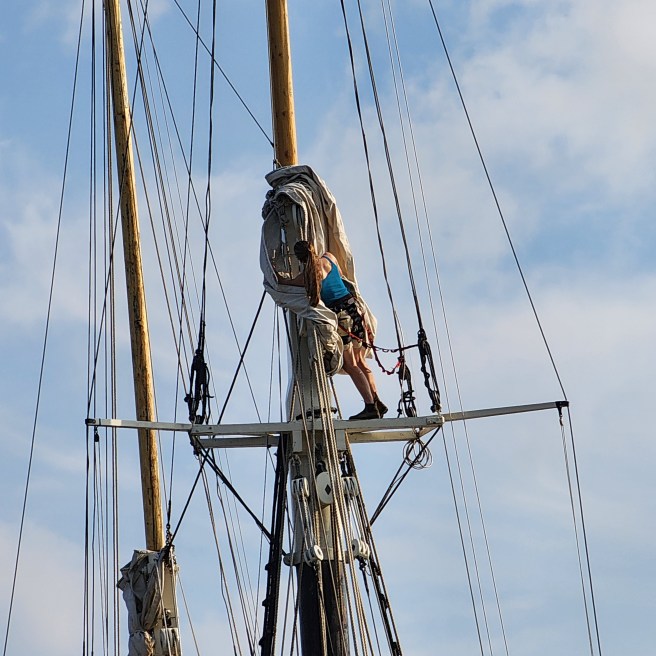
Crew in Mary Day rigging
You never know what we'll churn up in cleaning a stall
Crew in Mary Day rigging
Eastport’s growing community’s land claims needed to be clarified.
As Jonathan D. Weston notes in Kilby’s history, the Massachusetts legislature on June 17, 1791, authorized the survey of Moose Island, or Eastport, “the inhabitants prior to that time being simply ‘squatters,’ without titles to the land they occupied. The effects of this shiftless, temporary condition of affairs lingered for some time afterward.” Solomon Cushing then assigned lots to the occupants in 1791, according to Kilby. At the time, Eastport and Lubec, as Plantation 8 or Township 8, had a population of 244 people.
The deed John Shackford received from the Commonwealth of Massachusetts opens with the date June 18, 1791, and describes the committee appointed to “survey and lay out the [plan] of the settlers within said township one hundred acres of land to each settler to include his improvements,” as well as additional public lands to support a church and a school. Each settler who arrived before January 7, 1784, would pay the state five dollars for their property, while those who came later would be charged ten dollars. The purchasers would be exempt from any state taxes for five years.
Fitting “a plan of that part of said township called Moose Island with the several lots delineated thereon that Captain John Shackford a settler,” received lot No. 3, one hundred acres. The agreement was dated August 14, 1793, and recorded in Boston September 20.
His brother-in-law, Caleb Boynton senior, received lot No. 4, also one hundred acres. While his document was also dated June 18, 1791, it was not recorded until August 30, 1804.
Lot No. 17, 50 acres, went to Caleb Boynton junior in 1804.
The Shackford property would stretch along the waterfront from the middle of Shackford Cove to what would become Key Street and then back to County Road. Boynton’s stretched from Key Street to Washington Street. Together, their holdings would encompass about half of the business and residential lots of the eventual village.
The 1790 Census had a single Shackford household, John’s, with one free white male over 16, four under 16, and one free white female. This was recorded next to Caleb Boynton, with two white males over 16 and four females. Further down the list, Caleb junior had one white male over age 16, one under, and two females.
Curiously, in 1800, it was only one Boynton, Caleb senior.
You will find holes in the Census data.
Among non-family dwelling with Shackford around then was an unmarried Englishman, James Carter, in 1789. Quarters must have been tight.
With the deeds, the occupants became landowners rather than remaining squatters. Five dollars, do note, was a substantial amount at the time. Whether it was “reasonable” can be left to debate.
Thus, in 1793 Shackford gained clear ownership of one hundred acres at Shackford Cove, being lot No. 3 — and within that, the plot that includes our house. How much earlier he had built here becomes the question. By 1783, as his fee would indicate? Not all of this land went to farming, and he obviously augmented his holdings over time. If he was building ships, he definitely needed timber, which might explain the Shackford Head connection.
While I’ve been unable to find the deed of Shackford Head, it’s clear that Captain John acquired a hundred acres there, too. There are tales of the box of unsorted early documents at the courthouse.
The transactions I’ve found do undermine a story about a sheriff arriving from Massachusetts in 1797 with an armed party to seek payment for the lands. Remember, Maine was a district of Massachusetts until 1820. After being roughed up, and with what may have been a revised approach, the sheriff offered deeds from the state at a reasonable cost plus a five-year tax exemption.
Of Captain John and Esther’s children who survived to maturity, all four sons became ship captains, and two of their three daughters married likewise. Many of the grandsons continued that legacy.
Can you imagine the life in this house at the time?
The four years covered in my novel Daffodil Uprising brought about tremendous change in the nation and around the globe. In the light of recent events, a fresh overview of the period may provide some essential perspective on current events. For some readers, it may even be a stroll down a Memory Lane of an activists’ protest march. Maybe you remember or maybe you’ve just heard of it as ancient history. In my story, the Revolution of Peace & Love unfolds at the crossroads of the America, where it never got the attention it deserves.
This week, you can still get the ebook for FREE during Smashword’s annual end-of-the-year sale, which ends January First.
Act now, before the deal ends, and you’ll have Daffodil Uprising to read in the digital platform of your choice for as long as you like.
For details, go to the book at Smashwords.com.

… whenever the dissolution of the Union arrives, America will have reason to exclaim in the words of the Poet, ‘FAREWELL, A LONG FAREWELL, TO ALL MY GREATNESS.’
John Jay in Federalist No. 3
the fog’s burned off
but still hazy
with another schooner far off to the left of the Angelique
a sailboat comes between us
another windjammer’s way off on the horizon
while we skirted a sandbar
Camden grows as we approach
the Congregational spire for navigation
perhaps there’s a third behind her

entry into crowded harbor even in shoulder season
a bit tricky
especially when a pleasure boat backs into our path
shouts of “get back!” or “keep moving” finally heard
Coast Guard a bit more astute
the transom of one sailboat ASTARA also the name of our messmate
should they get acquainted sometime
haven’t seen a Kroger product for ages till now
the logo popping above someone’s pack
My messenger bag has a conspicuous stain
its first
remaining as a badge of honor
or oarlock grease
as I’m getting off, “This is all you have?” as in surprised
while I’m realizing how much I overpacked
now to send off a deposit for next year
(which I did)
John Shackford senior definitely explored what would become Eastport in 1782, and, as one account expressed the encounter, “determined to remain and make provisions for the safety and comfort of his wife and children preparatory to permanent settlement.”
The early years of Eastport and its Moose Island are generally fuzzy. Legally, the pioneer white inhabitants were squatters. Captain John initially settled at Broad Cove at the neck of what became known as Shackford’s Head, and soon afterward built a mile-and-a-half away, at the edge of today’s downtown and what was soon known as Shackford’s Cove.
In one version,
“The Shackford family originally settled on Shackford Head, where Revolutionary War veteran Captain John Shackford began a homestead in 1783. … He built accommodations for curing the fish he hired caught by the Indians and some white fishermen … He also erected a strong storehouse of logs, where he kept and sold such merchandise as met the requirements of the fishermen and Indians; the fishery and storehouse were in full operation, and he set about building a dwelling house and planting part of his farming lands. Everything being ready in 1784, he set out in his small sailing vessel, the Industry, for Newbury, and brought to their new home his wife and two children, John and William Shackford.”
The Indians, mind you, were Passamaquoddy, who are still vital component of the community.
In the other version, “In 1787, having built a dwelling-house near the shore, at the foot of Shackford Street, he brought his family, consisting of wife, sons John and William, to their new home in the wilderness …” Not only is the date different, but also their address or its equivalent.
As I said about fuzzy? The consensus for the Shackfords’ arrival seems to be 1783/1784, the end of the Revolutionary War.
Jonathan D. Weston’s recollections had the Shackfords as one of the first six white families in town, arriving in the spring of 1784. Five years later, Weston calculates, the number of households had increased to 22 or 24, “the heads of one-half of these families were either men of English birth or those who had adhered to the royal cause of the war.” Either way,
“John’s little craft was the first vessel owned in the place, as the fishing business up to that time had been done in open boats. Among the vessels subsequently owned by him were Delight, Hannah, Sally, and Patty,” two of them apparently named for his daughters. Patty, meanwhile, “plied between Eastport, Portland and Boston, and was the first freight and passenger boat employed on this route. She was commanded by his son, John.”
While that jumps ahead in our chronology, it does reflect the family’s identity as shipmasters and perhaps also shipbuilders. Shackford Cove wound up with four shipyards along its short shore.
From the start, even before being named Eastport, the small frontier community on Moose Island comprised of a handful of families gained a reputation for “sheltering and sharing the gains of adventurers, smugglers, and gamblers.” Not to cast a shadow over the Shackford family integrity, right? Or making a nice profit?
Welcome to America’s Wild East.
The genius of Republican liberty, seems to demand on one side, not only that all power should derive from the people; but, that those entrusted with it should be kept in dependence on the people, by a short duration of their appointments; and, that, even during this short period, the trust should be placed not in a few, but in a number of hands.
James Madison in Federalist No. 37

you’re out of line
you’re out of rope
rock, paper, scissor
last call
3 loons
heard first
and then seen
3 passengers showing the captain
photos of their parents’ and grandparents’ weddings
vintage dresses they thought she could consider
for her upcoming wedding in January
Captain Becky not yet 30
Becky our captain
is very funny
and so is Dylan, the mate
Maybe you remember your first year or two after college and trying to get your feet on the ground.
My wild novel Pit-a-Pat High Jinks relates, more or less, how it went for me way back when. It wasn’t always high, either, despite the stereotypes. These days, I see the episodes extending into the forties for many younger adults and their friends. Do check it out and see how it relates to your own experiences.
It’s of five ebooks I’m making available to you for FREE during Smashword’s annual end-of-the-year sale. You can pick yours out in the digital platform of your choice. Do note that it includes adult content, so you may have to adjust your filters when ordering.
Think of this as my Christmas present to you. In the meantime, be cool and stay warm.
For details, go to the book at Smashwords.com.

John Shackford was a Revolutionary War veteran who brought his young family to Eastport at the end of the war, making them one of just six households on Moose Island. For the next half century and a bit more, they were influential figures and then faded entirely from the scene by the turn of the 20th century. It was a pattern I’m seeing in seafaring families in coastal communities in American genealogy.
His ancestry in America goes back to Dover, New Hampshire, where I lived for 21 years before moving on to Eastport. His father, Samuel, was a mariner who resettled at the mouth of the Merrimack River in Massachusetts, where John was born in 1753 in Newbury, a decade before the port was set off as a separate town, Newburyport.
Among the other children of Samuel and his wife, Mary Coombs, were Mary, who married Caleb Boynton, for whom Boynton Street and Boynton School in Eastport were named; Captain Samuel Shackford, who died in Newburyport; Levi; and William.
As a sailor, John may have visited Eastport as early as 1763, age 10 or so. (As one version goes, “He was brought up a sailor and while so employed his ship visited Eastport, Maine, as early as 1763.”)
Around here, “captain,” as you may be noting, more often referred to a shipmaster than an army rank.
As a soldier in the newly formed Continental Army in its second major military operation, John enlisted in the strenuous march in September and October 1775 through the wilderness of Maine under the command of General Benedict Arnold. Serving in a Captain Ward’s company, Shackford was one of 1,100 men in the arduous trek that saw 300 soldiers turn back and another 200 die en route The surviving troops were left starving and lacking in many supplies and equipment assigned to attack Quebec City.
Joined by General Richard Montgomery’s forces after their capture of Montreal, the Americans attacked Quebec City in a snowstorm on the last day of the year. They were roundly defeated. Montgomery was killed and Arnold’s leg was shattered.
Shackford was taken prisoner and confined for nine months, six weeks of the time in irons — that is, chained.
After his release, he broke his promise to his captors not to engage in battle. In early 1780 he and instead served under George Washington at Kingsbridge, in Westchester County, New York.
During the Revolution, John’s brother Levi was wounded at the battle of Bunker Hill. More extensive was the service of brother William. First, he was captured on the privateer “Dalton” and confined in the Old Mill Prison in Plymouth, Devonshire, England, for three years; and then, on being released, he served under John Paul Jones and was either killed in action or died from hardships endured in the war — he never returned.
On the other hand, as a veteran, Private John Shackford returned to Massachusetts and married, on November 26, 1780, Esther, daughter of Captain Gideon and Hannah Woodwell. Her father was an extensive shipbuilder at Newburyport.
 Jnana's Red Barn