Turning to real estate

As the growing village took shape, John senior had his tract surveyed by Benjamin R. Jones, resulting in Shackford’s Plan of lots. A copy of that would help make sense of the wheeling and dealing that followed. Many of the purchasers were by John’s own children, individually or in combinations of partnership often formalizing land they had already “improved” and buildings they had constructed or sites where they would. Others went to Eastport’s new merchants and tradesmen. In all, I find 73 transactions, most of them as a grantor, or seller, recorded at the Washington County courthouse in Machias. I’ve probably missed a few, so take that as a rough figure.

It wasn’t just housing lots, either. Captain John’s waterfront properties were valuable sites for wharves, docks, and storehouses. He was even selling sites between the high and low tide lines. I’ll spare you the tensions between low tide mark claims today.

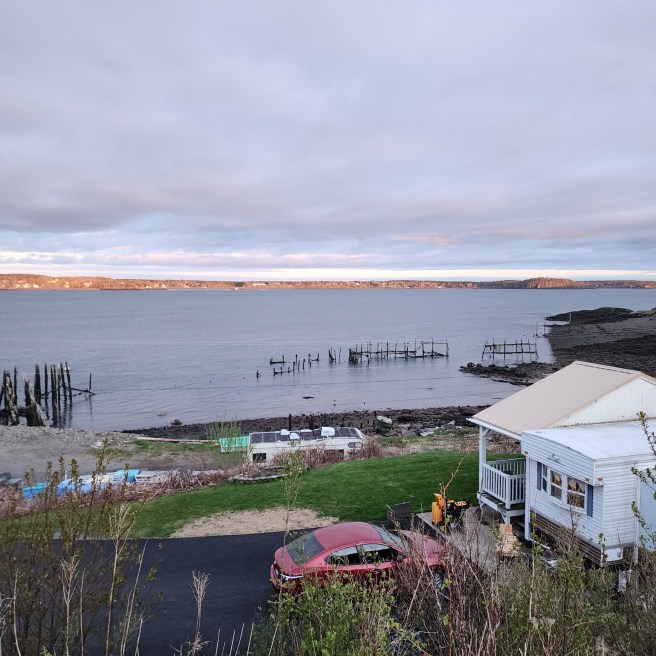
This is how some of the shoreline below our house looks today.

The one transaction I haven’t been able to track down is his title to Shackford Head. Was it simply overlooked by the indexers?

A significant deal took place on April 14, 1826, when his surviving offspring, all in adulthood, paid him $3,000 for the land between High (also known as Back) Street and County Road. And here I thought he had given it to them. Where did I get that idea? That was a huge figure for the time, by the way.

Was he a Scrooge with his offspring? Or merely cunning?

He still had plenty of lots left to sell.

Esther died on June 21, 1830, age 76.

All of it, of course, has relevance on the house we bought.


No, I’m not going swimming nude in a group at a summer lake any more

As I’ve previously mentioned, for much of my adult life, I’ve thought of myself as a retired hippie. Or I’ve simply been called one by others. One of millions and, unlike many, one who’s not embarrassed to admit it, that was a time to remember, no matter how short we’ve fallen from its promise and potential, even though I’m not so sure how much I’d want to go skinny-dipping with others these days or even sleep on the ground or a mattress on the floor.

That said, I’ll also admit that much of my first year after graduation from college in the height of the hippie movement was deep misery and loneliness punctuated by playful discoveries. The writing of Richard Brautigan definitely fits in here.

What’s often overlooked in the era is that the central element was the hippie chick. Plus, personally, I was without one, since mine had moved on and left me stranded. (Oh, misery, oh, woe, I am sounding pathetic, but let’s move ahead.) My novel, Hippie Farm, celebrated her in her many guises, even if you can’t even use the term “chick” anymore without being corrected. At the time, though, it was a badge of honor and invitation – one leading, in this case, to that rundown farmhouse in the mountains outside a college town I definitely restructured in terms of fiction.

A second novel, Hippie Love, retold the same plot line from a different perspective, one more of a what-if optimism. I would love to have heard that story retold from their impressions. Ouch? Were they as lost as I was? One I’ve been in contact with all these years has shared her insights, helpfully, and another, reconnecting much later, barely remembered who I was. And here I had thought she might be The One. Oh, my.

In the light of the publication of What’s Left, those two books were then greatly revised and newly released as a single volume, Pit-a-Pat High Jinks. Compressing the two was a major effort, but ultimately satisfying, at least for me. So much happened personally within that short span.

The inspirations cover quite a cross-section of people, with one becoming a United Way executive, another a U.S. Attorney, yet another one an OBGYN physician. Not that you would have guessed it at the time. As for most of the rest, I have no clue. Some were real losers, likely lost to drugs now. Others, tragically damaged. Being hippie wasn’t always a quest for enlightenment, justice, and equality. And when it was, it was countered by powerfully invested self-interests. Sometimes I’m surprised any of us survived, even before we look at the Vietnam veterans on the other side and their continuing traumas. Not all addicts, by the way, were hippies.

Flash ahead, then, and I don’t see youths today finding community anywhere, much less a shared cause. This is supposed to be an improvement?

Contrary to many people who lived through the era, I saw much that happened needs to be remembered and often cherished, even comically. It’s a place where people can begin rebuilding. I’m holding on, then, in my Quaker Meeting as one root to be grafted.

Look closely at the women, especially, and see how much of the legacy continues in spite of everything. (The kids today have it right, their perception of hippie as a girl thing.) Or, as they say. We’ve come a long way, Baby.

Yet that hippie label, I should add, has undergone its own transformation, rarely positive. Alas. Especially for us males.

Most of them, I hope, come across better in the book.

Still, it’s an account of history as we encountered it.

You can find Pit-a-Pat High Jinks in the digital platform of your choice at Smashwords, the Apple Store, Barnes & Noble’s Nook, Scribd, Sony’s Kobo, and other fine ebook retailers. It’s also available in paper and Kindle at Amazon, or you can ask your local library to obtain it.
Another taste of the shipmaster role

Among the many vessels in Eastport by the 1820s, according to historian Jonathan D. Weston, John Shackford senior was one of possibly two residents owning ships of “suitable size and equipment to perform voyages at a distance.”

Captain John’s schooner was the Delesdernier, named after an Eastport family owning the tract just south of his own.

Lewis Frederick Delesdernier was the town’s first customs officer, in fact, and Weston’s grandfather. Note the “D” for the middle name.

Was the naming of the ship an inside joke? I’ll take it that way. He may have also been an investor in shares, another common practice.

The remaining ships of note in Eastport, incidentally, were “owned by inhabitants of other parts of the country.”

All of it, of course, has relevance on the house we bought.

Our house as an early landmark

While Eastport had a twisting trail into the village, the first real road was Water Street, laid out in October 1803, “from Mr. Todd’s house to Mr. Shackford’s.”

The Todd house, most recently known as a bed and breakfast inn, is believed to be the oldest surviving dwelling in Eastport. It was built around 1781 — some say as early as 1775 as a cabin – by John C. Todd and has early additions. Unlike ours, it had a large central chimney with multiple fireplaces, a colonial New England architectural signature. Ours had two smaller chimneys, including a precariously collapsing brick arch in the cellar when we bid on the place. That had to go before the rest of the bricks caved in.

When I began this investigation, I didn’t feel our house goes back quite that far, though I’m now convinced that Captain John had some residence on our lot by the time Water Street came along. For now, let me simply say the plot has thickened. No pun intended.

As historian Jonathan D. Weston describes,

“Water Street was laid out, 24 feet wide, after opposition by those who contended that 18 feet was ample width as it would allow two wheel-barrows to get by each other with room to spare, and, at the suggestion that it would be too narrow for horses and carriages to pass, scouted the idea that the idea that strange curiosities would ever be seen on Moose Island.”

That does explain the traffic congestion downtown today, long after horses and carriages yielded to automobiles and delivery trucks.

Key Street, bordering Shackford’s northern property line, came along in 1805, and then Shackford Street. Third, meanwhile, appears to the third east-west street in the Shackford tract. It is the only numeral street in the city.

Do note that Water Street was interrupted by gates and bars until 1808, when the town ordered their removal.

Up to 1820, as Weston observed, the town had only four public ways and no suitable places of worship. The annual town meeting was conducted in a small meetinghouse on today’s Clark Street..

The 1855 and 1879 Eastport maps show the main section of the house situated as ours is on this property. In the 1855 map, above, there were two ells but only one, larger than the current mudroom, in the 1879 map. Thus, for a time, a small courtyard existed, a common feature of the period. We have no way of knowing their use, for now. Sheds for horses or firewood are possibilities, as are a kitchen and common room.

The cellar, though, has thick stone walls, a serious undertaking.

As our renovations work has confirmed, the house is timber framed — what you may think of as post and beam, except that pegs were used rather than metal brackets and bolts. The nails, by the way, were hand cut.

That rules out Weston’s mention of the second framed house in town being built shortly after 1812 by John Shackford but removed shortly before 1888, perhaps the one John junior had a block further south on Water Street. (It may have been moved across the street sometime after 1835, if we go by the maps.)

Other evidence of an early origin of the house are the hand-split oak lathing, found in the ceiling. and the hand-cut nails. Those lathes disappeared from common usage by 1830, or so we were told.

All of it, of course, has relevance on the house we bought.

On my own, I was writing contemporary literature, except that it turned into underground history

When I was starting out in my career and sitting at the edge of the semi-circular copy desk, one broad story I kept seeing in the headlines didn’t reflect what I was finding in daily life. It was the hippie experience, told one the public side as drug busts, antiwar protests, and rock concerts, while the personal side I sensed something much broader and transformative, which was largely ignored.

Tom Wolfe, who had come to prominence as a newspaper columnist, was right in saying that the great hippie-era novel needed to be written, though he was wrong in thinking a single book could cover it.

From my perspective, a traditional facts-and-quotes approach couldn’t touch the emotional reality, pro or con. Interviewing celebrities posing as leaders wouldn’t work, either – they largely betrayed us, maybe like never-a-hippie Trump would do later. Hippie was a grassroots movement on many fronts, many of them outside of the big media headquarters in the biggest cities.

In previous Red Barn posts, I’ve touched on many of the hippie movement’s continuing influences, things our kids and grandkids take for granted, but so much – especially of the broadest nature – remains to be examined and presented. I’ll leave that to someone else who can give it full and fresh attention.

For my part, I leave four novels as foundations for others to build on.

I’ve looked hard for work by others but found little yet faithfully left reviews online where I’ve could. Those works are, alas, slowly vanishing. Yes, we are passing.

I am haunted by a definitely hippie copy editor from the year I interned as what we called the rim, but he was gone when I returned a year later, perhaps after pressing for union organization. A lot had changed in those nine months. I wish I knew more about him, other than the ticket for Woodstock that I couldn’t accept, considering the scheduling and my bicycle as my only transportation.

~*~

The core of my perceptions remains in four novels to my credit.

 Daffodil Uprising: I was on campus when the repressive constraints of institutional America blew apart in the late 1960s. Crucially, many of the radical currents emerging on both coasts began connecting in academic nerve centers in the Midwest – places like Daffodil, Indiana, where furious confrontations exposed positions that later generations now take for granted. My novel revisits the upheaval and challenge, both personal and public, triumphant and tragic. As I still humbly proclaim.

Pit-a-Pat High Jinks: The hippie movement that is usually thought of as the Sixties actually appeared most fully during the Nixon administration, 1969-74, and brought changes that younger generations now take for granted. Yes, the ‘70s. In my case, that was Upstate New York where I lived in bohemian circles near the downtown and then on a rundown farm out in the hills where a grubby assembly split the rent and a bit more. My, we were so green and so wild-eyed.

Subway Visions: There were good reasons so many of my freaky housemates and new friends came from the Big Apple. My jaunts to The City, as they called it, provided high-voltage flashes of inspiration that ranged from grubby to psychedelic. It was a whole new world to me, even as a frequent visitor.

What’s Left: So much remained unvoiced and unexamined in the aftermath. I drafted a series of essays that came together as a creative non-fiction volume, but that went nowhere. But then I had the flash to reshape it from the encounters of the hippie protagonist of the previous three books but explored by his curious and snarky daughter. My intention for a big book about the revolution of peace and love turned into one asking what is family, primarily. Hers was quite the colorful circus.

~*~

I still believe there’s much in these that’s “still news” despite the dated surfaces that usually pass for the era.

This year, though, I’m finally saying good-bye to maintaining an effort to engage in an awareness. It’s ultimately in others’ hands.

You can find my novels in the digital platform of your choice at Smashwords, the Apple Store, Barnes & Noble’s Nook, Scribd, Sony’s Kobo, and other fine ebook retailers. They’re also available in paper and Kindle at Amazon, or you can ask your local library to obtain them.

As for the windmill?

Once the war was over and Eastport returned to the United States in 1818, the Shackford family thrived anew.

The heart of his activity seems to have been an old log store built at what would become Steamboat Wharf. Described as being at the foot of Shackford Street, it would more accurately be placed right below our house. When the store was constructed, the Customs Office was south of Shackford Cove, rather than to the north of the eventual downtown and its docks. That first store was standing as late as 1840 but being used as a stable.

Its replacement, the so-called Red Store, was removed from the waterfront around 1833 by John Shackford junior and still exists within the main part of the residence at the south-west corner of Third and Middle streets, an elaborate mansard house best known as master shipbuilder Caleb S. Huston’s residence.

Another portion of the old building went into a small, two-story frame house, “situated on the windmill lot” on Water Street, at the foot of Third Street — diagonally across the corner intersection from us. I’m told that the windmill foundation sits in the cellar of that house.

Windmill, you ask?

Windmill painting by Mrs. Bradish. Our Cape is at the upper left, though the artist omitted two windows on the front.  Note that there are no dormers.

Captain John junior is also credited with building a windmill upon the bluff at the entrance of Shackford’s Cove, one that “proved faulty in construction and was of no practical value, but remained standing on the bluff for many years as a conspicuous landmark.”

The small Cape at the left in the painting would be our house.

In the Kilby history, Samuel Shackford recalled, “The windmill which stood upon the bluff at the entrance of Shackford’s Cove for a generation or more was built for him,” John Shackford junior, “but, on account of location or fault of construction, proved a failure. In a moderate breeze, like a balky horse, it would not go, and in a gale of wind nothing could stop it until the wind abated. The old mill, after it had become dilapidated by wind and weather, was a picturesque object in approaching the town from the sea. It was taken down by its owner about forty years ago, much to the regret of the public.”

That is, dismantled around 1848.

~*~

But that leaps ahead.

All of it, of course, has relevance on the house we bought.

The War of 1812 impacted the Shackfords personally

Eastport fell under British control in 1814 and was then attached to Canada for four years. Not that it went quite that easily.

As the conventional story proclaims, Captain John “commanded the first militia company organized in Eastport, his uniform consisting of an old Continental three-cornered hat, and he wore an old sword. His company was made up largely of veteran soldiers of the revolution, a wild set of fellows whom their captain found it difficult to control.”

More descriptively, in William Henry Kilby’s history volume, as Shackford’s grandson Samuel contended, “His men were of a sturdy, wild set of fellows, who appeared to think that the first duty of a soldier on training days was to drink toddy; and their captain had a hard enough time to control them. Many of them, having served half-clothed and half-fed in the Continental Army, doubtless felt that they had earned the right to an occasional frolic.”

I won’t question his sources, but he neglects to mention that Fort Sullivan and its commanding officer surrendered without firing a shot, as did Castine, Machias, and a fourth Downeast town. Still, continuing the Shackford account,

“When the British fleet captured the island and the commodore came on shore to take possession of the island, Captain Shackford met him at the shore, carrying a goad stick in his hand,” not the old sword, mind you, “and addressed him thus: ‘Well, sir! What brought you here? I am King of this island, and these are my subjects. If you behave yourself, you can come on shore. If not, you had better be gone.’ The commodore politely assured him that he had called on business, and trusted that he should conduct himself in a manner becoming a gentleman and to the satisfaction of his Majesty.”

Goad stick? Like for cattle? Captain John apparently had a flair for drama, as the next incident illustrates.

“After the English had taken possession of the town, all of the inhabitants were ordered to swear fidelity to the King, or leave the town and have their property confiscated. But the old soldier, when summoned to appear and take the oath, replied to the officer that he had fought under General Washington; that he might take four horses and draw him in quarters, but never would he swear allegiance to the King of England. It was probably on account of his eccentricity and boldness that the old gentleman was excused from taking the oath and allowed to retain his property.”

Follow that? Who would you nominate to portray Captain John in the movie? And, for that matter, the Brit? It’s still a great scene.

Beyond that, Lorenzo Sabine, editor of the Eastport Sentinel, later contended, “No privateer was owned here,” though Eastport was subject to heavy privateering (state-sanctioned piracy) during the War of 1812. The British cruiser Breame took prize of the Delesdernier with master John Shackford junior and Samuel Wheeler, an owner on board as a passenger. They paid ransom for their property and were released.

Another ship, commanded by Captain John’s son William and sailing from Eastport in early 1812 with a cargo of rice and flour, was captured 25 miles from the port of Cadiz, Spain, by three French privateers. He and his mate and cook were left destitute.

Another prize was a chebacco boat with Captain John’s sons Samuel and Jacob Shackford, who paid a stipulated sum and were given up. The chebacco design, by the way, was a little two-masted boat, popular among New England’s inshore fishery, originating during the Revolutionary War. They were built by the hundreds and averaged from 24 to 48 feet in length, had two masts and no bowsprit. They were usually a flush-deck vessel with several cockpits, or “standing rooms” in which the fishermen stood to fish. A middle hatch gave access to the fish hold. They were also almost always built near the dwelling of the builder and sometimes no more than a few yards from the front door. Shackford Cove, then?

The third time John junior was taken prisoner was when the Delesdernier was captured off Cape Ann, Massachusetts. He and companion brother Samuel were taken to Halifax, Nova Scotia, where he was left without a hat and, one dollar excepted, entirely destitute in the streets.

Captain John’s son-in-law Darius Pearce/Pierce, in command of the schooner Sally, better known as Old Sal, was taken by the frigate Spartan and taken to St. John, New Brunswick.

Quite simply, the War of 1812 hit the Shackford family heavily. At one time, John and Samuel Shackford and Darius Pierce were all held captive by Lieutenant Blythe, who then released them.

All of it, of course, has relevance on the house we bought, as you’ll see.

Sounds true to me, living where I do

In the Literary Review of Canada, Stephen Marche profiled Canadians:

“To prove ourselves better than the Americans — more upright, more loyal — is the central tenet of Canada’s founding. The anglosphere divided itself up like a dysfunctional family: England the brutal bullying drunken father, America the glamorous rebellious son with a violent streak, and Canada the daughter always trying to smooth everything over, always trying to bury the dark secrets.”

Back to Benedict Arnold

After the close of the Revolutionary War, and by then disgraced as a traitor, Benedict Arnold took refuge among the Loyalists in neighboring St. John, New Brunswick, where he emerged as a merchant and shipowner. Once, he personally directed the work as Captain John Shackford and presumably a crew loaded a vessel at Campobello Island.

Shackford later recalled,

“I did not make myself known to him, but frequently, as I sat on the ship’s deck, watched the movements of my old commander, who had carried us through everything, and for whose skill and courage I retained my former admiration, despite his treason. But, when I thought of what he had been, and the despised man he then was, tears would come and I could not help it.”

The Loyalist impact on Eastport, as I’m seeing in this project, was immense. Neighboring St. Andrews, New Brunswick, and St. John further up the coast were both founded in 1784 by Loyalist families exiled after the American Revolution. Many of them later filtered back into Eastport, including some lines that owned our house.

All of it, of course, has relevance on the house we bought.

Zeal

Carved in stone in Trout Brook cemetery, Weston, Maine, this portion of the deceased’s name makes its own statement. Can we adapt this as a motto for the New Year, with a sense of zest?

I do suspect that gravestones can be a great source of first or last names when it comes to writing fiction, not that I did that in crafting my existing novels.