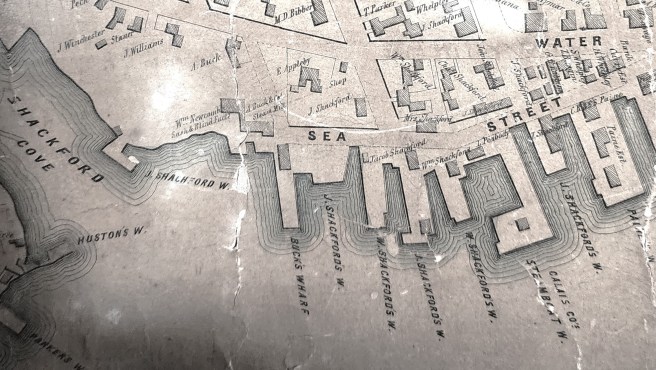
John Shackford junior had his own legacy

In following the history of our house, we’ve veered off from Captain John and Esther’s children as other families added their names to the dwelling. At this point, I’d like to return to the Shackfords to give you a better sense of the family’s additional impact on the community as well as ways the town itself changed over the years. When the Shackfords first arrived, the place wasn’t even called Eastport but rather Passamaquoddy or Moose Island on Passamaquoddy Bay. Sometimes it even went by all three at once. While the sons’ and sons-in-law’s escapades during the War of 1812 have been noted, their seafaring ventures continued well after.

~*~

John junior, for instance, not only commanded the first vessel owned in the town, but he also ran the first packet in the Boston and Eastport line, “through winter’s storms and summer’s fogs.” A packet was a new concept in shipping, with vessels departing on a regular schedule, rather than waiting for a full load or a set number of passengers. The innovation could be risky for the investors or highly profitable, depending.

In a fuller telling, he “was commander of the first vessel owned in the town and commander on the first freight and passenger traffic boat established between Eastport, Portland, and Boston, and his last packet, the Boundary, the swiftest vessel on the coast after 21 years in this service, had to give place to steamships.”

The May 9, 1828, edition of the Eastern Argus announced that the schooner Boundary, 142 tons with John Shackford, master, the schooner Edward Preble, and the Thomas Rogers would be running between Eastport and Boston, stopping at Portland both directions. That gives us a date and a possible commercial association of the three vessels. After that, newspaper mentions of the Boundary arriving or departing Eastport or Boston with Captain Shackford at the helm were common.

He “knew by sight all the dangerous places along the coast, but never had more than a passing acquaintance with them, and during his long experience as shipmaster never had occasion to call upon his underwriters for a dollar.  The Boundary, his last packet, so well known as the swiftest vessel on the coast, was driven off the route on the introduction of steamships, when she was 21 years old; but for 20 years after she was a staunch craft, engaged in the coasting trade.”

Coasting, should you wonder, refers to traffic that followed the coastline rather than crossing the open ocean. The swift, agile coasting schooners could easily run into trouble further out from the coast.

The December 2011 edition of the Maine Coastal News described the Boundary as having two masts and dimensions 79 by 22 by 9 feet. And, yes, she was built on Shackford Cove in 1825 by Robert Huston.

There was a legal tangle on June 26, 1826, when, as commander of the Boundary, Captain John appeared before the Boston board of alderman to respond to charges of an alleged breach of the law to prevent the introduction of paupers from foreign ports.

Captain John junior’s sons included three shipmasters: Benjamin Batson Shackford, who died in Eastport in 1885, aged 73; Charles William Shackford, master of the brig Esther Elizabeth, who with his vessel was lost at sea in the winter of 1853-1854; and John Lincoln Shackford., who died at St. Thomas, West Indies. More on him later.

John’s wife, Elizabeth Batson, came from another seafaring family. She died in 1830. Did she travel with him, as many captains’ wives and families did? I suspect he married a second time, perhaps to Eliza A. who died in Eastport on February 17, 1899, age 84 years four months five days.

When John junior died on August 12, 1866, he left no will. His obituary in the Eastport Sentinel, in the manner of the time, did not name other family members, something that might have revealed whether he had remarried after his first wife’s decease. Instead, it said, “He was a devotional man always found at prayer meetings and public preaching when he was able to be there.”

Remember, John junior grew up in the house we now own.

The allure of gold, too

Back to Elsie’s son, Ethel Olmstead. Several accounts have him marrying Abigail C. Harrington and having the son and three daughters, as recorded in the Census. She may be the Abigail Harrington born September 4, 1815, in Eastport to Andrew Harrington, who came to Moose Island from New Brunswick.

Another Loyalist connection?

Ethel’s gold-digger occupation noted in the Census leads us to the California Gold Rush. He died July 22, 1852, in San Francisco and is buried in Golden Gate cemetery, a potters’ field (the gravestone name has been transcribed as Esther and the birth date is 1812 by one source), although Yerba Buena is a second possibility. Both lines of argument have the same date of death but no cause. Natural or violent? Did he go by way of a sailing vessel around treacherous Cape Horn or perhaps crossing Panama? Perhaps working on one of the Shackford vessels? It makes more sense than a wagon train crossing the Prairie, considering the distance from Downeast Maine to the Oregon Trail and then points west. As for a cause of death? We can only speculate.

The Gold Rush angle thickens with the death of Major Ethel Olmstead of Calais, Maine, on March 15, 1856, at age 70, in El Dorado County, California. “No road leads up to the grave and the few trees and bushes surrounding the grave hide it from the outside world” outside the historic gold mining camp of Wild Goose Flat on the east side of the North Fork of the American River in the Sierra Nevada Range.

I do love the description of his final stop, “southerly from Rattlesnake Bar and easterly from Horseshoe Bar.” Those may be watering spots more than places in the river, should you wonder. Perhaps that’s gives you an idea of how widely some individuals traveled from the easternmost homes. His second wife, son, and daughter all continued in California after his death. In Calais, he had been a blacksmith.

This Ethel turns out to be the uncle of the Ethel of our house. I’m guessing neither of them struck it rich.

Since both Abigail and her son James were living at the time of the house sale to the next owner, more questions remain.

I’ll also note that having additional residences in Boston and New York was not uncommon for shipowners or captains, so I do wonder about Lucy Hooper’s husband’s occupation. One more thing to check out, when I can.

Curiously, the recording of that deed did not include a book-and-page citation to a previous sale, leaving me stymied on furthering the property’s earlier history. Still, as you’ve seen, I finally connected the line.

It’s a heavy awareness to carry, but it’s one I’ve shared 

Indiana sometimes shows up as a symbolic state. It’s not just a “crossroads of America,” as it likes to tout itself, a blending of North and South or balancing East versus West. It’s an anomaly even in the Midwest, where it’s the only state not bearing an Indigenous name yet it’s named in supposed homage to the Original Peoples – INDIAN-a.

With a capital called INDIAN-apolis. Or Naptown, as it’s known in other parts of the state.

Not that there are any tribes remaining within its boundaries.

It’s not as industrial as Ohio or Illinois nor as agricultural as, say, Iowa or Minnesota – feel free to counter that with hard data, I’m just running on gut feeling here.

And just what is a Hoosier, anyway? There are theories, but it’s certainly not like a buckeye or hawkeye or badger or the Bluegrass State bordering its south or Prairie State on its west or Great Lakes State on its north. You can get a picture in your mind with those.

In short, it rather strives to appear just average, or maybe a level just below. Somehow, that’s what fuels its role as a symbol of America itself, especially the Bread Basket sprawling largely westward, even though it’s rarely in the spotlight, except for Indy 500 week, and even that reflects an earlier glory.

That wasn’t always the case, though. The place gave birth to some leftist progressives over the years as well as some vital inventors. It also gave us the likes of journalist Ernie Pyle, jazz lyricist Hoagie Carmichael, actor James Dean, radio storyteller Jean Shepherd, basketball great Larry Bird, rocker John Mellencamp, late-night host David Letterman. But no U.S. president.

Early on, it had a heavy Southern influence, especially as Quaker families fled the slaveholding economy of North Carolina, as I learned after taking up genealogy and uncovering my roots.

It also has some distinctly different regions, including the once dominant steelmaking crescent along Lake Michigan adjacent to Chicago; the hardscrabble rolling forests and quarries of southern Indiana; and the flat agricultural belt in the middle.

I got to know it first by family camping trips and Boy Scout overnight hiking excursions. Yes, in the southern tracts of the state. We also had journeys when my great-grandmother decided to visit from Missouri or central Illinois; her son and his wife lived in a dreadful corner of Indianapolis and served as the relay point. Later, I finished college, again in the rustic south, and returned four years after as a political science research associate.

I must admit my angst at what’s been happening politically and socially, even though the Indianapolis Star was always a pretty dreadful archconservative voice, proof for me that “liberal” journalism has always been in the minority.

~*~

Not that the state hasn’t had an artistic presence. Just think of the artist Robert Indiana of the iconic LOVE image (born in New Castle).

Novelist Kurt Vonnegut nailed the state for me, though other writers of note include Booth Tarkington, Theodore Dreiser, Ward Just, New Yorker regular Janet Flanner (from Paris), and young-adult superstar John Green. The poets Clayton Eshelman, with his collection Indiana, and Etheridge Knight also have had strong careers.

For my part, my novels Daffodil Uprising and What’s Left are both based in an imaginative reworking of Bloomington – I do play with geography, making the Ohio River a lot closer to Indianapolis, for one thing. My novel Hometown News could also be placed in the upper half of the state, though its setting is more generalized.

My poetry chapbook Leonard Springs definitely reflects the cave country around Bloomington.

I anticipated remaining there much longer than I did, but fate intervened. And after that, I’ve never been back, except in my memories.


Of ship captains and their families at sea

The era of commercial wooden ships under sail is long gone, and Maine played a big role in its glory days. The town of Searsport, in fact, late in the 1880s claimed to be home to a tenth of the masters of American full-rigged ships, and thousands of ships were built along the state’s shores. Do note, though, steamships and steel hulls were rapidly changing the business.

As I learned in researching the history of our house, built by a shipmaster who raised four captains of his own, there seems to be nowhere they didn’t venture.

Unlike many, though, the Shackford wives seem to have stayed on land rather than venturing forth with their husbands and serving as the trusty navigator.

Here are some other families for perspective.

  1. Joanna Carter Colcord, daughter of Lincoln Alden Colcord, was born at sea in 1882 and is famed, among other things, for her collecting and musically notating maritime ballades and chanteys. She and her brother spent much of their childhood at sea, where they sent extensive letters to relatives in Maine. Later reminiscing how, after a break ashore where she could attend school, “when I was eight, I took my turn at seafaring, and Link got his introduction to the halls of learning. We put out from Portland lumber-laden into a full gale of wind, and I was sea-sick for the first (and last) time. On the fourth day out it faired away, and father took me, convalescent now, on deck and set me inside a life-ring that was lashed to the top of the after house. … I was not afraid; and I remember to this day the awe and enchantment of the scene. I thought I had never seen anything so beautiful, and I still think so. The little barkentine was running bravely, among the great seas which heaved up all around in sunlit walls of liquid sapphire. When she roe on one of the huge swells the seas stretched to a horizon of living blue, barred with mile-long white-capped combers. The sun warmed me, and its play on the snowy sails fascinated me.”
  2. Her brother Lincoln Ross Colcord, a year younger, was born at sea during a storm off Cape Horn. Recalling the life they shared growing up, he wrote: “I know no other home than a ship’s deck, except the distant home in Maine that we visited for a few weeks every year or two. My countryside was the ocean floor, where I could roam only with the spyglass; my skyline was the horizon, broken by the ghostly silhouettes of passing vessels, or at intervals by the coasts of many continents, as we sailed the world.”
  3. Also from Searsport was Georgia Maria Gilkey, who headed off to sea in 1906 as the bride of Phineas Banning Blanchard, of the same town. As she observed: “It seemed like old times being on board a vessel again. I spent most of my youth at sea with my parents, brothers, and sister. Banning grew up at sea, too, and he was a captain before he was twenty.”
  4. Not that the life was always so bucolic, as Captain John C. Blanchard noted in candid letters in 1844 to his wife Caroline in Searsport. “I am very anxious for to leave here for the mosquitoes,” in confessed in one, followed in another with “and the hot sun has made me look more like a native of Cuba than one from the North.  My health is tolerable good although I have no appetite to eat and the clothes that used to fit me now set like a ship on a handspike, as the saying is.” There was no respite in others, where “The mosquitoes would make you look more like a person with the smallpox than otherwise … The climate seems to me just as healthy in New York in heat of summer.” Also, “It seems as if the mosquitoes was determined on having the last drop of my blood. They were so plenty last night that we could but just breathe without swallowing them and as hungry as wolves. They make nothing of getting my blood right through my shirt and pants and now while I am writing they are doing their best.” Later, he noted having the American consul and two gentlemen from New York on board to dine as well as “a long string of Spanish ladies and gentlemen” who came calling. “I tell you what it is Dear C, you don’t know what a knack these Spanish ladies have of casting sheeps’ eyes but the gentlemen don’t like us Americans to even wink but dear Wife, all the Ladies in Cuba is no object to me.”
  5. Perhaps that provides one more reason for brides to join their sea captain husbands on his voyages. Nancy Sherman Mackintosh, for one, set forth with her new husband Alonzo Follansbee in 1837 and two months later admitted, “By this time I had learned all the nautical phrases, though I did not choose to use them, lest I get in the habit and use them on shore, which would be very mortifying for a captain’s wife.” Yes, salty language. At least she remained behind on shore in 1856, when her husband vanished at sea.
  6. Another bride, Fidelia Reed, in 1853 was so occupied with getting her quarters “systematized” for her honeymoon voyage from Boston that she barely noticed setting sail. Having “arranged all our books and movable articles so that they would not shake about by the motion of the ship,” she then saw “the steward fastened our trunks to the floor by nailing a bit of wood on each side of them to the floor, quite a new sort of arrangement to me.” As for her husband, John Jay Heard, “The Capt. says it seems quite as strange to him to have me on board, as it is to me to be here. He having always been alone, it looks rather queer to see ladies’ clothing hanging in the state room.” This, even though this was his second marriage. Novice Fidelia, by the way, did master the art of navigation.
  7. Manhattan native Cornelia “Connie” Marshall first set sail in 1855 as the bride of Captain Enoch Wood Peabody. Two days shy of Liverpool, their ship was overtaken by a tempest. As she wrote of that honeymoon cruise, “Weather continues very bad. Enoch is hard at work. Scarcely had a chance to speak to me during the entire day.” Conditions worsened, culminating in a cry in the night, “Breakers ahead! Hard down the helm!” as well as “That fearful sound, never shall I forget it, and amidst the noise I heard my poor husband’s voice in such tones as never before.” Amid the crisis, “He enters the cabin, how pale his cheek, my heart seems almost bursting. Oh, that he would but speak to me. His look is almost wild.” As for their life after that?
  8. Another Searsport-based wife, Maria Whall Waterhouse, took command of the S.F. Hersey in Melbourne, Australia, when her husband died, and according to legend faced down a mutiny with the aid of her late husband’s two pistols and the ship’s cook.
  9. Should you care to really dive into this topic, the academic article “Excitement and prey: Captains’ wives and the experience of marine animals on U.S. whaling ships in the 19th century” in the International Journal of Maritime History should be right up your alley, so to speak. Dealing with a more defined set of examples, author Emilia Svyalsami observed, “The ship’s society was hierarchical, and the captain had absolute power. A wife’s presence brought much needed comfort to captains, who often were lonely figures. They were even more so on the whaling ships, where the pressure of catching whales created tension and underlined the captain’s skills.” Many of the wives closely observed the natural world around them. Quoting shipmaster wife Mary Brewster, for instance, we have this about sunfish: “Had I never seen the fish perhaps it would have tasted better, but seeing it was sufficient to produce contrary feelings.” How droll. Add to that, from the following day, “Had porpoise for breakfast. The liver tastes very much like beefs’.”
  10. Missing from the records, though, are the observations of women like Sarah Bates, the wife of Captain Mariner S. Crosby, from the fatal last days before the ship went down. According to the memorial monument in Eastport’s Hillside Cemetery, the 33-year-old and her 44-year-old husband along with their four children, including an infant son, were “all lost at sea about Oct. 25, 1867, with the brig Sarah B. Crosby.” Similar markers, found across the region, have no bodies buried below.

The widow purchases the property title

In a transaction dated December 27, 1859, Elise purchased the property from the Shackford estate heirs for twelve hundred dollars. In addition to Captain John senior’s sons Jacob, John, and William and daughters Esther and Hannah, grandson Samuel Shackford,, and their spouses as the sellers, we find the name Myrick D. Bibber, the furniture merchant who built at the corner of Water and Shackford streets around 1840.

Note that daughter Sarah Shackford Lincoln is not mentioned in this agreement (she died in 1846). In December 1841 she had sold “my right title and deed [?] to the estate of my Father John Shackford, late of Eastport” to William Shackford and Bibber.

In the 1860 Census, the household was enumerated under Elsie’s daughter, Abigail C. Olmstead, 46, dressmaker, personal value $15 or $1,500 — the script is difficult to read. Elsie — or Eliza, as the Census recorded her — was 83 and had a real estate value of two thousand dollars.

The household also had boarders: storekeeper Peter Kane, 21; Sarah Leighton, 72; and Sophia Gleason, 67.

Ten residents in our house would be tight, even if the two ells attached at the time had living space.

An inventory of Elsie’s estate was ordered in August 1868 after she had been declared non-compos mentis and placed under the guardianship of her step-grandson John S. Pierce [Pearce], by way of Hannah Shackford Pearce.

Her death, October 19, 1868, was reported in the Eastport Sentinel as “Mrs. Elizabeth, relict of the late Captain John Shackford, 78 years.” The age would correspond to Elsie’s.

In 1880, her daughter-in-law, Abigail Olmstead, was recorded as age 65 living in the household of her youngest daughter, Mary A. Roberts, 31, in Boston.

The linkage to Fisher Ames Buck and later owners was finally apparent.

That sale was by Abigail’s daughters.

Confirming our house as Captain John’s homestead

The Shackford children had their joint holdings surveyed in January 1833, with Hannah Shackford’s husband, Darius Pearce/Pierce, performing the task. A flurry of real estate transfers followed, formalizing their agreements.

By 1820, according to the Census, the sons were heads of household.

Trying to follow the transactions gets rather confusing.

William and Jacob had even gone into business together in 1833, turning their attention away from seafaring. Their dealings included waterfront between the high-tide and low-water stretches as well as bands of shorefront below our house that would be developed into wharves.

From what I see, the boys weren’t getting a family discount. In 1830, John junior paid his father $1,000 for one parcel next to his brother William’s. In a transaction dated December 30, 1831, John senior specifies a band of waterfront “partially in front of my own dwelling house,” with the sellers being himself and “my wife Elsie.”

Among the deals were one on the easterly side of Water Street “to the fence of my homestead” and then westerly to Water Street, confirming that his homestead included both sides of the road.

Of special interest to me in confirming that our house was the one John senior occupied are the two deeds conveying adjoining land along Water Street. First was a sale to Myrick Bibber, a furniture merchant, on June 13, 1839, for a lot on the southwest corner of Water and Shackford streets, and then on July 10, to Daniel Aymar for the lot between the two.

Each of them is measured to the line of “the yellow house lot owned by me.”

Here’s how the description appeared on the two deeds recorded at the Washington County courthouse.

I was surprised to see that he signed the deeds with his mark, X, as did his wife in several instances. New England was noted for its nearly universal literacy, both men and women.

Here’s his X on his will.

Grandson Samuel Shackford said Esther, John’s first wife, “had been well reared and was a woman of superior intelligence” and that her children “were indebted to their mother for nearly all the educational advantages they ever enjoyed.” Unlike her husband, she signed some of the documents, as noted in the record, “her seal.” “School-teachers were rarely obtainable, in those days, in this then out-of-the-world. For a brief period, the services of William Lloyd Garrison’s [future] mother were secured to teach in the family” when she lived on neighboring Deer Island, Canada..

The real estate transactions indicate the children were all literate.

Esther died June 21, 1830. His second wife enters the picture rather obliquely soon thereafter.

His will of June 14, 1832, bequeathed “to my beloved wife Elsie the use during her life of my homestead or the house in which I now live, together with the lot and privileges thereto.”

Further down, it directs his six children and grandson Samuel to pay “to my wife Elsie the aforementioned annuity of one hundred & fifty dollars. And on my demise the homestead on house in which I now live with the lot come privileges pertaining thereto, and the one of which I have willed I am bequeathing to her during her life, I am bequeathing to them, my six children … in the same proportion of my other property.”

A harder to read codicil of October 5, 1839, raises the amount of the annuity to “my wife Eliza Shackford” to $200 during her natural life and “all my furniture and my pew in Baptist meetinghouse forever.”

After Captain John’s death, as Samuel Shackford confirmed, Elsie (or Elise, in his account) obtained the Revolutionary War veteran’s pension based on his service.

Elsie was later recorded in the 1850 Eastport Census as Eliza Shackford, 70, living in a household headed by Abigail Winslow, 37, along with four children — Anna E, 12; Lucy M., 6; James F., 4; and Mary A., 2; as well as Ethel Olmstead, 37, with his occupation as “gold digger” in the metal mining industry. An index to that Census listing placed Ethel as the head of household, even though he was at the bottom in the family. I am perplexed by the Winslow identity.

All of it, of course, has relevance on the house we bought.

Before you start your car, thank this auto pioneer 

When we think of many of the technological advances that impact our daily lives, we usually don’t know the names of their inventors, even when we know the businessmen who got wealthy as a result. Elon Musk did not invent the Tesla, for instance, nor did Bill Gates invent the internet or Henry Ford, the auto. The list is actually a long one.

Consider John William Lambert, mentioned in a previous Tendrils.

I remember visiting an early coworker and, upon seeing an old car with an impressive Lambert name in brass across the radiator sitting at an open garage door, I asked, “Ann? Is that car any relation to you?” She replied that her grandfather used to make them but otherwise conveyed no knowledge that he had been so prominent a figure.

Here are ten facts from his life.

This was the breakthrough vehicle.
  1. He invented the first practical American internal combustion gasoline automobile in 1890 in Ohio City in Van Wert County, Ohio, where he tested it on the village streets early the next year. It was the Buckeye gasoline buggy, a surrey-topped three-wheel runabout with one seat. It had a three-cylinder, four-stroke engine.
  2. In 1891, that horseless carriage became the first automobile offered for sale in the United States. Priced at $550, it attracted no buyers.
  3. Undaunted by the buggy’s reception, he turned his attention in 1892 to making stationary gasoline engines for farm and industrial factory use.
  4. Lambert’s base of operations was the Buckeye Manufacturing Company, which he had founded in 1884 as a farm implement manufacturer and moved in 1892 to Anderson, Indiana.
  5. His experiments with drive-train technology led to the Lambert friction gearing disk drive transmission. The gradual, or gearless, transmission became a signature feature on all of his future cars.
  6. His next attempt at an auto line came in 1895 with a model called the Buckeye. It was a four-wheel modification of the buggy but failed to find buyers.
  7. His first marketing success was the Union, released in 1902. About 300 of the tiller-steered cars were sold.
  8. In 1906 he introduced his first Lambert, establishing himself as one of the more successful automakers of the time. Production peaked from 1907 to 1910 with 2,000 cars a year.
  9. Buckeye Manufacturing, which built the cars, had moved by 1905 to Anderson, Indiana. The Lambert Automobile Company was one of its subsidiaries. Touting its Lambert Friction-Drive Automobiles and Trucks, the Buckeye factory mass-produced Lambert’s cars, gasoline engines, and auto components as well as fire engines, railroad inspection vehicles, and steel-hoof tractors before closing in 1917. At its height, the company had more than a thousand employees.
  10. Lambert held more than 600 patents and died in 1952, age 92, in Anderson.
At its prime, the Lambert came with 15 layers of hand-painted color.


Worshiping together, too

The Shackfords and Olmsteads had more in common than their livelihoods on and around the sea.

The oldest church in Eastport, founded in either 1798 or 1802, was the Calvinist Baptists, as some in town knew them, or more accurately, Particular Baptists, largely in line with the majority of Baptists today. That group moved into its Washington Street house of worship in 1837. (Today, it’s the Eastport Arts Center.)

The second congregation in town was the Free Will Baptists, organized in 1816 and incorporating with the state in 1820. Darius and Ethel Olmstead along with John and William Shackford and their brothers-in-law John Hinkley and John C. Lincoln were named in the incorporation papers.

Among other things, Free Will Baptists avoided alcohol consumption and, in its Northern stream, opposed slavery. As a rite, it practiced foot-washing. The denomination stemmed from the Dutch Mennoninte-influenced General Baptists in England, unlike the Baptists just down the hill. I am curious to learn how much our Shackfords and Olmsteads hewed to the denomination’s values. The General Baptists, I should point out, were earlier a strong influence on the emerging Quaker movement in Britain. My Quaking Dover book details more.

The Free Will Baptists dedicated their first meetinghouse in town in 1819, a year before the other Baptists had theirs. They were later known as North Christian Church, with the building at Washington and High streets.

Next to organize in town were the Congregationalists, 1819, and Unitarians, 1821. Roman Catholics had a chapel in 1828, early for New England.

The 1820 Census for Eastport has the brothers Darius, Ethell, and Jesse Olmstead as heads of household.

Two years later, Mrs. Darius Olmstead (Elsie Haddon) and Mrs. Ethel Olmstead (Nancy Ann Haddon) were among the charter members of the Eastport Benevolent Female Society, as were Mrs. William Shackford, Mrs. Jacob Shackford, and Mrs. John Shackford.

The Olmsteads and Shackfords obviously shared in an emerging social structure, having arrived in the Passamaquoddy region at the same time.

All of it, of course, has relevance on the house we bought.

Sometimes a Dover connection wasn’t quite what I expected

One of the things about the history of my far end of Maine is seeing how much of it springs from Dover, New Hampshire.

Neighboring Pembroke, for instance, was founded by Hatevil Nutter Leighton, a descendant of both a Dover Quaker family and one of the faith’s fiercest oppressors.

Daniel Hill, the first permanent resident of Calais (1779), came there from Jonesboro, though he had been a pioneer settler of Machias in 1763, along with a J. Hill – his half-brother Japhet.

Knowing that the Hills were a prominent extended family in the Dover Quaker Meeting, I became curious and found confirmation in the fact that Daniel is thought to have been born in Kittery, Maine – on the other side of the Piscataqua River from Dover – around 1734. Close enough. Dover Friends had a neighborhood Meeting on the Eliot/Kittery town line.

But in his case, forget any Quaker influence. That was at least two generations earlier in his line, which did gravitate in and around Dover.

Daniel fought in the French & Indian War and again in the American Revolution. He was rumored to be a skilled Indian fighter. There’s even a controversy over whether he was a Rebel or a Loyalist, considering that he apparently lived for a time on the Canadian side of the border. His father, though, died in Nova Scotia in 1782, befitting a Loyalist position.

Loyalists? You’ll hear more about them later here. Please stay tuned.