At first, I thought the ‘Mariner’ was a redundancy

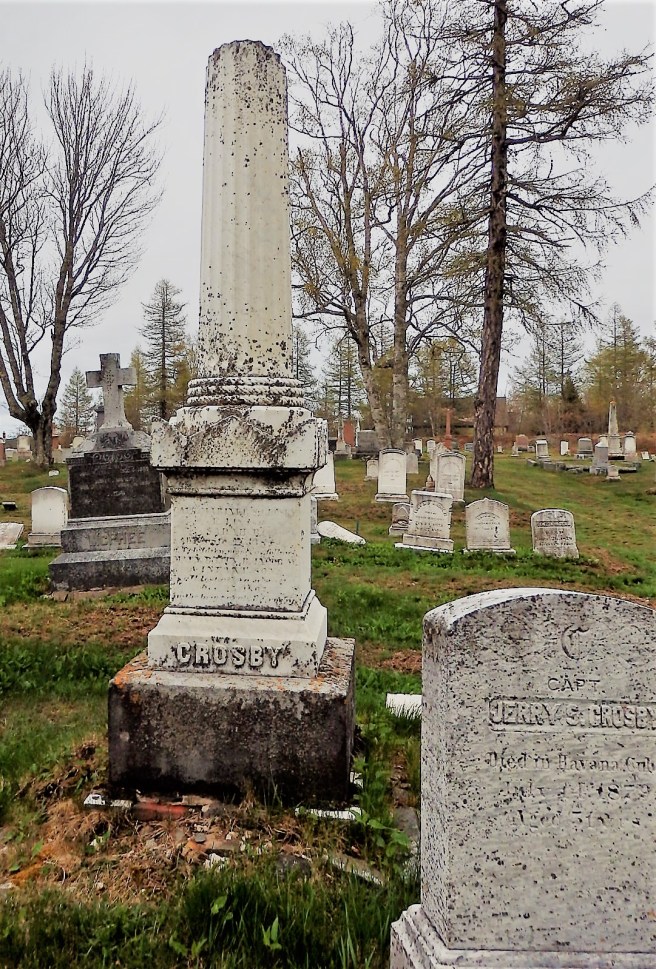
 Capt. Mariner S. Crosby. Given his Christian name, it was inevitable that he would take to the sea. That’s what struck me the first time I wandered through Hillside Cemetery.

The second time I went to the graveyard, I was looking for that marker but couldn’t find it. Back home and at my computer, Find-a-Grave led me to the rest of the inscription, which is admittedly rather worn away, as well as some additional facts.

What I found was this:

“Lost at sea with his family and the Brig Sarah B. Crosby,” named for his wife. She and the four children, one of them an unnamed infant, are then listed on the white memorial – Jacob W., Mary B., and Lucy B.

The date of their demise is uncertain, “around Oct. 25, 1867” – in season for a hurricane or some other vicious storm, although a fire in a wooden ship can’t be ruled out.

I trotted back to the cemetery for a closer look. Here it is:

The broken column symbolizes the loss of an upstanding citizen in his prime.

The Chamber of Commerce website reveals more:

“Mariner Crosby was the master of the brig ‘Maria White’ in 1852 and the schooner ‘Mary Jane’ in 1855. From 1861-1863 Mariner was the master of the barque ‘Charles Heddle,’ also built by C.S. Huston,” in Eastport. Around the corner from me, actually. “Mariner’s last command was the brig ‘Sarah B. Crosby,’ named for his wife, which was built in Pembroke. He commanded this vessel from 1863 to 1867 when the vessel was reported overdue. Mariner, his wife Sarah and four children, as well as the crew and passengers, were lost at sea without a trace.”

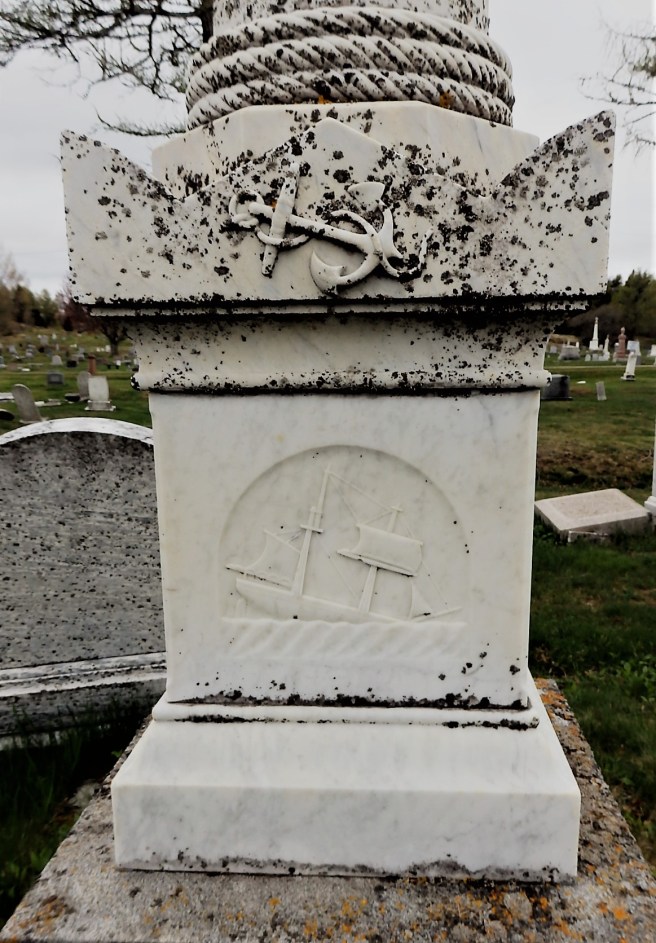
The pillar is a broken mast, as the three rings of rope emphasize. And there’s a carving of a brig going down, all but one of its square sails blown away.

We’re not even told where the ship was bound, much less about its cargo, passengers, or crew. And a brig did require significant manpower to manage the massive square sails.

The two-masted 316-ton “Sarah B. Crosby” was built in Pembroke by George Russell in 1863 and then based out of Portland, bound for ports such as New York and St. John, New Brunswick.

I started to investigate and found a bit more.

She knew the travails of the sea, having wrecked at treacherous Sandy Hook, New Jersey, on March 1, 1865, with the passengers and crew safely removed. And then, after being abandoned, she was reclaimed and repaired, with shipments of coal from Halifax, Nova Scotia, later in the year.

On March 19, 1867, the New York Herald carried this notice: “Brig Sarah B Crosby (of Portland), Crosby, Measina, Jan 27, with fruit to Lawrence, Giles & Co, passed Gibraltar Feb 16; has had heavy westerly gales, with snow and hail, and split sails. Mar 13, latitude 41 30, longitude 65, spoke ship Michigan, from Liverpool for London.” (Measina, a mystery unto himself, was first mate. They would have been just off England at the time this information was relayed.)

I would like to know more in general about wives and children traveling with captains. It turns out to have been common, with a significant number of the children being born at sea or spending a large part of their childhood there. Wives were partners with shares in the business, whether they went abroad or stayed ashore. They even learned navigation, but did not interfere with the cook aboard ship. There were strict lines of authority. Beyond that, what were Sarah’s views and experiences? Was she even related to the 1841 Robert Bates house a few doors up the street from me? She was only 33 or so at the end; there’s no age for Jacob, though Mary would have been around 11 and Lucy, only seven.

While Mariner grew up in Eastport, the son of a Nova Scotia immigrant, Sarah was the daughter of a hotelier in Calais, Maine, best I can tell. Her father came from Massachusetts; her mother, New Hampshire. Mariner Crosby and Sarah E. Bates were married in Eastport February 12, 1855, by the Baptist minister Nathaniel Butler, of note himself. We have no idea how they met.

Mariner came to the sea naturally. At least two of his four brothers were also sea captains. Not just sailors or first masters but skippers.

Capt. Jerry died in Havana in 1879.

And Christopher Crosby led the racing yacht “Coronet” that defeated the “Dauntless” in a famed trans-Atlantic race in 1897. He went to sea at age 17 and was skipper by the time he turned 19. Yes, born to the sea.

And that’s as much of their story as I’m able to find, all prompted by one name in stone.

Witchcraft in New England before the Salem hysteria

Something I pretty much skip over in my history of Dover is the Puritan authorities’ close examination of the bodies of the early Quaker women missionaries for any signs revealing them to be witches, from 1656 on.

That was down in Boston, for one thing, and I’ve seen no indication of similar actions along the Piscataqua watershed in New Hampshire and Maine, the center of my new book.

But it has come back to haunt me.

Much of my argument regarding the readiness for a significant portion of the Dover population’s joining Quakers has to do with the ways they differed culturally from the Puritan majority in the Massachusetts Bay colony and Connecticut. What David Hackett Fischer terms “folkways.”

For example, in all of their fearful piety, what made the Puritans so morbidly curious about the naked female flesh, anyway? And just what, exactly, were they looking for? This gets weird, doesn’t it? I’m not sure I want specifics, as in details, much less in those parading through Salem, Massachusetts, these days in preparation for Halloween. I’ll have to admit that part leaves me feeling queasy.

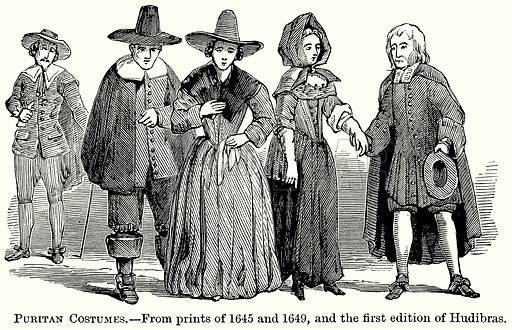
Puritan Costumes. Illustration from The Comprehensive History of England (Gresham Publishing, 1902).

Just consider the stereotypical presentation of witches in pointed hats and black capes and then recognize how much that resembles the dress of Puritan women in New England at the time. As for flying on brooms? How strange! Just how did that conflation happen, anyway? Put another way, witches didn’t dress differently than anyone else. As for the brooms? Every housewife had one.

Well, maybe that points to the male authority role in all of this, something I’m perceiving as a gender power play.

Back to the Quakers. As historian Arthur J. Worrall explains, “Two groups of Quakers arrived in 1656. The first, led by Anne Austin and Mary Fisher, came to Boston in July. The Massachusetts government promptly imprisoned them for five weeks; after checking them for signs of witchcraft, they expelled them in August. A second group of eight Quaker missionaries came to Boston two days after their expulsion,” aboard the Speedwell.

“Massachusetts imprisoned this group for eleven weeks and expelled them also, after the clergy had examined and debated with them.”

For perspective, Fischer notes that from 1647 to 1692, the Puritan colonies accounted for ninety percent of the accusations and eighty-five percent of the executions for witchcraft in English-speaking America. That is, almost ALL of them.

Moreover, “In England, every quantitative study has found that the recorded cases of witchcraft were most frequent in the eastern counties from which New England was settled.” Specifically, the Puritan heartland, in the motherland and then in the New World.

“Even white magic was regarded as a form of blasphemy. In 1637, for example, Jane Hawkins was punished for selling oil of mandrakes in Boston. Many other magicians and sorcerers were treated in the same manner.”

So just what defined a “witch,” anyway? Anyone who drew on folk remedies? Or even a midwife who knew more than she was supposed to?

Fischer goes into ways the Puritans’ Calvinist teaching and likely their earlier folkways combined to make them especially fearful.

As I observe, Salem itself was a cauldron of controversy from early on and a place where the Puritan invasion clashed with the existing population. Like Dover, the Puritans were latecomers there.

I’m still curious about the zealot ferocity of the Puritan outburst at the time of the infamous mistrials in Salem, 1692, in a perfect storm that may have fused an outbreak of hallucinogenic ergot in rye, a clash between traditional ways of examination versus newer ones, a gap in the governorship and jurisprudence, and a drive to curb the influence of the now well in place Friends by attacking their servants instead. Many, many other factors, perhaps even the weather, likely also come into play. All of the other angles I’ve heard point in the same direction.

One of the overlooked aspects in all the controversy is how the witch persecutions in Salem solidified the collapse of the rigid Puritan reign in New England. In a way, the old guard overplayed its hand and had to bear the consequences. With widespread revulsion at the executions and their abuse of the court system, a new strand of teaching and emphasis emerged in the Congregational churches. In another century-and-a-quarter, many of them would even become Unitarian, a far cry from the Puritan orthodoxy.

What makes witches so romantic for so many today?

Did the accused “witches” have their revenge in the end?

This sight caused a shudder

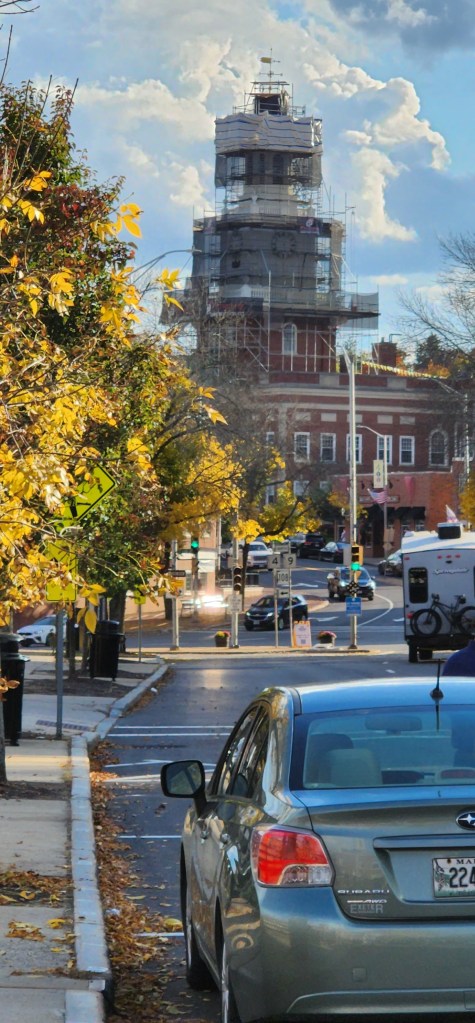
When I was last in Dover, 18 months ago, the downtown was booming with construction. But on my return a few weeks ago, when I first glimpsed this rising over Central Avenue, I thought a skyscraper was going up and I’d somehow missed the news.

I am impressed by the cloud as a backdrop.

A second look, though, had me realizing it was the clock tower on city hall, getting spiffed up for the city’s big 400th anniversary next year.

Well, it kind of look likes a space rocket about to take off, too.

Banners proclaiming that event are already along the major streets.

Were they or weren’t they friends?

Back in my undergrad days, I was hired by a retired jazz musician or some such insider to gleam through microfilm copies of the Indiana Daily Student and other sources as research for a bio or history book he was writing in New York.

The project opened my eyes to a wide range of 1920s’ history revolving around Bloomington, especially the legendary cornet player Bix Biederbecke and the Hoosier native Hoagy Carmichael. Yes, the place was a jazz hothouse, hard as that might be to believe.

I wish I still had carbon copies of my correspondence on that effort, but I do remember learning of a hitchhiking trip to a Harvard-Indiana University football game that Carmichael shared with Ernie Pyle, editor-in-chief of the Indiana Daily Student.

Seems it took them three weeks or maybe six to get back to campus from Massachusetts.

It’s a great story, no question, kind of pre-hippie, in this case two future celebrities back before they became famous.

The only problem, I’m not finding any corroboration online. Worse yet, I’m not sure how much Pyle and Carmichael’s timelines overlap. Besides, they were members of different fraternities, lessening the likelihood of a joint spree.

The game happened in October 1927, the same time Carmichael was making the premiere recording “Star Dust” in Richmond, Indiana. Pyle, meanwhile, was likely employed by either the New York Post or Evening World and had married. Some of his details get fuzzy.

I don’t remember who the writer was or whether his book ever came out.

By the way, IU lost, in a 26-6 rout.

How the Cocheco Mills reshaped Dover

My history of Dover, focused on its Quaker Meeting, begins trailing off about the time the textiles mills prosper at the Lower Falls in the Cochecho River. There’s no escaping the fact that the mills completely reshaped the direction of the emerging city, then and now.

  1. The complex began with the Dover Cotton Factory in 1812, but the surviving buildings were constructed between the 1880s and early 20th century. The downtown is built around them. The mills even span the river below the falls.
  2. A clerical error in the company’s 1827 reorganization, as the Cocheco Manufacturing Company, dropped the second h from Cochecho, leading to ongoing confusing about the proper spelling of the river’s name.
  3. In 1828, the mill was the site of one of the earliest labor strikes in the nation, the first to be conducted entirely by women. They were protesting a pay cut.
  4. The mills brought waves of immigrants to the city, especially from Ireland, Quebec, and Greece. The complex eventually employed 1,200 workers, most of them women.
  5. At its height in the 1880s, the mills shipped 65 million yards of printed calico worldwide annually, with esteemed designs from the associated printing operation on the site of today’s Henry Law Park.
  6. The buildings were subject to disastrous fires and floods. They were also noisy and cold in winter, hot in summer.
  7. The company owned lakes upstream to ensure water power through the year.
  8. The mills operated as the Cocheco Manufacturing Company and then the Cocheco Mill Company until 1908, when the operation was bought by the Pacific Mill Works of Lawrence, Massachusetts, which shuttered everything in 1937. The buildings were then bought at auction by the city.
  9. In the early 1980s, entrepreneur Joseph Sawtelle purchased the largest vacant building in the county and began a visionary restoration that uncovered the boarded windows and led to offices, entrepreneurial incubators, and retail stores in the heart of the city. After his death in 2000, Eric Chinburg acquired the properties and added trendy apartments to the mix.
  10. The mills were placed on the National Register of Historic Places in 2014.

Check out my new book, Quaking Dover, available in an iBook edition at the Apple Store.

This side of being an author is all new to me

Eastport’s senior center has invited me to talk about my new book, and that’s what I’ll be doing Friday, October 21, at 1 pm.

I’ll be focusing on Maine’s Nicholas Shapleigh, who was not a Quaker but played a crucial role in sheltering the missionaries who came to Dover. As a powerful lumber merchant, magistrate, and leader of the provincial militia, he was an important figure in what would become the Pine Tree State. His manor on the Piscataqua River sat directly across the water from Hilton Point, where the action began 400 years ago.

The overall content of Quaking Dover has been generating interest in a way I haven’t encountered with my novels or poetry. Having a handsome paper edition from the start is another plus. As much as I love aspects of ebooks, they are much harder to promote than a physical copy in your hand.

Dover may be a five-plus hour drive from Eastport, but there have long been connections.

The center’s at 9 Boynton Street, where I’ll be greeting friends and neighbors.

It’s the first in a series of presentations I’ll be announcing over the next few months. Please stay tuned!

There’s even an old gray wizard and his conjuring book

My favorite – and least expected – story from Annie Pinkham’s historical sketch of Dover Meeting includes a profile of Ambrose Bampton, who appears in Whittier’s “Snow-Bound” in the couplet, “We stole with her a frightened look / At the gray wizard’s conjuring book.”

Friends carefully avoided anything smacking of superstition, yet Bampton (1717-1790) had a local reputation for possessing “certain powers of disclosing the unknown and declaring the coming of future events with remarkable accuracy. To him resorted farmers who had lost their cattle, matrons whose silvers spoons and other treasures had disappeared, or maidens whose sweethearts were among the missing.”

Known as the Sorcerer, he may have been a continuation of traditions handed down in Devonshire, England, possibly through his mother, Hannah. “The meek-spirited old man received them all kindly, put on his iron-rimmed spectacles, opened his conjuring book, and after a season of deliberation, gave the required answer without money and without price,” in Pinkham’s telling.

Devon, a county southwest of London, is the origin of many of Dover’s early settlers.

Once, when a group of young people came to him for advice, he said to one of the girls,

“If ever thee marries anybody, thee will marry me.” She replied, “I would marry the devil first.”

A clue to her reaction might be hinted at in a notation that at the time of his death, he was said to weigh 400 pounds. I have no idea where Whittier had him already gray at this point.

The girl was a Quaker, Rebekah Austin, the daughter of Nathaniel Austin and Catherine Neal. Contrary to the prediction, she wed in 1745 with Simeon Hill in the manner of Friends. But five years later, as a widow, she did in fact marry Ambrose, again in a Quaker service. He had left First Parish and rejoined Dover Meeting. She predeceased Ambrose in 1802.

Ambrose’s father, John, was a member of Friends by 1705, so there were Quaker threads to build on.

Besides, I look at him as one more confirmation of my sense that some Friends are far more psychic than we’d let on.

~*~

Check out my new book, Quaking Dover, available in a Nook edition at Barnes & Noble.

Welcome to Dover’s upcoming 400th anniversary.
And now in paper!

Taa-tah! My Quaking Dover is officially out as a print-on-demand paper book around the globe.

Check it out through your favorite bricks-and-mortar bookstore.

It does mean going to your favorite book retailer for a copy, but there we are.

Independent bookstores and libraries have their own insiders’ routes to obtain it. Go to them to keep these channels alive.

As for me, I’m stocking up for copies to keep in my car, wherever I go.

How about you?

Where were the Baptists?

I’ve mentioned my bewilderment at the failure by the Church of England to serve its communicants in New England during most of the 1600s.

As well as the fact that Dover’s First Parish could have been the first Baptist church in America, beating Roger Williams in Providence, Rhode Island, by a year.

What perplexes me is that I find nothing in New Hampshire before almost 1800, although there was a church in Boston, a place where Friends struggled.

The fact is that the Baptist tradition originated as a liberal movement. We’ve seen threads of that continuing in Jimmy Carter and Bill Moyers.

In my research, I kept coming across fleeting references to Baptists during the years before the American Revolution, but curiously not much outside of Rhode Island to indicate ongoing activity in New England. They were not singled out like the Quakers as great dangers to social or godly order, even though they were still outlawed and ridiculed. Did they meet secretly, perhaps even at times other than Sunday morning? None were hanged in Boston, for one thing. In New Hampshire, they had only three congregations by 1770 – Newton, founded 1755; Madbury, adjacent to Dover; and Weare, which had a strong Quaker presence. Still, as I sense, theirs is a crucial history yet to be written.

Considering all the furor around minister Hanserd Knollys’ brief tenure in Dover, just before he began preaching definitively Baptist doctrines, as well as the support he had, I keep wondering about his legacy in the Piscataqua settlement. Somehow, he set off an unorthodox flame in the community, at least by Puritan standards.

Curiously, as I considered the matriarchal role in the continuing nurture of a faith tradition, the path led back to Thomas Roberts and his wife, Rebecca Hilton. This time I chanced across not their Quaker impact but rather a Baptist one.

Hugh Dunn Sr. built this house in New Jersey after moving from the Lamprey River and Dover in New Hampshire. He was one of the original settlers of Piscataway and a founder of the Baptist church there.

Their daughter Esther – also recorded as Hester and Easter – born around 1625 and one of the first English children in New Hampshire, married John Martin (also Martyn) around 1645 in Dover. He descends from Mayflower arrivals in Plymouth Bay. After a round of public service, they relocate to Oyster Bay on Long Island, perhaps among those who flee to avoid persecution, but in 1666 move on to New Jersey shortly after the British seized it from the Netherlands. Joined by Drake, Dunn, Gilman, Hull, and Langstaff families from New Hampshire, as well as other Baptist New Englanders, the name Piscataway soon sticks to their New Jersey community, reflecting their Piscataqua roots. Theirs was perhaps the seventh oldest Baptist congregation in America. The colony itself came under Quaker proprietorship in 1675, assuring religious liberty. Think about all that the next time you’re driving along the New Jersey Turnpike and see the signs for that exit.

That’s the last I find of Baptists in New Hampshire until a Scammon from Stratham on Great Bay – a surname that appears early among Friends – weds a Rachel Thurber of Rehoboth in southern Massachusetts in 1720. Resettling in Stratham, she struggles for 40 years, making one conversion, before moving on to Boston and being baptized into its second Baptist church.

Glory, hallelujah, and all that.

~*~

Welcome to Dover’s upcoming 400th anniversary.