Eastport’s economic glory days were when the city was the Sardine Capital of the World.
They’re small herring and abounded in the waters around Eastport, where they were easily caught and delivered straight to the cannery atop the wharf.
Here are some related facts.
Napoleon Bonaparte helped initiate the canning of sardines, the first fish to be so preserved.
Packing in Maine took off from Eastport in the 1870s and peaked around 1900, with 75 plants, mostly along the Downeast coast. The first sardine cannery in Eastport started in 1865 but failed to reduce the moisture in the cans, leading to a sharp, unpleasant odor. Its owner returned to Portland and found success with baked beans. Others in Eastport improved the process.
The workforce was largely women, with blurring hands and sharp knives or scissors expertly packing the small fish into cans – as crowded as sardines, as the popular expression went. Their hands were in cold seawater, year-‘round.
Eastport also cranked out the cans and lithographed labels.
The fish were packed in cottonseed oil, soy oil, or upper-end mustard sauce.
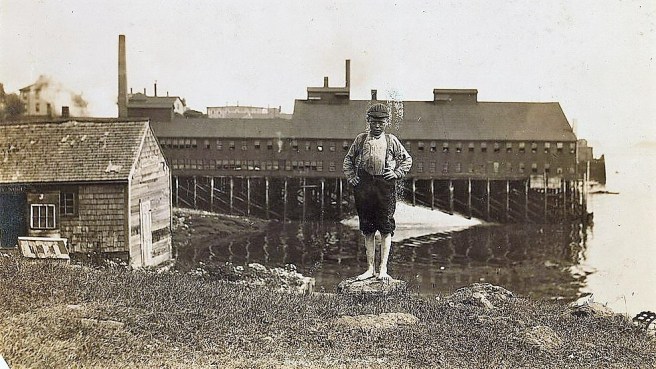
The world’s biggest sardine cannery jutted 250 feet out from the shore at the entrance to Shackford Cove.
Home refrigeration doomed the industry, making fresh cod, haddock, and other fish readily accessible.
Sardine tins were part of soldiers’ rations during the world wars.
The discarded fish parts were used to make fertilizer, while the scales were transformed into pearl essence, a shiny coloring used in many consumer products.
Vintage sardine cans and labels are collectors’ items.
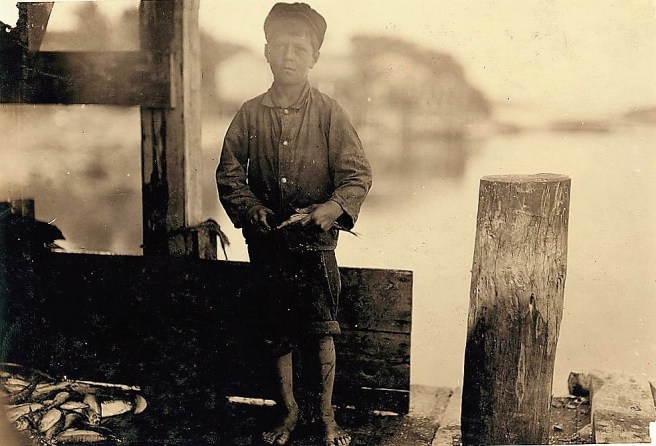
Eastport’s sardine canneries were also centers of child labor, as photographer Lewis Wickes Hine documented in August of 1911. Above, Fulsom McCutcheon, 11, was a worker at the covering machines. The world’s biggest sardine cannery extends behind him. It was about two blocks from my house. Hiram Pulk, 9, cuts sardines at the Seacoast Canning Company’s Factory No. 1 in Eastport. “I ain’t very fast – only about five boxes a day. They pay five cents a box,” he was quoted. Both photos from the Library of Congress collection.
You might think the ideal time to work in a forest would be spring or fall, but that’s not how it’s turned out in logging in the great northern forests of New England and New York state. Instead, the time to be out harvesting trees is deep winter. Yup, below zero around here.
I first learned of this when trying to order firewood after an uncommonly warm winter in New Hampshire. Because the ground hadn’t frozen hard enough long enough, the cutters hadn’t been able to access much of the woods with their heavy equipment. The result was a marketplace shortage.
For contrast, mud season can be notorious, so much so that come spring, logging roads are closed to prevent destruction. Much of Maine, in particular, is either standing water, once the ice melts, or boggy, including soft peat bogs. And in late spring and early summer, hoards of nasty black flies swarm about – the defenders of wilderness, as some contrarians contend.
~*~
Folklorists examining the songs of Maine have noticed that many of the songs from the old lumberjack camps originated at sea. You know, as shanties and the like. At first, these scholars were puzzled, but then they realized that winter was a treacherous time to be out on the water. Many sailors instead headed for the forests, to work in the camps for the season. Somehow, though, any songs originating in the woods failed to travel the other direction.
Historically, the logs were stacked along streams, awaiting the spring melting and surging high waters that the timber could ride to ride millponds. That, in turn, could be exciting, demanding, and deadly work where mariners would continue.
From there, the sailors went back out on the ocean.
Mechanization has changed much of that, on land and sea, but not the reality of mucky soil.
We’ll see what global warming does to the industry.
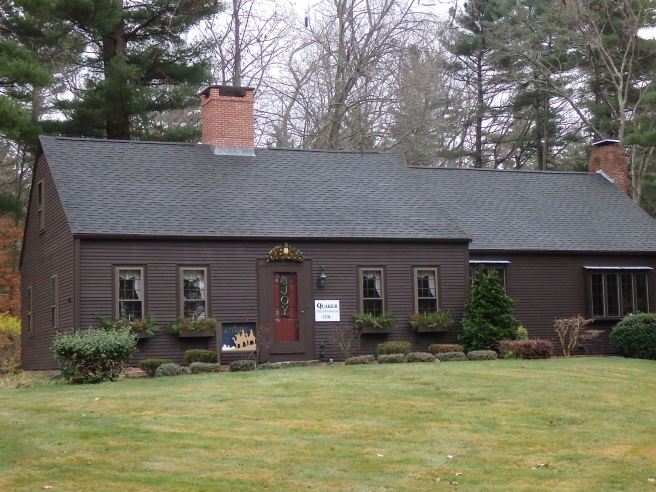
Hampton’s 1701 meetinghouse is now a private residence.
Through the first century of English habitation in New Hampshire, the other Quaker Monthly Meeting was at Hampton, and like Dover, it soon had satellite worship groups before coalescing in today’s Amesbury, Massachusetts.
Its full history is one that needs to be told. I’d like to know more about how it and Dover interacted.
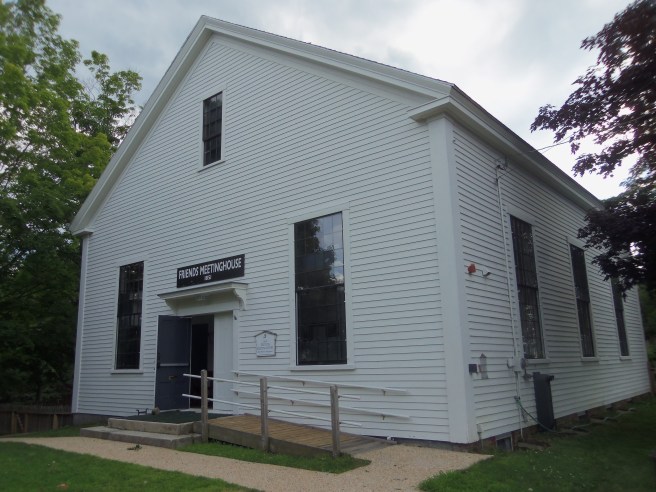
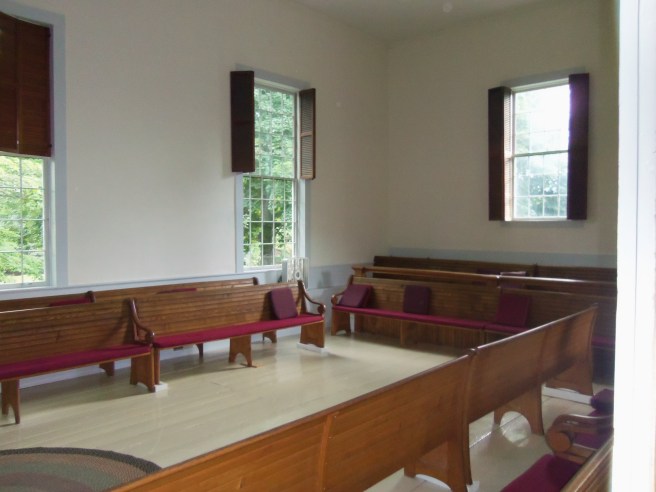
Amesbury, Massachusetts, Friends meetinghouse.Its interior has been lovingly restored. After her marriage in Dover, Abigail Hussey worshiped in Amesbury, eventually living just down the street.
Its Hussey family was one that came to be part of Dover Meeting. The family had two well-know weddings that occurred in the present Dover meetinghouse – May 3, 1769, of Samuel Hussey and Mercy Evans, and October 3, 1804, of their daughter Abigail to John Whittier of Haverhill, Massachusetts – another of Hampton/Amesbury’s Preparative Meetings.
Dover’s Hussey farm was on Baer Road in today’s Rollinsford but Somersworth at the time of the second wedding. It’s some beautiful farming country.
John and Abigail Hussey Whittier became the parents of the influential poet and abolitionist John Greenleaf Whittier, who was a frequent visitor to Dover Friends. Her portrait, reproduced in my recent post about the Whittiers, hangs above the stairway from the main floor to the lower level of the meetinghouse.
Two stories are told about the anvil that sits in a corner of the Dover meetinghouse. One is that it was recovered from the ruins of the Otis house after the Cochecho Village massacre. Richard Otis was a Quaker blacksmith. The other is that it comes by way of the Hussey family, which turned Civil War cannons into plowshares.
The Hussey family has a significant presence in New England Quaker history. Settler Christopher Hussey, described as the most prominent man in early Hampton, was one of the purchasers of Nantucket Island in 1659, where son Stephen eventually moved as it became a Friends stronghold.
Though Christopher was not a Quaker, his other son, John, was severely fined and threatened as an early Quaker, as Elizabeth Hooton related from her American visits. He was a Friends minister, married Elizabeth Perkins from another distinctive Hampton Quaker family, and they had 17 children, mostly daughters, before migrating as Friends to New Castle, Delaware, in 1688 or 1692.
There is argument whether John and Rebecca Hussey’s son Richard (1660-1733) remained behind and moved to Dover or whether it was an immigrant. Either way, a Richard Hussey who was a weaver moved to Dover by 1691, wed Jane Canney, and had a dozen children. Among them was Joseph (1699-1762), who then married Elizabeth Robinson and sired Samuel Hussey (1714-1814), leading to the Whittier connection.
Some of the Nantucket line, however, reconnects in Berwick, Maine, complicating the picture, especially when a Hussey marries another Hussey.
Stephen Hussey’s second son, Bechelder, moved from Nantucket to Biddeford, Maine, which leads to son Stephen, who had 12 children, the last three born in Berwick.
More prominent among the Berwick Quakers were the children of Ebenezer Hussey, Stephen’s fifth son, who wed Abigail Hale.
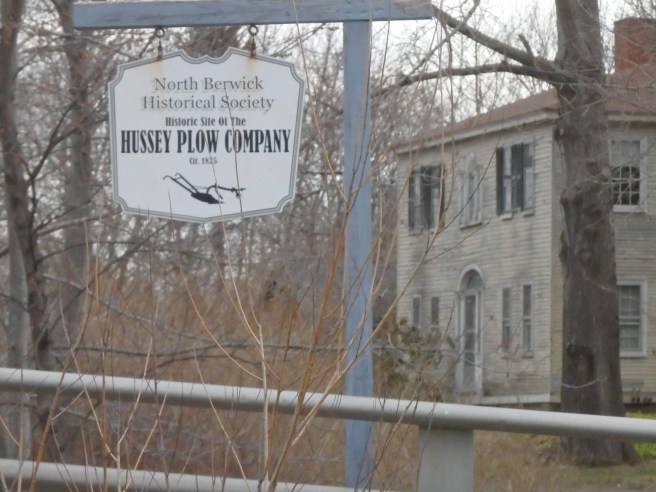
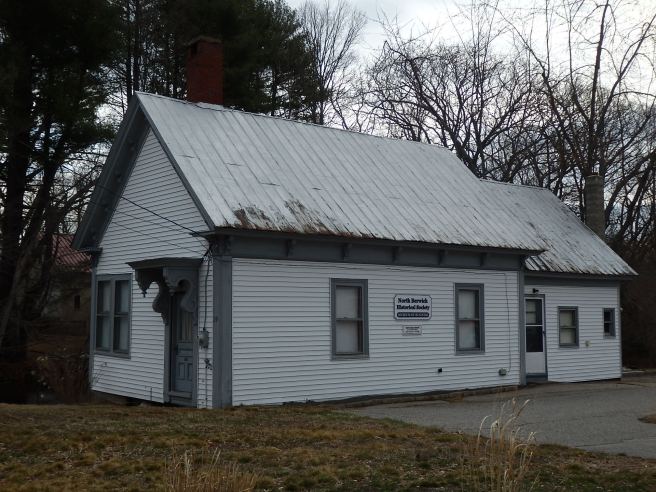
What is known is that in 1770, James Hussey – possibly Richard and Jane’s grandson or great-grandson – moved from Dover to North Berwick. His son William (1800-1870) created an efficient plow in the 1830s.
It’s right beside the millstream. The textile mills were owned by another Quaker.
The enterprise drew on Quaker connections, beginning with Joseph David Hoag’s relocation from Charlotte, Vermont, to North Berwick in 1825. The son of famed Friends minister Joseph Hoag, he brought with him a cast-iron plow created by blacksmith Jethro Wood of Scipio, New York, another Quaker. Wood’s mother, incidentally, was Diannah Hussey, a niece of Ann Starbuck on Nantucket.
Got all that? Just go with the fact it was a potent mix.
As a farmer, William Hussey felt that the plow’s moldboard was much too short. After pouring lead to make a rough pattern of a longer board, he had castings made at a foundry in Newmarket, New Hampshire. The results were carted by horses to North Berwick, where skilled carpenter Henry Estes made the wooden framework. William then traveled among his farmer friends to sell the plows.
With the distinctive size and shape of the furrow board, the plow could be pulled by less power than its rivals. As the company’s business envelopes proclaimed, “If I don’t hold easy, draw lightly, and turn a flat furrow, after five days return me.”
In his later years, William Hussey ran the N. Hobbs Inn at Bracey’s corner, but as a staunch temperance advocate, he refused to sell liquor. He was also an ardent abolitionist.
That led his son, Timothy Buffum Hussey (1831-1913), to establish the T.B. Hussey Plow Company, now operating as Hussey Seating and the oldest business in Maine.
The company’s early headquarters.
After graduating from Friends School in Providence and teaching there, his son, Timothy Buffum Hussey (1831-1913), took over the business in 1855. With his younger brother, William Penn Hussey, he also operated a foundry nearby.
After the American Civil War, he bought up cannons and melted them down in the foundry to make plows – wryly upholding the swords-into-plowshares prophecy of the book of Isaiah.
After an 1895 fire nearly destroyed the firm, the Husseys refocused on building steel products including fire escapes and bridge supports. I like to think that the shift in focus came to their mind during Quaker Meeting.
Through much of this, Berwick was an independent Monthly Meeting – but it was still part of Dover Quarter and, thus, my history. Besides, when Berwick was laid down as a Meeting, its remaining members, including Husseys, once again were in Dover’s rolls.
~*~
Check out my new book, Quaking Dover, available in an iBook edition at the Apple Store.
For those of us who come to New England from other parts of America, the insistence that here we live in either a town or a city but nothing in between comes as a shock. There’s no saying “near” anywhere, even if the place has its own post office. Nope, either city or town, the difference being the kind of government it has.
Eastport, for instance, is a city, while neighboring Lubec, roughly the same size, is a town.
And each may have its own neighborhoods or villages, further complicating the picture. A town typically has its historic center, even when larger development came later somewhere else within the boundaries – maybe out along the railroad tracks, for instance, or the mills. Note that when you look at maps.
Maine adds a third twist to this model. Much of the state was surveyed into parcels, typically six-by-six-mile squares, that never lived up to expectations, at least in terms of habitation and development. They remain uninhabited, seasonally or year-’round, or lack sufficient population to self-govern themselves.
Here in the Pine Tree State, they’re designated as townships or even plantations, though some do have names or have reverted by necessity from self-rule to management by the state.
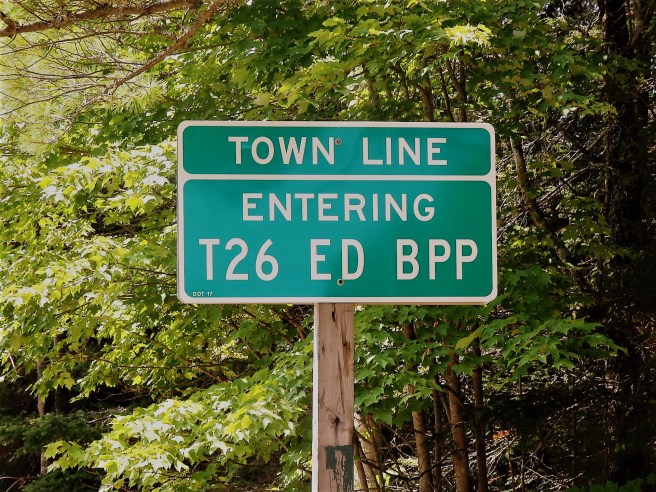
Thus, when driving along you might see a highway marker like the one announcing that you’re entering T26 ED BPP.
There are many more signs like this, equally baffling. This one translates as Township 26, Eastern District, Binghams’ Penobscot Purchase. Don’t ask me more, I’m already confused, as I’m sure you are.
There’s even another variation, PLT, for Plantation – and, no, it has nothing to do with fields of cotton or tobacco.
The Plt stands for plantation, which has nothing to do with a privately owned farm in Maine.
Significantly, more than half of the state is uninhabited. Hard to think of that, considering the urban and suburban density and congestion of so much of the rest of the Northeast.
Somehow, nobody’s counting mosquitos or moose in the equation.
What do you have to explain to others about the political setup of the place you live? Ward politics? The county sheriff? The nut jobs, right or left?
I’ve long been fascinated by what I’ve come to call the “shadow Meeting” – people who continued to worship as Quakers and uphold many of the values after being “read out of Meeting” for violating its discipline, usually over marriage procedures.
It’s a fact for several generations of my own ancestry in North Carolina.
One place I see it in Dover is with the Varneys.
The patriarch of this prolific Quaker line was Humphrey Varney (1636-1714), a brickmaker who moved to Dover from Ipswich, Massachusetts. He married Sarah Starbuck, widow of Joseph Austin, as her second husband.
After the Dover’s disastrous massacre, their son, Ebenezer Varney (1664-1753), married Mary Otis after her return from captivity, and their son Peter (1666-1732) wed Elizabeth Evans.
The Varney house, which stood near today’s Wentworth-Douglass Hospital, was once the largest home in Dover. After the massacre, it continued to keep its doors unlocked so that passing Natives could spend the night.
After that, well, it seems the Varneys married into all of the other Dover Friends families. Many of them also spread, most notably across Maine.
The family made its imprint on Dover, though I’m not sure how many remained Friends.
Jesse Varney was a morocco shoemaker when his store was consumed in flames in December 1810.
By 1837, Varney’s Block stood at Lower Square on Central Avenue near Washington Street. In 1844, a bigger building was erected.
In 1847, 99-year-old Eunice Varney died. She was the oldest resident and a member of the Society of Friends.
There’s Varney Road, extending Long Hill Road to Blackwater Road. And Varney Cleaners, founded by Fred Varney.
The Varney School on Washington Street, used from 1861 to 1953 and now as law offices, was named in honor of Judge John R. Varney. He died in an 1882 fire that destroyed the Washington Street Baptist Church building.
George Varney was a prominent merchant for more than 40 years and owned a drug store on Washington Street before retiring in 1920 at age 65 and passing the next year. He built a large home on Arch Street in 1913.
John R. Varney was co-owner of two newspapers – the Dover Enquirer, purchased in 1868, and the Dover Daily Republican, acquired in 1880.
My curiosity, of course, wonders how many of the Quaker values continued in their lives, as well as what directions their faith took. I like to think it worked like yeast.
The family also made a big impression in Manchester. The Varney School, now a private residence on the West Side, was named in honor of one of the city’s mayors.
~*~
Check out my new book, Quaking Dover, available in a Nook edition at Barnes & Noble.
Moving the event back a month has allowed Dover Friends to spread the word more widely, and I’m definitely excited.
Well, it’s their history, too.
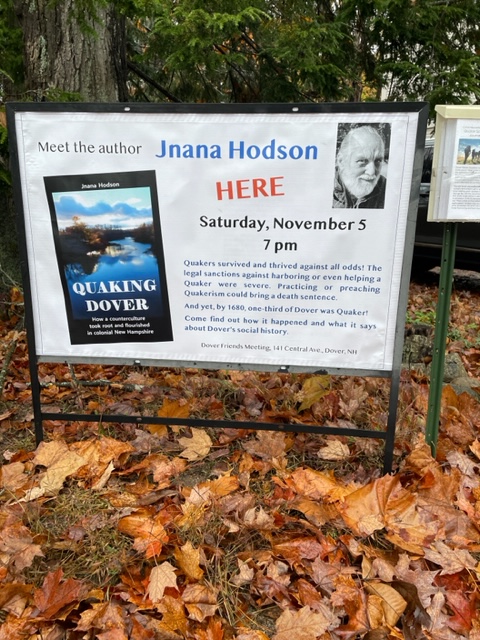
The official book release party for Quaking Dover is Saturday at 7 pm in the historic meetinghouse at 141 Central Avenue in Dover, and you’re welcome to join us, if you’re in the area.
In addition to the meet-and-greet, I’ll present an illustrated overview of the story and the ways this book came to be. I have to admit I was surprised by much I uncovered along the way.
One thing that fascinates me in regards to religion is the distinction between faith, based on a holy experience, and a culture, handed down within a family.
Among the Dover families that belonged to Meeting are the Tuttles, long known for their Red Barn market. Yes, Red Barn, like the name of this blog.
Three Dover Combination signers shared a tragic introduction to the New World when their ship, the Angel Gabriel, broke up in the August 14 “Great Colonial Hurricane of 1635,” either in the harbor at Pemaquid, Maine, or at the Isles of Shoals.
One was John Tuttle, who was about 17 years old at the time of the disaster. After their rescue, he arrived in Chebasco (in Essex or Ipswich, Massachusetts). By 1638 Tuttle settled in Dover, where he was known as Shipwreck John and had a farm on today’s Bellamy River – one that grew into what was long known as America’s oldest family-owned and operated enterprise. (Never mind that Thomas Roberts’ heirs nearby would have a longer claim.) Tuttle’s son Thomas was killed by a falling tree while still a young teenager, leaving John Jr. to continue the family name.
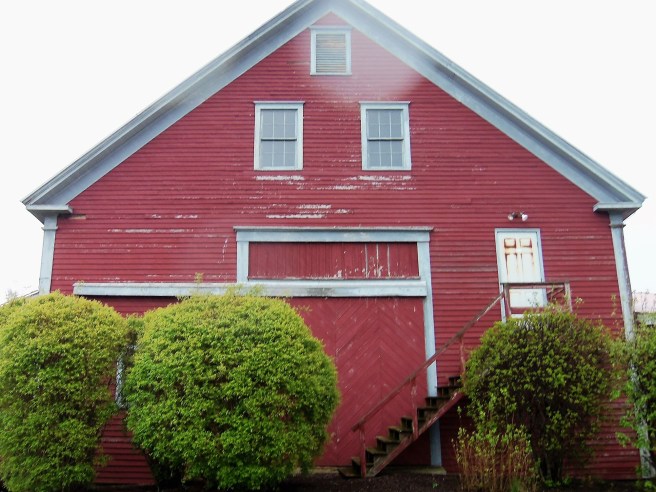
Tuttles’ Red Barn along Dover Point Road remains a landmark, even after the family finally sold the farm.
Shipwreck John’s grandson, James Tuttle (1683-1707), is believed to be the first Quaker in the family. He married Rose Pinkham (1682-1728) and they had two children before his death – Elijah Tuttle and Phebe, who married Moses Varney. Yes, these Quaker families quickly intermix.
The next four generations were very active in Dover Friends Meeting, according to William Penn Tuttle, who added that their home was always a resting place for visitors during Quarterly Meeting.
And some of the family even went abroad in missionary service.
Their farm on Dover Point Road, with its red barn, was long noted as a marketplace for fresh produce.
Across the river in Maine, one line still produces remarkable cider each fall – King Tut’s. Yes, short for Tuttle’s.
~*~
Check out my new book, Quaking Dover, available in an iBook edition at the Apple Store.
Business opportunities lured some Dover Friends to more lucrative destinations within the changing economy. With their many Quakers, Lynn, Massachusetts, and Philadelphia, especially, beckoned.
As a widely repeated quip goes,
Friends went to Pennsylvania to do good, and they did very well, indeed.
Among those who went to Penn’s Fair City was Lydia Brown Hanson’s nephew Moses Brown (1793-1878), who left Dover in 1815 to join his brother Jeremiah in the domestic textile trade. Moses, I should emphasize, was not the famed Rhode Island Quaker. These were the sons of William Brown and Abigail Peaslee, whose daughters Lydia, Alice, and Anna all married under the care of Dover Meeting. The brothers’ move to Pennsylvania came the year after the first textile mill in Dover was built – were the Browns selling its fabrics?
In Philadelphia, Moses had the good fortune to marry Mary Waln Wistar, a descendant of a socially prominent Quaker family, and their son Thomas Wistar Brown was born in 1826.
Described as a successful dry goods merchant who never went to college, T. Wistar Brown became a self-taught scholar and patron of education. A long-time manager of Haverford College and for 25 years its board president, he gave the college three professorial chairs and much of its old library and books, among his many philanthropic endeavors.
His profile calls him a quiet man of strong faith and convictions – including a refusal to succumb to the use of the telephone and automobile. As a young man he had followed Abraham Lincoln on horseback on the way to the first inaugural, and he saw Lincoln’s Vice President, Hannibal Hamlin, spattered with mud after a hairbreadth escape from an assassin’s bullet. During the Civil War he escorted the wife of his cousin, General Isaac Wistar, through enemy lines to visit her husband at Fort Monroe.
He was also a founder, with other Quaker businessmen, of the Provident Mutual Life Insurance Co. of Philadelphia.
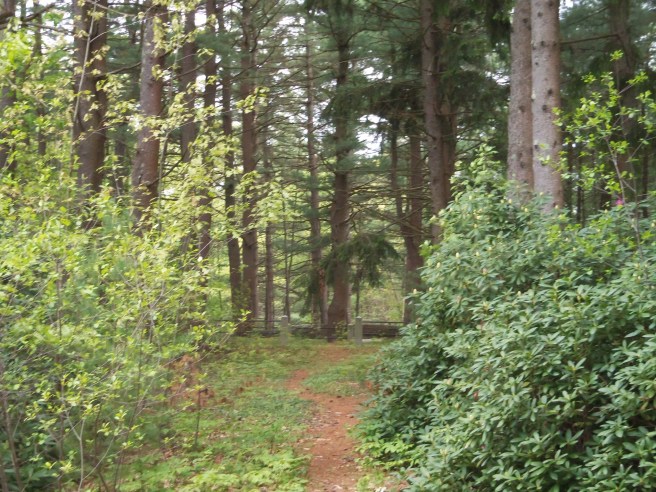
Brown and family members are buried in the plot at the end of the lane in Dover.
When he died in 1916, the Evening Post of New York in a long tribute said of him: “There was a blend of the stoic in his Christian resignation; he saw much and suffered much, gained much and lost much. He was one of the last of the old generation of Quakers who inherited from their forefathers discipline and patience, silence, and self-control. He faced life with quiet fortitude.”
He is buried with his wife, Mary Farnum, and other kin in the T. Wistar Brown Cemetery, now managed and used by Dover Monthly Meeting.
At times I do wonder if the City of Brotherly Love is reflected in the naming of some of Dover’s streets – Arch, Chestnut, Locust, Maple, Spring, Central, Broadway (from Broad) – as a result of the Philadelphia connections. A number of the city’s other streets carry Quaker family names, including Hill Street, named for a Varney and Hill land development partnership rather than its inclines.
~*~
Check out my new book, Quaking Dover, available in a Nook edition at Barnes & Noble.
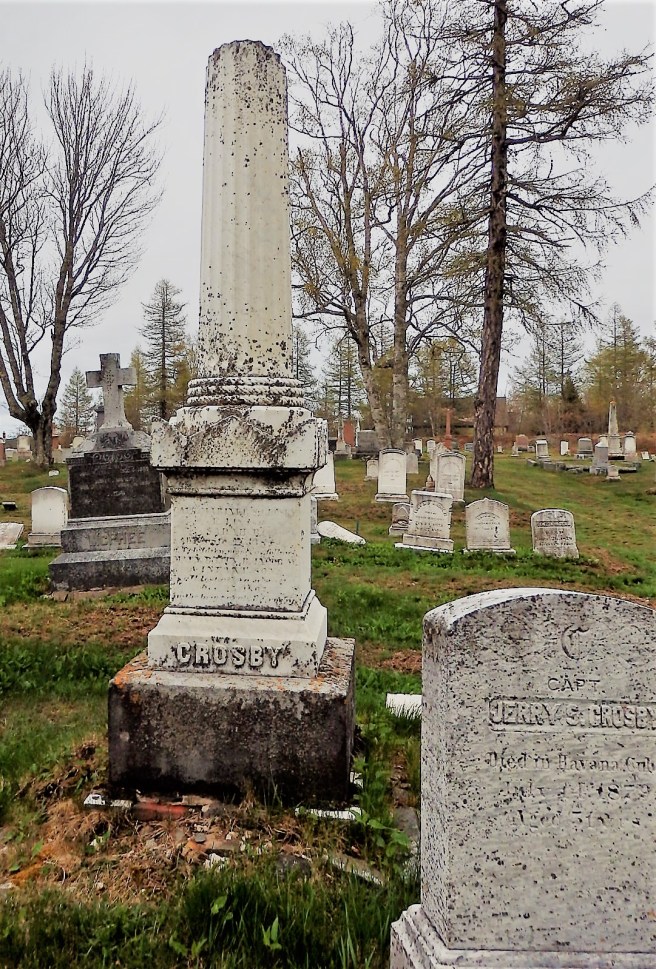
Capt. Mariner S. Crosby. Given his Christian name, it was inevitable that he would take to the sea. That’s what struck me the first time I wandered through Hillside Cemetery.
The second time I went to the graveyard, I was looking for that marker but couldn’t find it. Back home and at my computer, Find-a-Grave led me to the rest of the inscription, which is admittedly rather worn away, as well as some additional facts.
What I found was this:
“Lost at sea with his family and the Brig Sarah B. Crosby,” named for his wife. She and the four children, one of them an unnamed infant, are then listed on the white memorial – Jacob W., Mary B., and Lucy B.
The date of their demise is uncertain, “around Oct. 25, 1867” – in season for a hurricane or some other vicious storm, although a fire in a wooden ship can’t be ruled out.
I trotted back to the cemetery for a closer look. Here it is:
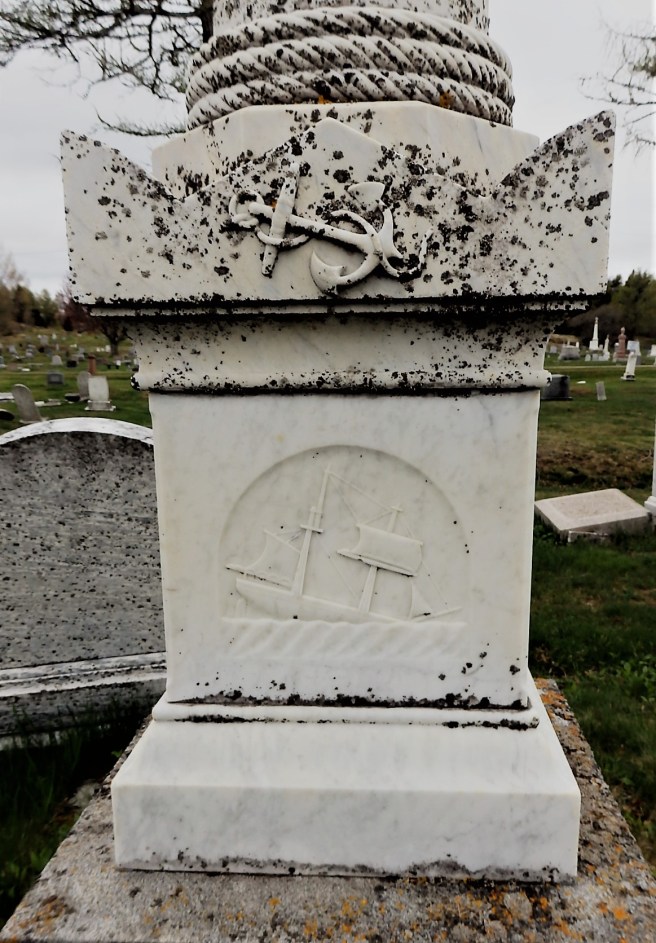
The broken column symbolizes the loss of an upstanding citizen in his prime.
The Chamber of Commerce website reveals more:
“Mariner Crosby was the master of the brig ‘Maria White’ in 1852 and the schooner ‘Mary Jane’ in 1855. From 1861-1863 Mariner was the master of the barque ‘Charles Heddle,’ also built by C.S. Huston,” in Eastport. Around the corner from me, actually. “Mariner’s last command was the brig ‘Sarah B. Crosby,’ named for his wife, which was built in Pembroke. He commanded this vessel from 1863 to 1867 when the vessel was reported overdue. Mariner, his wife Sarah and four children, as well as the crew and passengers, were lost at sea without a trace.”
The pillar is a broken mast, as the three rings of rope emphasize. And there’s a carving of a brig going down, all but one of its square sails blown away.
We’re not even told where the ship was bound, much less about its cargo, passengers, or crew. And a brig did require significant manpower to manage the massive square sails.
The two-masted 316-ton “Sarah B. Crosby” was built in Pembroke by George Russell in 1863 and then based out of Portland, bound for ports such as New York and St. John, New Brunswick.
I started to investigate and found a bit more.
She knew the travails of the sea, having wrecked at treacherous Sandy Hook, New Jersey, on March 1, 1865, with the passengers and crew safely removed. And then, after being abandoned, she was reclaimed and repaired, with shipments of coal from Halifax, Nova Scotia, later in the year.
On March 19, 1867, the New York Herald carried this notice: “Brig Sarah B Crosby (of Portland), Crosby, Measina, Jan 27, with fruit to Lawrence, Giles & Co, passed Gibraltar Feb 16; has had heavy westerly gales, with snow and hail, and split sails. Mar 13, latitude 41 30, longitude 65, spoke ship Michigan, from Liverpool for London.” (Measina, a mystery unto himself, was first mate. They would have been just off England at the time this information was relayed.)
I would like to know more in general about wives and children traveling with captains. It turns out to have been common, with a significant number of the children being born at sea or spending a large part of their childhood there. Wives were partners with shares in the business, whether they went abroad or stayed ashore. They even learned navigation, but did not interfere with the cook aboard ship. There were strict lines of authority. Beyond that, what were Sarah’s views and experiences? Was she even related to the 1841 Robert Bates house a few doors up the street from me? She was only 33 or so at the end; there’s no age for Jacob, though Mary would have been around 11 and Lucy, only seven.
While Mariner grew up in Eastport, the son of a Nova Scotia immigrant, Sarah was the daughter of a hotelier in Calais, Maine, best I can tell. Her father came from Massachusetts; her mother, New Hampshire. Mariner Crosby and Sarah E. Bates were married in Eastport February 12, 1855, by the Baptist minister Nathaniel Butler, of note himself. We have no idea how they met.
Mariner came to the sea naturally. At least two of his four brothers were also sea captains. Not just sailors or first masters but skippers.
Capt. Jerry died in Havana in 1879.
And Christopher Crosby led the racing yacht “Coronet” that defeated the “Dauntless” in a famed trans-Atlantic race in 1897. He went to sea at age 17 and was skipper by the time he turned 19. Yes, born to the sea.
And that’s as much of their story as I’m able to find, all prompted by one name in stone.




 Jnana's Red Barn