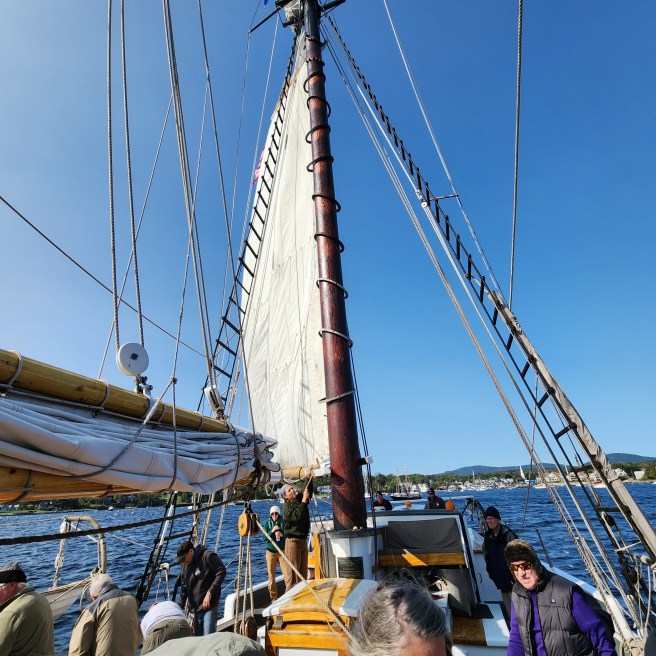
Hoisting the sail

perfect weather, sunny, 60s
a knot = 1.1 mph

a little more up
meaning into the wind

luffing, meaning chuffing in the sheets

no sea legs yet
wobbly

even on calm seas

bit queasy
edge of mal de mer?

slow lull

slow sun

will I feel a late-season burn?

“all on the bowline, we sing that melody
like all good sailors do when they’re faraway at sea”
a song our Dylan doesn’t know
in his impressive repertoire
a generational gap

116th Street Blues, starts out with Captain Ahab
then more nautical lines

find your own style

it’s an active experience
just relax

Keeping a scoundrel at bay

An avaricious man, who might happen to fill the offices, looking forward to a time when he must at all events yield up the emoluments he enjoyed, would feel the propensity, not easy to be resisted by such a man, to make the best use of the opportunities he enjoyed, while it lasted; and might not scruple to have recourse to the most corrupt expedients to make the harvest as abundant as it was transitory; though the same man probably, with a different prospect before him, might content himself with the regular perquisites of his station, and might even be unwilling to risk the consequences of an abuse of his opportunities. His avarice might be a guard upon his avarice. Add to this, that same man might be vain or ambitious as well as avaricious.

Alexander Hamilton in Federalist No. 72

Historic ironworks dam

Evidence of the long-gone Pembroke Iron Company, established in 1832, is seen in the half-hidden stonework ruins of its dam along U.S. Route 1. In 1856, at its height, the company produced nearly 5,000 tons of iron spikes, rivets, and nails – many of them used in the town’s shipbuilding industry.

The Pennamaquan River now flows naturally around it to a newer dam and fish ladder carrying nearly 10,000 migrating alewives a day from the head of the tide nearby to breeding grounds in lakes upstream.

Recognizing a degree of imperfection

But cool and candid people will at once reflect, that the purest of human blessings must have a portion of alloy in them, that the choice must always be made, if not of the lesser evil, at least the GREATER, not the PERFECT good; and that in every political institution, a power to advance the public happiness, involves a discretion which may be misapplied and abused.

James Madison in Federalist No. 41


Some things ‘Quaking Dover’ has in common with my novels

Not that I really noticed the parallels until now.

  1. Counterculture is central, leading to an awareness of an underground community or at least kindred spirits.
  2. Both have meant learning to write differently than my neutral third-person journalism. Emotion, for instance, over fact, is the rule in the fiction. And the history opened a similar vein as creative nonfiction.
  3. The role of a narrator in both. In the history, that meant developing the gently laughing curmudgeon as he pored over historical data. In four of the hippie novels, it was the snarky daughter reviewing her late daddy’s hippie experiences.
  4. Both veins are self-published, falling under the shadow of being “not commercially viable” by publishing houses. That places an additional burden on the author.
  5. Marketing is a huge challenge. Apart from Subway Visions, none of my stories take place in a big city or address a big audience. How many hippie novels can you name, anyway. As for Quakers?
  6. Spirituality and religion run through all of them. In the novels, it’s often yoga, though Hometown News runs up against a puzzling array of churches. In Quaking Dover, though, it’s often the clash between the upstart Friends and what I first saw as rigid Puritans before both traditions begin to, uh, mellow.
  7. There’s a strong sense of place, even if these locations are far from the mass-media spotlight.
  8. I go for the big picture. I really would like to have a simple book – something, as Steven King advises, having only one big idea – but that’s not how my mind works.
  9. They’ve all undergone deep revision. Much of the fiction actually got new titles and new characters after their original publication.
  10. They were all labors of love.

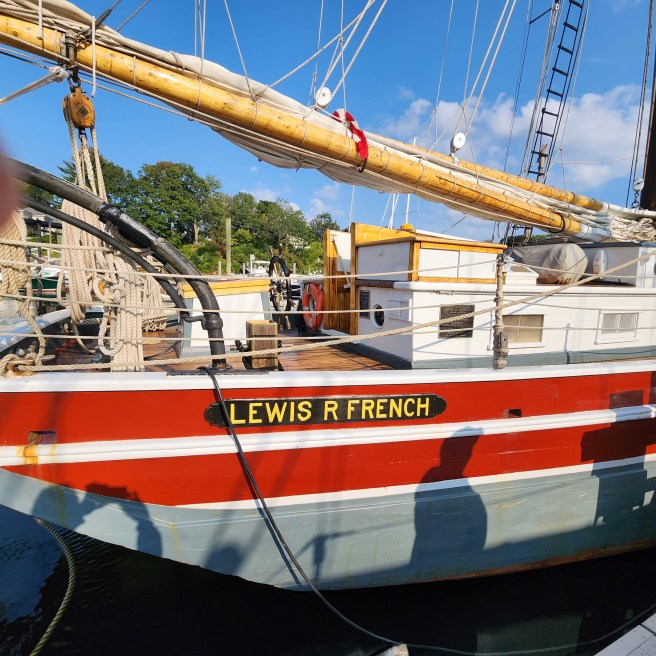
Time to meet her, the Louis R. French

So who was Louis Robbins French?
Father of the three sons
who built this in South Bristol, Maine

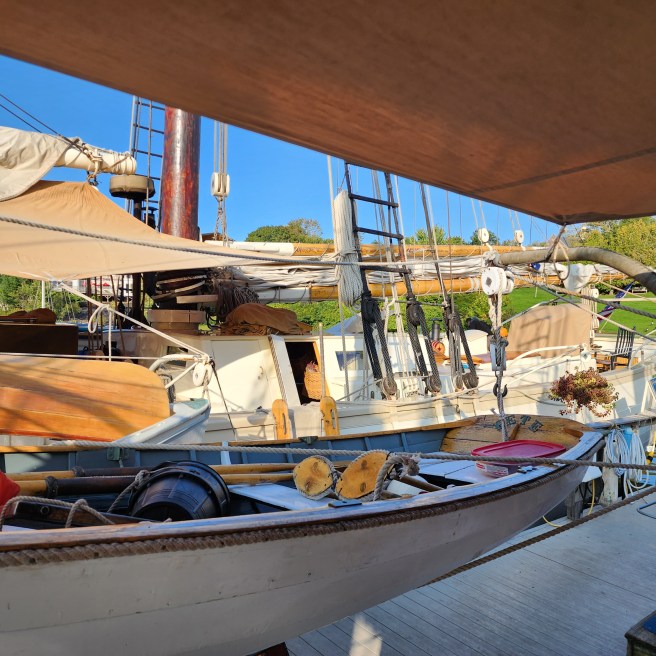
The French is docked at the left of the Mary Day in Camden, Maine.

The French is 101 feet overall, 65 feet on deck, with 19 feet of beam, as the brochure proclaims. She draws 7.5 feet with a full keel. A proven vessel in all conditions, she is a nifty and quick sailor, having won the Great Schooner Race many times. The French has also participated in recent Tall Ships gatherings in Boston. It spent part of its life based out of Lubec just south of Eastport.

The quarterboard carries the name proudly.

the French was largely stripped and gutted
and rebuilt for passengers
what’s left?

As my buddy Peter grinned at me at the end of our week:

“Your first love. You never forget.”