… a faultless plan was not to be expected.
James Madison in Federalist No. 37
You never know what we'll churn up in cleaning a stall
… a faultless plan was not to be expected.
James Madison in Federalist No. 37
The poems in this rant aren’t in my usual voice, but they do address today’s political precipice, only from a slightly earlier historical perspective. And yes, that’s scary. Kinda like the Fourth of July fireworks that way.
For this month only, I’m offering the ebook for free at Smashwords.com during its annual July sales sweep. What do you have to lose? Remember, it’s free. I promise you’ll get a bang out of this.

Check it out at my author page at Smashwords.com.
As usual, there were kerosene lanterns, which I didn’t attempt to photograph.
And this time, phosphorescence in the water itself. Ditto.

But, as I noted:
unseen, the moon grows more luminus
in night shrinking from day
The members of the executive and judiciary departments are few in number and can be personally known to a small part only of the people.
James Madison in Federalist No. 49
A sloop has only one mast, for starters.
There’s a whole new vocabulary to learn.
It’s a way of looking through the eyes of others.
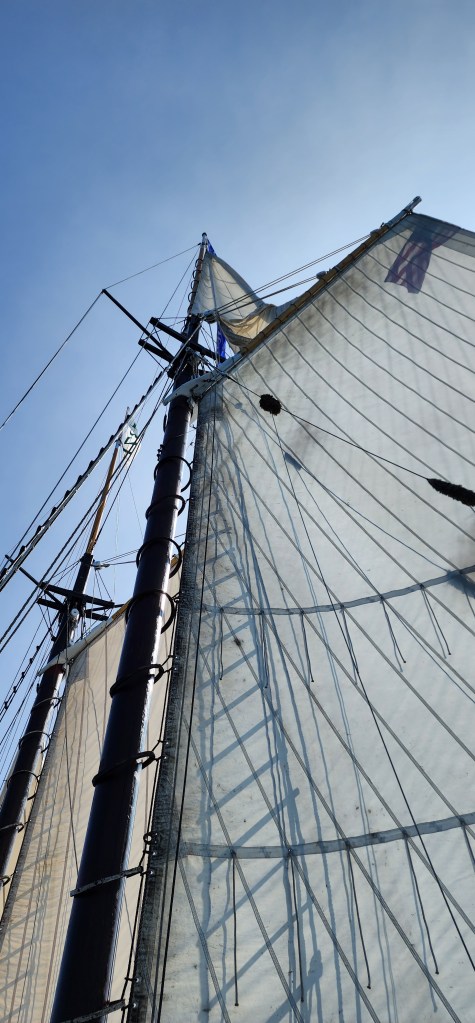
Those things on the ropes, er, lines are called baggy wrinkles. They protect the lines and sheets, i.e. sails, from harmful rubbing. That is, they’re a furry cover for rope sphering.
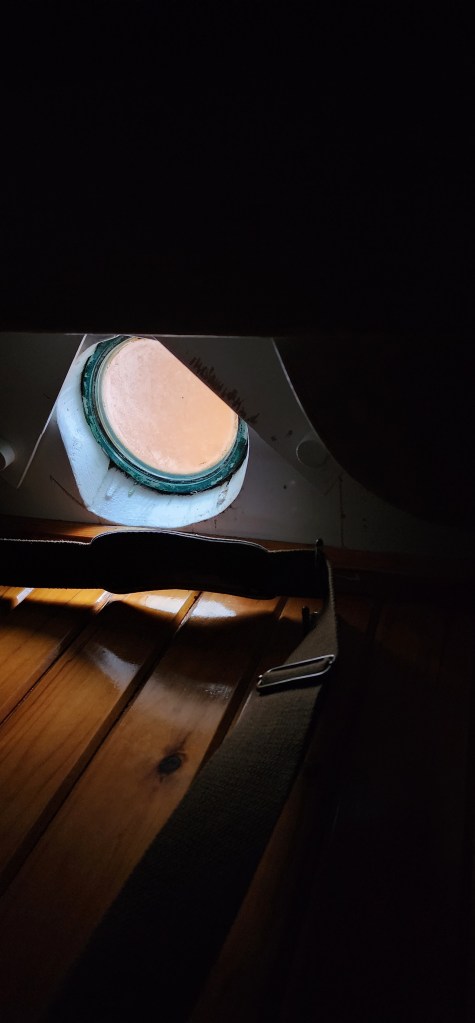
Deck prism is another term. It’s a small round window. Here’s how it looked from my bunk. Overhead, people were walking on it.

Hatch is the opening between the deck and the hold below. This one connects by a ladder (not stairs) to cabins (aka staterooms).

Another leads to the galley, which includes what others would call a kitchen.
What are the chief sources of expense in every Government? … The answer, plainly is, war and rebellions – the support of those institutions which are necessary to guard the body politic, against those two most mortal diseases of society.
Alexander Hamilton in Federalist No. 34

the Stephen Tabor carried
64 cords of firewood at a time
back in the day
oh, look, another damn lighthouse

okey dokey
“ready about!”
Preparing to tack
“press it off!”
“well, that’s backwards”
… a mere demarcation on parchment of the constitutional limits of the several departments, is not a sufficient guard against those encroachments which lead to a tyrannical concentration of all the powers of government in the same hands.
James Madison in Federalist No. 48
Every night, the canopy is spread
every morning, stowed away
how he manages a wood cookstove
eludes me
the galley’s tight and must be a hot space
on a hot or humid day
regardless, he starts at 3 a.m.
and there’s coffee by 6:30 all the same

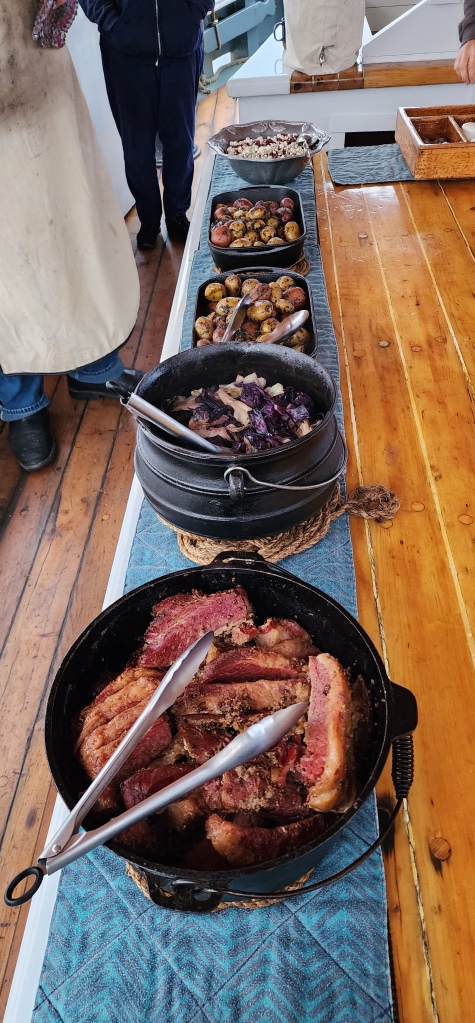
blueberry pancakes, slice of melon
cod chowder, a biscuit
roasted chicken drumstick, asparagus,
a risotto, Boston cream cake
lunch an excellent beef stew
and a great, crunchy sourdough bread
feeling like I’ve been here forever
in a good way
knowing it’s rarely this perfect
“no matter how much I eat
I keep losing weight on this ship”
sez male crew member
the cook’s apron
a variation on his overalls
the cook never learned wood-stove cookery
in culinary school
‘cuz he never attended one
in lighting a cook fire
the secret’s you have to stack
the firewood in tight
the galley’s quite crowded
the French burns four cords in a season in summer
Zen temple abbot and head cook
two most important personages
the cook also helps with the crew
mans an oar
hauls line, as needed
I rather backed into this project, beginning with the elusive question, “What do Quakers believe?”
It led me to something much bigger, ranging beyond the Society of Friends, but springing from the seemingly quaint language of its earliest voices in mid-1600s Britain. There are good reasons the time and place are referred to as the world turned upside down.
Centering their experiences in three interlocking metaphors – Light, Seed, and Truth – they created what’s been called an alternative Christianity, and though their thinking and process have been diluted over the centuries since, their foundation remains revolutionary, startling, and challenging. I’ll argue that it’s cutting-edge contemporary, as well, in a time of disbelief and skepticism.

For one thing, how do you see “truth” as a verb? It becomes something quite different from carved marble or courtroom proceedings.
While some of the chapters originally appeared as chapbooks at Thistle Finch editions, this newly enlarged volume of essays is now available on your choice of ebook platforms at Smashwords.com and its affiliated digital retailers. Those outlets include the Apple Store, Barnes & Noble’s Nook, Scribd, and Sony’s Kobo. You may also request the ebook from your local public library.
The book now ranges far beyond religion and spirituality, by the way. Even atheists have their beliefs. Change the perspective, as I think I do, and you can find the exchange of first-hand experiences refreshing. How else can we talk about the deepest issues in life?
The move unites the essays in a single volume, rather than a series of four smaller chapbooks, and makes them available to a wider range of readers worldwide.
Do take a look.

