The Federal and State Governments are in fact but different agents and trustees of the people, instituted with different powers, and designated for different purposes.
James Madison in Federalist No. 46
You never know what we'll churn up in cleaning a stall
The Federal and State Governments are in fact but different agents and trustees of the people, instituted with different powers, and designated for different purposes.
James Madison in Federalist No. 46
The 1990 application to include the restored and repurposed Louis R. French in the National Register of Historic Places includes much more than a detailed physical description of the schooner and her history.
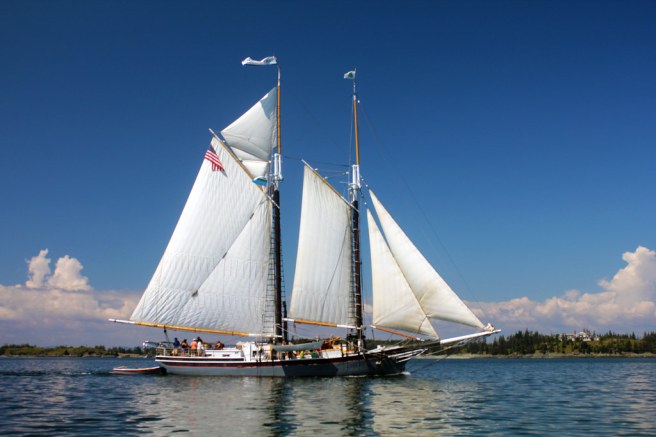
The National Park Service document, Louis R. French (Schooner), available online portrays the two-masted coasting schooner as the most common American vessel type, with tens of thousands of them functioning as the “freight trucks” of their time, carrying coal, bricks, iron ore, grain, oysters, lumber, and even ice between ports.
Yet, at the time of the application, only five of them were surviving in the United States.
In addition, the French was the oldest surviving sailing vessel built in Maine, the center for wooden shipbuilding in the United States after the Civil War.
As the application noted, until the outbreak of World War II, the coasting schooners were so common that nobody paid much attention to them. Designed to run fairly close to shore, the coaster lacked the fishing schooner’s ability to ride out a gale offshore on the fishing grounds. Nor did the coaster approach the scale of the great four-, five-, or six-masted coal schooners that transported coal from southern to northern ports.
Deepwater sailors, who occasionally took a large schooner across the Atlantic, scorned the useful and ubiquitous little coasters, sometimes accusing their skippers of “setting their course by the bark of a dog.”
The application quoted maritime historian Howard I. Chapelle, who observed “the straight fore-and-aft-rigged schooner is decidedly a coastwise vessel, and attempts to use such craft for long voyages have invariably been disappointing and disillusioning, if not disastrous to the adventurers.”
The schooner supplanted the square-riggers in the coasting trade for practical reasons:
Fewer sailors were required to handle the vessel, and a schooner could be worked into and out of harbors and rivers more easily than any square-rigged craft. Her trips could also, as a rule, be made in quicker time, as she could sail closer into the wind, and it was hardly necessary for her to sail from Maine to New York by way of the Bermudas, as some square-rigged vessels have done during baffling winds.
Put another way, they were the errand boys, the short-haul freight droghers, and the passenger buses for many a year, and their contribution to coastal community life, especially in New England, was substantial.

“Without them, the country could hardly have been settled,” as the report quotes one source.
These days, there’s nothing Plain Jane about them, though. Not in my boat – err, book.
… who can think it possible that the president and two-thirds of the senate will ever be capable of such unworthy conduct. The idea is too gross and invidious to be entertained. But in such a case, if it should ever happen, the [ruling] so obtained … would, like all other fraudulent contracts, be null and void by the laws of the nations.
John Jay in Federalist No. 64
Finally warm enough to take my cap off
and we’re getting some wind
yes, it’s all atmosphere
haze-infused grays with tinges of green forests
and bluish mountains
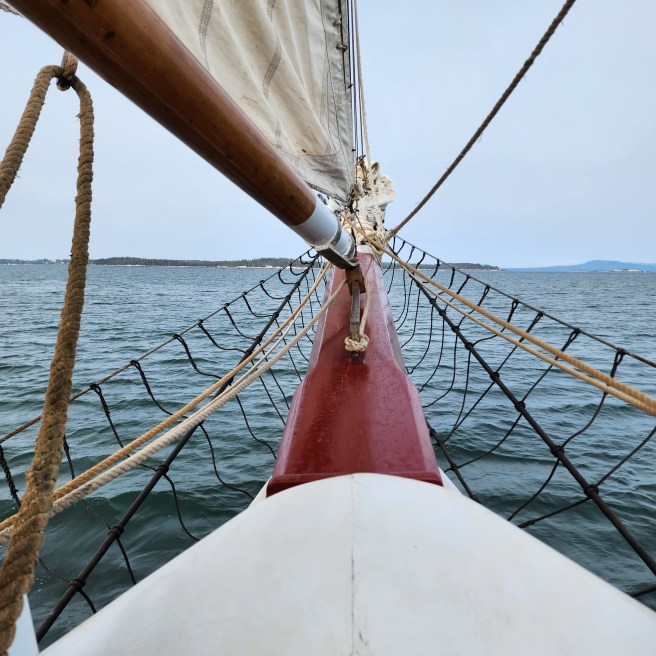
pulley block rasping behind me
the advantages of a cloudy day
without sunscreen
for a bald guy
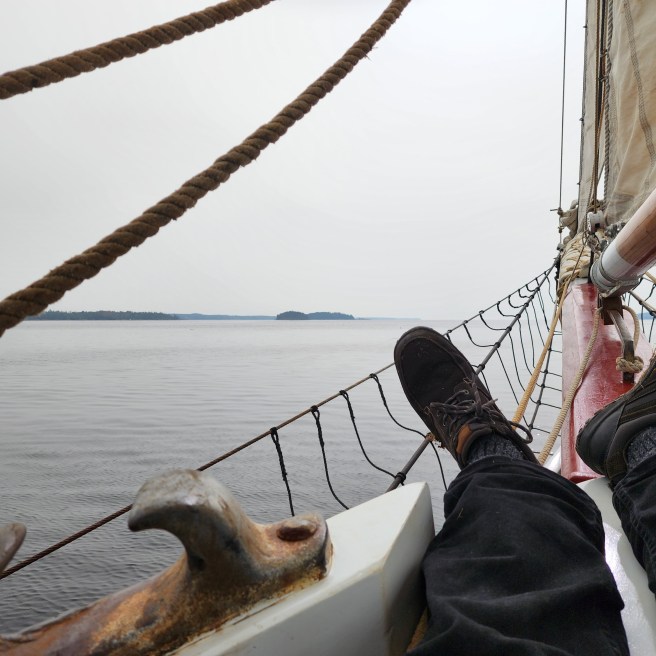
sitting motionless
apart from a slight roll
in a nearly dead wind
how calming
am still surprised the tiny yawl can push this big boat
a porpoise here, a porpoise there
a bald eagle flies past
the chains to even the tension
on the bowsprit with jibs
If the federal Government is to have collectors of revenue, [they] will principally be on the sea-coast.
James Madison in Federalist No. 45
Somewhere in the past I heard about a kind of public journal that wasn’t overtly personal but carefully recorded by devoted individuals. News items, witty thoughts, chance encounters, weather observations might fill them.
Recently, I came across one of those, the Record Book Kept by Daniel C. Osborne (1794-1871), Quaker and Banker. The copy was online at the Friends of Allen County’s website – the highly regarded genealogical center at the public library in Fort Wayne, Indiana.
What especially interests me is that he was a member of Dover Friends Meeting in New Hampshire. His entries provide fresh insights on the life of the congregation and the broader community, both the subjects of my book, Quaking Dover.
A record book, as this one demonstrates, is a collection of random accounts the individual found fascinating or significant. Daniel’s, for instance, has entries on the manufacture of watches in U.S., John Jacob Astor’s will and estate, the popular vote for president 1848, the wife of president Franklin Peirce president-elect, population of the states 1855, English Bible translations list, executions for murders, steam boat accidents and Atlantic Ocean steamers lost, even the royal family of England – most of those notations are on distant events – but they accompany family genealogies and other things closer to home.
Daniel, a son of Marble and Mercy (Nock/Knox) Osborne, operated an iron foundry and was later president of the Strafford Bank, now part of TD Bank. He lived in a Georgian Colonial style home his father had built adjacent to the Quaker meetinghouse, where Daniel continued as an active member while the congregation aged and declined.
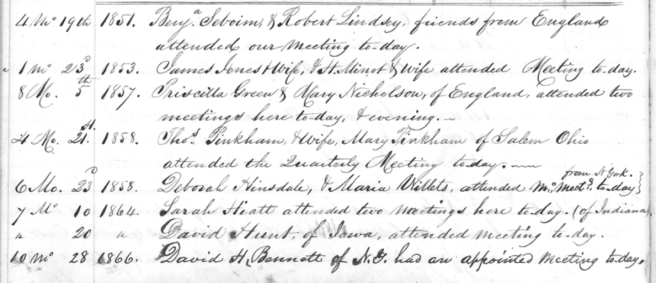
Although his penmanship was impeccable, I’m not confident in my ability to decipher it clearly. Even so, I find his records filling in details I’m not sure I’d uncover otherwise. The family genealogies, for instance, have details otherwise lost from the Quaker records when an individual “married out of Meeting,” was “disowned” for other reasons, or moved from the area.
The accounts of deaths, mostly around Dover but sometimes including U.S. presidents, the Marquis de Lafayette, or soldiers at Lexington, Massachusetts, also name neighbors who weren’t Quaker. Perhaps they were even involved in business dealings with him. Notations in the margins point to a surprising number of suicides and, especially, drownings. One 53-year-old man was killed by his own father. Mention of the passing of Quaker evangelist Joseph John Gurney reflects the branch of Friends that Dover followed while that of Congregational minister Lyman Beecher indicates an openness to religious liberalism.
Notations of family marriages point to a much broader interaction of Dover Friends with fellow Quaker families in Rhode Island than I had suspected, including the Wilbur family, prominent in a schism in the yearly meeting, through no blame of their own. I’m guessing it’s because so many attended what’s now the Moses Brown School in Providence.

Of special interest to me is this notation, “10th mo 22, 1864. Israel Estes of this City, died this day, aged 64 years. He was a lineal descendant of Joseph Estes, who died in Dover Neck in 1626, coming over with Edward Hilton, in the first vessel, and had lands assigned to him as early as 1631.” If true, it would add another person – and, obviously, eventually a wife – to the settlement before the Puritan invasion that multiplied the frontier settlement now known as Dover. As the history stands now, Thomas Roberts was the only other person who arrived with Edward, and they were followed a few years later by brother William Hilton.
It would also place the origin of the surname in America at Dover rather than Massachusetts.
Well, that’s what I get in a first sweep through the record book. I suspect there’s much more to glean.

Yes, time marches ahead. I can’t count the number of times I rewound and reset this before Quaker worship in Dover each Sunday, or First-Day, in the old parlance. Some Friends said the ticking kept reminding them, “Slow down, slow down.” Others found the sound disturbing.
It’s hard for me to believe my book Quaking Dover has been published more than a year now.
Jesus was a carpenter, after all, surrounded by fishermen and their boats. Maybe he built a few to float, too.
the curve of the deck – sheer
ours noticeably higher at the bow
than even the stern
while the crown with its sides
for water runoff

a dutchman
a piece of wood
cut in
to replace a rotten section
ditto in our home
“You’ll be the next Tom Wolfe,” one creative writing prof promised me. I loved the guy’s flashy writing and, for the most part, his subject matter.
Where he eventually rubbed me wrong was his consternation that no big novel of the hippie era had appeared. There, he kept ringing as a prompt for me.
Part of his hook for me was the fact that my dream job in the newspaper world would have been as a columnist, especially one like Hub Meeker’s State of the Arts in the Dayton Journal Herald. Arts journalism was, alas, a shrinking field, along with the more general community columnist, like that paper’s Marj Heydock or Binghamton’s Tom Cawley.
Wolfe had briefly been one of those, at the New York Herald Tribune.
The bigger part, of course, was about that novel. He was dismissing Richard Brautigan’s unique voice altogether and others, like Gurney Norman, John Nichols, Tom Robbins, who rode the vibe.
Wolfe was also snidely suggesting that he had been the one exception, with his Electric Acid Kool-Aid Test, which really wasn’t a novel and predated the blossoming of the hippie movement.
His idea of the Big Hippie Novel reeked of the misguided quest for a Great American Novel.
Quite simply, there were too many strands of the movement to fit into a single book. Political or social action, anti-war witness, civil rights, gender equality, environmental awareness, organic and vegetarian foods, intentional community, group housing, alternative education were all part of it, even before the sex, drugs, rock’n’roll, hair, fashion, or slang.
These other factors would come more fully into play when I revised Daffodil Sunrise into Daffodil Uprising, and Hippie Drum and Hippie Love into Pit-a-Pat High Jinks.
I’d like to think of those books as nominees for the Big Hippie Novel distinction.
Wolfe’s charge also overlooks the outstanding nonfiction books that reflected the experience, such as Zen and the Art of Motorcycle Maintenance.
Moreover, I still feel that many of the difficulties in the current political scene arise from a failure to clearly understand the demons raging from the Vietnam conflict, both for those who fought in the army and those who fought the unjustified war itself.
So here we were, struggling through disco without having faced the lessons of either the hippie outbreak or the Vietnam disease. Hippie had become a dirty word, and many who had been happy to be one were no in psychological denial. It was something nobody wanted to relive either, apart from maybe Woodstock.
As others have observed, an ignorance of history carries a heavy price.
… the senate, who will merely sanction the choice of the executive, should feel a bypass towards the objects of that choice, strong enough to blind them to the evidences of guilt so extraordinary as to have induced the representatives of the nation to become its accusers.
Alexander Hamilton in Federalist No. 66
 Jnana's Red Barn