SPIRITUAL ENCOUNTERS FROM THE HIPPIE ERA

Nowhere do we see a bigger before-and-after contrast of the hippie impact than when looking at mainstream religion in America.

The idealized smiling family of father and sons in suits and ties and mother and daughters in their hats, dresses, and heels – maybe even with gloves – was once a common image with the church and steeple in the background. But that has become a rarity, and even at funerals and weddings the dress is likely to be casual. Intact families are a minority – weekends are often custody matters – and going to church or temple is a low priority.

Before we blame it all on hippies, we need to look at other influences from recent decades, including the elimination of blue laws, and the expansion of weekend job demands and children’s soccer leagues and the like.

Still, I see a few glimmers where the hunger many hippies felt for a spiritual connection has taken hold.

First is the practice of meditation, which is no longer considered exotic. Even health providers are urging people to turn to it daily, maybe not as a religious pursuit but at least for letting go of some of the daily stress.

Second, yoga studios are everywhere. It may not be with the strong spiritual teaching I feel is essential, but it is another way of opening ourselves to inner awareness and peace.

Third is a recognition of the feminine side of the holy, including the Jewish and Christian traditions. For that matter, think of all the women pastors and rabbis now found across the continent. Others will point to Native American, Wiccan, and other teachings with feminine components that now proliferate.

Fourth is a sense that faith is not an obligation, to be performed as a social requirement, but rather a relationship that includes hands-on, sensory experience. As the axiom went, “If it feels good, do it,” extends to religion this way.

As a fifth facet, I’ll point to outdoors encounters with their Transcendentalist streak. God, as you’ll be reminded, can be felt keenly when you’re close to nature.

Look closely and you can see the hippie influence working. There’s a desire for community and caring, on one hand. And the mega-churches with their rock-concert emotions, on the other, as well as the praise songs with their repetitions function more like Hindu chanting (kirtan) than the motets and hymns of Christian tradition.

But there are also examples of shoots gone astray. I keep thinking of Jim Jones’ Peoples Temple and its cyanide-laced Kool-Aid, especially.

As we kept watch in the ashram, the warning was this: “You’re on a false trip.” No matter how exciting it might have felt at the moment, there was always the danger of ego-based excitement rather than a deepening surrender to the Holy One.

For me, then, the most crucial part of the legacy is in having a circle of others committed to the practice, to encourage one another and keep each of us on course, as best we can. This form of discipleship is rather communal, actually – and far from what I saw growing up in the pastor-and-sheep model.

So what are your spiritual encounters these days? And how’s the “inner hippie” responding?
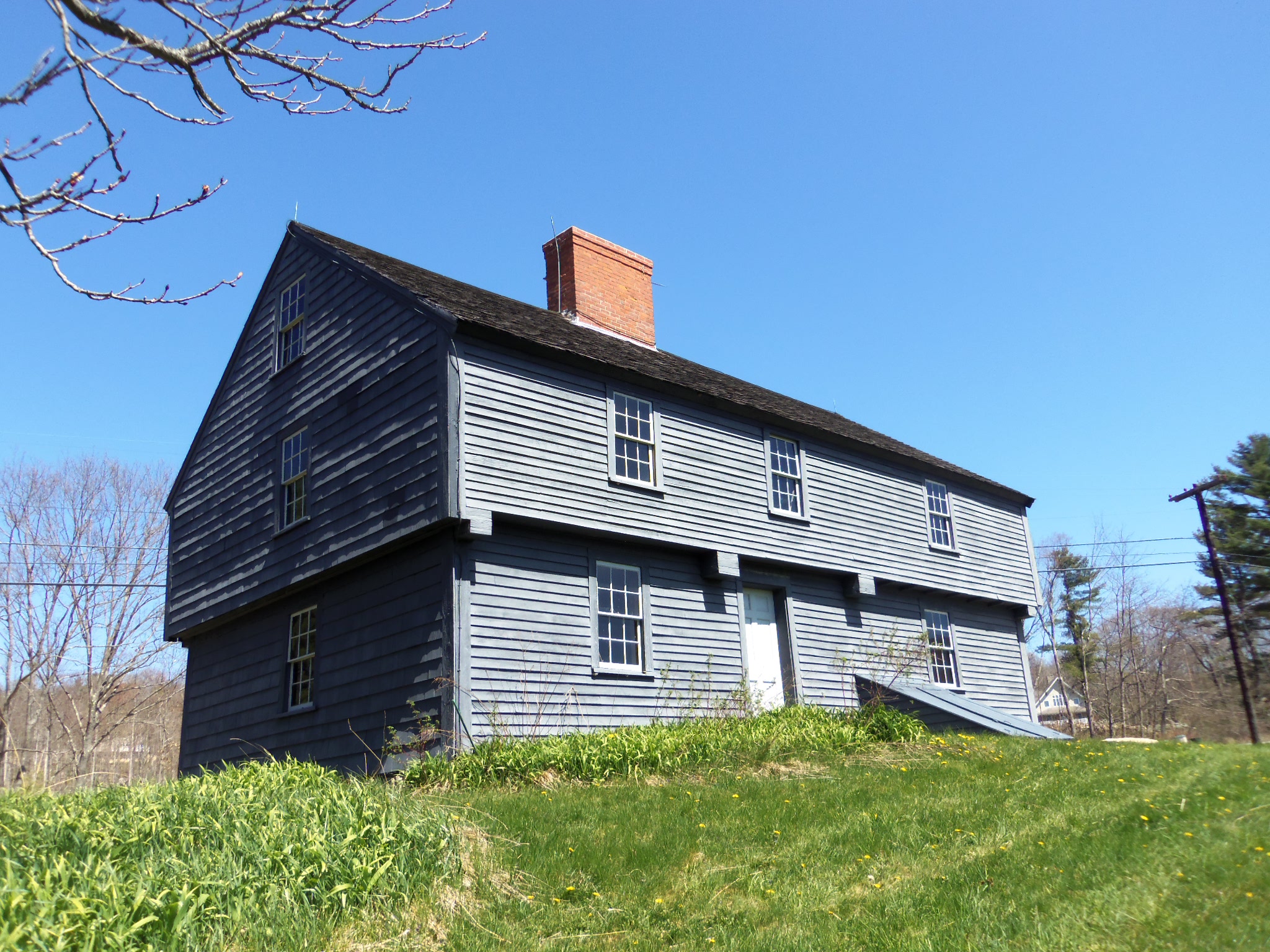
GARRISON HOUSE

The distinctive overhang design allowed for self-defense from within.

From the outbreak of King Philip’s War in 1675 until the conclusion of the French and Indian War in 1763, much of northern New England was under an ongoing threat of violence along its frontier. Nearly all of the English settlement in Maine was pushed back to a few towns nearest New Hampshire, and many villages, including Dover, suffered devastation and massacre.

Indeed, officials ordered many residents to construct fortified garrison houses, like this reproduction along Cider Hill Road in York, Maine, where families could retreat for armed protection when an alarm was sounded.

The site overlooks the inland tidal salt marshes that give rise to the York River. The hay from such spots was prized, even though feeding it to cows would produce a distinctively salty milk.
Also on the site is a more traditional New England style of construction -- shingle siding that weathers to gray.
Also on the site is a more traditional New England style of construction — shingle siding that weathers to gray.

SOUNDS FROM THE HIPPIE ERA

For many, as we’ve already noted, the hippie experience revolved around its music. Just think of Woodstock and the many ways it was the explosion that spread the movement across America and the globe.

Each of us likely has a musician or band we most identify with the era. Maybe it’s tracing the Beatles in their evolution to “Lucy in the Sky With Diamonds” and beyond, including the individual paths after the breakup, or the Rolling Stones or, of course, the Grateful Dead.

I think, too, of Crosby, Stills, and Nash whenever I turn to the jam sessions depicted in my Hippie Drum novel.

Personally, it’s Sly and the Family Stone, Jethro Tull, and the Incredible String Band who most embody the hippie sound in my ear. Maybe with Leonard Cohen, James Taylor, and Leo Kotke or Leon Redbone thrown in. Whatever happened to those folks around me who introduced these musicians, anyway?

Whether you were there or came along much later, there are probably a few favorites of your own. Were they at Woodstock? Did anyone else even know of them? What memories do they stir up? Please fire away in the comments section here!

I’m hoping we got that list of top musicians started yesterday. But there’s more than a list to consider. Get busy. Fire away. And we’ll listen.

WHAT KIND OF HIPPIE WERE YOU? OR ARE YOU TODAY?

Maybe it was a New York Times Op-Ed piece at the time that pointed out six or more levels of maturity or psychological development in the adult population, and then saw hippies as falling into three of them. One may have been second from the bottom, that is, just going along for the ride, while the other two were closer to the top, probably reflecting the appeal the movement had for many college students and graduates and/or social activists (think antiwar/anti-draft, for starters). I found it interesting there was a gap in the middle.

I suspect this is one of the reasons it’s difficult to define “hippie” clearly – we covered a wide spectrum of individuals and motivations. Just listen to the argument today over “hip,” “hipster,” and “hippie” for something similar. These days, I’m leaning more toward something along the lines of the “boho” term that would embrace beatnik and hippie as continuations of a stream of counterculture, but that’s still in embryo as far as my thinking.

What I am curious about today is how we’ve grown and matured along the way. On one hand, Robert Bly’s Iron John took aim at the “soft male,” the sensitive hippie guy, who now needed to gain some inner strength and responsibility. 

On another, I recall reading the singles ads back when I was searching and coming across more than one self-proclaimed mid-40s “flower child” who was still clueless and passive, and my reacting, “It’s time to grow up,” even as I intuitively backed away. And that was two decades ago.

But it does seem to me there’s a wide stream of individuals continuing in that Bohemian mode. In my case, I’m still a poet and writer who’s moved into the radical Christian tradition called Quaker. And I have a beard, not that it’s necessary.

As for the rest of you, ‘fess up. The comments section is open!

WHAT IF THERE HAD BEEN NO VIETNAM ENGAGEMENT?

Oh, if John Lennon had only penned this one! Just imagine, what if there had been no Vietnam engagement?

What if John Kennedy had not been assassinated and had been free to curtail or even dismantle the CIA?

What if the military-industrial complex President Eisenhower had warned of just a few years earlier had not been called into high gear for yet another round of (highly profitable) business? Would it have been brought under control and reduced greatly, with all of the investment directed elsewhere?

What if the Red-baiting bluff had been called and we’d instead seen Vietnam as a civil war rather than a Communist intrusion into the “free world”?

There would have been no lingering black cloud over America like the one that continues to fester. Even without the antiwar movement, I suspect, the nation would have been bitterly divided by the fiasco that ensued in Southeast Asia.

Would our economy have been unencumbered to grow the way Japan’s did at the time we were saddled with the costs of fighting or the accompanying steep inflation? Or the costs we’re continuing to pay in debt interest and veterans’ benefits?

And, oh yes, maybe there would have been no Hippie Trails novels, either.

Just imagine. And then add a comment on your vision. Music optional.

THIS SECRET SOCIETY OF READERS

One of the more baffling questions for just about any author, I suspect, is the one that asks, “Who are your readers?”

Yes, I know about genres and their core audiences – Chick Lit, aimed at unmarried females in their 20s; Romance, middle-age women; Sci-Fi, geeky males; Young Adult, well, it’s self-explanatory. I even know that commercial radio programmers could target their listenership to hit an average, say, of 24.7-year-old women in the office.

For a poet, though, or the novelist working outside common genres, this question becomes more problematic. I can imagine those I hope will find the work appealing, but the reactions often turn up elsewhere. I’m thinking of a writer who hoped her work would speak to her friends, only to hear them say, “I don’t read books,” as if it’s a badge of honor. (Oh, for shame!)

What that suggests is that rather than expecting a boffo bestseller, we writers might envision a much smaller-scale enterprise – connecting with readers one-on-one, as an underground understanding. Let it be private and personal, then. Our own quiet conversation.

Whether my Hippie Trails novels find their appeal more for those who lived through the era or among younger readers undergoing similar searching is still taking shape. I would hope both. But I am enjoying the feedback I’m receiving, from wherever.

It’s not the big-business Manhattan operation I once dreamed of or the San Francisco counterculture success, either. But here we are, connecting, in our own little underground society. Little do the others know what they’re missing now, do they?

ANTIQUE OR JUST OBSOLETE?

Climbing around the barn the other day, I came upon a few items I now realize are ancient history. The T-square, for instance, was used for paste-ups for pages that would be photocopied for publication. But nowadays, that’s all done in the computer. The circular wheels were actually slide rules we used to calculate proportions when cropping photographs, also for publication – and once again, that’s all done in the computer these days. The metal ruler has special calibrations in picas and points, the measurements traditionally used by printers. You run into point measures now in the font section of your word program. And then there’s the mouse pad. You remember those, back before you switched to laptop?

100_6667

So I came back into the house and turned on my stereo. You may notice I still play vinyl, which probably deserves a posting of its own. When I was a teen, I dreamed of the day I’d have an entire wall of LPs and the system to play them on. Now I look at this and realize it can essentially fit into my laptop or, uh, an iPod, if I ever go there.

100_6686

COCHECO MILLS CLASSICS

A typical water-powered textiles mill would have thousands of these foot-long bobbins feeding its looms.
A typical water-powered textiles mill would have had thousands of these foot-long bobbins feeding its looms.
A sampling of the designs that made the Cocheco Mills world-famous.

The short distance between New England’s mountains and its Atlantic coast means its rivers and streams drop in elevation rather quickly, and that has provided both powerful currents and many opportunities for power-generating dams. As a consequence, the region is peppered with old mills – usually brick but sometimes stone or even framed wood – that were once the industrial backbone of America.

Downtown Dover, for instance, is built around the Cocheco Falls, where the river plunges into the tidewater. The falls are topped with a dam, and the diverted water once powered a complex of textile mills that produced world-famous calico, among other woven products. The Amoskeag Mills in Manchester, meanwhile, were noted for their denim, which supplied Levi Strauss in his legendary San Francisco production. Nor was fabric the only product coming from the mills. Everything from precision tools to locomotives to shoes and socks and cigars was being shipped from the cities and towns along the waterways.

Over the years, many of these mills have fallen into disuse through a combination of newer technologies, cheaper competition from steam-powered Southern mills, and overseas production. But the legacy remains.

As I learn from my elder daughter while examining a glorious sampling of cloth she’s intending to turn into quilts or comforters, the designer Judie Rothermel has recreated some of the classic patterns found at the American Textile History Museum in Lowell, Massachusetts, and reproduced them in partnership with Marcus Fabrics.

The Cocheco Mills Collection, issued serially over several years, is one of the impressive results.

Let me say, some of the technical results are mesmerizing while the colors are deep and delicious.

How did we ever stop making this?

REGARDING A GRANDFATHER CLOCK

When I was growing up, “going to the farm” meant a trip to my grandmother’s sister and brother-in-law in the other corner of our county. One of my memories was of the grandfather clock that stood at the top of the stairs and Aunt Edna’s mentioning that it had been carried over the mountains in a Conestoga wagon “from the place where Conestoga wagons were made.”

As a history buff, I eventually realized that was Lancaster County, Pennsylvania, now famed for its Amish population. The plot thickens, as I explain at my genealogy blog, The Orphan George Chronicles.

Decades after the farm had been sold and I began working on the genealogy puzzle, I received a few photographs of the clock, and a few days ago I scanned them into my computer. You can’t see many of the details, but I remember the small moon and sun that would rotate in the clock face. A few years ago, back in Ohio, I was surprised by how short the clock itself is. We think of grandfather clocks as large, but this one is probably shoulder-high to me.

Most amazing, though, is the sweet ringing it issues in singing its quarterly rounds. Not a gonging sound at all, but more like the clinking of crystal stemware.

And to think, the clock itself had been rediscovered, hidden away on its side in a loft of one of the barns. Just goes to show, you never know quite what to expect when you go rooting around in an old barn now, do you?

SCN_0002

SCN_0001

SCN_0003

FROM ONCE UPON A TIME TO HAPPILY EVER AFTER

Continuing this month’s survey of Books Read, here are a few more entries:

  • Maria Tatar, ed.: The Annotated Brothers Grimm. As one who’s come to treasure the grittier sides of both Native American mythology and Biblical texts, I’ve long wondered about the earlier versions of the stories collected by the Grimm brothers and, as the notes to this volume also discuss, their French parallel Charles Perrault, especially with his Mother Goose. At last we’re getting glimpses into those unsanitized roots, in large part thanks to the work of Tatar and others. The introductory pages by her and A.S. Byatt make the volume worthwhile on their own, as they examine the fine line between folktales and mythology and recognize that these are really wonder tales, full of magic and harsh reality, a kaleidoscope of rapid presentation where fairies rarely have a role. The mentions of versions having Gretel as a trickster, Rampunzel as not realizing her weight gain is pregnancy, Little Red Riding Hood performing a seductive striptease, Snow White’s pricked finger blood as her menstruating or deflowering all add powerfully, as does the sense of polyphony in the overlapping voices. Although reading all of these close together can be a bit much, it does allow the patterns to emerge: sibling rivalries where the youngest and seemingly dumbest child is in reality blessed, and so on. As for the surrounding forest, where is it in the urban reality? The ghetto? The cellar under the apartment house? The subway?  Another volume I’ll be returning to frequently.
  • Philip Pullman: Fairy Tales From the Brothers Grimm. Reading Pullman second gives the astute reader a sense of what a translator can add or omit. As a famed writer himself, he admits to taking liberties at times, drawing on similar tales and the like. You can see the differences from the very outset, with “The Frog King, or Iron Heinrich,” which Tatar begins, “Once upon a time, when wishes still came true,” versus Pullman’s “In olden times, when wishing still worked …” His translation is often more direct and less tradition-bound, and often has a deft detail or insight that is simply brilliant.
  • Nicholson Baker: The Size of Thoughts, U and I, and A Box of Matches. Back in high school, hearing a teacher proclaim that all fiction is based on conflict, set a challenge for me: can a novel work without any essential conflict? Baker comes close here with his Box of Matches, set as daily reflections before sunrise one January, as he lights a fire in his fireplace (hence the matches) and drinks coffee — the closest he comes to conflict, in fact, may be the struggle of making coffee in the dark, a consequence of his decision to keep the lights off. Lovely meanderings through the minutia of daily living. U and I is his notorious paean to John Updike, full of deliberate misquotes that reflect the ways of time on the memory and wonderful confessions on the joys of reading and the trials of writing. (I’m happy to see I’m not the only writer who has a lifelong admiration for a great model, or at least an adult lifelong admiration.) The Size of Thoughts, meanwhile, is the perfect volume to end this month’s collection of readings. Each of its quite varied essays follows a topic through a wandering net based on thinking itself. Of special importance are his pieces on the loss of learning that occurred when university libraries junked their card catalogs and his 148-page investigation of the other meanings of “lumber” as they evolved in the antiquity of English poetry. As the second essay begins, “Each thought has a size, and most are about three feet tall, with the level of complexity of a lawnmower engine, or a cigarette lighter, or those tubes of toothpaste that, by mingling several hidden pastes and gels, create a pleasantly striped product.” If you’ve sensed something similar emerging through this month’s discussion, just remember, The Size of Thoughts mentions many, many fine books in passing. Just in case you’re ready to read more.

100_6973