SOUNDS FROM THE HIPPIE ERA

For many, as we’ve already noted, the hippie experience revolved around its music. Just think of Woodstock and the many ways it was the explosion that spread the movement across America and the globe.

Each of us likely has a musician or band we most identify with the era. Maybe it’s tracing the Beatles in their evolution to “Lucy in the Sky With Diamonds” and beyond, including the individual paths after the breakup, or the Rolling Stones or, of course, the Grateful Dead.

I think, too, of Crosby, Stills, and Nash whenever I turn to the jam sessions depicted in my Hippie Drum novel.

Personally, it’s Sly and the Family Stone, Jethro Tull, and the Incredible String Band who most embody the hippie sound in my ear. Maybe with Leonard Cohen, James Taylor, and Leo Kotke or Leon Redbone thrown in. Whatever happened to those folks around me who introduced these musicians, anyway?

Whether you were there or came along much later, there are probably a few favorites of your own. Were they at Woodstock? Did anyone else even know of them? What memories do they stir up? Please fire away in the comments section here!

I’m hoping we got that list of top musicians started yesterday. But there’s more than a list to consider. Get busy. Fire away. And we’ll listen.

WHAT KIND OF HIPPIE WERE YOU? OR ARE YOU TODAY?

Maybe it was a New York Times Op-Ed piece at the time that pointed out six or more levels of maturity or psychological development in the adult population, and then saw hippies as falling into three of them. One may have been second from the bottom, that is, just going along for the ride, while the other two were closer to the top, probably reflecting the appeal the movement had for many college students and graduates and/or social activists (think antiwar/anti-draft, for starters). I found it interesting there was a gap in the middle.

I suspect this is one of the reasons it’s difficult to define “hippie” clearly – we covered a wide spectrum of individuals and motivations. Just listen to the argument today over “hip,” “hipster,” and “hippie” for something similar. These days, I’m leaning more toward something along the lines of the “boho” term that would embrace beatnik and hippie as continuations of a stream of counterculture, but that’s still in embryo as far as my thinking.

What I am curious about today is how we’ve grown and matured along the way. On one hand, Robert Bly’s Iron John took aim at the “soft male,” the sensitive hippie guy, who now needed to gain some inner strength and responsibility. 

On another, I recall reading the singles ads back when I was searching and coming across more than one self-proclaimed mid-40s “flower child” who was still clueless and passive, and my reacting, “It’s time to grow up,” even as I intuitively backed away. And that was two decades ago.

But it does seem to me there’s a wide stream of individuals continuing in that Bohemian mode. In my case, I’m still a poet and writer who’s moved into the radical Christian tradition called Quaker. And I have a beard, not that it’s necessary.

As for the rest of you, ‘fess up. The comments section is open!

WHAT IF THERE HAD BEEN NO VIETNAM ENGAGEMENT?

Oh, if John Lennon had only penned this one! Just imagine, what if there had been no Vietnam engagement?

What if John Kennedy had not been assassinated and had been free to curtail or even dismantle the CIA?

What if the military-industrial complex President Eisenhower had warned of just a few years earlier had not been called into high gear for yet another round of (highly profitable) business? Would it have been brought under control and reduced greatly, with all of the investment directed elsewhere?

What if the Red-baiting bluff had been called and we’d instead seen Vietnam as a civil war rather than a Communist intrusion into the “free world”?

There would have been no lingering black cloud over America like the one that continues to fester. Even without the antiwar movement, I suspect, the nation would have been bitterly divided by the fiasco that ensued in Southeast Asia.

Would our economy have been unencumbered to grow the way Japan’s did at the time we were saddled with the costs of fighting or the accompanying steep inflation? Or the costs we’re continuing to pay in debt interest and veterans’ benefits?

And, oh yes, maybe there would have been no Hippie Trails novels, either.

Just imagine. And then add a comment on your vision. Music optional.

THIS SECRET SOCIETY OF READERS

One of the more baffling questions for just about any author, I suspect, is the one that asks, “Who are your readers?”

Yes, I know about genres and their core audiences – Chick Lit, aimed at unmarried females in their 20s; Romance, middle-age women; Sci-Fi, geeky males; Young Adult, well, it’s self-explanatory. I even know that commercial radio programmers could target their listenership to hit an average, say, of 24.7-year-old women in the office.

For a poet, though, or the novelist working outside common genres, this question becomes more problematic. I can imagine those I hope will find the work appealing, but the reactions often turn up elsewhere. I’m thinking of a writer who hoped her work would speak to her friends, only to hear them say, “I don’t read books,” as if it’s a badge of honor. (Oh, for shame!)

What that suggests is that rather than expecting a boffo bestseller, we writers might envision a much smaller-scale enterprise – connecting with readers one-on-one, as an underground understanding. Let it be private and personal, then. Our own quiet conversation.

Whether my Hippie Trails novels find their appeal more for those who lived through the era or among younger readers undergoing similar searching is still taking shape. I would hope both. But I am enjoying the feedback I’m receiving, from wherever.

It’s not the big-business Manhattan operation I once dreamed of or the San Francisco counterculture success, either. But here we are, connecting, in our own little underground society. Little do the others know what they’re missing now, do they?

ANTIQUE OR JUST OBSOLETE?

Climbing around the barn the other day, I came upon a few items I now realize are ancient history. The T-square, for instance, was used for paste-ups for pages that would be photocopied for publication. But nowadays, that’s all done in the computer. The circular wheels were actually slide rules we used to calculate proportions when cropping photographs, also for publication – and once again, that’s all done in the computer these days. The metal ruler has special calibrations in picas and points, the measurements traditionally used by printers. You run into point measures now in the font section of your word program. And then there’s the mouse pad. You remember those, back before you switched to laptop?

100_6667

So I came back into the house and turned on my stereo. You may notice I still play vinyl, which probably deserves a posting of its own. When I was a teen, I dreamed of the day I’d have an entire wall of LPs and the system to play them on. Now I look at this and realize it can essentially fit into my laptop or, uh, an iPod, if I ever go there.

100_6686

COCHECO MILLS CLASSICS

A typical water-powered textiles mill would have thousands of these foot-long bobbins feeding its looms.
A typical water-powered textiles mill would have had thousands of these foot-long bobbins feeding its looms.
A sampling of the designs that made the Cocheco Mills world-famous.

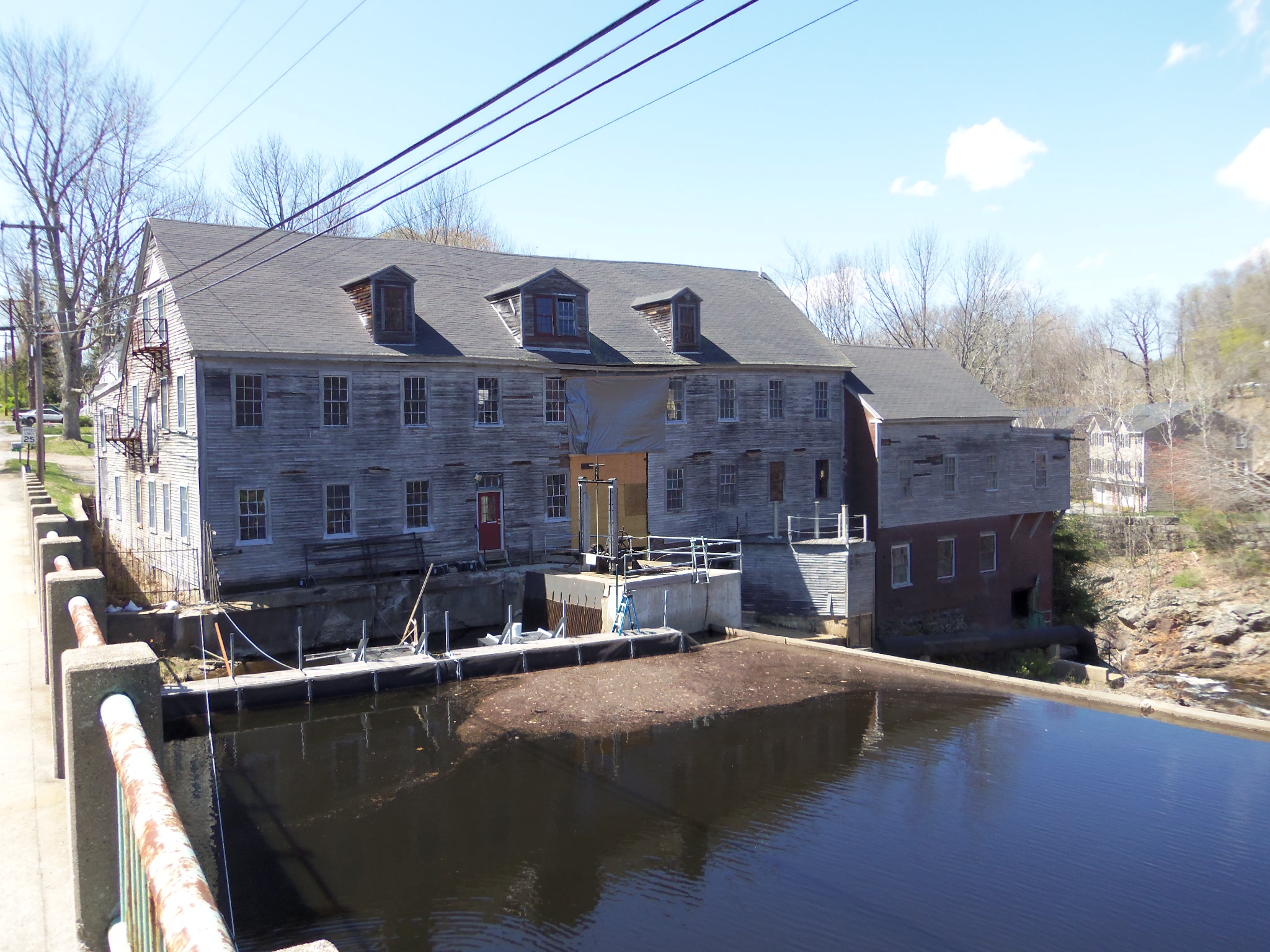
The short distance between New England’s mountains and its Atlantic coast means its rivers and streams drop in elevation rather quickly, and that has provided both powerful currents and many opportunities for power-generating dams. As a consequence, the region is peppered with old mills – usually brick but sometimes stone or even framed wood – that were once the industrial backbone of America.

Downtown Dover, for instance, is built around the Cocheco Falls, where the river plunges into the tidewater. The falls are topped with a dam, and the diverted water once powered a complex of textile mills that produced world-famous calico, among other woven products. The Amoskeag Mills in Manchester, meanwhile, were noted for their denim, which supplied Levi Strauss in his legendary San Francisco production. Nor was fabric the only product coming from the mills. Everything from precision tools to locomotives to shoes and socks and cigars was being shipped from the cities and towns along the waterways.

Over the years, many of these mills have fallen into disuse through a combination of newer technologies, cheaper competition from steam-powered Southern mills, and overseas production. But the legacy remains.

As I learn from my elder daughter while examining a glorious sampling of cloth she’s intending to turn into quilts or comforters, the designer Judie Rothermel has recreated some of the classic patterns found at the American Textile History Museum in Lowell, Massachusetts, and reproduced them in partnership with Marcus Fabrics.

The Cocheco Mills Collection, issued serially over several years, is one of the impressive results.

Let me say, some of the technical results are mesmerizing while the colors are deep and delicious.

How did we ever stop making this?

REGARDING A GRANDFATHER CLOCK

When I was growing up, “going to the farm” meant a trip to my grandmother’s sister and brother-in-law in the other corner of our county. One of my memories was of the grandfather clock that stood at the top of the stairs and Aunt Edna’s mentioning that it had been carried over the mountains in a Conestoga wagon “from the place where Conestoga wagons were made.”

As a history buff, I eventually realized that was Lancaster County, Pennsylvania, now famed for its Amish population. The plot thickens, as I explain at my genealogy blog, The Orphan George Chronicles.

Decades after the farm had been sold and I began working on the genealogy puzzle, I received a few photographs of the clock, and a few days ago I scanned them into my computer. You can’t see many of the details, but I remember the small moon and sun that would rotate in the clock face. A few years ago, back in Ohio, I was surprised by how short the clock itself is. We think of grandfather clocks as large, but this one is probably shoulder-high to me.

Most amazing, though, is the sweet ringing it issues in singing its quarterly rounds. Not a gonging sound at all, but more like the clinking of crystal stemware.

And to think, the clock itself had been rediscovered, hidden away on its side in a loft of one of the barns. Just goes to show, you never know quite what to expect when you go rooting around in an old barn now, do you?

SCN_0002

SCN_0001

SCN_0003

FROM ONCE UPON A TIME TO HAPPILY EVER AFTER

Continuing this month’s survey of Books Read, here are a few more entries:

  • Maria Tatar, ed.: The Annotated Brothers Grimm. As one who’s come to treasure the grittier sides of both Native American mythology and Biblical texts, I’ve long wondered about the earlier versions of the stories collected by the Grimm brothers and, as the notes to this volume also discuss, their French parallel Charles Perrault, especially with his Mother Goose. At last we’re getting glimpses into those unsanitized roots, in large part thanks to the work of Tatar and others. The introductory pages by her and A.S. Byatt make the volume worthwhile on their own, as they examine the fine line between folktales and mythology and recognize that these are really wonder tales, full of magic and harsh reality, a kaleidoscope of rapid presentation where fairies rarely have a role. The mentions of versions having Gretel as a trickster, Rampunzel as not realizing her weight gain is pregnancy, Little Red Riding Hood performing a seductive striptease, Snow White’s pricked finger blood as her menstruating or deflowering all add powerfully, as does the sense of polyphony in the overlapping voices. Although reading all of these close together can be a bit much, it does allow the patterns to emerge: sibling rivalries where the youngest and seemingly dumbest child is in reality blessed, and so on. As for the surrounding forest, where is it in the urban reality? The ghetto? The cellar under the apartment house? The subway?  Another volume I’ll be returning to frequently.
  • Philip Pullman: Fairy Tales From the Brothers Grimm. Reading Pullman second gives the astute reader a sense of what a translator can add or omit. As a famed writer himself, he admits to taking liberties at times, drawing on similar tales and the like. You can see the differences from the very outset, with “The Frog King, or Iron Heinrich,” which Tatar begins, “Once upon a time, when wishes still came true,” versus Pullman’s “In olden times, when wishing still worked …” His translation is often more direct and less tradition-bound, and often has a deft detail or insight that is simply brilliant.
  • Nicholson Baker: The Size of Thoughts, U and I, and A Box of Matches. Back in high school, hearing a teacher proclaim that all fiction is based on conflict, set a challenge for me: can a novel work without any essential conflict? Baker comes close here with his Box of Matches, set as daily reflections before sunrise one January, as he lights a fire in his fireplace (hence the matches) and drinks coffee — the closest he comes to conflict, in fact, may be the struggle of making coffee in the dark, a consequence of his decision to keep the lights off. Lovely meanderings through the minutia of daily living. U and I is his notorious paean to John Updike, full of deliberate misquotes that reflect the ways of time on the memory and wonderful confessions on the joys of reading and the trials of writing. (I’m happy to see I’m not the only writer who has a lifelong admiration for a great model, or at least an adult lifelong admiration.) The Size of Thoughts, meanwhile, is the perfect volume to end this month’s collection of readings. Each of its quite varied essays follows a topic through a wandering net based on thinking itself. Of special importance are his pieces on the loss of learning that occurred when university libraries junked their card catalogs and his 148-page investigation of the other meanings of “lumber” as they evolved in the antiquity of English poetry. As the second essay begins, “Each thought has a size, and most are about three feet tall, with the level of complexity of a lawnmower engine, or a cigarette lighter, or those tubes of toothpaste that, by mingling several hidden pastes and gels, create a pleasantly striped product.” If you’ve sensed something similar emerging through this month’s discussion, just remember, The Size of Thoughts mentions many, many fine books in passing. Just in case you’re ready to read more.

100_6973

FROM HISTORY MUSEUMS TO GRACE, ALONG WITH A FEW MEALS

Continuing this month’s survey of Books Read, here are a few more entries:

  • Joy Williams: The Quick & the Dead. This 2000 novel, a finalist for the Pulitzer Prize, is built around three essentially motherless preteen girls who are ultimately unsupportable as believable characters. I kept reading, wondering why, only to find the ending simply evaporate. She has her fans, but I’m not one of them.
  • Warren Leon and Roy Rosenzweig, eds: History Museums in the United States: A Critical Assessment. As someone with long familiarity with both natural history and art museums, I have also long visited American history museums without giving them much thought as a separate category until my wife mentioned the cabinet of curiosities concept, based on the trunks seafaring captains were expected to bring home for the enlightenment of their communities. Wonderful insights in these essays into the growth and critical limitations of theme-focused collections, living history villages, historic house sites, shrines, and so on. My favorite rips Disney, especially at EPCOT, to shreds.
  • Kate Chopin: The Awakening and Selected Short Fiction. Despite her glimpses into Deep South and Creole society in the late 1800s, Chopin’s portrayal of an infantile self-centered heroine, like Madame Bovary and Anna Karenina before her, drew little sympathy from me. Tedious.
  • Richard Russo: That Old Cape Magic. A lively, humorous story with a pair of very dysfunctional, professorial parents unfolding in the background of the protagonist’s own string of affairs and failing marriage. In the end, quite pointed, bitterly funny, and emotional moving. Quite different from Empire Falls.
  • Angelo M. Pellegrini: The Food-Lover’s Garden; The Unprejudiced Palate; Lean Years, Happy Years; and Vintage Pellegrini. More than a decade before Julia Child began to transform American cuisine, this Seattle-based English professor born in Italy launched his own arguments for a more delicious, healthier alternative to the dull meals of the era, on one hand, and the impossible directions for preparing pretentious international fare, on the other. For those who grew up thinking spaghetti came out of a can, as I did, Pellegrini’s texts are a reminder that even garlic, zucchini, and broccoli were exotic rarities, when they could be found at all. (As for cheese?) His emphasis remains stubbornly on fresh vegetables and fruit, the essential role of homegrown herbs, and the joys of wines made in one’s own cellar. I love the simplicity of many of his meals – a broth, salad, and bread as dinner, for instance. His stories along the way are delightful. I can see why he has long been one of my wife’s favorite food writers.
  • Anne Lamott: Grace (Eventually): Thoughts on Faith and Blue Shoes. Another of my wife’s favorites, Lamott’s confessions of faith are refreshingly both comic and startling. While the novel Blue Shoes sets out on that light-toned approach, about halfway through it takes on a dark realism that soon parallels Russo’s That Old Cape Magic, complete with the parents’ infidelities.  It’s hard to think of other authors who present children as masterfully as she does, or, for that matter, relations with a parent in mental decline. Her real-life religion admits the realities of adultery, even among believers, and of grace in unexpected encounters. The protagonist’s discoveries about her own father lead to some of the most heart-breaking pages one will encounter, and some of the most illuminating examples of selfless love. A knockout.

January3 086

FROM TRUE LEVELLERS TO WHITTIER, CALIFORNIA

Continuing this month’s survey of Books Read, here are a few more entries:

  • David Boulton: Gerrard Winstanley and the republic of heaven. This all-too-brief overview of the legendary leader of the True Levellers (Diggers) focuses on his four years of publication, 1648-52, which are coincidentally the early years of Quaker history for which we lack original writings. Boulton makes a compelling case for Winstanley’s early impact on the emerging Quaker movement, his subsequent divergence from it, and an eventual reunion. Tantalizing in its possible reconsideration of the origins of thought and practice in the resulting Society of Friends.
  • Dietrich Bonhoeffer: The Cost of Discipleship. An unrelenting, passionate argument first published in 1937 of Christian faith rooted in the Incarnated Word, and giving up all to follow the call of Christ. Seen through the ensuing events of the Nazi regime and World War II, the martyrdom becomes all too inevitable. From our own perches, however, a still startling set of demands emerges, one that often stands in contrast to the Light/Logos faith I see emerging from the same chapter of John.
  • Paul Buckley, ed.: Dear Friend: Letters & Essays of Elias Hicks. These pieces, taken from the last quarter-century of Hicks’ life and ministry, give us the clearest existing insights into his theological perspectives as they led into and through the controversies that now go by his name. To the surprise, no doubt, of many, his writings are thoroughly immersed in Scripture, citations that now demand footnotes, which Buckley provides. Perhaps the one nuance Hicks applies to the traditional Quaker understanding of the Light is his equating it with the Spirit of Truth as well as Reason. Still, he grounds both of these in personal spiritual experience, rather than outward teaching. A welcome addition to our understanding of the evolution of the Society of Friends, pro and con.
  • MFK Fisher: Among Friends. The acclaimed author of food classics grew up among the non-Quaker minority in the Orthodox (Gurneyite) enclave of Whittier, California. In this memoir of a childhood before and during the First World War, she repeatedly touches on the inconspicuous prejudices of the small-town Friends, as well as her own family’s quirky social (and asocial) reactions and adaptations. An insightful counterbalance to other volumes that have examined the matter of living “behind a protective hedge” and the ensuing Quaker cultures that emerged.

100_6970