JUST A ROLLING STONE

Lately, thanks in part to a great yard-sale find, I’ve been revisiting a lot of Bob Dylan and realizing how many phrases that pass through my head originate in his lyrics. Or at least the ones that also have a musical line. I came to him in late ’62 or early ’63 and was a loyal fan until he went electrified and left the activist and folk scenes. Count me among the contingent that felt betrayed.

OK, I’ve come to recognize and even admire a lot of significant material he wrote in the years since. The man could turn a phrase, for certain, even when he was drawing heavily from others.

The line, “Like a Rolling Stone,” had me wondering about its relationship to the naming of the band and the rock magazine, all three products of the ’60s. Did the song prompt the other two?

Turns out the band was formed in ’62; the song, ’65; and the magazine, then a tabloid newspaper, November 9, ’67. But, in another twist, the band took its name from Muddy Waters’ 1950 “Rollin’ Stone.”

As for the popular phrase, “A rolling stone gathers no moss,” the line points to John Heywood’s 1546 translation of the Roman-era Pubilius Syrus. So it’s been rolling around for some time.

~*~

Also from the ’60s was my discovery of the common Pennsylvania road sign, “Beware of Rolling Rock,” along with the brew. I suppose looking at the connection between those two would be like asking which came first, the chicken or the egg. Or even why the chicken crossed the road before or after.


FURROW

Like the American bison that dominated the prairie, the continuous ocean of tall grasses, which for so long spread from a corner of Ohio into Montana and Colorado, has been decimated. Homesteaders – seized by a fever to possess farmland of their own – sowed apprehension in their furrows. Inhabitants and land itself now lay open to chronic infection. After each harvest, the Breadbasket of the World, the Interior States of the American Soul, is left vacant, a stubble desert awaiting rebirth. Descendants of those who made this band agriculturally productive bear both its blessing, in economic output, and curse, as if no one can entirely escape the desperation that prompted settlement in the first place. In the recesses of the psyche, inheritors of these spaces must likewise sense themselves to be buffalo-people, and then fear they, too, may be heir to this fate. Pushed to the fringes, the intrinsic beauty and spiritual potential of the heartland are easily overlooked, both by the remnant population and the world’s policy-makers. Today’s farmers are mechanics, first and foremost. Cry, then, for harmony and healing – a proper reentry into Canaan, a taste of balm in manna. Look, ultimately, to the surviving bison and tall grasses with their underlying lavender shadings. Respect the faint drumming, growing louder.

A PROSPEROUS TURN

Demand for wool in the first three decades of the 19th century shaped the boom years of agriculture in New Hampshire, at least until the invention of the cotton gin allowed for a cheaper clothing alternative – a condition that was accompanied by a changing American workplace and economy.

The brief but prosperous boom financed many of the Granite State’s landmark large farmhouses and barns as well as the nearly ubiquitous stone fences that are still visible, some in the most unexpected remote forests.

Pay attention while driving along country roads, and you’ll often notice stretches where each house seems to be an evolution among the others. I suspect that what happened was they were all built by one craftsman carpenter and his crew – perhaps itinerants who would stay for a season of erecting a house before returning home – who were invited back in another year to build another, each one to customized specifications. The chimneys, for instance, reveal a progression away from the massive central fireplace of the Colonial era to the use of multiple chimneys after the Revolutionary War – something that has me thinking of how much firewood these houses must have consumed through a winter.

Kodak10 080

It’s possible, of course, that the carpenters and masons and others came to live in the neighborhood as well. But one thing I feel certain: the resident commercial farmers, faced with the demands of their flocks and fields, did not have the time or perhaps even skills to build houses like these.

Kodak10 084

Kodak10 073

Kodak10 075

Kodak10 079

Kodak10 087

Here are some of the fine examples found in a village along a ridge in the town of Deerfield, a neighborhood known as South Deerfield. There are more, I should mention, than I could capture in this outing. Meanwhile, I’d like to know more about the site of the popular Mack Tavern, with its fiddler’s throne to protect the player from the wild dancers.

NOTHING NOSTALGIC ABOUT IT

One thing I strive to avoid in my Hippie Trails series of novels in a sense of nostalgia. Admittedly, the music, especially, can bring back groovy feelings. (The close reader will notice how little of it I touch on directly, but rather I try to look at other facets of the experience.) And, yes, it is easy to get wistful with some of the memories – Woodstock, for example, while conveniently overlooking all of the physical discomfort, or for some of the lost social life and friendships – but there are good reasons we can’t and don’t go back. Our youth, obviously, has turned to aging, and our freedom turned to responsibilities, many of them ones we’ve chosen.

We need to emphasize that much was not happy. There was desperation, in fact.

The period and the movement were far from perfect, but we also had glimpses – epiphanies, for some – and their influence is far from completed.

If we wholesale deny the dreams and prophetic directions we experienced in that youthful outburst, we cut ourselves off from our higher nature – and both we and our largely society are impoverished as a consequence.

As I look at the array of problems facing America and the world today, I sense that the more serious currents under the surface of the hippie outbreak may finally provide some much needed direction, if we can be honest with ourselves and our history.

That’s definitely not nostalgia, no matter the anthems and hymns in the music of the era.

~*~

To learn more about my novels, go to my page at Smashwords.com.

BREAKING THE STEREOTYPES

She never did drugs, and she married a soldier. She was a faithful mother and wife. She doesn’t even know the smell of marijuana, and she talks to her legislators rather than standing in a demonstration.

But in my book, she’s still a hippie. There’s no question where she falls on the granola-heads to fundamentalist spectrum.

I’d give you my reasons she’s a hippie, as far as I’m concerned. But I bet you know others who are something like her. So I’d like to hear some of the qualities you perceived that help us break the stereotypes, at least when thinking of hippie.

YEARBOOK CONFESSIONS

There was the night when my daughters – at the time, one in college, the other beginning high school – had been chattering about something that prompted me to get out the yearbooks. Show them what things had been like back then, when Bob Dylan was just going electrified, Vietnam was ramping up, and hippies, well, were still more than a year away in the future. (My wife insists this came up on my birthday.)

Their reactions weren’t quite what I expected. Yes, there was the giggling, especially over the girls’ flip-style hair and A-line dresses. And their dismissal of some beauties I’d lusted after, as well as their agreement on others. Initially, they couldn’t find me in the pictures, and then, when they did, they started laughing: “You’re everywhere! Is there a group where you weren’t an officer? Hey, he even has some poetry here!” As well as my wife’s, “My, you were cute back then.” Which pains, in a way: I’m not now? Of course, I was the skinny, clueless intellectual back then – and generally unloved. To my further surprise, my girls declared that the boys in my high school class were generally pretty attractive – “They look put together,” as they put it – compared to those today. Maybe it was all the ties and shorn heads. I thought we looked pretty dorky. Still do, looking back.

A bit later, one night at the office, as one of my coworkers was complaining to another about the latest machinations by her son’s teacher, and his high school’s draconian response, I remembered that I’d been having a fleeting sense that this would have been the year for my 40th reunion – that is, if anyone was still in charge. With all of my moves about the country, though, they’d long since lost track of me. I’d never made any of the reunions anyway, either being unemployed at the time (and thus short of cash), unable to get the vacation time off or budget for the air fare, or even learning of the last one a couple of months after it happened. Lately, though, there have been some tentative Web searches for individuals, which did lead to a posting of some items from The Hilltopper, from when I was editor-in-chief. So now, around midnight, I decided to Google, just in case, a reunion notice might be posted, somewhere. And lo and behold, there it was. The Victory Bell, and then photos from their 35th anniversary gathering.

The Web site itself wasn’t in the best shape. A bit of nosing about did turn up a notice that there would, indeed, be a 40th observance, though because “we’re especially short of funds,” no mailings would be sent out. (As if they had my address.) But do I want to spend an evening in an American Legion hall with a DJ and people trying to make happy? The idea gives me the creeps. I’m a country dance kind of guy, or would at least prefer a setting where conversation would be facilitated, rather than masked.

Still, something in my awareness was pierced, and the emotions could not be restrained. For 40 years, from my perspective, at least, these classmates have been frozen in time. Their supple flesh and worldly inexperience, preserved intact. Jarring, then, comes the notice on the site, informing of the death of one who had been incredibly desirable, with side-by-side photos of her at 18 and then aged. As are notices of a cluster of others, now deceased. I click again, to photos from the 35th reunion, and am appalled. I recognize no one. They’re loud, badly dressed, and have not aged well. Finally, I find a few photos with the people identified, and then admit some are actually in pretty good shape. Another icon leads to a listing that includes married surnames, and the trail of these classmates is no longer lost from my sight. Further Web searches, for instance, present one I’d idealized who is now spouting political drivel, while another – once the epitome of cool sexuality and now apparently divorced in the past five years – is teaching knitting or quilting in a fundamentalist church. I return to the class Web site. Wonder about the Adonis club males, and just how did so many become so grotesque? As for the dress, strange tans, paunches, and wrinkles, the gray or dyed hair, or lack thereof: this is what I thought I wanted to return to, after college. Here, I must confront the reality that some – essentially the reunion crowd – were able to stay in town, largely on the one side of town, at that – while some others have been scattered to the winds. After all, I am among those “location unknown.”

How could I possibly begin to relate to them all of the twists in my own life – the ashram experience, the orchards and mountains of the Pacific Northwest, the St. Helens eruption, my Quaker progression and return east, publication of experimental novels and countless poems, the divorce and finally coming to have children when many of them are enjoying grandchildren, to say nothing of having a wife who’s nearly the age of their own children?

I looked at the posted photos and wondered, who are all these old people? Wondered, too, how I ever escaped that circle. (Oh, vanity!)


BUSINESS AT HAND: IN THE MINUTES

Much in our Quaker practice seems quaint, none more than our practice of minuting. It’s not the same as taking minutes of a company board meeting or city council session, but has a dimension all its own. Originating in the recording of persecutions in the initial decades of the Quaker movement, and in the subsequent petitions for redress and justice, our earliest minutes tell of “sufferings for Truth’s sake” and soon lead into the efforts of determining just what it means to live as a people of conscience.

Sometimes today we find the practice burdensome or unnecessary. Friends who follow the Old Ways in this matter will draft and read aloud the record on that part of the agenda, moving ahead only after that minute has been revised to satisfaction and approved. It’s slow and tedious, but it does focus the deliberations.

Here, the concept of clerking – especially for the recording clerk – has a meaning related to “clerk of court,” where the official records decisions from the bench above. In our case, Friends traditionally feel the high judge as Christ, and the meeting gathered as witnesses who would voice the sense of the resolution. I suppose we might see Friends attending our business sessions as a jury, then. If it were only as simple as guilty or not guilty!

Revisiting historic minutes, as I’ve done as a genealogist in the archives at Swarthmore and Guilford colleges, opens an appreciation for the practice as an art form. Perhaps no other records in America before the 1850 Census offer as much genealogical information as ours do. Even so, one discovers how faulty even the best efforts become. A individual simply fades from sight, a family moving away is recorded simply as “Robert and Sarah and children,” rather than naming them individually, as another clerk might have done, or the records might be lost to a house fire, as Centre, North Carolina’s, were, or simply lost altogether, as the first half-century of Dover’s were or West Epping’s were in our own lifetime. You might see an erasure, from first cousin to second, or a misspelling – and suddenly, you find yourself sitting with that clerk, somewhere in our history. This becomes something other than quaint, but personal engagement.

QUEEN SLIPPER CITY

The train station, perched at the side of downtown, includes Amtrak's Downeaster service to North Station in Boston, in one direction, and Maine in the other. (That run stops in Dover, New Hampshire.) There's also MBTA's Purple Line into Boston.
The train station, perched at the side of downtown Haverhill, Massachusetts, includes Amtrak’s Downeaster service to North Station in Boston, in one direction, and Maine in the other. (That run stops in Dover, New Hampshire.) There’s also MBTA’s Purple Line into Boston.

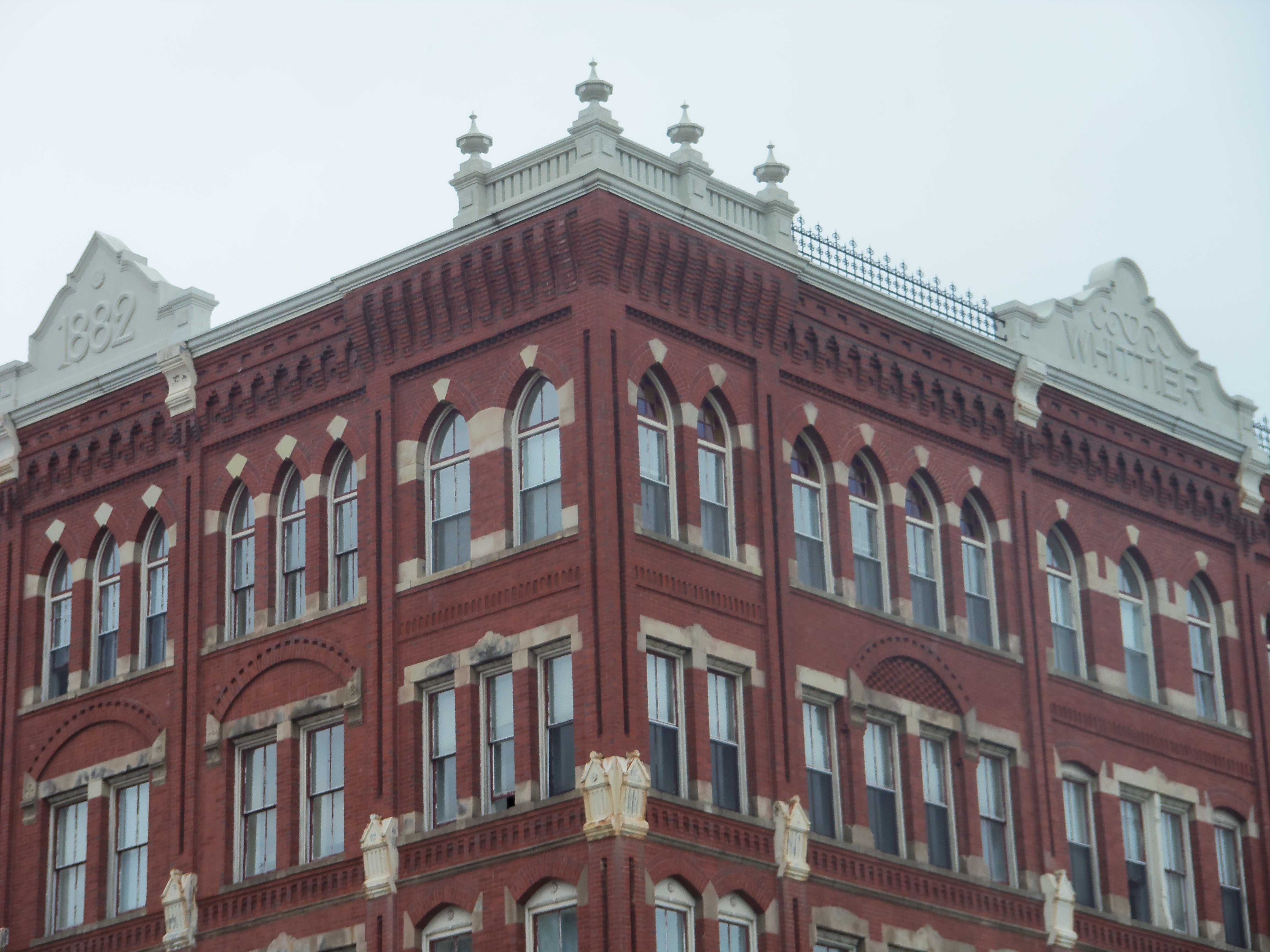
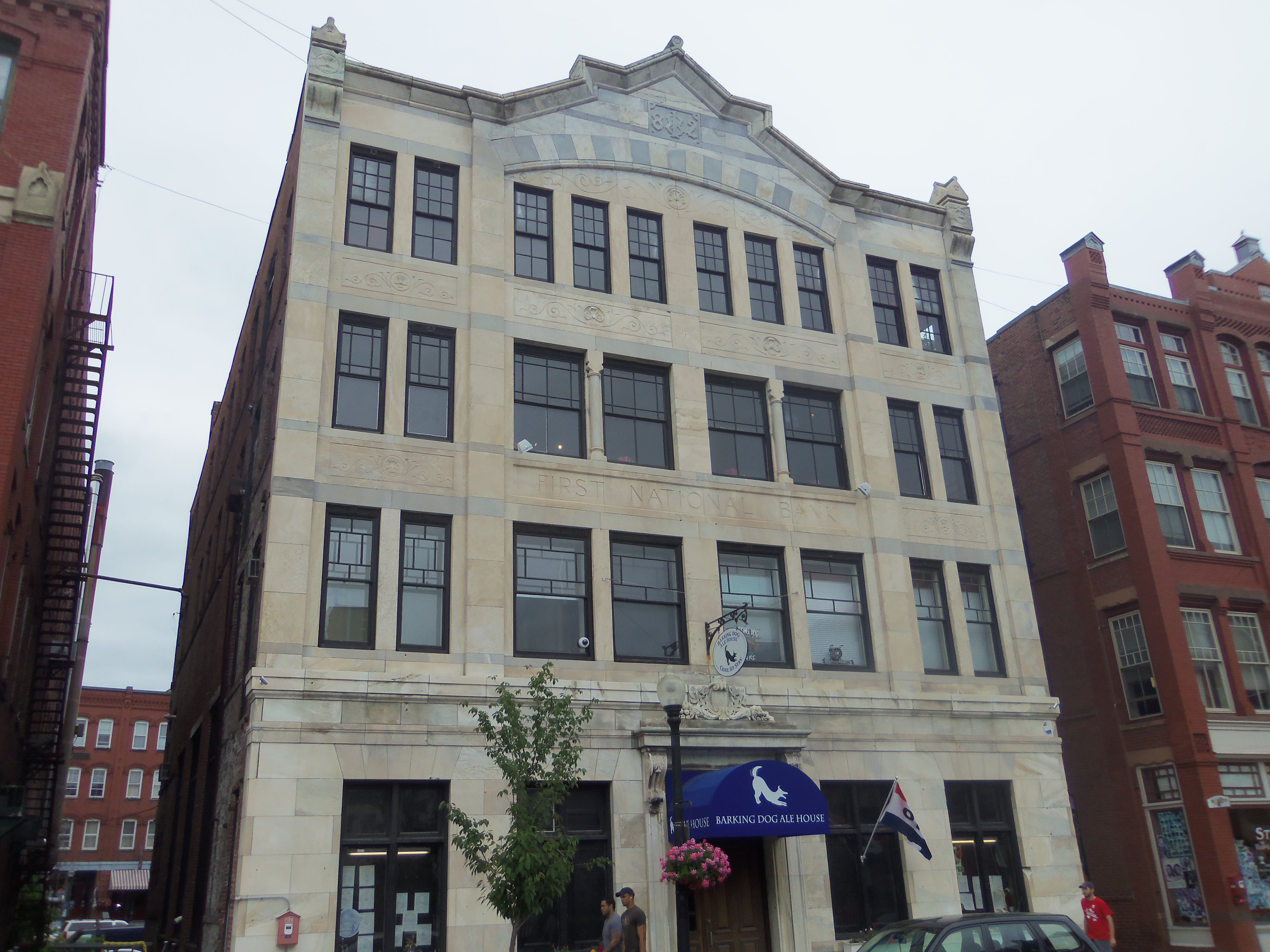
New England’s waterways are dotted with historic mill towns. The Merrimack River alone could boast of the water-powered industrial centers of Manchester and Nashua in New Hampshire as well as Lowell, Lawrence, Haverhill, and Amesbury downstream in Massachusetts, along with Newburyport and its harbor.

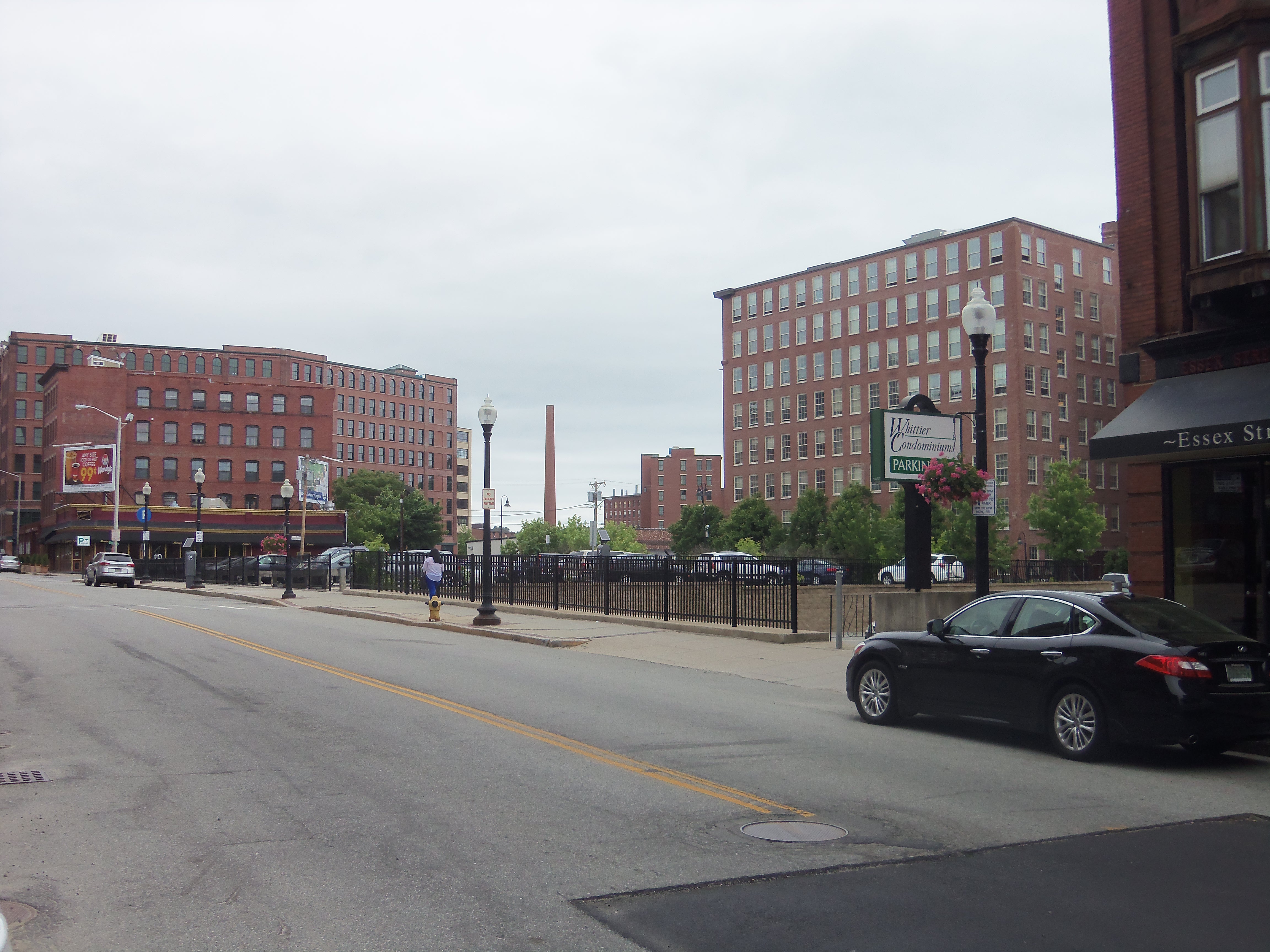
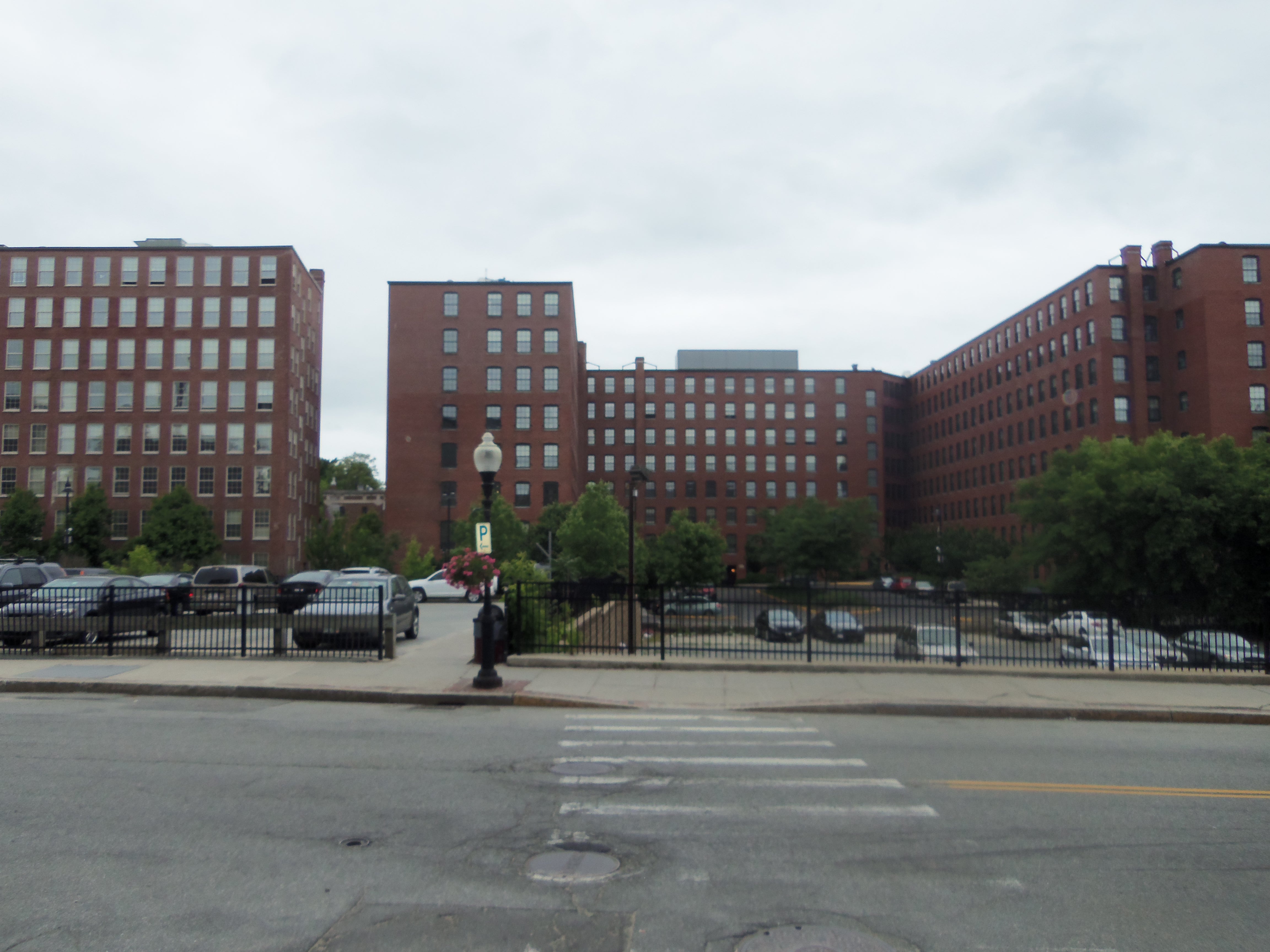
Some of the warren of old mills remains, including buildings converted to offices and housing.
Some of Haverhill’s warren of old mills remains, including buildings converted to offices and housing.
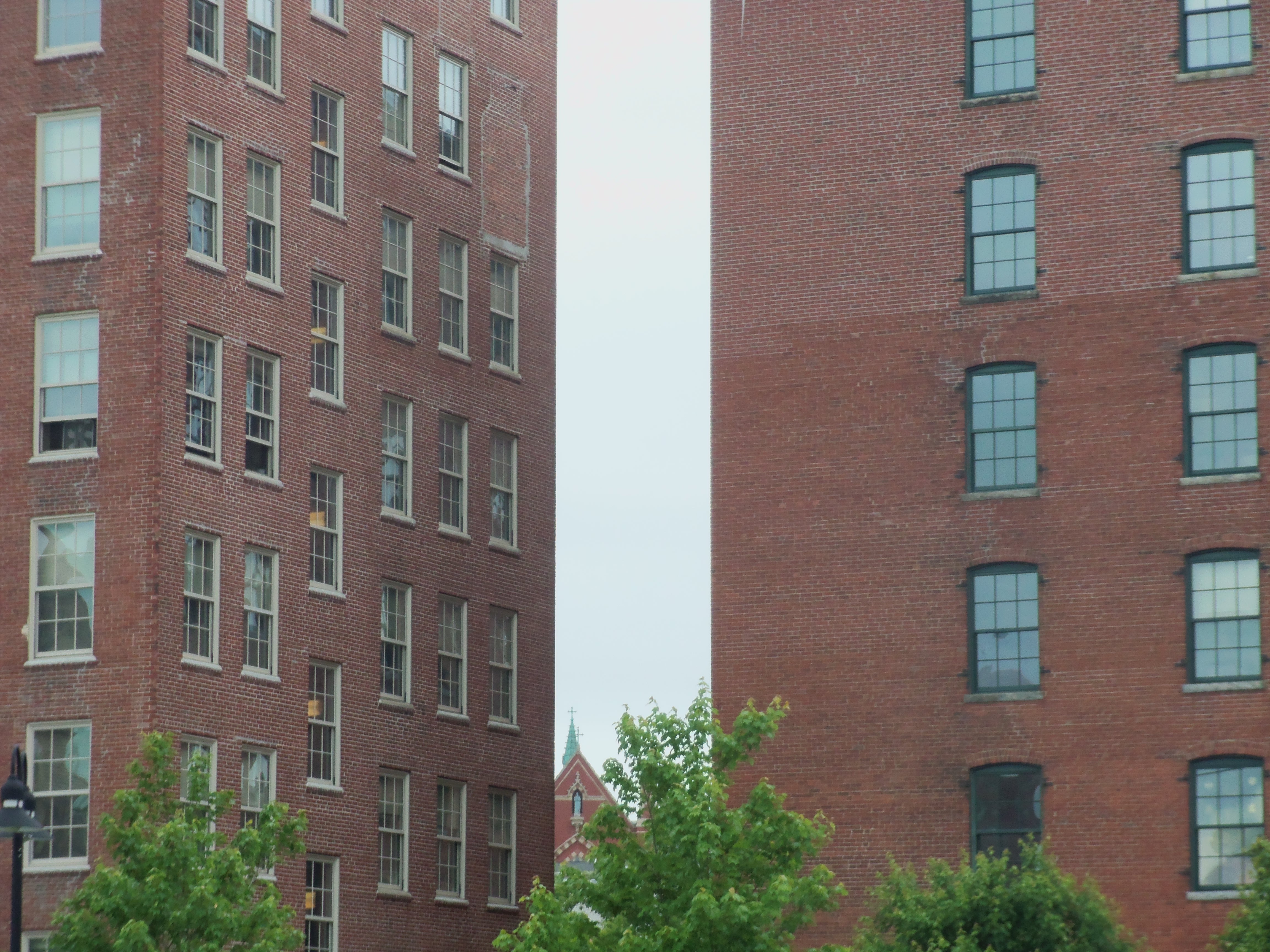
Catch the view of the distant church in the gap.
Much has also been razed, often for parking lots.
Here's a bit of scale.
Here’s a bit of scale.

While textiles were the focus of much of New England’s mill output, the power was applied to other products as well. Haverhill, for instance, emerged as a center of shoemaking, by 1913 producing one of every 10 pairs in America and earning it a whimsical nickname of Queen Slipper City. Its earlier commerce rested on woolen mills, tanneries, shipping, and shipbuilding.

Downtown details.
Downtown details.
Still impressive.
Still impressive.
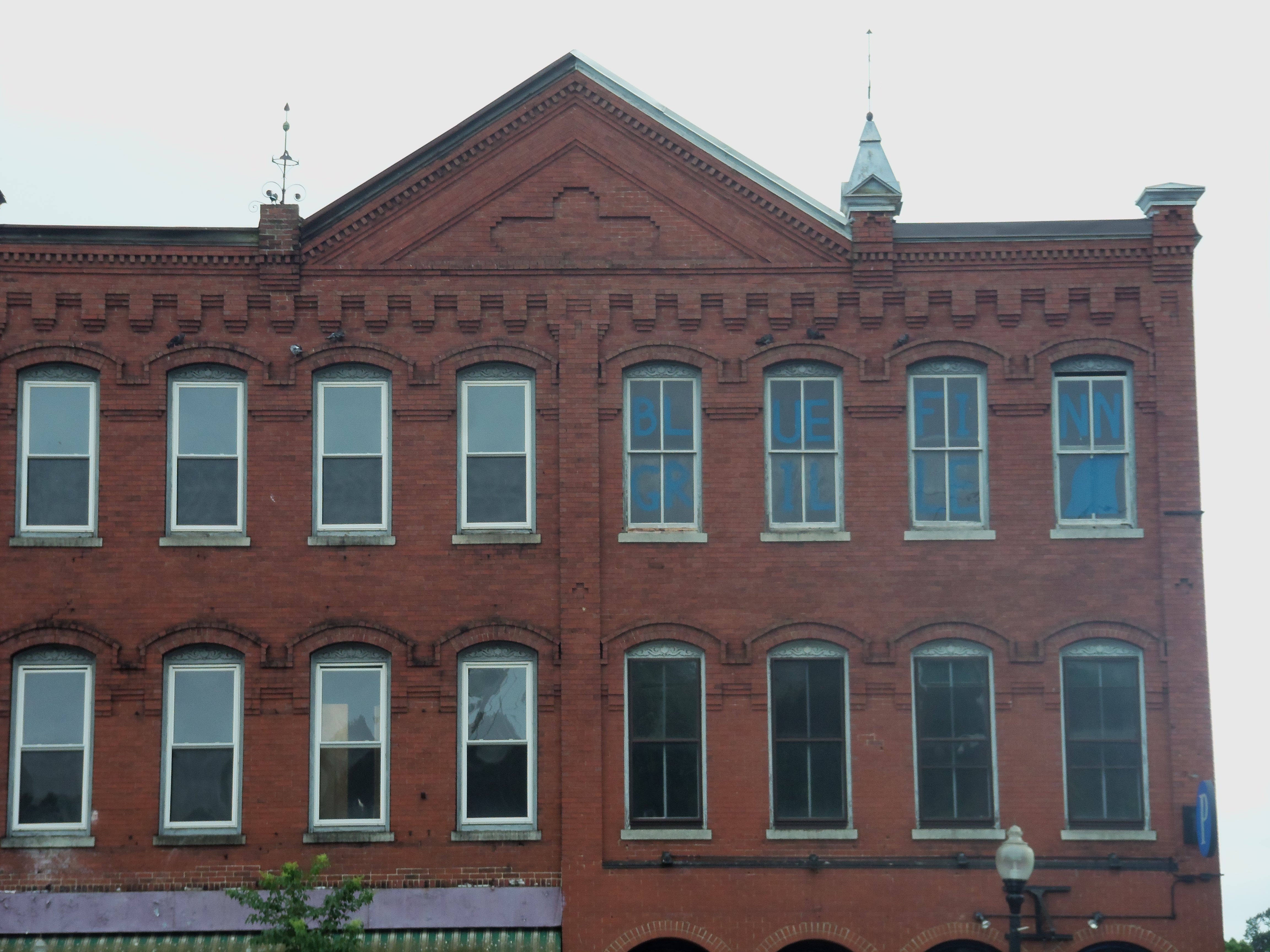
In those days, every building could be a "block."
In those days, every building could be a “block.”
Facing the train station, a reflection of earlier prosperity.
Down the street, around the corner.
Not everything was brick.

Like many of these once industrial centers, the city has been struggling to adapt to new directions and refit its legacy of old structures.

By the way, in Yankee style, it’s pronounced HAY-vril and is today a city of 60,000. But the river still runs through it.

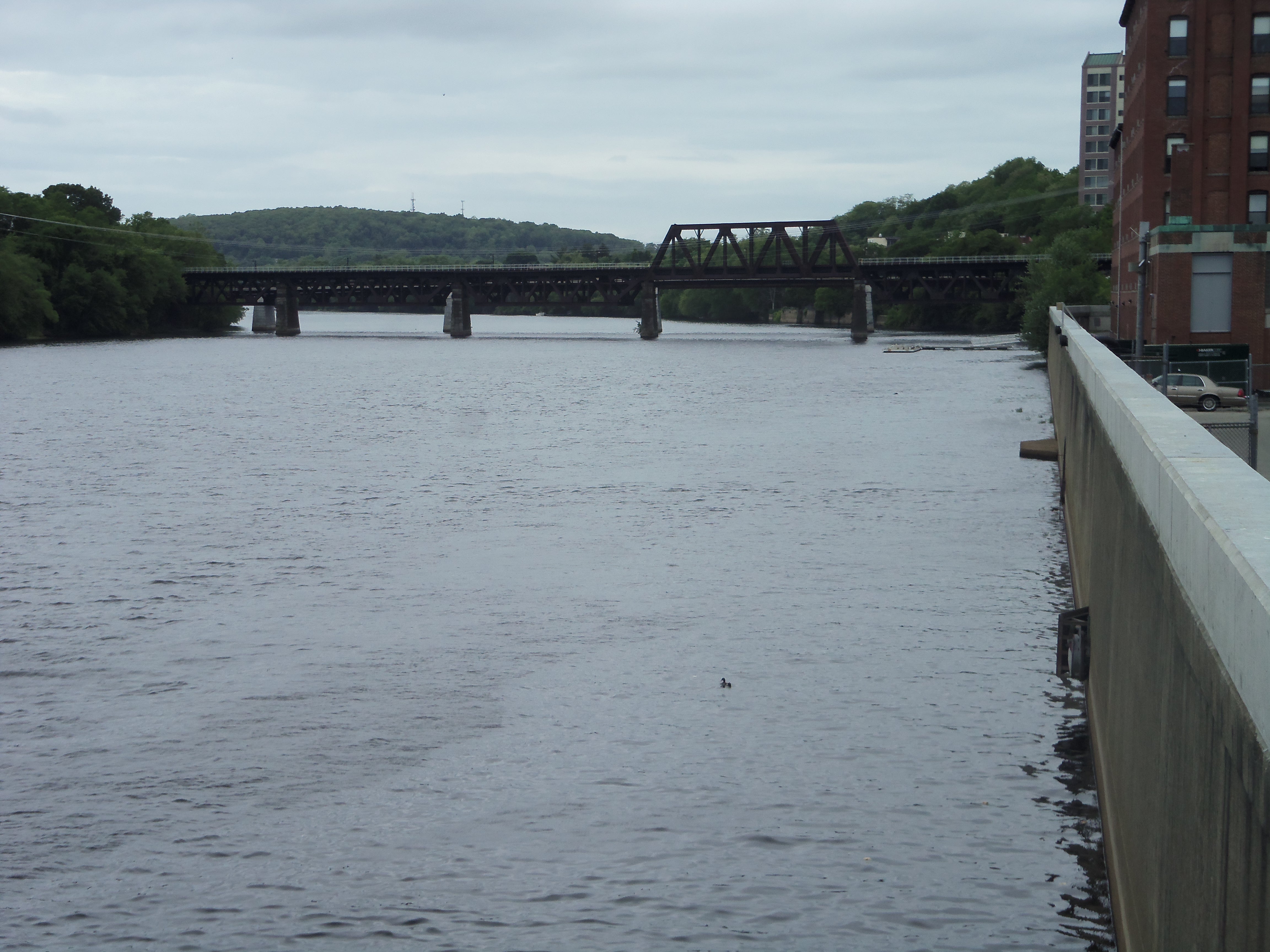
The river flows toward the Atlantic.
The river flows toward the Atlantic. The tides fluctuate widely here twice a day.
The railroad crosses from downtown and then follows the river upstream to Lawrence. It's a lovely ride.
The railroad crosses from downtown and then follows the river upstream to Lawrence. It’s a lovely ride.


CONTINUING SHADOWS OF THE HIPPIE EXPERIENCE

Look at a lot of the bikers or some of today’s teens and you can see they’re carrying some of the hippie legacy. The long hair, especially, and the desire to be as free as Gypsies. But something there doesn’t quite fit, either.

Too much military, for the bikers – the peace vibe ain’t there.

As for the teens, I don’t see the playful side that accompanied the late ’60s and early ’70s, along with all the desperation. Even the drug use seems different, maybe purely numbing rather than mind-expanding.

I’ve already mentioned some of the hippie streams I see continuing. But I haven’t said much about the darker side. I’m open for some suggestions and comments here. Feel free to weigh in. Anybody still picking up hitchhikers, for starters?

VISUALS FROM THE HIPPIE ERA

Nobody, I bet, can think of the hippie era without thinking of wild color. Just try listening to the music without it. Or reading my Hippie Trails novels.

There’s the clothing, of course, as well as those incredible hand-lettered Fillmore concert posters, the Peter Max illustrations, and the record album covers. The old Rolling Stone weekly newspaper, from the years it was based in San Francisco. Maybe some hand-thrown pottery, macrame, or a paisley pattern or big brass belt buckle.

So what comes to your mind’s eye when someone says hippie?

What would you put on the list?