Confessions with a few natural observations in the background

1

My own world was fracturing
when glacier-clad Mount Saint Helens erupted
and sent me in exile
to here
at the easternmost fringe of the nation
forty years later

 2

As a friend said
the other day
of piloting a warship
and noting

no seals
on their familiar outcropping

indicating
a shark
on the prowl in the waters

 3

In my case
a starched white-shirted shark
had invaded

In one family for a century

Fishing for the purchase document by the Bucks led to Fisher A. Buck, who bought our Cape from Lucy M. Hooper, Anne Dodge, and Mary Roberts in July 1875, beginning a century of family ownership, the longest span in the property’s history.

Who were the three women? They lived in Boston and Brooklyn, not Eastport. And they weren’t Shackfords, as far as I could tell.

The Bucks, on the other hand, saw many changes in the place.

Sometime after urban mail delivery was established during the Civil War, the stylish front entry, with its vertical mail slot and side panel windows, was added, followed at some point by the downstairs two-over-one sash windows, perhaps larger than the originals. (When we replace them, do note, there was significant rotting.)

The house narrowly averted destruction when the 1886 downtown fire that started in a cannery just below our house and continued northward along the waterfront, destroying 160 homes plus stores and wharves. The rafters in our house were intensely charred, though. The Bucks would have also installed the electrical knob-and-tube wiring, along with indoor plumbing and the small bathroom.

The two large ells shown on the 1855 and 1879 maps were removed, for whatever reasons, eliminating the small courtyard on the back of the house. We can speculate about their uses, a horse shed in one and a kitchen perhaps in the other. Or perhaps one was a cabin that first sheltered the Shackfords while the deep cellar was being dug for the bigger main house. As for a woodshed? Why not?

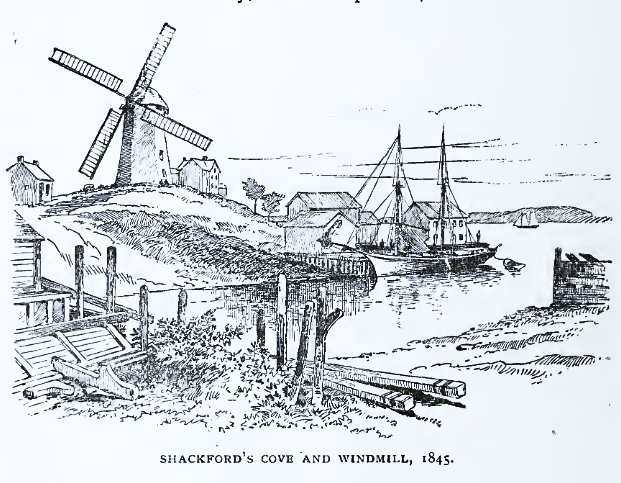
Over the Bucks’ time, portions of the foundation were replaced or upgraded, and a mudroom was added, slightly smaller than the ell it replaced. The two dormers may have also been added — they’re not obvious in the 1879 map of Eastport though they may be the two white dots and there are none in an 1847 sketch of the windmill where the house appears in the background. (Windmill? We’ll get to that later.)

Significantly, there was at least one chimney fire and perhaps one or two additional house fires, as well as the downtown fire of 1886 that charred the rafters.

Quite simply, it was a different house when it left the family than when it had entered it.

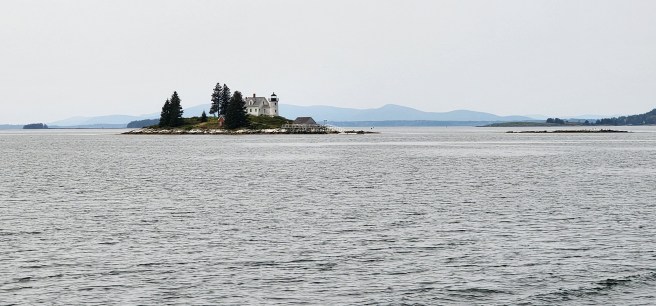
Pumpkin Isle light

marking entry to Eggemoggin Reach
below Castine

the free lighthouse guide I brought along
2013 edition I see now
newsprint
has no mention of Saddleback Ledge light
not to be confused with Saddleback Island
other than a listing
no photo or description
nor does it list Eastport as a harbor
nor Lubec
though Calais somehow counts

buoys: green have flat tops
red, coneheads

Which Buck stopped here?

The Buck family had its own prominence.

Several branches of the family originating in Haverhill, Massachusetts, arrived early on in Eastport.

The most celebrated and traceable line descends from Revolutionary War Colonel Jonathan Buck (1719-1795), who came to Maine and gave the Penobscot Bay town of Bucksport its name. He is best known through a questionable story of a witch he supposedly sentenced who then cursed him at her execution.

His son, Captain Ebenezer Buck (1752-1824), born in Haverhill, built the first framed house in Bucksport, but because he was captain of the local militia, the British burned it during the Revolutionary War.

So much for broader historical importance.

Ebenezer’s son Jonathan (1796-1843) brought the line to Eastport. He was a member of the Eastport Light Infantry in 1818 during the War of 1812, as was a John Buck.

Beyond that, Jonathan’s “business life was passed at Eastport, where as a merchant, he was associated with a Mr. Pillsbury, of Portland, Maine,” as one account noted, while the Eastport Sentinel in October 1839 reported,

“Died, in this town, on Wednesday last, Jonathan Buck, Esq., aged forty-three years. Mr. Buck belonged to that class of men who may well be called the creators of the wealth of a community. To an untiring energy, which enabled him to accomplish more than most men, he added an enterprise, energy, and intellect well fitted to direct the exertions of others. In every relation of life, he will be missed and lamented. To his family the loss is irreparable. Those whose labor he has for years directed will miss their guide. The community loses one of its leading men and little at this time can it bear the loss. He rests from a life of severe labor, and when such a man dies, we feel that a part of society has gone.”

The account was signed by Seth B. Mitchell, editor.

Another line in the Passamaquoddy area came through Captain Eliphalet Buck. The 1820 Census for Eastport includes an Eliphalet Buck, who wed Mehitable Vose in 1818 in Robbinston, Maine, and drowned in 1836.

None of this, though, pointed toward our house.

Only later, after learning that Fisher Ames Buck had once owned our house, could I sense a different route going back to Jacob Buck, half-brother of the Bucksport founder. Jacob’s wife was Hannah Eames, a surname that evolved into Ames. They had six sons, four of their fates unknown, as far as I can tell.

That line led through Canada and the Loyalists who left the United States at the end of the Revolutionary War. You probably weren’t taught about them in your American history classes, but they were a significant factor around here, as I’ve learned in this project.

On the perils of a veto by a small minority

… they have reported a plan which … may be carried into effect by nine states only. … The forbearance can only have proceeded from an irresistible conviction of the absurdity of subjecting the fate of 12 States, to the perverseness or corruption of a thirteenth; from the example of inflexible opposition given by a majority of 1-60th of America, to a measure approved and called for by the voice of twelve States comprising 59-60ths of the people …

(Rhode Island had refused to send delegates to the Federal Convention.)

James Madison in Federalist No. 40

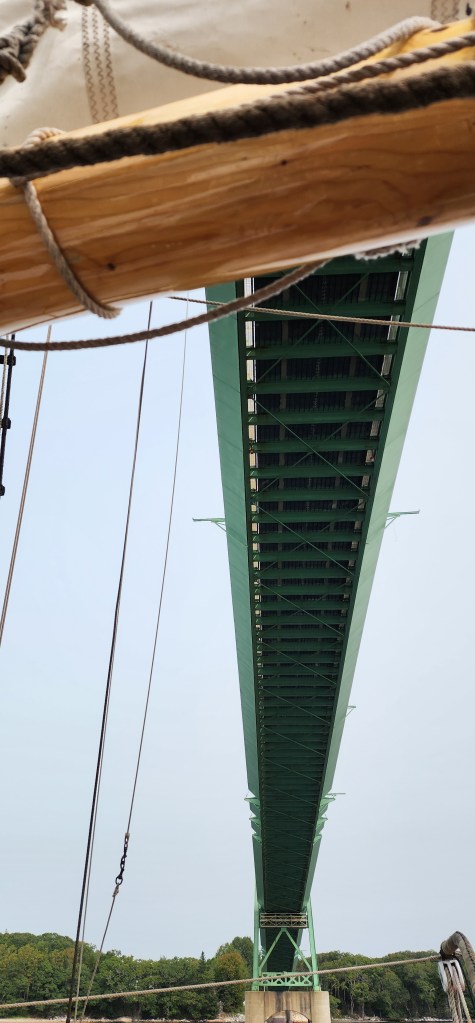
We clear the bridge by a foot and a half, if she’s read the charts right

Eggemoggin Reach
the Deer Isle bridge ahead
we’ll barely clear
six inches or sixty feet, what’s the difference?
other than a margin of error

the electronic gizmo’s
soundings in feet
at mean lower low water

I got to steer today
a feel of command
aiming for the arch of the bridge

Taking forever to get to the span
Deer Isle Bridge, as seen by vehicular traffic
Eggemoggen Reach Bridge from the water

a fixed bridge meaning
it doesn’t draw open
one more detail on the chart
(see Note B)
which I can’t find anywhere
until it’s pointed out in the margin,
same color type as the notice

we’re pushed by Greyhound
the inboard yawl

the motor behind me as a drone note
humming above lapping water

people bundled up this morning muted sun water depth 64
just gone to 72

Eggemoggen Reach broader
than Friar’s Road
where I live

A change of direction in the search

Working the line of our old house downward quickly led to a tangle. You’ve been following what I uncovered at the Washington County courthouse, but at this point, an earlier reference was not recorded in the transaction at hand. Zip, zero, nada. Without that, I was stuck at 1975, well within my own lifetime, not exactly historic in my viewpoint.

The sale to the Greenlaws, according to the record, involved Oscar L. Whalen, executor for estate of Arline F. Vaughn, of New York, and someone named Rose Lee. But there was no Book and Page mention to lead me to the next entry.

The best I could do was to try working from the earliest residents and hope to build a line to 1975.

Since the 1855 map labeled our house “Shackford Est,” looking at the Shackford family made sense. Maybe Arlene was one of them.

Revisiting the Tides Institute and Museum of Art’s online survey of the homes of Eastport, I found that they had added a notation to their photo of our house. They quoted the weekly Eastport Sentinel account of U.S. Navy Commander Albert Buck returning home after World War II. Home, of course, is the one where we’re now living.

Buck? That gave me another family to start investigating, especially since they were living across the street in the 1855 map.