I’ve engaged much of our world from a daily newspaper perspective

Let me express my own everlasting gratitude for Glenn Thompson and his eye for talent, in my case after my letter to the editor and then his offer of an internship, later followed by a full summer. In a seemingly casual interview, he urged me to keep a personal journal, which I actually have. And then came the job offer. Without him (and so many others), my life would have taken a different direction. Gee, indirectly he even led to my first lover. (Look for Mitch in Daffodil Uprising, who’d been a copy boy I met thanks to Glenn’s support. Mitch was the catalyst to the crucial introduction. That dimension, in itself, could be a novel.)

Glenn was the editor-in-chief of the morning newspaper in Dayton, Ohio, and in his own way, a visionary. Behind the scenes, he even brought together the first university I attended, Wright State. And also, through him, I became a professional journalist, even while still in college. Another long story.

The paperback cover …

And he asked questions no one had prodded me with before. How would I change the world? What issues could I raise and address? At first, I was speechless. We were so green, and within a year, everything would look different. The biggest item on the agenda was the Establishment, not even its war in ‘Nam. Civil rights issues were a distant second.

The next summer I was a hundred miles up the road from Woodstock, working for a publisher who totally ignored me and editors who kept their heads down. But a new direction was taking shape for me.

Alas, as I’m also seeing, mine are steps youth today cannot follow. The pathways simply no longer exist, to the larger society’s impoverishment.

As I describe in my novel Hometown News, American journalism has long been based on a precarious business model. News itself is a byproduct of trying to attract customers for advertisers, and many publishers considered news gathering mostly as a costly nuisance. Successful newspapers were defined mostly by their obscene profits, and the pay levels for reporters and editors were often at the bottom of pay scales for professionals. As a priest reminded me before my first marriage, we might as well have been bound by vows of poverty. Oh, yes, and some of the highest quality papers – the kind I aspired to – were fighting for their very survival. We can now add to the toll of the role of the Internet.

So it’s all in flux now.
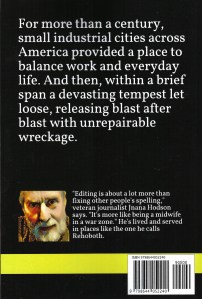
… and the back cover.

Still, newspapers show up in the majority of my novels, though in Nearly Canaan the field turned from journalism into non-profit organizations where the long, odd hours, public service, and stress nevertheless remained.

As I look back on my own years of being on the management track in a shrinking business, I see how I started out a hot-shot who thought the New York Herald Tribune in its last years was the best newspaper ever – led by an editor who later admitted in a letter to me he seemed to have become a specialist in trying to recover dying papers. Even then, I would have loved to have worked for him.

Despite my own honors, I had some crucial near misses. For one, I wound up in the final 24 for a dozen summer internships at the Washington Post but failed to make the final cut. The next summer, the Wall Street Journal was laying off staff rather than hiring, so their interest evaporated. Ten years later, something similar happened with timing for a high-level spot at the Detroit Free Press. And so my career veered away from the big cities where I had dreamed of living and from the big time, maybe for the best for me personally and ultimately professionally.

Somehow, this also has me thinking back to the lost hippie wannabes at the corner of Third and Main in Dayton during the summer of ’68. Theirs was a story I had hoped to write, but I couldn’t ask the right questions, I was too green myself. But, more honestly, maybe I just wasn’t cold-hearted enough to cut through to the real hurt and relate it without concern for the consequences.

Why I keep returning to counterculture particulars

I wish there were a better label than “hippie” to apply to the counterculture explosion that swept the world in the late ’60s and early ’70s. Contrary to popular assumptions, there was no standard-issue hippie, male or female. Not everyone did pot or ventured into acid and beyond, nor did everyone participate in a protest march or have long hair or have sex every night or at least on the weekend. We all came in various degrees of separation from general society yet, somehow, we also recognized a kinship with each other.

The paperback cover …

“Are you sure you were a hippie,” my wife sometimes asks. So what if I didn’t like rock? Many of my friends had been at Woodstock just down the highway from the milieu I describe in Pit-a-Pat High Jinks. No, we didn’t recite a credo, you dig what I mean?

The only other flash in history I can see similar to this was the mid-1600s in England, with its World Turned Upside Down before the restoration of the monarchy – stresses that would fester until the American Revolution a century later. What we shared was a vision of a more just, equal, and caring society. We didn’t have standard-issue, card-carrying members. Alas, we didn’t have elders or cohesive discipline, either. And the breakdown that followed can’t be blamed entirely on a youth movement crossing over into the dreaded age 30. (Oh, how I’d love to be back there, if only I wouldn’t have to figure out how to survive in the current economy.)

Tom Wolfe, author of “The Electric Kool-Aid Acid Test,” pointedly asked why there wasn’t the big hippie novel, overlooking a few notable entries like Gurney Norman’s “Divine Right’s Trip.” The problem, as I see it, is that the scope of the events was too big and too fuzzy to be encapsulated in a single volume. You had the activist side, from civil rights and draft resistance to pacifism, feminism, and the environment, for starters. Add to that sexual revolution. And then drug use, abuse, and visions, as well as new spiritual teachings and practices. All before we even get to the music and its scene. How could you possibly wrap all of that, plus more, into a single volume?

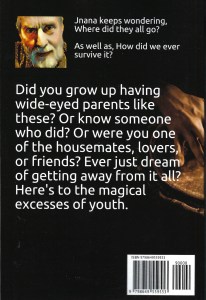
… and the back cover.

Believe me, I’ve tried with my own Daffodil Uprising and its companion “Pit-a-Pat High Jinks.” Hate to admit there’s so much more that could be added to the, uh, pot. Make that “pan.”

By the way, I think there are worthy nominations in each of the subcategories I’ve just mentioned. I’d love to hear more.

Frankly, I think we, as a nation, have been in a state of denial about the era, with its tension between the war in ‘Nam and the Establishment supporting it, on one side, and the opposition on multiple grounds, on the other. Those rifts in the soul of the nation have never been adequately examined and addressed from either side, much less healed. We could start with the MIA-POW myth, for one, or the ways we might have failed to answer our kids’ questions about pot use, for another. They are definitely exploding in our face now.

Meanwhile, Cassia, in What’s Left, has come along to try to make her own way out of the debris.

And so I humbly or brashly offer my own novels for discussion.

Care to share in my field notes from a lifetime’s zigzag trip?

Writing has been a means for me to investigate the question, “Who am I,” and of recollecting fragments, especially those that might eventually coalesce into a larger perspective. Unlike many adults, I have few vivid childhood memories, but what I am piecing together is often troubling. I grew up in Ohio in a mainstream Protestant tradition, became an Eagle scout, loved chemistry, hiked and camped, that sort of thing. I can blame becoming a hippie on my first lover, and thank her, too, for pointing my life in an unanticipated direction even after she flew ever so far away.

In the years since, I’ve followed a zigzag journey that’s been rich in many ways excepting money. Let’s just say it’s been off-beat.

Now retired from a career in daily newspaper journalism, I’ve married for the second time, live in a historic mill town in the seacoast region of New Hampshire, and am an active Quaker. It’s a full plate. What I didn’t expect was how much of my own “contemporary” fiction is now history – so much has changed so quickly in my own lifetime.

It’s hardly the end of the story, though. Not if we can help it.


Manic Mitch is also lurking from the past

In my novel What’s Left, a seminal figure in her father’s past is Mitch, who introduced him to her aunt Nita as well as Nita’s roommate Diz and then, let’s just say hippie highs.

It’s possible Nita and Cassia’s father never would have met on such a large campus without having manic Mitch in the story. It would be a tighter plot, but how much vibrancy would we lose? I’ve seen him pretty much as a catalyst, modeled loosely on a real-life figure from my past.

Well, he’s more of a key actor in in Daffodil Uprising, where Nita’s also important.

~*~

Just how do friendships begin? Not all of them originate through introductions by mutual acquaintances. Sometimes you just bump into someone and sense a connection.

Was there an accidental way you met someone you now consider a great friend?

~*~

In the family, Cassia may have had food like this. Nut pie and fried apple with ice cream at the Ammos restaurant, Perivolos beach. (Photo by Klearchos Kapoutsis via Wikimedia Commons.)

~*~


Back to gut issues

Once Cassia gets a clearer picture of her father’s past, she can ask her aunt Nita more pointed questions.

Here’s some of what she learned before the final revisions of my novel What’s Left:

He just felt Vietnam was wrong. Said he sensed it in his bones. I think he was beginning to identify some of his bloodlines that support pacifist witness, once he started looking into genealogy just a few years before his passing. These are all part of what he called the hidden histories that Americans need to know.

~*~

In another deleted passage, she hears her uncle Dimitri’s take on the newspaper work her father was doing:

The public doesn’t want to admit there’s corruption or deceit in their neighborhood. They’ll take umbrage at anything that would satisfy your pursuit of honest revelation or artistic perfection. No, why should you prostitute yourself?

~*~

In an early consideration of what Cassia’s father might do if he settled in with her mother’s family, we had this:

Nita interjects, Don’t you know I’ve been asking around? Would you believe there really are some opportunities for a first-class freelance photographer? And not just weddings or anniversaries? Even if you’ve never been to a football or basketball game, don’t forget you can shoot them and make decent bucks? How about a crying need in the performing arts, too, for somebody who knows the ropes?

Well, that seemed a bit unrealistic. Besides, his career — thanks to her family — was enabled to flow in a more fulfilling direction.

~*~

Cassia’s father is essentially struggling to find the right places to deal with the public. In his case, his talent with a camera is part of the equation.

Have you ever been pictured in the newspaper? What was the occasion?

~*~

Cassia’s roots included inspiration like this comedic figure from the province of Myrina (circa 330 BCE), based on a play by Menander. Unlike the Old Comedy Period, Meander wrote about everyday people, much in the style of a modern sitcom. It’s possible that this statue represents the character Knemon, from Menander’s play “The Grouch” (Dyskolos/Δύσκολος), Location: Louvre Museum, Paris. (Photo by Rennett Stowe via Wikimedia Commons.)

~*~


Remembering radical politics

As Cassia examines her father’s photographs in my novel What’s Left, she sees his generation from a fresh perspective.

Here’s her impression before I greatly condensed it in the final story:

That evening, back in her apartment, we sit down with more of the photos.

What I sense now is an unfathomable well of aimless, restless energy on the verge of erupting. The tattered crowd’s seated on the ground for a rock concert. It mills about, waiting for something to happen or someone to appear. It walks en masse down a city street or country highway. It’s lovers clinging to each other in desperation and escape. It’s an angry look while puffing on a cigarette — or a pipe or roach. It’s shirtless, braless, sunburned, tangled. 

There’s the happy streak too — defiantly so. And the frenetic dance that could become a tarantella. If only it had been channeled! Directed into sustainable communities, given meaningful work, paid livable wages, engaged fully in public service.

Some powerful forces have run hard against us, Nita says grimly. They set out to destroy it before it overran them.

And?

We were scattered. Not that our causes ever ended. You know, the peace movement. Racial and sexual equality. Educational alternatives. Environment and earth-centered economics. Natural and organic foods, even glutten-free. Fitness, spirituality, music, art … it all continues. You just have to pay attention.

~*~

As the passage relates, many vital social concerns remain.

What would you like to see happen to society in the future?

~*~

In the family, Cassia may have had food like this. Fried eggplant (“small crabs”) from Τα καβουράκια restaurant in Agios, Georgios, Santorini. Photo by Klearchos Kapoutsis via Wikimedia Commons.

~*~


Missing from his photographic evidence

As Cassia discovers in my novel What’s Left, her father’s photographic record includes some serious gaps.

One involves a side of the hippie era, especially his experiences going underground in New York City.

As Cassia comments in an earlier draft of the story:

From his photos, I have little to go on regarding the hitchhiking, much less the subways. Not that there aren’t images — they just don’t reveal anything. Maybe it was largely in his mind. Maybe mostly a pipe dream. Entertaining, all the same. And one or the other landed him here.

~*~

Looking back on the era, I wonder how I’d react seeing photos of the people I was with or the experiences we shared. The nude group swimming at the remote lake in the summer? Not nearly as sensuous as I remember? Former lovers? Half of the places I lived have been torn down, as I see from satellite maps. You get the idea.

The time seemed so full of promise.

Tell me about the biggest disappointment you’ve ever had.

~*~

~*~


What I see looking at a few more hippie novels

As I’ve previously posted, social critic Tom Wolfe was perplexed that the hippie era didn’t produce any great novels. He’s wrong, of course, starting with Norman Gurney’s deceptively modest Divine Right’s Trip.

Reactions to earlier Red Barn posts suggested that many of the most influential books were nonfiction, including Wolfe’s own Electric Acid Kool-Aid Test but extending to Zen and the Art of Motorcycle Maintenance and the Whole Earth Catalogs and a whole lot more.

But there was notable fiction, beginning with Edward Abbey, John Nichols, and Richard Brautigan.

More recently I’ve come across ebooks at Smashwords that attempt to reflect the wide variations in experiences of the era.

One, for instance, takes a hermit’s perspective in retreating to the mountains outside Los Angeles. Another, the trials of being an activist. Yet another, the life of sex and drugs. And then there’s the spiritual trip. We even have descriptions of living the life in the deep South. You get the picture. Hippies came (and still come) in many varieties. No one size fits all, and I doubt any one novel could cover the range.

Naturally, I have my own fiction entries yet to be considered.

To get a taste of what I’ve been reading, see the book reviews at my Jnana Hodson at Smashwords page.

Got any related books to recommend?

Are you sure you’d want your parents to see this?

In What’s Left, Cassia spends hour after hour organizing the chaotic mess of her father’s photo studio after he vanishes in an avalanche halfway around the globe.

He was something of a hippie, too, as she sees in some of his excesses from the period. Here’s something that popped up for her in a conversation with her aunt Nita. You won’t find it in the final version of the novel, though — some things just got toned down.

And? You ever see the movie he made about the courthouse?

The one with the dome turning into his girlfriend’s breast? Diz’s?

You remember he made that while he was still an undergraduate? Before all the really freaky stuff that followed?

Yes, and that reminds me. We need to have to get that reel converted to digital from Super 16. Before it starts disintegrating or fading. 

You know what a hit that was in some circles? How he was on the verge of notoriety or celebrity?

So why didn’t he continue in that vein?

How would he have paid the bills? The big bills? Where were his introductions? Producers, distributors, even actors? Or his confidence,

~*~

I’ve been trying to think if there’s anything in my past quite that outrageous, but it all seems to be included in my Freakin’ Free Spirits series. My kids would likely be disappointed, but I’m glad my parents never knew the details. I hate to think, though, of some of the things my two girls are hiding from me. My, the times have changed!

What’s something you or your friends are hiding from your parents? What’s most shocked or surprised you about them? What other directions might their lives have taken? What might you hope your own kids never ask you about?

~*~

The vibe lives on, one way or another.

~*~


Building a lingering legacy

As she asks her aunt Nita for details about the hippie era, she gets an earful. Here’s a passage that was condensed before the final version of my novel, What’s Left:

You know, peace and social activism. Environmental and ecological awareness. Racial and sexual equality. Sustainable economics. The whole spiritual revolution, including yoga and meditation. Education reform. Well, I miss the music – the fact it got lost in time. Don’t forget the health and nutrition angles, either – not just natural food and vegan. Farmers markets? We’ve certainly been participants on that front.

Weren’t there some communes around our Mount Olympus?

They’re hanging on, actually. The survivors turned into cooperative housing, where the members own their own homes but share the land. An interesting concept. Land trusts, too.

Thea Nita, you know how Theos Tito rants from time to time about the Establishment’s interference with the counterculture?

You mean, beginning with the CIA’s role in moving hard drugs into the country to undermine the peace movement? And Big Money’s work to undermine radical economics? Sure.

What do you make of it?

It’s another big book waiting to be written.

So we come back to politics?

Yes, Cassia. The nation’s divided by the fact we won’t look openly and honestly at the experience. Why should we be embarrassed by our hippie identity? Our antiwar righteousness? Our desire for liberty? There’s no real public dialogue, and that’s a disgrace.

~*~

OK, open up: Do you think the hippie generation should be embarrassed?

~*~

A large Queen Anne-style house with a distinctive tower something like this is the headquarters for Cassia’s extended family in my new novel, What’s Left. If only this one were pink, like hers. (Manchester, New Hampshire.)