My encounters in a yoga ashram altered my perception of life

I stepped out of my journalism career three times in my life before retiring for good. The first was when I decided to move to the ashram where I could immerse myself in yoga philosophy and practice. Responding to Swami’s invitation to settle into her rural setup was something I did slowly and deliberately, with a large degree of trepidation. As I relate in my Yoga Bootcamp novel, the daily life was intense and evolving. Leaving the ashram was a different matter, with others largely resolving the outcome – out you go. For weeks afterward, I felt myself falling helplessly through space. Eventually, I reestablished my feet on the ground and then headed off for a new life in a town I call Prairie Depot.
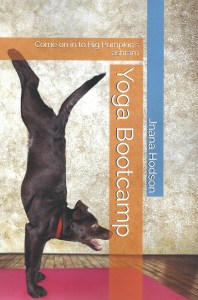
The paperback cover …

What happened for me during my residency was life-changing. I regard it as my master’s degree and my introduction to psychotherapy of an amateur sort. Among other things, it led me to the Society of Friends, or Quakers, which turned out to be the faith of my Hodgson ancestors from the 1660s down through my great-grandfather.

In the novel, I chose to confine the structure to a single day, in part because I had so many lingering questions I could not answer. Yes, within that day individuals could look back on their previous history, but the focus was on the NOW. And a lot could happen there in a 24-hour span. Besides, as I later learned through some candid discussions with a former Episcopal nun, monastic life has some commonalities of its own. As she said, some of the most intense interactions came in trying to choose the flavor of ice cream when the rare opportunity arose. I’ll argue you’re the most human under such rarified circumstances.

On top of everything, when I was drafting the book, I was out of contact with the place and its people. Critically, I had refused an order to return to the ashram after I’d married and moved to Washington state and a follow-up stipulation of heavy financial support was out of the question. A half-dozen years later, back on the East Coast, I had an opportunity to stop by but was not admitted into the house. I did learn that Swami had died and I sat by her grave. So much for making amends.

… and the back cover.

Since then, I’ve reconnected through social media with some of the key players and had a few assumptions, not in the story, deflated. In addition, Devan Malore’s “The Churning” reflects life there a few years after I’d moved on.

The story itself could have gone another way, if I hadn’t wanted to present the ideals that drew us together and kept us going. Especially the humor and playfulness.

More compelling for many readers would have been a more sordid tale of just one more “new religion” outfit run into scandal of a sexual or financial sort, preferably both. There were enough elements for that, as I’ve since learned.

The story first came out as a pioneering ebook in PDF format only and was later updated to Smashwords and its affiliated partners. A more recent, quite thorough recasting (again, blame the influence of Cassia in “What’s Left”) changed Swami from female to male and introduced Jaya as one of the eight resident yogis, thus linking her to the heftier Nearly Canaan novel. Besides, the transformation made Swami more acceptable to the expectations of many readers and allowed the Big Pumpkin and Elvis dimensions. The role was already unconventional enough, and this was more fun.

Am I still doing yoga? If you mean hatha, the physical exercises, let me say rarely and embarrassingly, at that. As exercise, I’ll substitute my daily laps in the swimming pool, and as meditation, my weekly Quaker meeting for worship. And no, I’m no longer vegetarian, other than when I voluntarily follow the Greek Orthodox “fasting” of Advent and Great Lent (again, blame Cassia), though I also eat much less flesh than most Americans. Actually, in these seasons, the Eastern Orthodox Christians are stricter than we yogis were.

I do wish there were a similar haven for youth today, one freed from the burden of student college debt. I’ll let “Yoga Bootcamp” stand where it does.


No, it’s not always business as usual

My first published novel ends as the protagonist joins with five hippie siblings who run a restaurant they’ve just inherited.

My novel What’s Left returns to the scene, to find the family’s prospered under the alternative approach.

Do you know any “retired hippies” who did quite well professionally? Tell us about one.

~*~

When her family buys an old church like this and converts it into a hot nightspot, the move simply feels like a natural extension of what they’re already doing.

More about ‘What’s Left’

No book was more of a struggle for me – or ultimately more transformative. Not that any of them came easily or quickly.

Each of them would have been much simpler if I had only hewed to a specific genre and with a particular reader in mind, but my goal was to explore a theme and see where it led rather than fill in a blueprint and hope that others would be fascinated by the discoveries. That put me in the “pantsers” end of writers, meaning seat-of-the-pants, rather than the “outliner” side, which can be paint-by-numbers rather than “painterly,” layer upon layer added or scraped away for intrigue, depth, and motion.

My earlier novels were grounded in people, places, and events I had experienced directly, which I then abstracted, of course, for a more inclusive understanding. When needed, I could turn to my journals for details and to my correspondence for dialogue or even make a few phone calls.

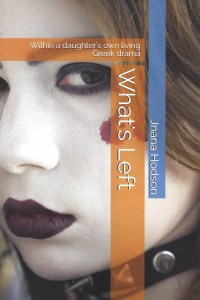
The paperback cover …

What’s Left, though, took me far beyond that. Yes, I was starting from the finale of my first published novel and trying to advance the scene by as much as a half-century, but I had no experience in a family-owned business. (I had skirted marrying into one, but I didn’t know how it would feel growing up in that situation – this was totally unlike my grandpa’s plumbing outfit, anyway.) Nor had I really worked in a restaurant. As for being part of a tight-knit extended family? Much less Greek-American? The adage, “Write about what you know,” now became, “Write about what you want to know.” More pointedly, that led me more and more into my daughters’ generation and its struggle for survival. As if anyone has answers to the big questions.

I set out thinking the story would take up the ongoing issues of the counterculture movement one by one – peace and non-violence, sexual and racial equality, the environment and ecology, natural foods and fitness, alternative education, spirituality, boho lifestyles, and so on. I had plenty of extended outtakes from the earlier books plus a set of essays that could be woven into the narrative.

But my upbeat, idealistic outlook started ringing hollow. Yes, the issues remain, even thrive, in spite of the entrenched opposition, and they need to be taken up by a younger generation. What hit me was the debris of broken dreams and promises, much of it caused by our own petite shortcomings. Yes, some of them mine as well. Broken families, too – just what is a family, anyway, especially when you examine the evidence closely, as the novel does? Where was the tight community we envisioned, much less that sense of tribe? As I looked around, I saw those who most continued in the hippie image were either bikers or what my kids would call losers. I have to say substance use or abuse has taken a heavy toll.

… and the back cover.

It’s too much to pack into a single novel, though one can touch on them. My focus slowly shifted on trying to pick up from the wreckage. That is, the place where Cassia found herself.

I was still mulling my approach when I chanced upon Jonathan Lethem’s “Dissident Garden” and was taken by its unique structure of 16 mosaic panels that could be moved about, if one wants, within its developing chronology. Lethem also had me realizing how much I needed to develop Cassia’s family’s past, with its own bohemian streams in coming to America. How many threads could I manage within this?

Voila! I had an organizing point. As poet Gary Snyder says, quoting an ancient Chinese folksong, to make a new ax handle, you use an old one as your pattern.

While I inherited the Greek-American element from an impulsive touch at the end of my first published novel, where this one picks up a generation later, I was only now piecing together how pervasive its presence in my own life without any earlier special awareness. As I’m seeing now, apart from Jeffrey Eugenides’ “Middlesex,” very little about Greek-American culture seems to exist in literature. (He nails the largely overlooked Midwest, too, by the way.) And then I started to engage it here where I live, beginning with Greek dancing and then Eastern Orthodox Christianity, so different from my own Quaker and Mennonite grounding – it’s like the difference between Zen and Tibetan Buddhism, as Snyder once quipped, two ends of a long arc.

The novel itself demanded at least a dozen major revisions, pushing it ever more toward the present, especially once Cassia found her own (snarky) voice and her brothers and cousins became vital characters. My personal genealogical research techniques also came into play as I examined her ancestry, both on her mother’s side and later, to my surprise, Cassia’s father’s.

What I really wasn’t expecting was the way she prompted me to return to my earlier fiction and severely revise it as well. In most cases, adding new characters and new scenes, cutting heavily, and renaming results. The three books about her father’s past gained a unified structure and timeline as well. So, in more ways than one, through Cassia, my novels embody what’s left.

Look for the witness in the work, too

Cinema critic Roger Ebert was talking of the importance of the witness in every movie and pointing to the places where the character appeared in the film under discussion, mostly in a lower corner. The comment flashed me to the reality of how often the hardest thing to see is what should be the most obvious. It’s not just the elephant in the room, it’s things we take for granted.

One way or another, all fiction is built on the observer, who is also to some degree an outsider or misfit, too. (If there are any exceptions, I’d love to hear them.) Four of my novels, for instance, were intuitively built around a photographer, a profession that makes Cassia’s father a well-trained witness. In turn, as she investigates his archives, she, too, becomes a witness, even before she starts commenting on his earlier life.

Of course, as a reader, you also become a witness. Or even a voyeur, as Camille Paglia has contended. It’s almost like every page is a microscope slide to be interpreted.

Curiously, I now see this also at play in a long-term non-fiction project in my life. Forty 40 years ago, seemingly by accident, I became involved in trying to uncover my father’s ancestry. I thought we were simply homogenous Midwesterners who had always been in Ohio from its beginning. What I discovered, though, was that one branch was – but German-speaking and largely akin to Amish. My name-line, however, was Quaker by way of North Carolina and its slaveholding culture. Both strands were outsiders to the larger society and also pacifist. It opened my eyes to alternative histories and to a recognition that stories don’t always have to resolve nicely – three people may record their memories quite differently, and maybe all three are true, if not factually accurate.

Oh yes, the research was often collaborative, with correspondence going and coming from others working on parts of the puzzle. It wasn’t always quite as lonely as drafting fiction or poetry.

To my surprise, as my novel What’s Left was taking shape, Cassia started assembling bits about her Greek-American grandparents, who had died before her birth, and then beyond to her great-grandparents, who brought the family to the New World. Like me, she found valuable clues in the surviving snapshots and formal portraits regarding their personalities, as she also did in the letters and other documents.

None of my ancestors came by way of Ellis Island, and on Dad’s side, they were all in this country by the time of the Revolutionary War. I once pondered doing a series of novels on them, but I’m still intimidated by the technical challenges – a realistic language they can speak and we can understand being high among them.

Witness, I might add, has an extra dimension in Quaker thinking. It’s not just what one sees or hears but how one lives. The goal is integrity, as in wholeness or consistency. Is that what others see in us or our lives and work? Or even as our goal and ideal, even when we fall short reaching for it?


The role rides on conflicted feelings

Sitting down to compose a novel requires some bravado, an assumption or presumption, even outright arrogance, that you have something important to say and an ability to do it in an interesting way.

You know, balls, swagger, mojo. Go to a writers’ group and just listen. But it’s not all sheer ego-driven. For many, at least, there’s an ongoing tension between believing in our own talents and shielding ourselves from the nagging self-doubts. Even Stephen King has them. Remember, the practice of the craft is a solitary act, not a team sport. It gets lonely, especially in the absence of feedback or fans in the stands, whether they’re cheering or jeering. Sometimes, to your surprise, harsh criticism is easier to handle than any praise.

Unless you’ve been there, you have no idea how precious a voiced reaction can be in nurturing you. Those brief reviews and star ratings are important, not just for guiding others to certain books but for guiding you as an author in your practice. An astute reader picks up important elements that have slipped right over their creator’s consciousness. Please, please, please take a few moments to weigh in when you finish a volume. We all need confirmation that we’re not wasting our time – or yours. Best of all is the epiphany when we’re left feeling that someone finally “gets it,” actually understands what we’re about. Don’t be shy.

The paperback cover …

I recall giving a friend a booklet I’d written about the Quaker metaphor of Light. (By the way, in the first two centuries of the Society of Friends, the term was always Inward Light or some variant, never the Inner Light expressed today. It’s a crucial distinction.) When he finished, he thanked me, said the text had cleared up his understanding, and then added, “You write very well.”

Even after four decades in the words-on-paper business, I was taken aback, considering that he is, by any measure, an important American literary figure and a master of the language. It was like “welcome to the club,” the exclusive one with the dark paneling and Manhattan address. It was like a cup of fresh water in a desert. Within myself, I felt freed from the “hack writer” label so often applied to journalists from Dr. Samuel Johnson on.

Later, in an aside, he told me I was more of a poet than a novelist. Knowing his fondness for poetry, I took some comfort in the perspective, as well as some umbrage about the fiction part.

On reflection, I now have to agree on his assessment, at least as my novels stood then. He certainly helped my character Cassia press her case for the reworking of all my existing novels, as I did in the aftermath of What’s Left, where she’s the star.

There’s also that frightening moment in the gap between when a book’s been accepted for publication and when it actually comes out. We’re afraid someone’s going to somehow uncover our darkest secrets or that we’ll be shamed by some indiscretion or that we’re about to make an unforgivable transgression. Again, go to a writers’ group and listen … or even ask. If you’re an author, you think you’re somehow bonkers when you feel this, not knowing how much company you actually have.

… and the back cover.

I’m of the camp that hews to Bukowski’s regime of daily “butt time” at the keyboard, day in and day out, regardless of how inspired you might be feeling. Many days it’s a dry struggle, but on others something different and amazing blossoms. From my perspective, it’s when writing becomes a kind of prayer and you find yourself in a “zone” where things come together as if by magic and characters start dictating to you, if only your fingers can keep up with what your soul is hearing. It’s a dialogue with the Other, as in Muse, and you’re the mere scribe at her service.

It’s what happened when Cassia started dictating to me.

It’s not always at the keyboard, either. Sometimes it happens while you’re in the shower or on the throne next to it or swimming laps in the pool or commuting to work.

You can’t control this. Realistically, it happens when you’re not in control.

It happened to me at the finale of “Subway Hitchhikers,” which years later became the launch pad for “What’s Left,” where I had to make sense of what I’d been given, however intuitively.

Perhaps the best, well, I just had a phone call and lost the thread of thought. Maybe it wasn’t that important.


A baroque twist runs through my distilled expression

Samuel Johnson and his baroque constructions gave a big push to my literary ambitions after high school. Let me just say I’ve loved the clarity of Mozart from my adolescence on, and Bach and Handel have risen in my estimation in the years since. The brash English master fell right into that, though I now see again just how irreverent he was, despite all of his professed orthodoxy.

What it means it that I’m comfortable reading and writing certain kinds of complex sentences that are foreign to modern readers. Perhaps I should apologize? At least it’s not the only way I put sentences in line. Still, there’s a richness that’s missing in Hemingway and his progeny.

And here I am, drilled in the newspaper journalism Papa Ernie claimed was his inspiration. Think again. (Ernie? Makes me think of Pyle, and his big desk at the Indiana Daily Student, where I once worked.)

My wife has noted the dichotomy between my fondness for many Old Ways and the rule-breaking, experimental edge of my writing and thinking. She can point, for instance, to my fascination with the fiery writings of early Quakers in the mid-1660s placed in contrast to wild hippie extremes.

Are they really that different, though? I feel they enrich and deepen each other.

When adventure called

In my novel What’s Left, there’s one big subject Cassia couldn’t ignore — not if she truly wanted to understand her father. It’s the whole hippie thing.

As he noted, in a sentence no longer in the text:

Will any of our inner music — our desires and activity — ever come into a reliably ongoing harmony?

As was this tidbit:

This is all new to him. The language, unfamiliar, even after the sporadic trips of his youth. The music, profoundly moving.

Take his hitchhiking. As her aunt Nita explained in yet another deleted text:

As for your body, well, you could go about anywhere on your thumb. Maybe not the Deep South or some of the big cities. But adventure called. Out in the countryside. And in the heart of the metropolis. There were moments when everything turned utterly surreal. It was a wild time, wasn’t it? You’re forgetting Nixon got reelected to the White House? If you were a freak — a hippie — you were part of a stream of kindred souls. You saw the world askew. You wanted to explore and discover new vistas, many of them psychedelic. You knew there was more — much more — than what your parents had ever imagined. The entire world was spiraling, about to go out of control, or so it seemed. And what difference does any veracity of hitchhiking in the subways make? Aren’t those some wild stories? Where does the line fall between what’s real and what’s imaginary? Didn’t your Baba land here after all? Return to build on earlier connections? Who cares how he got here as long as he did? You believe this is where he was destined, don’t you?

Admittedly, it’s a lot to take in. More than we needed, in fact. Even this flash:

Angels as hitchhikers! As subway riders! As candy store clerks!

~*~

These days, I’m left with mixed feelings.

Where do you think the hippie movement missed the boat? And what do you think it got right?

~*~

Hitchhiking might have led you to places like this.