We’ve once more subscribed to the community fishery’s summer season weekly catch selection, which we pick up every Friday at our natural foods grocery. Often, what’s offered is a sustainable variety not often even sold at the supermarket, but this time, it was tuna. A beautiful, fresh, one-pound sirloin, which indeed looked like a steak.
Yes, sirloin is the term I found used in the recipes.
So far, I’ve never attempted homemade sushi, but looking at our tuna and then the recipes, I took the leap into sashimi, which I first encountered in a four-table Japanese restaurant in San Francisco back in the ’70s and maybe two times since. And yes, that first time remains memorable, even the plum wine accompaniment.
In a restaurant, it appears so daunting. As one recipe said, though, nothing could be further from the truth. Sashimi is a staple dish in Japanese homes.
I had no idea this would be so simple. Using a very sharp chef’s knife, you firmly cut long strips across the grain – no sawing. One swipe! And, by definition, no cooking. Sashimi is raw fish from the ocean, not fresh water.
It just happened that we’re growing daikon radishes for the first time, as an experiment, so I went out to the garden and pulled one, which turned out to be larger than we were expecting. No problem. Came in, sliced it, put those rounds into a ramiken, and covered them in rice vinegar as my side dish.
The dipping sauce was a ramiken of soy sauce mixed with the juice from half a lemon.
That was it. Easier than making a salad, actually.
Accompanied by a cup of sake (which we also chanced to have in the cabinet), this made for one of the most heavenly meals ever, at least from my hand. And this wasn’t even sushi-grade fish, which gets flown immediately to Japan for a much higher price. I can only imagine.
Still, this was fresh, and that’s much of the secret.
Great cuisine is about respecting the ingredients.
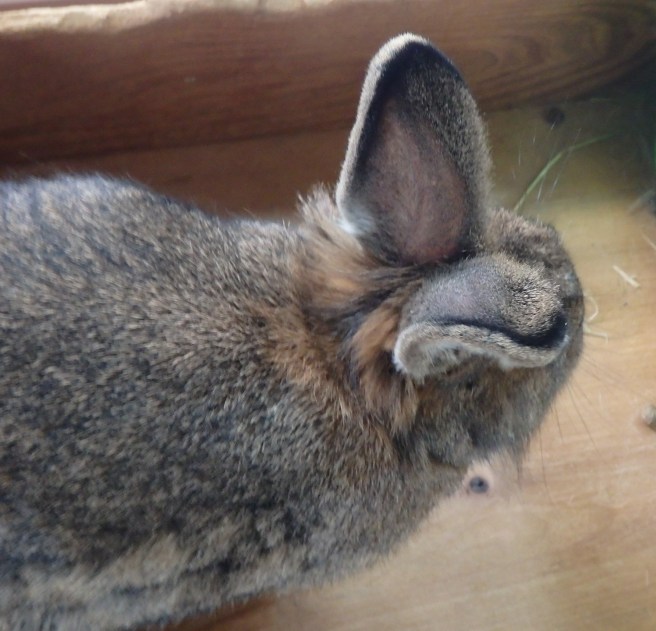
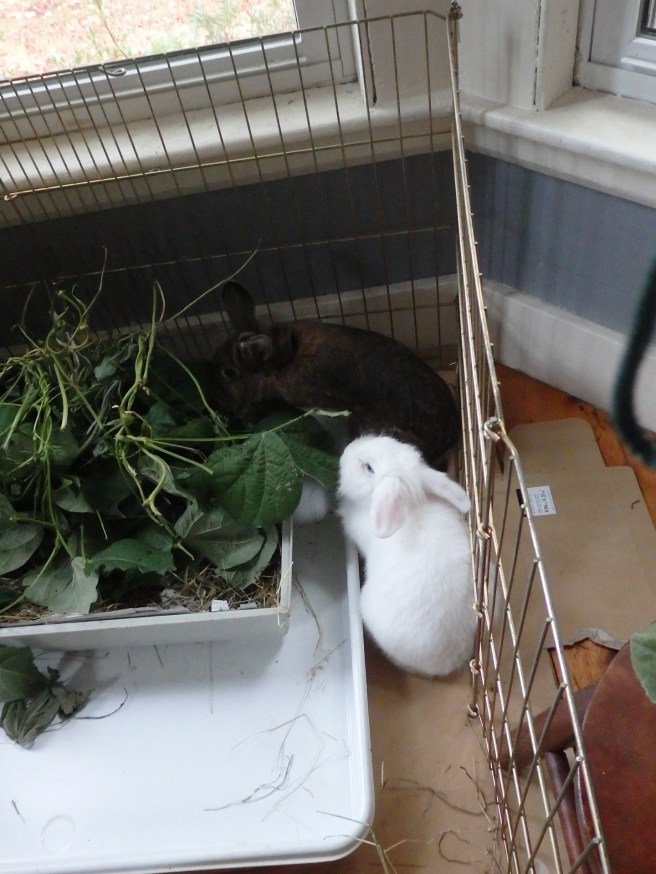
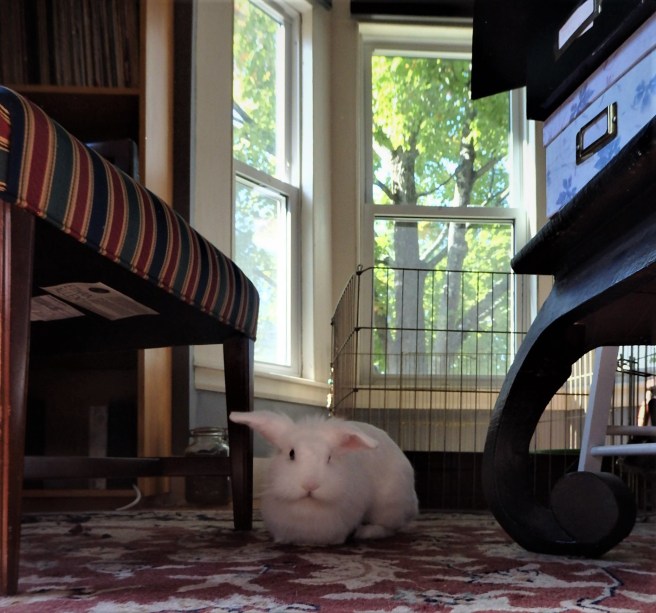
Salty and Pepper are my excuse to do more daily weeding than I used to. They love their greens. Sometimes, that includes garden plants that have finished their season, like these pole beans last summer. Oh, yes, they like the beans, too, even the ones that are too ripe for our own taste.
Back in April, Smashwords co-founder Jim Azevedo presented a six-hour writers conference via Zoom for ebook authors newbie and long-standing. I found it a rich experience and must applaud his stamina in sitting in front of his computer screen camera that long.
From this to …
His candid advice about rival Amazon prompted me to bite the bullet and look into reformatting my novels for Kindle Direct Publishing as one more digital retailing site for my work. I am, after all, fiercely loyal to Smashwords. Still, with Amazon, the most exciting thing is that I can now offer my work in print-on-demand paperback editions as well. I’ve come to love ebooks, but paper is, well, a special world to me.
Amazon has cleaned up many of its earlier formatting issues, and I can say my maiden foray went surprisingly smoothly. The one hiccup came with the paperback cover – my existing one was too small to run full-size. I compromised by reducing it within the glossy black background field.
I recently posted about tweaking that cover, which I did back before the online conference. Fortunately, it holds up to the new twist that’s been added to my thinking.
Azevedo spent some time covering the importance of covers, something I’ve previously blogged on. Frankly, from a design point of view, I find most book fronts to be cluttered and unfocused, combined with artwork that often strikes me as soft.
The making of a hippie
Maybe it’s all my years in journalism, but I’ve long leaned toward photographs as having more impact than paintings or drawings, and I want a strong graphic element other than type. Ebooks have an additional challenge of appearing, as Azevedo said, like postage stamps at the digital retail sites. That means any cover graphics have to pop if they’re going to catch your attention at all. You can’t be the least bit subtle.
What really struck me in Azevedo’s pitch was his insistence that a good book cover makes a promise.
What? The cover doesn’t mirror the story?
No, a promise.
As I started pondering potential new fronts for my paperback releases, his point kept kicking in. The result is a slew of new ebook covers already. Here I thought I’d be keeping what I had, but instead felt a need for improvement.
There was no escaping the necessity for a cover to have an emotional appeal, a gut-level reaction from a potential reader. Just who am I trying to entice? I’m not a famous writer, like Tolstoy or Stephen King or even Kurt Vonnegut, whose name alone could sell copies.
Still, thanks to an earlier project, I have a clearer concept of my ideal reader than I had in the past. So I’m not simply trying to stop a shopper for a moment’s reflection, as I might with a “literary” appeal. No, I’m trying to connect with her soul and spirit. Whew! So much for that calm bookish repose.
From this to …
Let’s jut say I’m aiming for real readers rather than schoolteachers or librarians. You know, the kind of readers who just might turn into not just fans but superfans, as Azevedo touts, the ones who tell everybody they know about the hot unknown book they’re devouring.
Flash forward and look what’s happened to my Subway Visions cover. The previous one set the underground urban tone, but just what’s the promise? It looks pretty static. Waiting for a train to somewhere, but what then?
The new cover, though, gives a totally different impression. Its brightly tagged subway car goes careening into the depths. We’re not just standing around, waiting, but off into the action. The typeface and solid color provide a retro take on old-fashioned paperbacks. Whoopie! As a reader, I expect to be entertained. We’re in for a wild trip. Well, there’s the promise. Come along with me.
Finding the right image, of course, is a challenge. I lucked out on this one, even though it required a long search and then winnowing down the other options. One where the photos all ultimately lost out.
Along the tubes to nirvana
I do hope that big piece of graffiti doesn’t say something truly embarrassing.
Daffodil Uprising was a bit more wrenching.
I’m quite fond of the clean appearance of that single bloom, but as I came back to the question of promise, I didn’t see the cover suggesting anything. It just stands there, like a monument.
The new cover, though, suggests a row of daffodils blazing into full bloom. It’s colorful and happy, reflecting much of the hippie expectation, without getting caught in the time warp. Yes, the story includes Flower Power but it’s more about youth and shared discoveries rather than Sixties. I’m surprised how fresh this new cover feels.
That’s appropriate, since my extensive revisions of these works sought to move them into being more about NOW than exclusively back THEN, even when the tale is full of what has become ancient history to most of the populace.
As I hunted for the new image, I wound up sorting through thousands of MsMaya’s mesmerizing abstract flower creations before finding one that captured something resembling daffodils. But then it blooms into something much more. Once again, the photos failed to make the final cut.
I think it was in Peter Ouspensky’s writing that I came across the concept. He argued that having a foundation in an activity that requires patience and long training is essential for anyone hoping to grow in spirituality.
Simply put, practicing an art, a sport, a craft, a trade, or the like provides the stamina for personal religious enhancement. He called it the magnetic center.
It’s not a passive pleasure but rather active, with deferred gratification in terms of results. It requires doing something for its own nature rather than some final event or production, even though such things might provide inspiration. What’s important is the means itself rather than the end.
These other activities aren’t a substitute for spiritual progress, which can come about by undertaking any number of tested traditions, but it does offer a solid starting point.
Maybe there are exceptions, but I still find it an interesting insight.
As I’ve looked with delight at the renaissance of my small city’s downtown, one modeled in part on Jane Jacobs’ then revolutionary attack on urban renewal back in the ’50s, I am a bit bothered by how much of it is now based on a commercial cookie-cutter concept known as mid-rises – five-story stick-frame construction above a steel-frame pedestal that’s then given a brick or similar exterior facing.
It’s happening all over the country, actually, and not just in the heart of a city, either. Even here in Dover, we’re seeing something similar happening about a mile south of downtown as an over 50s-something neighborhood called Pointe Place with rents that astound me. Who can afford it? Some retirees, apparently. It’s a downtown within a doughnut, in effect. You can’t really walk there from anywhere else.
Of course, the Covid-19 pall casts a big shadow over these developments, but some observers say it might encourage more people to move from big cities to smaller communities like ours. We’ll have to be patient and see what actually unfolds.
As I’ve argued here in various forms, I’d rather have a real city center abutting organic neighborhoods, one with a funky fringe of mixed-use buildings, unlike apartment complexes surrounded by parking lots along the major highways or shopping strips.
What we definitely have here in Dover is the attraction of a river that rises and falls with the tide, as well as the historic mills once renowned for their calico and now serving as entrepreneurial incubators and housing.
Call it atmosphere and scale.
~*~
As Dover’s emerged as New Hampshire’s fastest growing city, the bulk of the new downtown residents are presumably singles and child-free couples, either young professionals or older folks who want the amenities of living close to restaurants, parks, and public events.
The retail and professional rentals are a larger concern, though, especially as many small merchants find themselves at a disadvantage against Amazon. Take the local hobby shop as an example. And that’s even before the bigger threat of coronavirus hit the entire economy.
Even so, these projects haven’t been on hold.
The new Orpheum takes shape downtown, matching the height of the old Masonic building to its east and the old Strafford Bank across from that. The spire at top left is city hall, a block away from the back of the new building in what was previously a parking lot.The Robbins Block storefronts are now gone and a five-story Orpheum is rising in their place. The hardware store, lower right, is still there. From the top left are the library, community center, and district court.
The old block may look charming in the photo, but the buildings were rundown and unwelcoming to pedestrians, as was the sprawling parking lot behind them. There was also a traffic bottleneck that’s being eliminated.






 Jnana's Red Barn