A generic side to Dover’s downtown transformation

As I’ve looked with delight at the renaissance of my small city’s downtown, one modeled in part on Jane Jacobs’ then revolutionary attack on urban renewal back in the ’50s, I am a bit bothered by how much of it is now based on a commercial cookie-cutter concept known as mid-rises – five-story stick-frame construction above a steel-frame pedestal that’s then given a brick or similar exterior facing.

It’s happening all over the country, actually, and not just in the heart of a city, either. Even here in Dover, we’re seeing something similar happening about a mile south of downtown as an over 50s-something neighborhood called Pointe Place with rents that astound me. Who can afford it? Some retirees, apparently. It’s a downtown within a doughnut, in effect. You can’t really walk there from anywhere else.

Of course, the Covid-19 pall casts a big shadow over these developments, but some observers say it might encourage more people to move from big cities to smaller communities like ours. We’ll have to be patient and see what actually unfolds.

As I’ve argued here in various forms, I’d rather have a real city center abutting organic neighborhoods, one with a funky fringe of mixed-use buildings, unlike apartment complexes surrounded by parking lots along the major highways or shopping strips.

What we definitely have here in Dover is the attraction of a river that rises and falls with the tide, as well as the historic mills once renowned for their calico and now serving as entrepreneurial incubators and housing.

Call it atmosphere and scale.

~*~

As Dover’s emerged as New Hampshire’s fastest growing city, the bulk of the new downtown residents are presumably singles and child-free couples, either young professionals or older folks who want the amenities of living close to restaurants, parks, and public events.

The retail and professional rentals are a larger concern, though, especially as many small merchants find themselves at a disadvantage against Amazon. Take the local hobby shop as an example. And that’s even before the bigger threat of coronavirus hit the entire economy.

Even so, these projects haven’t been on hold.

OLYMPUS DIGITAL CAMERA
The new Orpheum takes shape downtown, matching the height of the old Masonic building to its east and the old Strafford Bank across from that. The spire at top left is city hall, a block away from the back of the new building in what was previously a parking lot.
The Robbins Block storefronts are now gone and a five-story Orpheum is rising in their place. The hardware store, lower right, is still there. From the top left are the library, community center, and district court.

The old block may look charming in the photo, but the buildings were rundown and unwelcoming to pedestrians, as was the sprawling parking lot behind them. There was also a traffic bottleneck that’s being eliminated.

More than colorful pins stuck on the wall map

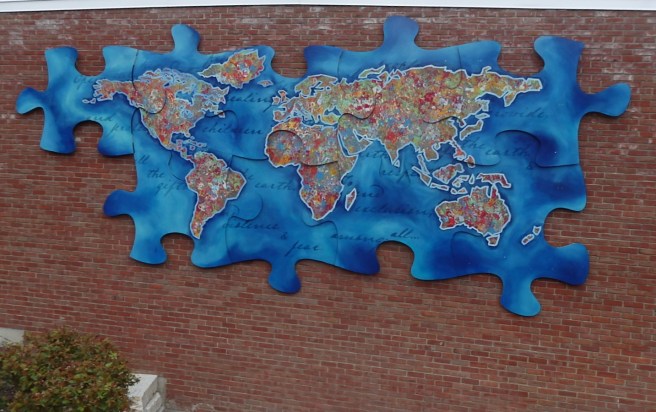
Wow, I really have been all over the map in getting to here. That’s what’s stirred up as I look at the range of experiences reflected in my novels and poetry as well as here at the Barn. That ‘scape has covered a childhood in the Midwest, college in a Big Ten school, an inner city ghetto during my hippie years and then the farms that followed, as well as desert and mountains, more Midwest and then Baltimore, along with my first marriage and some wild romances, and finally New England and my little city farm here.

Sometimes I wind up feeling dizzy. Those pins and needles are all over the place.

Are you one of the lucky ones who got to stay put?


Heart-stopping moment

We’re still learning not to panic at scenes like this, where one of our rabbits looks like rigor mortis has set in. It’s even scarier when one’s running about, stops, and then flops over into a deadly pose like Pepper’s here. That’s when I look closely at her side to see if she’s breathing. Grab a camera, though, and the subject pops right up like nothing’s ever happened just as you’re ready to click the shot. My wife finally caught this instance, and I’m envious.

Kinisi, from Greek for ‘motion’

I’ve long been fascinated by the inner workings of English in very short segments. Typographical errors, for instance, when they seem to release some other possibilities. Aram Saroyan’s Lighght would be a prime example, presented as a poem in its entirety.

We accept the silent “gh” without question in conventional writing, but a second one brings us back to the perplexity we had as children learning some very strange spellings. And then, maybe, it points to the wonder of light itself.

There’s also the question of just how short a poem can be. One word? Two? A single line? Two lines?

Beyond that is the concrete poem, including those where typography itself seems to embody its own beauty, apart from any obvious meaning.

More recently, I’ve become fond of two or three synonyms or antonyms in juxtaposition.

I’ve played with all of these concepts, some of the results now appearing in my Thistle Finch chapbooks and others in my Kinisi series here.

And some of them could simply be prompts for a writing exercise.

Trying to figure out what to call them has always been a challenge. I wound up with Kinisi, from the Greek root for kinetic, when I noticed what attracted me to these fragments was some mysterious innate motion generated by the bits.

Here’s hoping they leap and dance in your imagination, too.


IKEA, where small is stylish

The Swedish retailer of low-cost home furnishings, appliances, cookware, and the like is a magnet for folks trying to make the most of tight spaces like apartments. Say a challenge like a 400-square-foot apartment.

Even if you have an old five-bedroom home like ours, the interiors can be challenging. IKEA has frequently come to our rescue. Yes, some assembly is usually required, and I can attest it’s not always idiot proof, but overall, we’ve been pleased with the results.

The closest IKEA superstore to us is located south of Boston, and since deliveries aren’t cheap, it’s worth the four-hour round-trip, even if you get lost inside once you’re there, as I have. The cafeteria, by the way, is quite the bargain.

Are you one of those intrigued by the small-scale living space displays in the IKEA superstores?

What’s your experience been?

A new kind of doctor’s house call

When I was a rug rat, family physicians would still visit patients in their homes. The docs even carried little black bags, as I remember, along with a different demeanor than we see today.

And then all of that became history. The front-line medical personnel even became referred to as primary caregivers or physician assistants or nurse practitioners rather than docs.

The Covid-19 outbreak, though, has it returning with a twist. The medico in question, even a specialist, is now calling some patients at home. Yup, on the phone. Voice, not texting. I’d say dialing them up, except nobody has a dial phone anymore.

And that’s what’s happening with my latest cardiologist checkup.

OK, I did have the echocardiogram at the hospital lab, so he has those results to work with. I’m wondering if he’s going to want my latest weight and blood pressure readings. I do have the home kit for that. There will be no listening to my breathing and other internal sounds.

Well, I’m also told of psychotherapists who are conducting their sessions over the phone, though I have trouble imagining that going very deep. Dunno. There are just certain things that come up in face-to-face interactions that don’t happen by telephone.