Gingerbread village

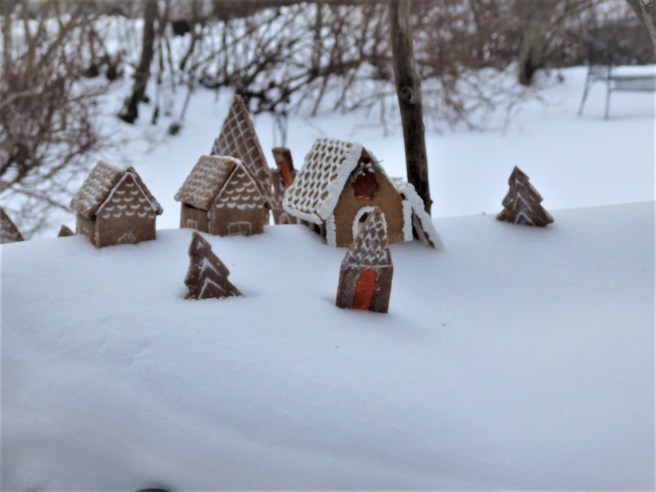
Sometime after the Twelve Days of Christmas end on January 6, we take our gingerbread decorations outdoors for the wild critters to discover and devour.

Here’s part of a village inserted into a pile of snow on a tabletop.

Looks like it belonged there all along. The squirrels, however, will soon be scampering off with the pieces.

Looks to me like a little ski village.


Don’t overlook your guardian angels

In my Freakin’ Free Spirits novels, aunt Nita serves Cassia’s guardian angel.

Earlier, she had played a similar role for Cassia’s future father, from their college years together onward.

In fact, without Nita in the background, the daughter may have never come along at all, as she eventually appreciates in What’s Left.

Reflecting on my own life, I’m now sensing moments when someone stepped in, behind the scenes, to affect a change that opened an opportunity in my life. At the time, I was clueless. One led to a summer job and later part-time employment. Another, to my being able to transfer away to college, rather than continue at a commuter campus.

There were another attempts that were turned away, in my ignorance or incomplete understanding.

But there were also the other, more typical and ethereal guardian angels, the kind that kept me a brush away from death or serious injury, say being hit by a car or bus or finding myself in the deep end of the pool when I could barely swim or maybe even getting sexually involved with the wrong person.

Has someone in your life ever functioned as a guardian angel?

A case of real life intersecting fiction

One of the many things I like about using the DuckDuckGo search engine as an alternative to Google is that its home page includes Pocket, an informative selection of intelligent, substantive articles, many drawn from magazine archives, rather than fluff about celebrities and sports.

This morning’s Pocket, for example, included a 2015 Narratively article by Lilly Dancyger, “Planning My Father-Daughter Dance Without My Dad.”

What especially caught my attention was the ways Lilly’s experience intersected with my novel, What’s Left.

Like Cassia in the book, Lilly lost her father to death when she was 11, and like Cassia, she dressed largely in black for years afterward. (Whew! Confirmation I had that part right.)

Unlike my novel’s character, though, Lilly dropped out of high school, sought relief in alcohol, tobacco, and other drugs, and embraced a dim future. The homeless were some of her favorite companions.

In contrast, Cassia had a large extended family that stayed with her, even when she kept pushing them away. Yes, she had struggles with her mother much like Lilly’s, and she skirted some of the self-destructive behavior, but each of the three aunts on her mother’s side of the family found ways during her difficult teen years to break through to her, as did several of her first-cousins. In today’s world, few are so fortunate, not with our fractured nuclear households.

Moreover, through her aunt Nita, Cassia also had her father’s trove of his professional photography to sift through, each shot reflecting his thoughts and feelings.

What Lilly presents – and I didn’t – is the workings of guilt within a survivor. As she declares, it merely “isn’t just about feeling unjustly lucky to have lived while someone else died; it’s guilt for going on without them, guilt for changing and growing and becoming a person they never knew. Any milestone is tinged with their absence, any joy feels like a betrayal, like you’ve forgotten them, if only for long enough to laugh at a good joke or enjoy a good meal. But as long as you’re in mourning, your life is still about them, and in that way, they’re still there.”

Lilly’s experience came to a head in planning for her wedding and trying to decide who would walk her down the aisle, if anyone, and who would share that first dance with her at the reception.

That wasn’t the case with Cassia, who instead chose to remain single. But Lilly’s words burn, all the same, as they point to another dimension my novel might have developed.
Ten special diets

These days it seems everyone’s on a restricted diet.

Here are ten of them.

  1. Kosher. This means the historic Jewish restrictions. You know, no ham. But that’s just for starters. And even the plates must be blessed.
  2. Halal. The Muslim equivalent of dietary laws. By the way, Ramadan still sounds like cheating. I mean, what’s the hardship of refraining during the day if you can eat like a pig, uh, beast all night?
  3. Eastern Orthodox fasting.  Food’s allowed, but the options are highly limited. No olive oil, for instance, and no meat. It can be tricky.
  4. Caffeine-free. The Mormon church recently lifted this restriction from carbonated drinks, though it still holds for hot coffee or tea. Some other disciplines, including yogis, also ban it.
  5. Vegan. Or its less restrictive vegetarian alternatives.
  6. Gluten-free or lactose-free or peanut-free. Based on a medical diagnosis, OK?
  7. Healthy Heart. A little broader, largely to reduce cholesterol levels.
  8. Weight-loss. Oh, my, these are endless and ever so trendy.
  9. Alcohol-free. Sometimes as a religious tenet, sometimes as a consequence of addiction.
  10. Hindu. No beef. Those cows are sacred … and sources of milk.

Are you observing any dietary restrictions?

Ten major yoga brands today

In the decades since I took up yoga in the early 1970s, the movement has had its ups and downs. For a while, it looked like it was about to peter out altogether, especially as scandals hit many of the teachers or their organizations.

And then came the boom in popularity, far outrunning the earlier flowering.

Today, it’s hard to keep up with many of the trends, especially as they take on commercially branded identities. Back in the day, we knew it essentially as hatha, raja, karma, and so on … but not anymore. When you’re looking for a class, it can be rather confusing.

Here are ten on my radar. Many of the details come from Kristin McGee’s fine overview at the MBGmovement website.

  1. Iyengar: Founded by B.K.S. Iyengar after his arrival in Ann Arbor, Michigan, in 1973, this system relies heavily on props to help students to perfect their form. The positions are held for longer periods while focusing on details of the pose. Photos of the props still disturb me. Guess I’m just old school.
  2. Restorative yoga: Focused on winding down and relaxing after a long day. As an outgrowth of Iyengar yoga, includes props like bolsters and blankets.
  3. Astanga: (Also spelled ashtanga.) Popularized by K. Pattabhi Jois in the ’70s. Very physically demanding sequence of postures with an emphasis on continuous movement. No props, no music – I wholeheartedly approve, but I am from a line that had long rests in the corpse pose between asanas. Aah. Our goal was meditation, more than physical fitness.
  4. Vinyasa flow:  Adapted from astanga in the 1980s, it is more varied, depending on the teacher and students and the intent of the day. It may include props and music. Vinyasa is considered the most athletic of the popular styles, more suitable for students with previous yoga experience.
  5. Jivamukti: Founded in 1984 by Sharon Gannon and David Life as an outgrowth of vinyasa flow, this includes teachings from Hindu philosophy with an Earth-conscious connection. Many of its followers are also vegetarian.
  6. Hot: Supposedly intended to simulate the steamy jungles of India where yoga was practiced, this covers a range of styles as long as the room’s hot and humid. It’s intended to produce a lot of sweating. I’ll assume that’s to sweat out impurities in the body. One of its earliest strands is Forrest yoga, developed by Ana T. Forrest.
  7. Bikram: Founded by Bikram Choudhury in the late 20th century, it’s the best-known form of hot yoga. Its 90-minute class format has postures each performed twice in a 105-degree room with 40 percent humidity, great for producing sweat. The certified teachers have a standard patter to accompany the workout. He seems to be very proprietary.
  8. Yin: Slow paced and meditative. This system dates from the late ’70s with the work of Paulie Zink, a Taoist and martial arts expert, and developed by Paul Grilley and Sarah Powers.
  9. Anusara: A more traditional hatha yoga with a focus on heart-opening and spirals to align each part of the body. Founded by John Friend in 1997 and now continued by a nonprofit school that certifies its teachers.
  10. Acroyoga: The most gymnastic of the systems, this features partners exercising in acrobatic poses. It requires three people – a base, a flyer who will be elevated off the ground, and a spotter to break the fall, if needed. The couple on the cover of my upcoming novel Nearly Canaan are shown in one of its poses.

Note that they’re all focused on physical fitness of one sort or another, rather than the meditative or ethical dimensions of the underlying religious foundation. Where are the swamis nowadays, anyway?