Schooner or later

Ships come in all sizes and shapes, and people aware of the differences see vessels that float quite differently than the rest of the population. Well, it’s like looking at birds and then birders.

Living beside the ocean I had learned to differentiate a sloop from a schooner, or so I thought. Both have triangular sails, with sloops having just one mast and schooners, two or more.

Not to be confused with square-riggers, the kind of tall-mast ships most people envision from history. Or so I once did. You know, Old Ironsides, the USS Constitution, or even the Mayflower, however much smaller.

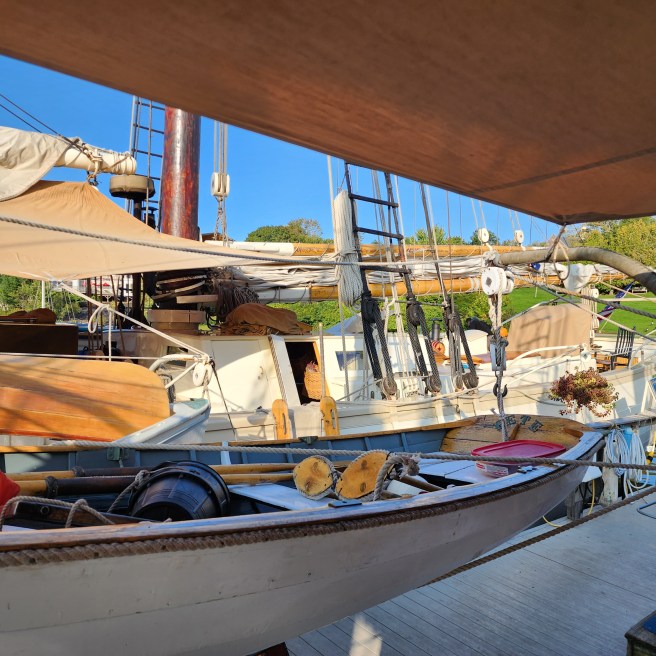
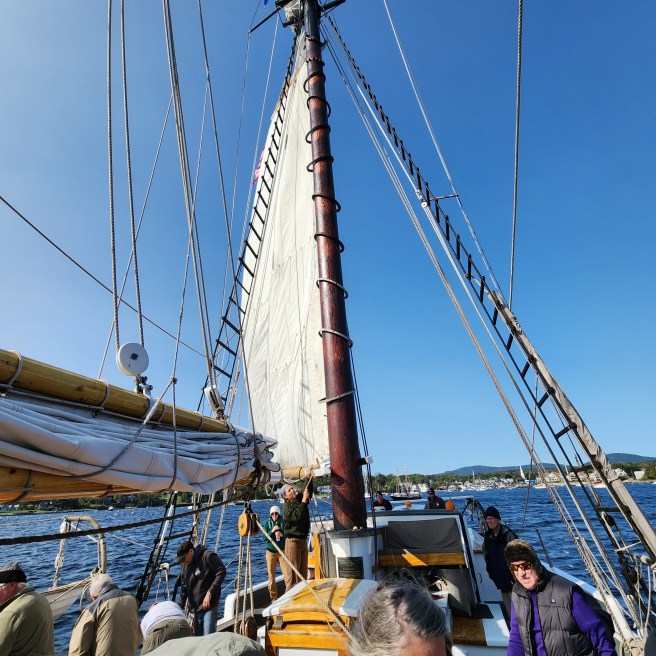
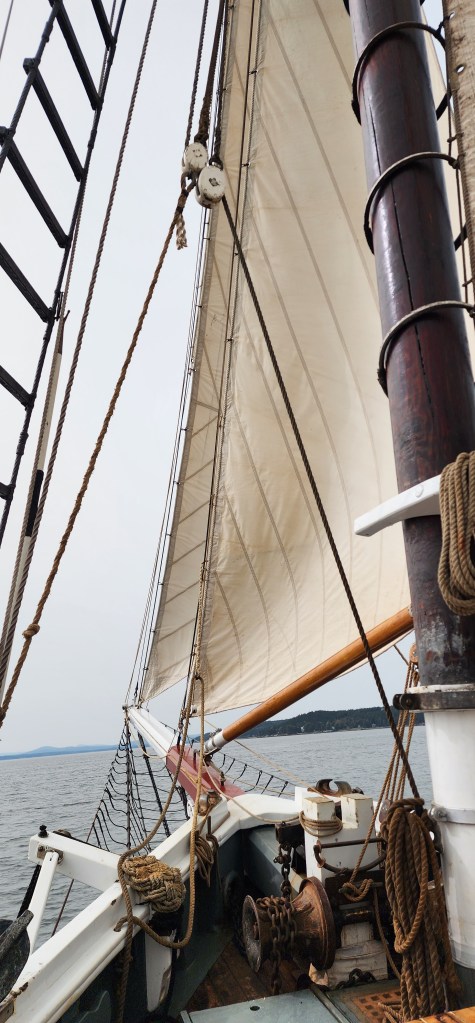
As for triangular sails, like those on sailboats. Not quite accurate when it comes to schooners. There’s something called a gaff … creating the hip-roof look of a schooner’s sails.

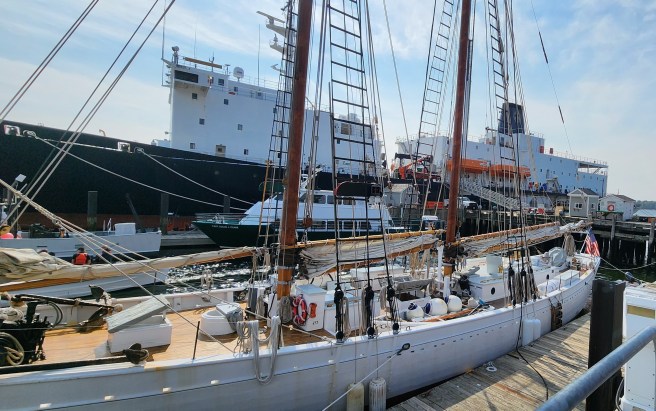
The Bowdoin of Arctic exploration fame.

My closeup introduction to a schooner came in a side trip earlier in the day I would step aboard one for my virgin voyage that will inform later posts. To kill time, so I thought, my buddy and I headed off to Castine, then a hole in my inner map of Maine, apart from references by friends.

And that’s where I was introduced to the Bowdoin, now named for the college of the same name but more importantly a historic vessel used by Donald Baxter MacMillan in his Arctic expeditions. Quite simply, she was designed to withstand incredible freezing – and did. I’m now wondering how the crew did, under those conditions.

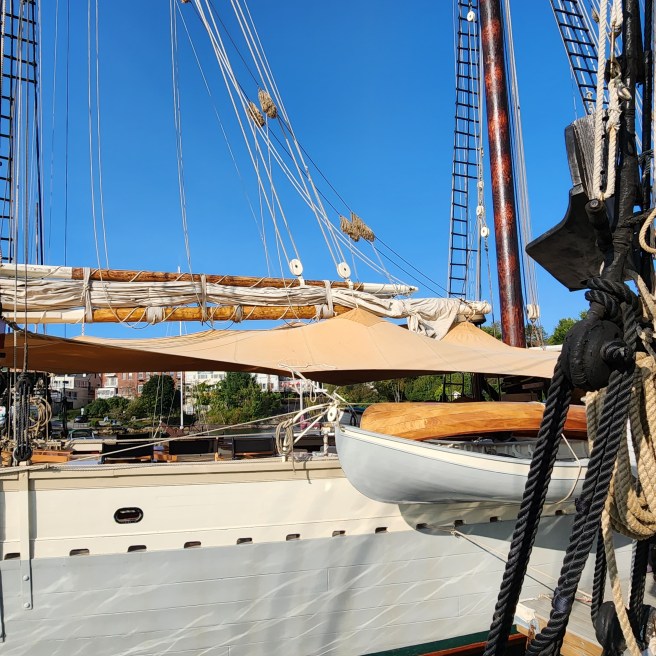
That said, she was a schooner. I had seen one docked in Eastport, but this time I had a curator at hand to explain the distinctive parts.

Emphatically, it is not a square-rigger.

Schooner, as Dutch, it’s not SHOONER, after all, as my New Amsterdam Dutch-descendant Peter could easily point out, yet from deference, hasn’t. (Do I get points for noticing?)

Typically, a crew of 2½
two men and a boy
no cook?

an average life of 25 years

for a wooden ship
(owned in shares
spread the risk and profits)


Let’s fill in some more blanks

Some people sit down in the depth of winter to peruse seed catalogs and dream of harvests. We’ll be doing some of that in our household, and you’ll no doubt sample some of the results here.

Some find it a good time to revisit highlights from the previous year or further back. Yup, that too.

The snowy months also offer delightful travel opportunities, and not just to warmer climes. Even if you stay close to a wood fire or the equivalent, taking time to sift through brochures can stimulate plans for trips long or short later in the year. Consider my upcoming posts based on my week on the waters of Penobscot Bay at the beginning of autumn in that vein.

Quite simply, retirement and winters aren’t a blank stretch in my life.

~*~

One movie I viewed as a kid in the Dayton Art Institute’s tapestry-walled auditorium left a lasting impression on me. I think the film was scheduled to be shown outdoors but this was the rain site. What I do recall is its presentations of windjammers racing along under full sails. I was still far from any actual encounter with the ocean or sailing, but from that point on I did realize I had no interest in a traditional cruise, or what I’ve seen as a floating nightclub. No, if I went out on a cruise, it would be under sail. Not that the option quite came in front of me.

Instead, the closest over the years were jaunts on ferryboats in the Pacific Northwest and then the Northeast, along with whale watch daytrips and, especially, my boss’ 32-foot sailboat in the Gulf of Maine.

One impression I gleaned from those outings is how differently a geography fits together when it’s experienced from its waters rather than its land. That awareness certainly came into play in my history research for Quaking Dover.

Being on the water filled in some blanks.

~*~

As a lover of maps, from childhood on, I’ve also learned how the mere fact of being in a place transforms the charts. A location becomes real when I’ve walked around in it. Or, as I learned in my time on Penobscot Bay, if I’ve walked around in a boat just offshore.

Listening to new friends in Maine presented a series of towns I could place only vaguely – Castine, Stonington, Brooklin, Islesboro, Southwest Harbor – along with related locations like Vinalhaven, Isle au Haut, Blue Hill, Swan’s Island (not to be confused with Swan Island in the Kennebec River), or Little Cranberry. I could nod along with a blank look. My week on the water filled in more of that comprehension.

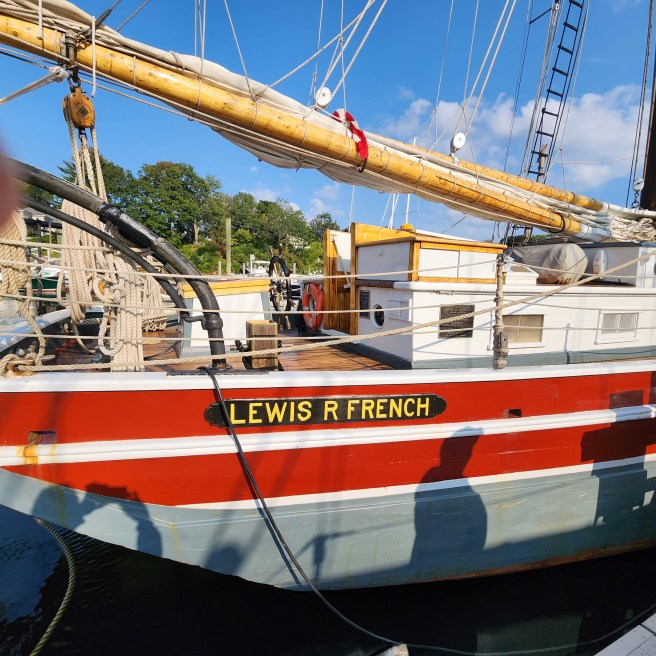
Now, let me fill in the name of the ship in question here – the Lewis R. French – and the fact she was a schooner, a very special distinction, as I would learn.

And as you’ll see.

What is ‘home’?

The definition, like that of “family,” can be complex and elusive.

I’m looking at home as someplace much more than where I sleep at night or eat the majority of my meals. It’s more than a house or an apartment or even a tent, for that matter, even though for much of my life, my address has felt more like an encampment before I arrive, well, at what’s truly home.

The Biblical sense of sojourning matches much of what I’ve experienced, pro and con.

Think of a sense of comfort, for one thing, and belonging, for another. Not everyplace I’ve dwelled has measured up there. Rental units have always had limitations on how much you can personalize the space, even to the exclusions on painting the walls. And who knows what happens when the rents or lease go up.

As much as my native geography and its character are imprinted on my soul, the house I grew up in isn’t. How curious. As for family? I’ve now spent the majority of my life on the Eastern Seaboard, mostly New England. Four years in the Pacific Northwest were especially transformative. Yet deep down, I’m still a Midwesterner, though one now amazed almost daily by the movements of an ocean close at hand.

The place I’ve lived longest is Dover, New Hampshire, in an 1890s’ house that’s appeared often in this blog. As “home,” it had shortcomings, but it was where I built my own family, did some very serious writing and revising, ate marvelous food we had raised in our garden, delighted in some extraordinary neighbors (especially Tim and Maggie), delighted in the parties and guests we hosted, and thought I would spend my final moments within. Well, I almost did – but that’s another post or two. As I told the kids when we moved in, I would be in a pine box when I left.

Not that my plotline wound up following that course. It might have, actually, if my elder beloved daughter-slash-stepdaughter hadn’t whisked me off to the emergency room in time for a cardio-stent.

Back to the bigger story. As I retired from the office, it became clear we needed to downsize. I won’t go into details, but my elder daughter/stepdaughter (those distinctions blend for me but not everyone – room for many future blog posts) fell in love with a remote fishing village at the other end of Maine. And then, so did her mother. My introductions to the place were positive, but even though I had begun some intense decollecting and downsizing, and was well ahead of the others on that front, there was still a long way to go. Besides, I was in the midst of a major writing project and knew how long it would take to get back in gear if I packed up in the midst.

Even so, after a few furtive efforts, we bid on a property that had been for sale forever and were accepted. I was promptly dispatched to keep an eye on the place – essentially, as a writer’s retreat.

It needed, to put things succinctly, tons of work. But somehow, it’s felt more like home than anyplace else I’ve dwelled. As you’ll see.

How to really play a Strauss waltz

Most conductors try to make it melodious and strictly in time, constrained by starched shirts and gowns. Seated audiences typically go for that tuneful approach, not that humming along is approved.

What I find more compelling and exciting, though, is when the performance is filled with bubbles, like champagne, and a tad tipsy. One dance partner stepping on the other’s toes. Even better, when there’s some tension between, say, the brass and the strings, with a hint of freedom within the beats, the way one dance partner is a hair ahead or behind the other. Yeah, a little swing, if you will. And a little playful unpredictability.

Well, here we go, in the air approaching another new year.

Hodie, hodie!

My choir has been singing a joyous Renaissance piece that translates, in Allen M. Simon’s rendering, as:

Today Christ is born:
Today the Savior appeared:
Today on Earth the Angels sing,
Archangels rejoice:
Today the righteous rejoice, saying:
Glory to God in the highest.
Alleluia.

I first heard it in the second classical concert I ever attended, around age 12, with the velvety Roger Wagner Chorale on tour. Never, ever, did I imagine I’d be part of presenting it myself.

Still blows me away, all around.