Acid test poet and essayist: Gary Snyder (1930- )

It’s pure coincidence that he should appear in this series on Earth Day, but it’s totally fitting.

The tumultuous spring of 1970, when the first Earth Day was observed, was also when I first saw someone sitting in deep meditation. The figure was in lotus position under a beech tree totally motionless for perhaps a half hour while I waited for my girlfriend at the street corner nearby. My inner reaction was hostile, wondering how anybody could withdraw from the world amid all of the conflict around us at the time. Only later did I put the events together – Gary Snyder, just back from years of Zen practice in Japan, was giving a reading on campus. I even admired some of his calligraphy in a display in the Student Union. And, as I would discover, he was a leading activist on progressive fronts.

About a year later, when I took up yoga and its meditation, I had already begun reading his poetry and was struck by what seemed wild construction. What I eventually detected was how precisely it fit an American voice yet moved on Asian meters with utmost economy and, in his case, clarity.

About a year later, I was living in a yoga ashram, a monastic community not that different from the Zen monasteries he had known in Japan. In addition, one of his essays told of visiting the ashram of our teacher’s teacher in India. It was perhaps the best portrayal of Sivananda I’ve yet read, free of the usual guru adoration.

Similar flashes continued as I returned to Indiana, where he had done graduate studies, and then on to his native Washington state, where he had long been a much better mountaineer than I ever would be. Still, the high country he celebrated was both real and transcendental, even in my briefer experiences. His familiarity with Indigenous tribes also informed my own encounters while living at the edge of the Yakama reservation.

I relate more of this in a poem in my Elders Hold chapbook, should you be interested.

Or, for a thinly veiled biography of him before he left for Japan, there’s Japhy Ryder in Jack Kerouac’s Dharma Bums.

Much of my writing, poetry and fiction, has concentrated on place itself, and that’s been something Snyder, too, has done. While I have moved independently of his example, I have been indebted and inspired.

Hari Om Tat Sat!
As one neighbor says, ‘It’s my least favorite job’

His sympathy was much appreciated while I worked with one around the garden.

So here’s why I hate using a weed whacker.

  1. My shoes and legs or pants get splattered in green juice.
  2. As do my hair, eyes, and lips. (I don’t like slurpies.)
  3. Stems and blades of tall grasses and weeds often twist into a knot around the connection of the driveshaft to trimmer spool. Their tangling soon chokes the high-speed revolutions. Even with a razor blade, they’re hard to extract. I can spend more time clearing this than actually cutting the tall grasses and weeds.
  4. The two plastic trimmer cords – the part that actually cuts the greens – are hard to extend to the desired length or to replace when the spool’s empty. The procedures feel counterintuitive. And they quickly fray in actual usage.
  5. The “trimming” isn’t nearly as precise in its surgery as my wife presumes. It’s more like using a chainsaw than a scalpel.
  6. That means there’s collateral damage. Domestic flowers and vegetable plants are at risk, especially if I bump into something I can’t see behind me. Oops! Sorry.
  7. I have an electric battery-driven version, a huge advance over the gasoline alternative. Just the thought of having to deal with the fuel mixture, rip-cord starter, or other maintenance is enough to put on my to-hate list.
  8. The battery in mine is difficult to remove for recharging. It’s just too tight to get out without an extra set of hands. Help!
  9. It’s top-heavy, meaning that when I’m trying to clear those tangles in No. 3 or am trying to store it in the shed, it wants to roll over inconveniently or just fall over.
  10. They’re noisy, even the electric-battery versions like ours.

Would herbicides, which we don’t use, do the job better? (Satan, get thee behind me.)

Not just moose but a murder mystery, too

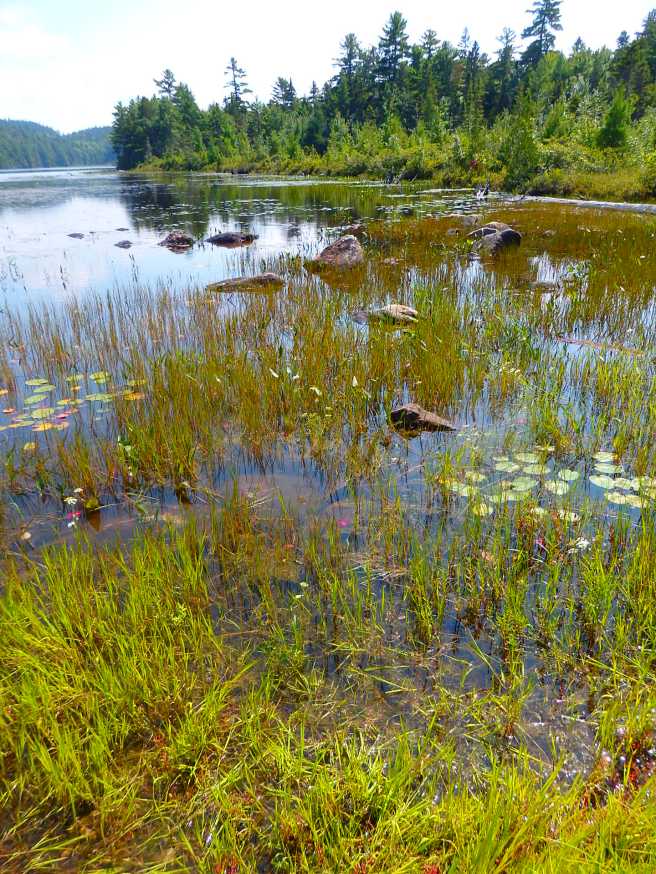
The joke is that moose don’t have horns, they have antlers. The Moosehorn National Wildlife Refuge excuses itself by noting that it’s named after a brook that meanders through the preserve. Not that it’s the only fine body of water.

Canoeing, kayaking, and fishing are welcome.
The marked lanes make for some lovely strolls.

And the U.S. Fish and Wildlife Service adds that the preserve is home to much more than moose, bear, beaver, and deer. For example, some 223 bird species have been identified in its two divisions – the 31-square-mile Baring Division to our northwest and the 13-square-mile Edmunds Division to our west, both within a half-hour drive from Eastport.

The terrain is varied, much of it wetlands, and a third is protected as wilderness.

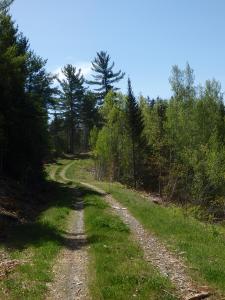
I especially appreciate the miles of hiking trails, some along former roads.

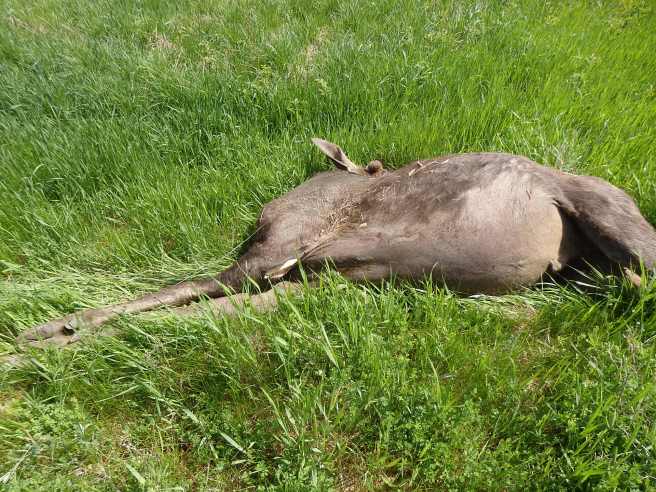
What I wasn’t expecting on one outing was the moose I encountered on a grassy roadside near a flowage.

When I first spotted the tawny hump amid the green, I thought it might have been one bent over grazing, in which case I’d need to approach cautiously, or else just a big rock.

Instead, it became a mystery.

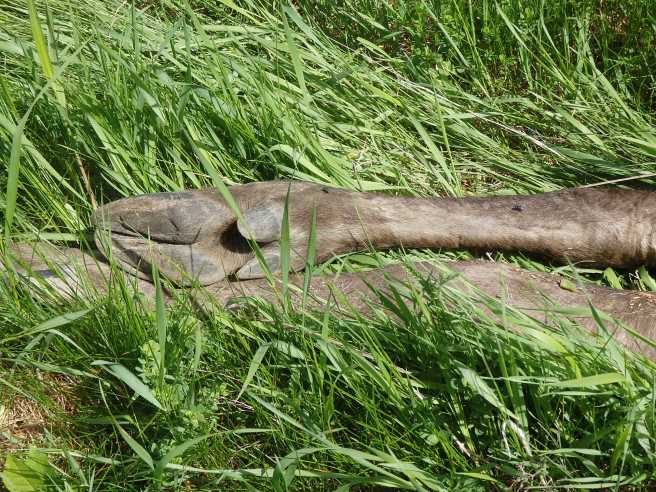
The hooves and legs.
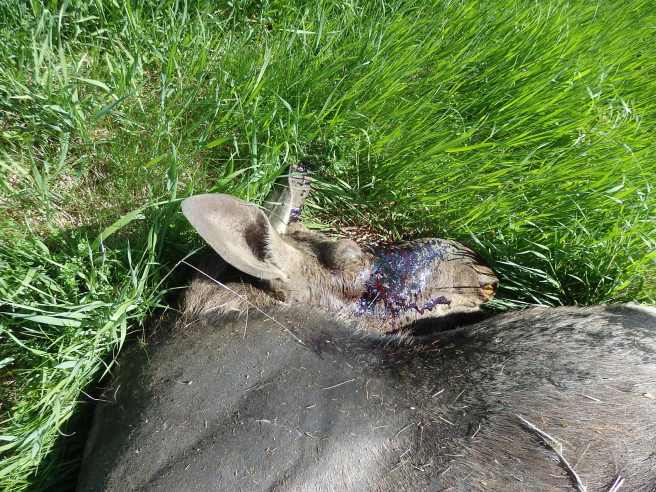
Apart from the head injury, the body was in fine shape – no mat of ticks, for one thing.
It really is a big, powerful jaw.

Tire tracks in the grass had me wondering if a ranger driving down the gated-access lane had tried to veer away from the animal on the roadway, only to have it bolt into the oncoming vehicle.

The carcass was fresh enough that a solitary vulture overhead wasn’t even taking notice.

Later, back in town, I began picking up details. Everybody seemed to have more to add, most of it from Facebook.

Seems the baby male was hit on Charlotte Road earlier in the morning. (Baby? It was bigger than me.) Folks were wondering what took the wildlife officers so long to clear the road. They then took the remains into the preserve, to return to the food chain. Mama Moose, meanwhile, spent the rest of the day wandering forlornly.

It is a relief to know that moose collisions aren’t so common around here that they’re taken for granted. Deer, on the other hand, as everyone will remind me – keep your eyes open.

For my entire hike, I was the sole human experiencing sights like this.

What’s the most surprising thing you’ve ever encountered out on a walk? Or even a drive?

Maine’s Common Ground Fair has a cult following – and we’re going

It’s like a state fair in the hippie, organic, granola-mind reality. There’s no midway with carnival rides, for sure, but for truly inquiring-minds folk, it’s an autumn equinox slash harvest-time celebration.

Yes, let’s declare a true Thanksgiving, minus turkeys.

Shortened in its post-Covid resurrection, this year’s gathering in Unity, Maine, is the premiere event of the Maine Organic Farmers and Gardeners Association (MOFGA), and runs Sept. 23 through 25.

Now that we’re living in Maine, we can identify as members and look forward to attending, even though in New Hampshire we were surrounded by devotees. Yes, it’s that boffo.

As an aside, I can attest to enjoying my best-ever souvlaki ever, from a wood stove, no less, at an earlier fair. Gee, and I hate standing in line. It was worth it.

This is definitely a hippie-vision positive manifestation of the radical mindset of nirvana. And there’s no honky-tonk.

This year’s poster will no doubt be displayed on a wall of our new abode.

See you there?

An eagle nearly collided with me here

Funded by a family trust, Cobscook Shores is preserving waterfront lands around Cobscook Bay and its subsidiaries for public use and pleasure. One of its 14 sites is Pike Lands Cove, facing Eastport’s west side across the water from the North Lubec peninsula.

A trail leads out around tidepools I hope to investigate later.


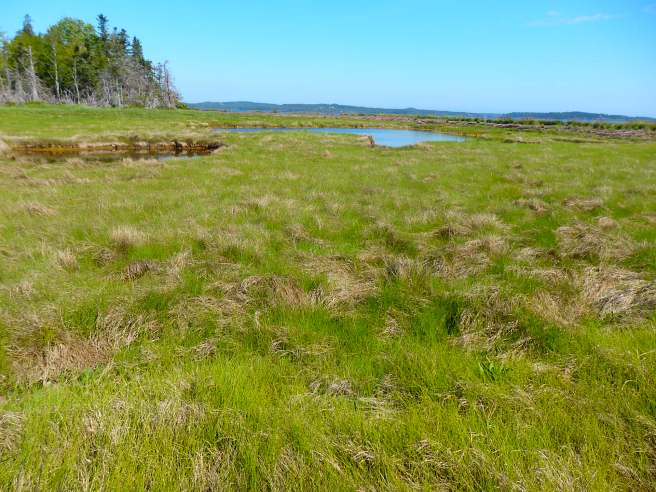
A saltmarsh can be explored up-close.


Here’s where that eagle nearly ran into me. It was being chased by an angry gull. Eastport is across the water.


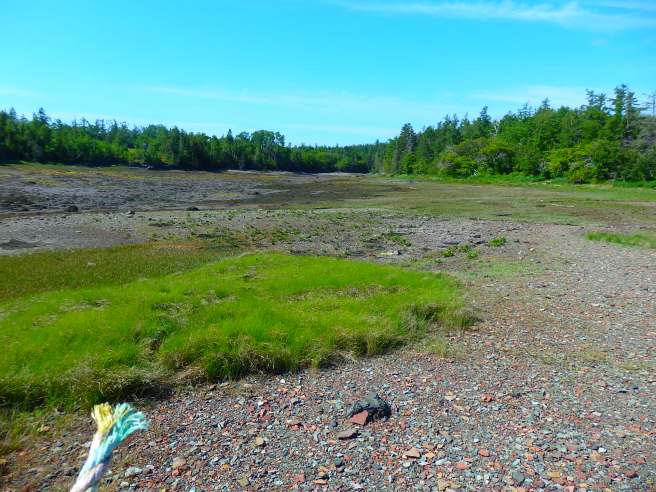
The beach trail culminates in this cove.


The villain raiding our suet feeder

I thought I was done with winter feeding of woodpeckers, grackles, and even crows, but all the action around the suet had me continue well into spring, allowing us to watch closely from the kitchen table. And then the holder started appearing open and empty.

I doubted that deer were doing it again, since the tube feeder next to it was still full. Deer, as I’ve discovered, detest a hint of cumin there, so the main birdfeeder’s gone pester-free for months.

Finally, I nailed the culprit, a raven that’s learned to pop the holder open, spilling the block of suet to the ground.

Well, this has given me a good way to get a close look at the large shiny-almost blue black bird, skittish though it may be. I keep thinking male?

The species is more imposing and beautiful than a crow. Somehow, I’m guessing it would take pride in being labeled a villain. Crows seem sociable by comparison.

Does Poe really sway our thinking here?

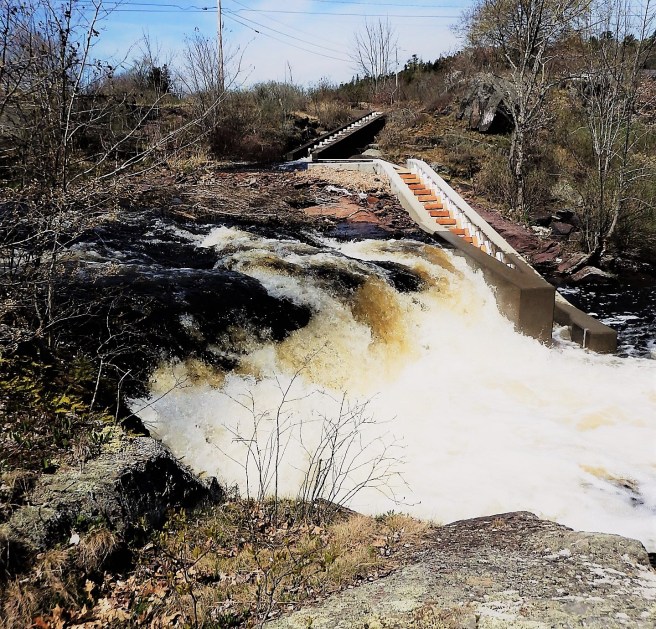
Pennamaquan falls and fish ladder

During their three-week run each year, 30,000 alewives a day press up this fast-moving fish ladder beside the small dam and waterfalls on their way to breeding grounds upstream.
The current is strong but the six-inch fish are stronger.
The added touch of the birdhouse makes me smile.
The Pembroke United Methodist Church overlooks the lake just above the dam, with some much bigger ones miles ahead.

Deer are everywhere in this city

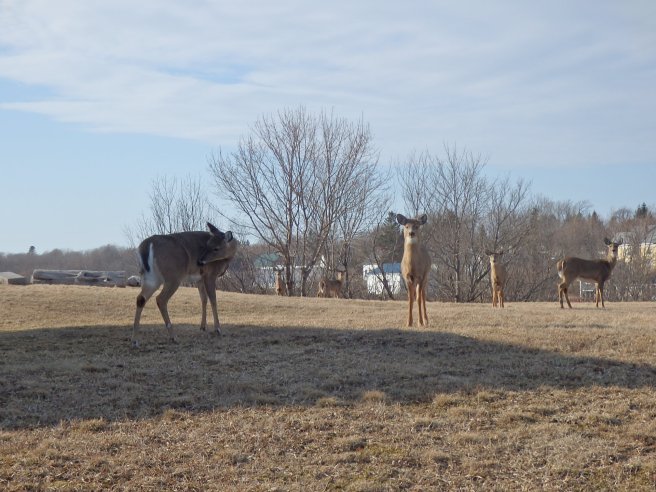
Eastport is a city, after all, and many of the homes are packed in close together. Not that it matters to our local wildlife.

Here’s one in our driveway.
And crossing over to our neighbors.
They frequent a large lawn overlooking Shackford Cove and the sea.
This yard’s only a few blocks from downtown.
And these critters are just a block from the Breakwater.

They’re so much a part of the place they even have their own Facebook page, Deer Eastport, and it is very active.

No matter how cute, though, they’re a gardening challenge. As are the raccoons.