As one neighbor says, ‘It’s my least favorite job’

His sympathy was much appreciated while I worked with one around the garden.

So here’s why I hate using a weed whacker.

  1. My shoes and legs or pants get splattered in green juice.
  2. As do my hair, eyes, and lips. (I don’t like slurpies.)
  3. Stems and blades of tall grasses and weeds often twist into a knot around the connection of the driveshaft to trimmer spool. Their tangling soon chokes the high-speed revolutions. Even with a razor blade, they’re hard to extract. I can spend more time clearing this than actually cutting the tall grasses and weeds.
  4. The two plastic trimmer cords – the part that actually cuts the greens – are hard to extend to the desired length or to replace when the spool’s empty. The procedures feel counterintuitive. And they quickly fray in actual usage.
  5. The “trimming” isn’t nearly as precise in its surgery as my wife presumes. It’s more like using a chainsaw than a scalpel.
  6. That means there’s collateral damage. Domestic flowers and vegetable plants are at risk, especially if I bump into something I can’t see behind me. Oops! Sorry.
  7. I have an electric battery-driven version, a huge advance over the gasoline alternative. Just the thought of having to deal with the fuel mixture, rip-cord starter, or other maintenance is enough to put on my to-hate list.
  8. The battery in mine is difficult to remove for recharging. It’s just too tight to get out without an extra set of hands. Help!
  9. It’s top-heavy, meaning that when I’m trying to clear those tangles in No. 3 or am trying to store it in the shed, it wants to roll over inconveniently or just fall over.
  10. They’re noisy, even the electric-battery versions like ours.

Would herbicides, which we don’t use, do the job better? (Satan, get thee behind me.)

Urban deer, oh dear

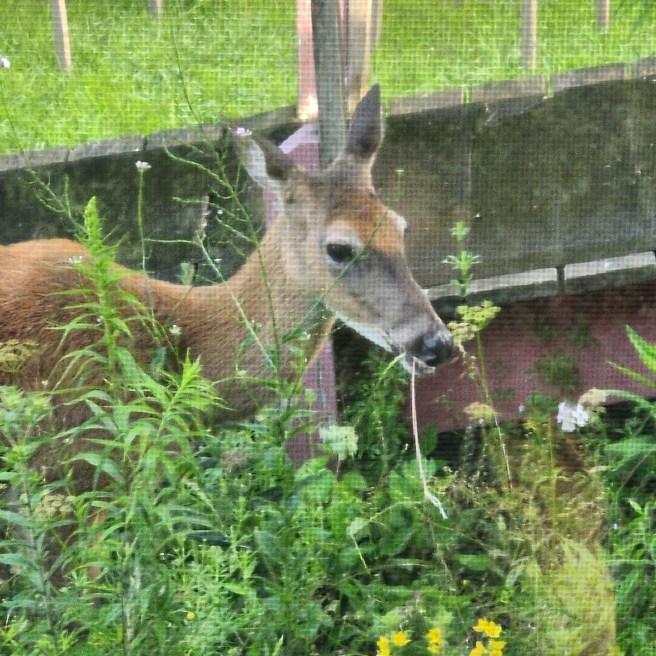
Eastport – centered on Moose Island – is one of many small cities being overrun by deer. You may have met some of the culprits here at the Red Barn.

Here are some random bits as a result.
  1. In the Wampanoag language, they’re known as “the ones with wet noses,” for the way they investigate the world around them.
  2. Why do fawns have white spots? I suspect it could be a good opportunity for a storyteller to develop. Along with the question of why fawns eventually lose them.
  3. They like apples. Man, do they. Some will dance on their hind legs in reaching for the branch overhead.
  4. They can destroy a garden overnight.
  5. That said, they’ll eat just about anything. One even swallowed a spigot on our bird feeder.
  6. Speaking of which, a bit of cayenne pepper in the feeder seems to repel them. As the adage goes, better late than never, regarding some lessons.
  7. They’ll eat out of your hand if you’re patient. Not that I advise that.
  8. Bucks get bumped out of the circle as they come of age.
  9. The most we’ve counted in our small yard at one time was ten.
  10. We’ve had an albino in the north end of town. I first thought it was a goat in the night.
Here’s a shot from our dining table. Or hers, as well.

Red squirrel jitters

Squirrels were a pestilence back in Dover, raiding our garden and devouring the crown molding in our barn, in addition to some damage to the house itself.

While deer are a problem here, we haven’t had squirrels.

But the other day, I looked up from my keyboard and saw a small red squirrel scampering across our brush pile.

A few minutes later, my wife, working in another room, called out to say she’d seen a squirrel.

“A red one?”

Yep.

They’re worse than the grays we had, in the opinion of many.

So far, at least, it hasn’t been back.

Cross our fingers. We really no longer see them as cute.

Lookin’ lush

Here’s a progress report on our raised, fenced-in garden experiment this year. So far, we’ve had no further problem with the deer, although they’ve been daily visitors to the back yard and neighbors lately, especially as small apples have been falling from the gone-wild trees.

The picture shows tomato plants thriving as they’re finally blossoming in our mostly cool climate, along with basil, calendula, cucumbers, and peppers.

The adjoining bed has been producing romaine lettuce, Swiss chard, parsley, and sugar-snap peas, while the leeks are coming long royally.

An island garden isn’t entirely quaint

I’ve loved the phrase, “island garden,” even before we relocated to Moose Island, Maine.

The resonance comes in a classic book of that title by poet Celia Thaxter from her efforts on Appledore Island at the other end of the state. Her volume is illustrated by the great American Impressionist painter Childe Hassam, an addicted summer visitor. He made some stunning paintings on the island.

My wife and I did make a pilgrimage to the site, which once included a hotel considered by many to be America’s first artists’ colony. Nowadays, you do need permission to land there – we arrived on a research vessel as guests of the University of New Hampshire, which shares a major ornithological center with Cornell in what had been a World War II watchtower and bunkers.

Moose Island, in contrast, connects to the mainland by a causeway – no need for a ferry – but it’s still an island, an element that grows in awareness the longer I’m here.

Celia’s text often laments the arrival of garden slugs on the previously uninfected island, a pestilence we certainly understand, even before relocating from New Hampshire.

Alas, we do have those slimy destructors here. Apparently, Celia was unaware of the advantages of using seaweed as a mulch, one that repels the offenders in both its fresh and dried states. It’s something I’ve previously posted on. And something I need to reapply here.

While her garden was mostly flowers, ours skewers more toward edible items. And that adds a further layer of offenders, as you’ve been seeing here: deer. The ones with voracious appetites.

The next steps

Filling the new beds with clean soil atop a landscape fabric and cardboard barrier against weeds and the tainted ground below takes shape. Our planting season here naturally runs late – early June still had overnight low temperatures in the 40s. So transplanting seedlings is running on schedule.

The plastic is to help warm the soil.

The upright frames are for peas, which will probably continue to produce through the summer, thanks to the cooler temperatures. Tomatoes, though, will be tricky.

The biggest challenge will be deer, as you’ll see.