Well, it’s actually in our yard, using bits of bark and other debris after I stacked two cords of firewood. This stretch can be pretty muddy in season, so the dry fill offers some relief.
In previous years, the netting we’ve used to keep birds and squirrels off the blueberries simply sat on top of the bushes. It tangled in the plants, and resourceful critters could still get at some of the berries. Last year we used fallen branches to create this rig, which kept the netting further from the plants. It made harvesting much easier, too – just lift one side as needed. How do you think it looks?
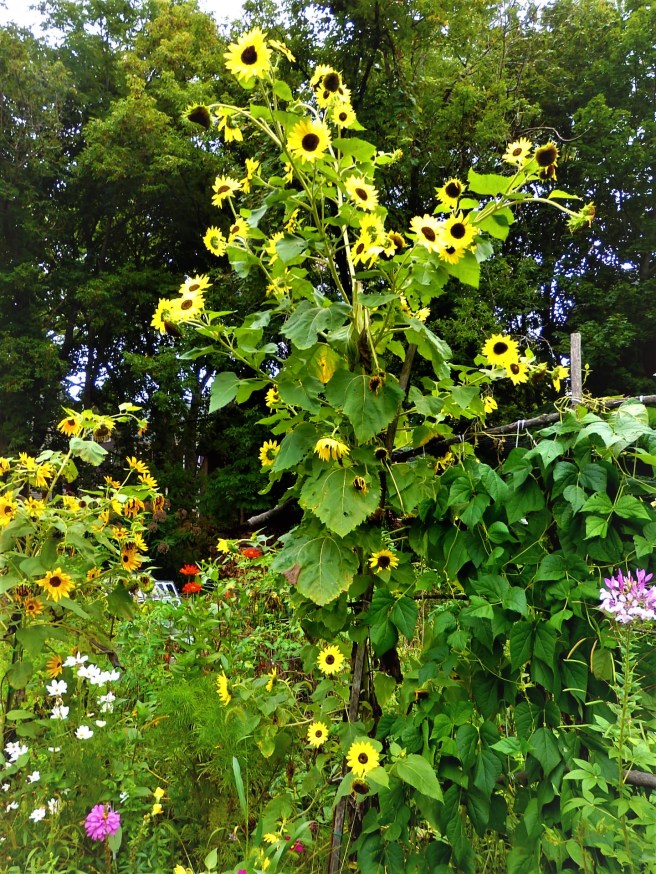
It’s been years since we last planted sunflowers, but we can count on them in our garden. They self-seed from previous years. The birds and squirrels find the kernels to be irresistibly tasty. We’re curious to see how our honeybees react when the scene gets to this point in a few weeks.
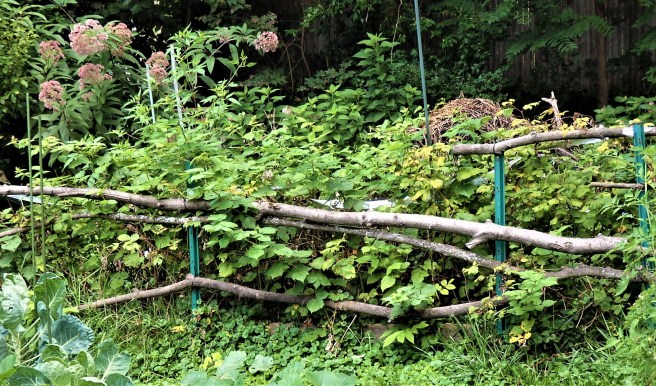
A couple of particularly nasty winter storms brought down a lot of big limbs in our yard. I really do need to get a chain saw to convert them to firewood, but in the meantime, I’ve put them to work in the garden. One place is in the row that lifts the raspberries away from the rest of the yard. Using the limbs here is much more satisfactory than the rope and wire of before – the branches keep the fence poles from pulling toward the center. How do you think it looks?
My wife couldn’t resist getting up close to the entrance to our new beehive and using her cell phone camera to record this. The portal is getting a lot of action during the day as the honeybees are take off in search of food and return. The one with the fat yellow legs is carrying a load of pollen home. The colony itself seems to be thriving.
Blame my elder stepdaughter. Or give her all the credit. She took up the cause last year by setting up two beehives at her house. Her mother and I then witnessed much of the excitement and drama that followed. It was contagious.
Jump ahead to this spring. We were encouraged to get our own hive, starting with the boxes and frames from another couple at Quaker Meeting, and then, drawing on said daughter’s expertise and guidance, we launched into our own “greening” venture. I painted the brooder- and honey- “deeps” or “supers” and the landing board all a light green, and set up a concrete-block base to discourage dampness, ants, mice, and our local skunks from invading. Positioned the entry to catch the morning sun, per said daughter’s instructions. And then she taught us how to attach sheets of what are called foundations to each of the frames that go inside the boxes for the bees to build their honeycombs on. Oh, there is definitely a whole new vocabulary for us to ingest.
The buzz really kicked in when our colony and queen arrived from Georgia earlier this month. We gingerly poured them into the hive, like a big glop, and they do seem to be settling in perfectly. Watching the details is fascinating, from their purging of the drones shortly after the big move and then moving on to the guard bees who expel “robber” bees trying to invade from other colonies while the workers get their bearings, explore, and arrive home with their legs brightly loaded with pollen. Who would have thought there would be so much personality in an apiary? We haven’t even gotten to the queen bee yet,deep within the hive – we hope.
We’re not expecting to collect any honey this year – we’d rather have the hive be well supplied for its first winter – but the benefits to our garden and the surrounding environment give us justification enough.
Yes, we got bees – honeybees!
Once the colony’s fully settled in, we’ll add another “brooder deep” to the beehive stack sitting at the edge of our raspberries. The structure off to the right is our compost bin.




 Jnana's Red Barn