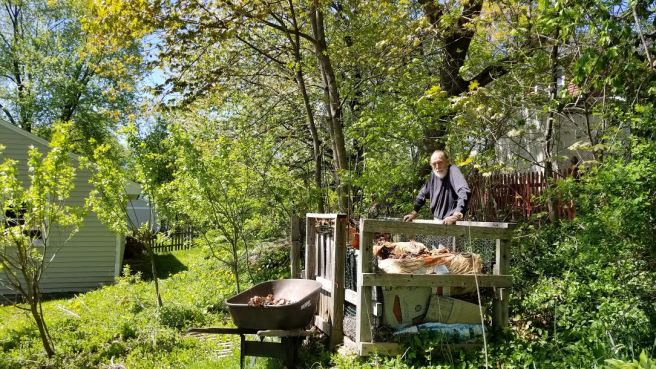
Flowers in the compost
You never know what we'll churn up in cleaning a stall
In our part of the world, it’s been a short summer. That is, it’s felt even shorter than usual.
Normally, our summer doesn’t kick in until the Fourth of July, and that was the case this year. We had an uncommonly dry June and some oppressively hot, humid days in July. OK, it’s global warming, we know that much – the climatic instability shift that’s no longer deniable to anyone who’s been paying attention to reality. That’s left August, which included a very dark, rainy week.
So here we are, in what’s officially the final three weeks – usually some of our best, if we can get outdoors to engage in them. That is, if you don’t have kids in school. (Unofficially, of course, the whole thing ends on Labor Day weekend.)
Here are 10 highlights from my Summer of 2018:
Even with a field guide, weeds can be hard to name. At least in polite terms. As a gardener, identifying them as weeds is easy enough, once they’re past a certain point of sprouting – they aren’t what you’re expecting and they’re growing faster than what you planted. Staying ahead of them is another matter, especially if you’re trying to be organic like us.
Here are 10 that have been especially problematic this year.
I wonder if the longstanding tradition of morning cleansing of marble steps at the front door in many inner city neighborhoods of Baltimore has survived the stresses of two-income families or single-parent households? Who knows when it started or in how many other locales it’s also practiced. This has been a custom of row houses, connected to each other – blue-collar communities, in fact – and not of detached suburban housing. And that makes the foremost difference.
These poems consider what women do and preserve – though not always exclusively. Yes, I’ve known women who bale hay or decipher monastic manuscripts, and I’ll also admit men can know nothing of bearing children or nursing. Yet, somehow, many women seem most at home around the kitchen, even if it’s nothing more than a teacup or a picnic. Even her garden, should she be so inclined, seems to extend from that table or the alchemy of her oven. And that goes for flowers, as well as vegetables and berries. (Remember, though: not all mothers and daughters can stand to be in the same kitchen at the same time, though they both be masterful cooks.)
Looking back on Baltimore, I remember my next-door neighbor, each morning in season watering the black locusts between our houses and the street. Maybe she did her stoop, as well. But the trees, which seemed to have always been there, were beautiful and timeless, as if spreading their own table.

~*~
For the poems, click here.
They won’t coexist. They strangle any competition. At heart they’re boa constrictors with stubborn roots. And if that won’t work, they’ll just suffocate it.
Mint comes close. We have both spearmint, east of the house, and peppermint west of the Smoking Garden. But sometimes it comes in handy. Especially for folks who want contractors bags filled to brimming.
~*~
What would you add to the list?

In the cardio aftermath, I was generally laying low, apart from my immersion in some serious revisions of my previously published novels.
And then? I looked at the window and saw an outburst of green – on the trees, especially. I had a sharp sense of having lost a big chunk of time.
We had some hard storms this winter, and some major branches came down from our trees. We were lucky they missed hitting roofs, cars, or outdoor furniture.
Still, it’s meant a lot of cleanup, and there’s more work to be done with a chainsaw.
The gardens, too, are behind schedule. I never got to the beach to collect seaweed, back before the seasonal out-of-town parking ban kicked in. Hauling those buckets and extracting the collected bags from the car trunk takes exertion, beyond what’s considered safe during recovery. I mean, I’d hate to take a nitroglycerin pill at the beach while working alone.
Nor did I get to some interior painting and picture-framing, as planned this winter. Some? There’s a lot.
We are watching some big changes downtown, especially where the city is carving away a hillside to extend our riverfront park and open space for new housing as well as open direct access to a hilltop park above, which is also being expanded and developed. This development, which crept up on me while I was recovering and not heading down that way to the indoor pool, will greatly enhance the central focus of the city.
Downtown is also undergoing the razing of an old retail block to make room for a five-story retail and worker housing structure. It will also eliminate what’s been an annoying traffic obstruction.
Glad I’m back in action. Wonder what else I’ve been missing.

The daily soup special at the family restaurant in my new novel, What’s Left, was one way to introduce the now widely touted practice of local sourcing, perhaps with a hint of organic gardening. Here it begins when Cassia’s great-grandmother and her sister make rounds of nearby farms, gardens, and orchards in search of fresh produce, eggs and dairy, and perhaps meat. (I never get quite that specific, but a quick brushstroke will do.) The action picks up with her parents’ generation and its back-to-the earth movement – one in which I suspect some bartering might have occurred. Used cooking oil, for instance, has found value as motor fuel for some farmers.
he could die now
flattened by wheels
electrocuted, biting a live wire
poisoned
or simple disease
or drown
all the complications, amassed
* * *
somewhere, in the limbs
what had riled him so early?
Blue Jay
squawking
could be confused
for squirrels
(What was the opera, anyway? Certainly not Cinderella
with her matching fur slippers)
unlike Cardinal
or those who keep a steady pace
each sunrise
each species how much bite off and chew
bury the rest now in a fury neighbors gain consciousness
take aim if they can brush the turret
* * *
Was she more rabbit or possum?
“Oh, but possums are meaner – they have more teeth
and they’re sharp” – well matched, in the end
* * *
knowing all the same they’ll be back
dawning alarm not of squirrels but outraged jays
surround a marauding crow
every jay within a mile or two assembles for attack
one after another, they dart at a wincing intruder
that finally departs, offended
already crows lay siege to a mockingbird nest
they pestered before destruction
try as you will, you can’ prevent much
even when striving for balance
still, you undertake what you can
alarmed, yes, and full of frustration,
load and fire the kid’s super-saturation water gun
startle a few squirrels raiding the bird feeder
knowing, all the same, they’ll be back
yet hoping he can prevent them
* * *
stripping the black walnut tree
after the strawberries and blueberries
all in their brief season
* * *
from the instrument he carries across thin snow
duty said nothing children, you know
domestic matters and adventures
of mice and squirrels and the manor
gingerbread, the squirrels and rabbits love to nibble
* * *
before the endless domestic encounters
Snakes in the basement.
Bees streaming
from the barn’s
loose siding.
I’ve lived many places:
I’ve lived nowhere
but the wind
or the workplace
until now.
* * *
keep the shell healthy for all within
he once thought, ignoring the empty fruit basket
he would learn there are jobs a man does
as if that, in itself, is sufficient qualification
what does he know now the world’s shrinking
save for trash removal? tell him, then, the eternity of hell
is different from the eternity of paradise
one just won’t end the other seems a flash
it’s no different than becoming conscious
abed they listen in winter night scratching inside old house walls
all the same she rolls toward him
he could depart as an old man baffled by suspenders to his pants
while his wife’s away having her hair styled
all along, his lady has been a holy terror as much as any
holy mother even so, they always get envelopes in the mail
* * *
he could be the squirrel at the bay window
or that whistle
Poem copyright 2015 by Jnana Hodson
To read the full set of squirrelly poems, click here.
picnic table with a block of snow 2-feet deep atop it
and a hole at the center
extraordinary deep purple in the Siberian irises
Quaker ladies abloom on the meeting burial ground –
even on the Friends graves in Pine Hill Cemetery
the ox-eye daisies I lifted from rock and sand
to transplant here – my wife’s beloved June flower,
the blossom smaller and more delicate than the Shasta
old woman across the street with her phlox
sunflower, yes
forest sunflower
jungle sunflower
and the jingle, from the neighbor’s
wind chime
Poem copyright 2016 by Jnana Hodson
For more, click here.
he’s not a bird
eating fish
or worms
see how frantically he spades
without weeding
how voraciously he climbs out
on the seeded maple twigs
* * *
incisor
domestica
rodentia
in residence
* * *
a squirrel with a martini
too much too often
fog in treetops before the wind blows
how do sparrows remember
once nested in this eave before rats or squirrels
found them out?
if it were only hickory nuts for high-fat content he’d
look shiny with such thought snickering abounds how is it
they acquire a taste for the Big Bad Wolf who bought the house?
* * *
nobody charged extra
for the vermin
* * *
in the walls they’re all wild creatures
of course, considering the jerry-rigged affairs
the preceding landholders had undertaken within this plot
(oh, the stories the neighbors were relating, all hinting
at more scandalous expansions now lost to posterity,
nobody could remember much in the way of detail,
except for the wild noises and all the coming and going)
the remaining evidence held no apologies
so what if we live
in cages of our own making? we still escape
into further flames or muck or fencing, all depending
on the company we keep
everyone’s a social creature,
the chattering
he’d considered birds was more or less
incensed squirrels, tearing about his estate
with that obscene flick of the tail
Poem copyright 2015 by Jnana Hodson
To read the full set of squirrelly poems, click here.

