
Netting around the blueberries
You never know what we'll churn up in cleaning a stall
After years of gardening in this place, her design became apparent, even in the raised beds.
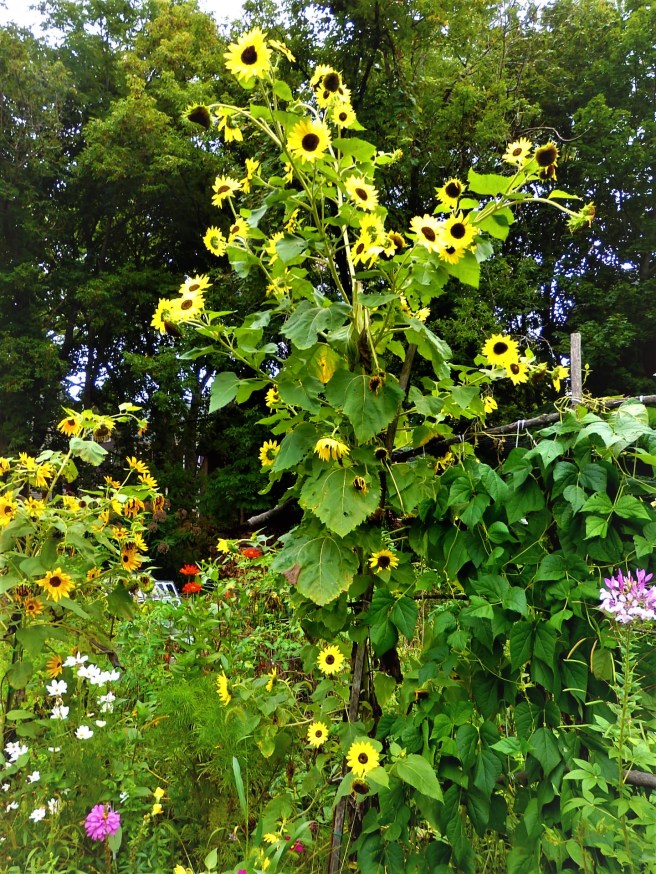
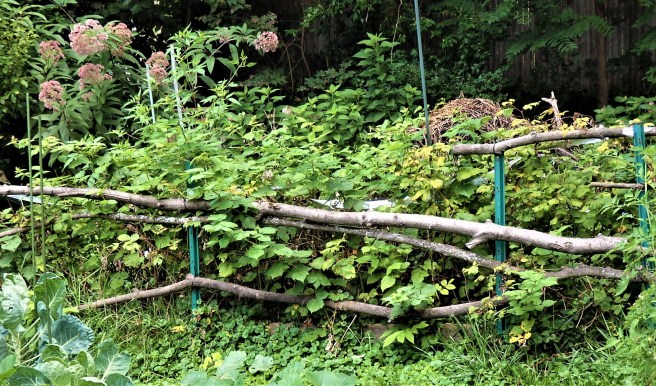
It’s not just adults passing on the sidewalk. We hear it from children, too.
Here we are, grumbling about the weeds.
But what others see is something else altogether.
Well, I find their pleasure in viewing our greenery refreshing.
Thank you, in more ways than one.

Blame my elder stepdaughter. Or give her all the credit. She took up the cause last year by setting up two beehives at her house. Her mother and I then witnessed much of the excitement and drama that followed. It was contagious.
Jump ahead to this spring. We were encouraged to get our own hive, starting with the boxes and frames from another couple at Quaker Meeting, and then, drawing on said daughter’s expertise and guidance, we launched into our own “greening” venture. I painted the brooder- and honey- “deeps” or “supers” and the landing board all a light green, and set up a concrete-block base to discourage dampness, ants, mice, and our local skunks from invading. Positioned the entry to catch the morning sun, per said daughter’s instructions. And then she taught us how to attach sheets of what are called foundations to each of the frames that go inside the boxes for the bees to build their honeycombs on. Oh, there is definitely a whole new vocabulary for us to ingest.
The buzz really kicked in when our colony and queen arrived from Georgia earlier this month. We gingerly poured them into the hive, like a big glop, and they do seem to be settling in perfectly. Watching the details is fascinating, from their purging of the drones shortly after the big move and then moving on to the guard bees who expel “robber” bees trying to invade from other colonies while the workers get their bearings, explore, and arrive home with their legs brightly loaded with pollen. Who would have thought there would be so much personality in an apiary? We haven’t even gotten to the queen bee yet,deep within the hive – we hope.
We’re not expecting to collect any honey this year – we’d rather have the hive be well supplied for its first winter – but the benefits to our garden and the surrounding environment give us justification enough.
Yes, we got bees – honeybees!

In our part of the world, it’s been a short summer. That is, it’s felt even shorter than usual.
Normally, our summer doesn’t kick in until the Fourth of July, and that was the case this year. We had an uncommonly dry June and some oppressively hot, humid days in July. OK, it’s global warming, we know that much – the climatic instability shift that’s no longer deniable to anyone who’s been paying attention to reality. That’s left August, which included a very dark, rainy week.
So here we are, in what’s officially the final three weeks – usually some of our best, if we can get outdoors to engage in them. That is, if you don’t have kids in school. (Unofficially, of course, the whole thing ends on Labor Day weekend.)
Here are 10 highlights from my Summer of 2018:
Even with a field guide, weeds can be hard to name. At least in polite terms. As a gardener, identifying them as weeds is easy enough, once they’re past a certain point of sprouting – they aren’t what you’re expecting and they’re growing faster than what you planted. Staying ahead of them is another matter, especially if you’re trying to be organic like us.
Here are 10 that have been especially problematic this year.
 Jnana's Red Barn