Moose on the loose

This was going to be about squirrels, my nemesis in Dover, but now I’m thinking of Bullwinkle and his kin.

After all, I am living on Moose Island, not that I’ve seen any in town yet. But then I’m not seeing many squirrels here, either. Instead, it’s mostly deer.

Now, for the star of today’s show.

  1. Moose are the biggest member of the deer family and, unlike the others, prefer to be solitary rather than in herds.
  2. A bull can weigh in at up to 1,500 pounds, while a cow can be up to 1,000 pounds.
  3. Their broad, “open-hand” shaped antlers (not horns) can stretch up to six feet end to end.
  4. Calves stay with their mothers for a year or more but are weaned at five months.
  5. Their mothers are quite protective and have been known to kill bears with their kicks.
  6. They’re adept swimmers and can trot at up to 35 miles an hour, despite their slow-moving, sedentary, and dumb image.
  7. They’re a road hazard. They’re drawn to the pavement for the salt that’s been spread to melt snow and ice. And then they think they can outdo a car or truck, not that they don’t do some serious damage.
  8. A bull can eat up to 71 pounds of food a day – half of it aquatic plants needed to balance the bark in their diet.
  9. The fall mating season includes energetic fights between bulls over a desired cow.
  10. Their hide is often covered with a blanket of thousands of parasitic winter ticks, which stay attached for up to six months, sapping a moose of energy, blood, and hair. They’re the leading cause of death in moose less than a year old and diminish adult cow reproduction.

Favorite canines from a non-dog lover

Eastport is filled with dog walkers, even more than Dover was, and their perspicacity in making the rounds umpteen times a day amazes me. What else do they do with their lives?

Don’t count me as a dog lover. I grew up having cats. You never step in their poo or take them for walks. And now, rabbits. Ditto.

That said, here are some dogs I’ve had to deal with, one way or another.

  1. Grimm. The one in Mike Peters’ comic strip. I had a small role in getting it rolling. Still love the caustic humor.
  2. Rin-Tin-Tin. A frontier mascot in a TV series we watched back in the black-and-white days of TV. Gee, how could I forget Rusty, orphaned in an Indian raid, much less the fact his dog was a then-exotic German shepherd or their home was a U.S. cavalry outpost? I always wanted a pair of gloves like the lieutenant’s.
  3. Lassie. Another TV star. Gee, when’s the last time you saw a collie? They used to be everywhere, in no small part because of this show.
  4. Silas. Our neighbor’s German shepherd back in Indiana. He appears in my novel, Nearly Canaan.
  5. Sal. The big pit bull my younger daughter and her roommate rescued from a shelter. An amazing animal who had one unacceptable quirk. This story ends sadly.
  6. Our neighbor’s Irish wolfhounds. They would hang over the six-foot fence separating our yards and howl mournfully. Maybe they knew their lives were doomed to be short, a problem with huge dog species.
  7. Blue. Maybe you know the song? “I had a dog and his name was Blue, bet you five dollars he’s a good dog, too.” Get me the Kleenex.
  8. Pluto. The mopey Disney cartoon character, not Roman mythological ruler of the underworld. Back to childhood, naturally.
  9. Simon and Schuster. A pair of basset hounds walked around here by an aspiring writer and her dutiful partner.
  10. Snoopy. Back to the funny pages, we have Sparky Schultz’ classic and patient observer of human folly. I didn’t appreciate him until he was nearing the end of his run. I think Mike Peters’ wife had a role in opening my eyes here.

Honorable mentions to Fang in Harry Potter or Toto in Wizard of Oz. If only I were a fan of those works.

And then there’s Argus, Odysseus’ faithful canine in antiquity, despite the fact the Greek hero hadn’t fed him for 20 years. Oh, for such loyalty anyway! Some commentators note a contrast to problems our hero will face with his wife.

Tell me about your dogs. Please!


Signs we’re reverting to ghost-town status

The indicators started showing up by the last week of August but are inescapable now. Eastport’s locking up for the winter.

As evidence?

  1. The passenger ferry to Lubec has already been hauled out of the water and is up on props in the boatyard for annual maintenance.
  2. The Tides Institute Museum is closed for the season, with the Eastport Art Gallery set to do likewise at the end of the month.
  3. I trot down to Horn Run Brewing and find it closed today. Gotta check the new schedule. Not that I expected its popular deck to be open all year. And other restaurants have curbed back as well.
  4. Nobody’s out on the Breakwater.
  5. Rosie’s hot dog stand is closed and its sign thanks us for a good summer.
  6. I haven’t seen a super yacht for a month, much less tied up at the dock.
  7. Most of the out-of-state license plates are gone, along with the luxury car models. It’s mostly Maine and New Hampshire now, and soon it will be about all Maine.
  8. Well, there is a sole convertible stubbornly zipping about – but just one, with its driver bundled up.
  9. There just aren’t as many folks around, period. At least the dog walkers are holding up their end.
  10. There’s an uptick in the number of houses for sale as some Summer People realize they can’t keep up with another year. And the places are staying on the market longer.

Our fisherman gets an upgrade

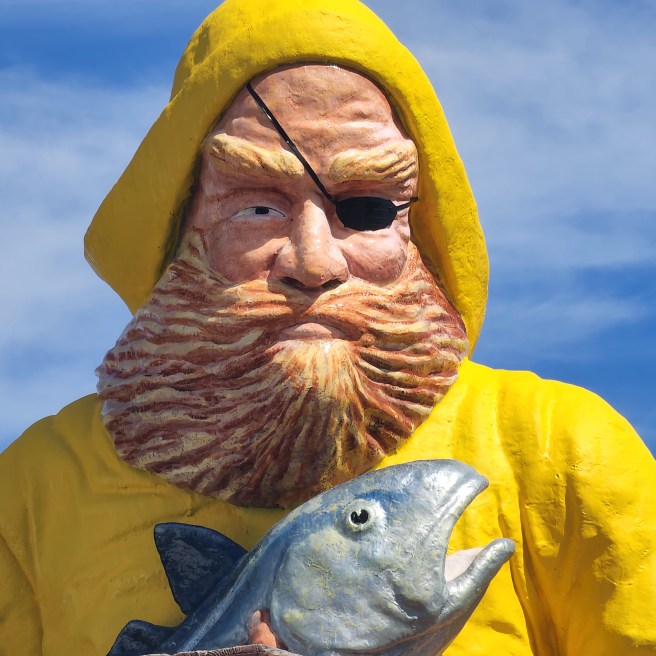
I thought the guy was kidding when he pulled up in town and confided that he was going to repaint Eastport’s iconic waterfront fisherman statue, changing the blue coat to a yellow slicker. I was sworn to secrecy at the time, but the next day, there he was, in full light, doing the deed.

The somewhat surreal, but shall we say fiberglass de facto emblem of the city, really got a fashion update. Or upgrade, in my opinion. Seems I’m not alone. Yes, that yellow slicker fits much better.

Just look.

My kudos to Patrick Keough of Seward, Nebraska, for something that even included an imaginative eyepatch.

Some folks, however, are seeing a similarity with the Gorton’s guy down in Gloucester on Cape Ann, Massachusetts.

I think they have that backwards.

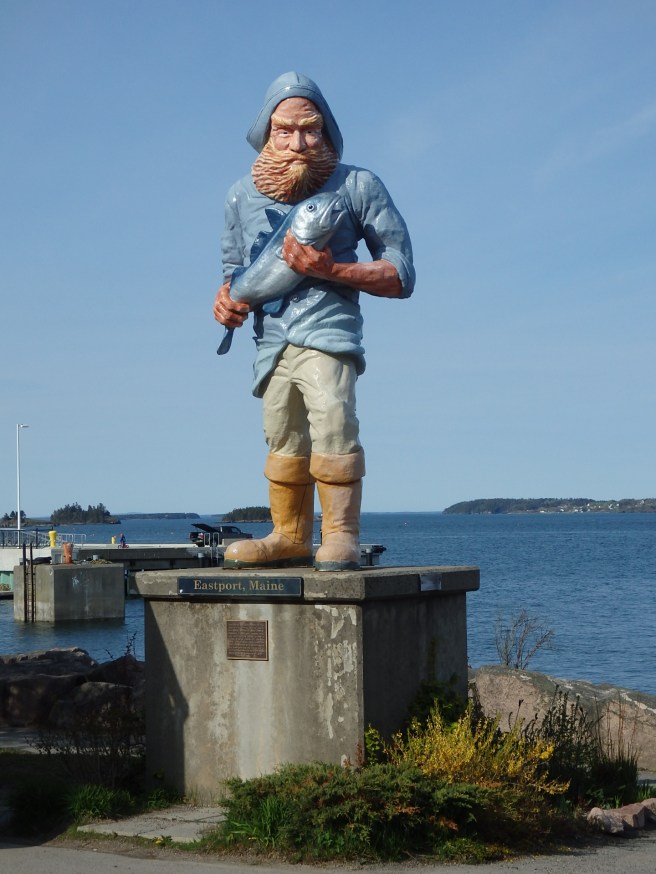
Well, here’s how he looked before. The figure was a leftover from a television series set in the town.

Reflecting on the character of New Hampshire

When I arrived in the Granite State 35 years ago, I expected to be spending a lot of my time in the mountains to the north, but that never really materialized. I’ll blame my quest for love, usually found down in Boston, in the opposite direction, back before I met the woman I adore.

Contradancing soon claimed a lot of my social attention, with regular events across the state, across the border in Maine, and especially in Concord and Cambridge, Massachusetts. Add to that all of my time hunkered down in my literary endeavors or Quaker activities, even before I started singing in an incredible choir weekly in Watertown, just outside Boston, or swimming laps daily once I’d retired from the newsroom.

Whatever the character ultimately is, I found sufficient nurture and inspiration to do some good work. Gee, that’s starting to sound like Garrison Keillor.

Each of the six states, by the way, has its own character despite the overall New England identity. In general, those New Englanders are friendlier than their reputation for aloofness contends. It’s just that they’re more reserved – respectful of your privacy – but open up with a sparkle, for the most part, given a hint.

So here’s what I learned while residing in Manchester and then Dover.

  1. New Hampshire isn’t as archconservative as I had expected. Not that it doesn’t have a lot of blockheads, but the place was definitely shifting, especially along the border with Massachusetts.
  2. A large portion of New Hampshire residents have roots in Quebec, and others in Ireland, providing a significant Roman Catholic presence. Both reflect the textile-mills workforce in the 1800s. But other ethnic minorities have thrived, too.
  3. At heart, the population is largely blue-collar in outlook, generally practical, but these days, half of them come from other states, especially Massachusetts.
  4. Some of us used to joke that the stereotypical New Hampshire male had a Harley and his wife or girlfriend had big hair. That wasn’t far off the mark. Add a snowmobile, more than downhill skis or hockey skates.
  5. Agriculture isn’t a major economic factor. There aren’t many large commercial farms these days. And what farming exists is typically diversified.
  6. There are relatively few large employers. The commute to Greater Boston and back each day is huge – that’s where the paying jobs are.
  7. That also means few deep pockets for the arts and charitable action.
  8. It’s the most perfect test market for presidential candidates we have. Forget trying to find the ideal demographics, this delivers.
  9. Avid Red Sox and Patriots fans abound, with Celtics and Bruins supporters close behind. Keeping up with the teams’ developments is socially important. College sports, on the other hand, hardly matter.
  10. It might not have a sales or income tax, but you still have to pay for public services somehow. And so your property tax or apartment rental rate will be a whopper.

Surprises about Eastport

Maybe I just didn‘t notice, but I don’t recall noting so many quirky sides in the other places I’ve lived. Maybe they’ll pop out when I review my old journals.

Still, there are things in Eastport I hadn’t anticipated. For instance …

  1. As far as birds go, it’s basically gulls and crows. Just listen. Even with bald eagles right overhead.
  2. In summer, it’s ten degrees cooler than the mainland seven miles away. In fact, I wore my shorts only three times last year – and two of them were when I was running around inland. Well, as far as that goes, I should mention how much I now perceive the fact I’m living on an island.
  3. Watching the fog roll in from the Bay of Fundy, either up from the channel by Lubec or down between Campobello and the islands just north of it. As well as watching spectacular sunsets from the other side of town, in contrast to the amazing dawns I face from my house.
  4. No nightlife. Apart from events at the arts center, the place pretty much settles in after dusk. And then rises early.
  5. No commercial net fishing. The haul is largely lobster, scallops, clams, and urchins – a delicacy in Japan. But we were also once the sardine capital of the world, which left a bigger impact than I ever imagined.
  6. The importance of smuggling in the port’s past, as well as shipbuilding.
  7. The impact of Dover on its early settlement. Many of the early settlers came from the Piscataqua watershed, and even those who claimed Portsmouth or Newburyport, Massachusetts, could trace their lines back to Dover.
  8. Horn Run Brewing and Bocephus. Two new businesses, each one run by an enterprising and delightful couple.
  9. Diver Ed. A long-time tourist attraction in Bar Harbor, with all of its Acadia National Park crowd, he pulled up anchor and brought his Starfish Enterprise to our Breakwater instead. As a natural ham, he knows how to entertain an audience, even otherwise reticent teens, while teaching them the wonders in our waters.
  10. The number and variety of wild apples. That helps explain the appearance of so many deer on the island. I’d call them wild, but (another surprise) have seen neighbors feeding them by hand.

A few things Mainely about lobsters

Somehow, lobsters have become identified with Maine the way maple syrup has stuck to Vermont, even though both are found abundantly in neighboring states and provinces. I won’t even get into moose in this discussion.

Here are some talking points.

  1. Unlike other varieties, ours are distinguished by having large claws. One claw, the crusher, is larger than the pincher.
  2. They have clear blood.
  3. They smell with their eight legs but have poor vision. Their four antennae help them locate food. They can also swim backward.
  4. They chew with their stomachs, which are located right behind their eyes. They lack teeth but have a “gastric mill” that reduces their prey.
  5. They live on the ocean floor and never stop growing, which they accomplish by molting. Some are known to be more than a hundred years old. In fact, they show no signs of aging and almost universally die of external factors.
  6. It was once a poor-man’s dish, typically fed to servants. Impoverished families sent their children to school with lobster in their lunch buckets and an envy of the richer kids’ roast beef or chicken.
  7. Lobster comprises 75 percent of Maine’s commercial fishery value. In 2016, a banner year, the state’s 6,000 lobster-fishers landed more than 130 million pounds worth more than $533 million.
  8. A traditional lobster pot or trap has two sections – a “parlor,” where they enter, and the “kitchen” behind it. But for much of the region’s history, they were more likely to be harvested by hand along the shore and tide pools, where they washed up after storms.
  9. Most lobsters are caught in the summer months, before the shellfish trot off to deeper waters where they’re harder to harvest. In Eastport, many of the lobster boats do double-duty each winter, rigged to drag the bay bottoms for scallops. A few even go after urchins.
  10. Maine commercial lobstering is tightly regulated – more than in neighboring Canada – and licensing involves a long waiting list. You’d better apply well before your twenty-third birthday if you’re interested. Even if your dad still has his boat.

Why Maine’s blueberries are special

Across the country, pumpkin flavoring seems to infuse about everything on the menu come October, and something similar happens every summer in Maine with blueberries. The tourists and summer people, especially, seem to eat it right up. (Err, couldn’t help myself there.) So it’s not just lobster they come to devour.

Here are some facts about Maine’s in relation to the rest of the nation and world,  mostly.

  1. The local brewpub calls its obligatory blueberry ale Skul Clothes. The name puzzled me until I was told that’s how kids traditionally earned the money for their school clothes each year, at least before mechanized machines took over most of the patches. “It’s hard work, down on your hands and knees,” as one recent high school graduate told me. “But the pay’s good.” After that, I could tell the locals who walked in for the first time, looked at the offerings on the chalkboard, and broke out in a grin. They’d all done it.
  2. Ours are lowbush, wild, unlike the highbush varieties cultivated elsewhere. We lead the world in lowbush production, though it’s a drop in the bucket compared to the highbush harvests of British Columbia, Oregon, or Washington state. While Atlantic Canada produces half of the world’s wild blueberry tally, that covers more than a single province – Nova Scotia is the leader there.
  3. Lowbush berries are smaller but more flavorful, in our humble opinion.
  4. They’re also preferred in making blueberry wine.
  5. Blueberries are one of the few commercially-available fruits native to North America. The First Nations, some of whom called them star-berries for their blossoms and the tiny ring at their base, have been eating them for at least 13,000 years
  6. They top the list as an antioxidant and are rich in Vitamin C and even manganese.
  7. Wild blueberry patches are burned every two years.
  8. Wild blueberries freeze in just four minutes.
  9. Some research indicates they counter memory loss in aging. I’ll have to remember that. They’re also good for the heart, cancer-risk reduction, and lowering blood pressure.
  10. I like mine fresh, with yogurt or cream. Pancakes, muffins, jams and jellies come next.

A few memorable camping adventures in my life

I’ve mentioned the impact of my rogue Boy Scout troop on my life via hiking. Camping was related. We used homemade square tarpaulins – three rows of muslin our mothers sewed together that we then dyed and waterproofed.

Here’s the general idea for pitching a trail tent.

We called them “trail tents,” though “tarp tents” seems to be more universal. They could be set up in any number of ways – a two-sided triangle with the front open was most common, using a second one as the ground cloth – or in good weather we could even roll our sleeping bags into one and stretch out in the open.

We took pride in our primitive camping abilities.

Our vintage umbrella tent was like this, with the poles inserted along the ridges inside.

My family, on the other hand, had a clumsy and often smelly “umbrella tent,” so named for the way you had to set it up from the inside and then remove the aluminum center post – well, they’re now called “cabin tents,” and apparently more flexible.

I inherited the tent and used it for many of my escapes in the Pacific Northwest, my complaints aside. It got a lot of miles over the years.

The result in either case was some memorable opportunities to get closer to nature. Among them:

  1. Family summer vacations at Indiana state parks, especially Spring Mill with its limestone caves; Natural Bridge in eastern Kentucky with its old railroad tunnel at the base of a mountain with a stone arch at the top; Mammoth Cave in Kentucky; and Lincoln’s Old Salem in Illinois.
  2. There was also a Florida trip we shared with a Chattanooga family Mom and Dad were fond of from his Army-Air Force days. At age 12, it was my first exposure to the ocean and a Southern belle a year or two older than me. Our trip back included a night 17 miles back from the highway in Okefenokee Swamp in Georgia, where we were surrounded by masses of mosquitoes, more than a few three-legged deer (the result of encounters with ‘gators), and raccoons that could open the doors to the porches of the camp headquarters and then raid the top-slider Coke coolers. Let’s say simply we heard a lot of eerie sounds in the darkness and escaped with our lives once the sun rose through the Spanish moss.
  3. My first time in a trail tent was shared with another neophyte. We proudly set up our tent, tying the front line to an Osage orange tree – I remember the strange color when we split firewood. Alas, a storm blew in during the middle of the night and pulled up some of our stakes. I rolled enough of the ground cloth around my sleeping bag to get through the night. Not so, Jackson. He nearly froze and his bag the next day must have weighed a hundred pounds. After that experience, I always checked the wind direction before deciding where to raise the tent.
  4. Another Scout outing, remembered vaguely, was in May or June in a farmer’s woodlot. It simply felt magical, nothing like a designated campground.
  5. Our troop joined one or two others in the summer at a site in Lake Vesuvius State Park near Ironton, Ohio. This time we used wall tents, but it was still primitive. The park had the remains of an early stone blast furnace, and we spent a day in rowboats exploring the lake. One fall, we returned to plant trees in a strip mine. I’ve hated that form of mining ever since.
  6. Out-of-state hiking trips also included overnights, usually two. I especially remember those of the Lincoln trails and others around Lexington, Kentucky. And there was the near-perfect night in Indiana when we rolled out under the stars only to be interrupted at midnight and having to hustle our gear under a nearby picnic pavilion when a harsh storm blew in. And then the rangers showed up and scolded our scoutmasters. But the next morning, and for much of our drive home, we saw tornado damage.
  7. Roan High Knob, at the end of our week on the Appalachian Trail, turned into a festive array of unconventional trail-tent setups. It was like a camel caravan had moved in. At least until the big thunderstorm and repeated deluges.
  8. Later, as an adult, there was a week circumnavigating the Olympic Peninsula, an event I celebrate in a longpoem.
  9. Also in Washington state, a week I spent in the North Cascades – where poet Gary Snyder, especially, wrote extensively as a forest fire lookout. Silver Star Mountain was especially memorable and worth a return with my then-wife.
  10. Another week in the North Cascades included time at the base of Mount Shuksan and Mount Baker. Washing my dishes in the small river, I recognized gold flecks in my bowl – not enough to pan, if I could, but the valley had been the scene of a big gold rush once upon a time. I also noticed that the river level kept rising through the day, a result of melting snow and glacier ice upstream, up above me.
Imagine opening your tent flap and seeing this. I did, in the North Cascades.

Curiously, I haven’t camped since 1980, though there was a week I spent in a spartan, bare-bone cabin near Lake Sabago, Maine, in October ’99. That’s when I learned to canoe … and to steer clear of the middle of the water when it’s just me all alone.

Don’t overlook Baltimore

There are reasons it’s also known as Charm City. Or, as they say of neighboring D.C., it has Northern charm combined with Southern inefficiency. By the way, don’t blame me for that perspective.

USS Constellation, built in 1855, graces the Inner Harbor. (Photo via Wikimedia)
  1. Baseball great Babe Ruth was born here (1895) and poet Edgar Allan Poe died a drunk on its streets (1849).
  2. Speaking of baseball, the Camden Yard ballpark spurred the return of smaller professional arenas to central cities across the continent. Now, if the Birds could only fly higher than the Yankees or Red Sox in their division. They really are doomed in that association.
  3. Speaking of birds, the Baltimore Oriole got its name because its colors resembled those of the coat of arms of Maryland founder Lord Calvert. I have no idea about their religion, but he was an advocate of religious liberty.
  4. The port was second only to Ellis Island in the number of immigrant arrivals in the 19th century. And while the city sits below the Mason-Dixon line and has a Southern outlook, it also has a strong German presence and Northern connection strengthened by the Baltimore & Ohio train tracks.
  5. With his profits from those rails, Quaker Johns Hopkins founded the nation’s first research university in 1876. Today it and its related hospital and institutions are the state’s largest employer.
  6. The metro area is also home to McCormick spices. You can smell it in the humid spring air.
  7. The National Aquarium crowns the redevelopment of the Inner Harbor as a popular destination. The waterfront is also graced by the tall-masted USS Constellation of Civil War glory.
  8. American Methodism was founded in 1784 at the site of today’s Lovely Lane church. And a 1789 conference at Old Otterbein Church led to the formation of the United Brethren denomination of German-Americans (it merged in 1968 with the Methodists, giving them the “United” in today’s name). Also in 1789, the nation’s first Roman Catholic archdiocese was founded in the city; its cathedral was finished in 1821. It even produced a saint, I believe.
  9. A flag waving over Fort McHenry during the War of 1812 inspired Francis Scott Key to write the lyrics to the National Anthem, the one that was much in the air yesterday, but the music’s from a much older British drinking song. How ironic, especially since it challenges even the most professional singers.
  10. The city doesn’t show up in my fiction, despite my living in the inner city’s Bolton Hill and suburban Owings Mills for three years. Even if the place is so hot and humid you have to turn on your air conditioner on the same day you turn off your furnace. Or, as they say of neighboring Worshington, it’s built over a swamp you know.