We’re off to a most uncommon country fair

There’s no Ferris wheel, no cotton candy, no neon lighting, no celebrity performers – for years there wasn’t even coffee, until fair-trade organic became an option – but the three-day event still draws roughly 60,000 folks to a two-lane road toward its grounds in the rolling farmland of central Maine.

For the first dozen years I lived in New Hampshire, I heard about the most recent gathering and spotted its current T-shirts at contradances and farm markets afterward, but my work schedule didn’t fit attending.

And then, newly remarried, I took some precious vacation time that gave me a first-hand experience – including the now legendary traffic jam that rivaled any big city. Once there, we encountered a number of people we already knew, even though we lived three hours away.

Another dozen years passed before we returned, from the other direction, and this year’s an encore.

It’s the Common Ground Fair, a three-day weekend affair held a few weeks after Labor Day – more or less an equinox celebration held by the Maine Organic Farmers and Gardeners Association, or MOFGA,  the nation’s oldest and largest statewide organic organization in America.

It’s like a Whole Earth Catalog come to life. Of, if you’ve ever wondered where the hippies went, a good place to see places the movement has evolved and continues in practical ways.

Not all of it’s back-to-the-earth, either. Sustainable living, local economies, and spirituality augment the emphasis on organic agriculture and food use. There’s even a workshop on organizing a labor union.

Here’s hoping for some prime fall weather.
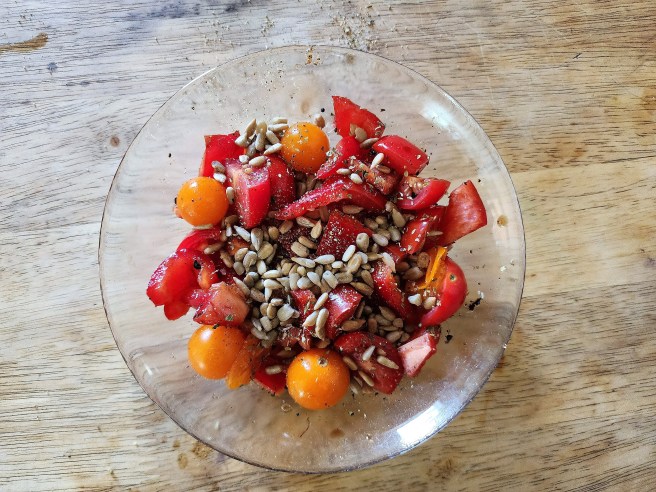
Does anyone else savor cornmeal mush?

It was a favorite breakfast when I was growing up in Ohio, but not an everyday offering.

First, it would be served as a hot cereal, and afterward, after hardening in bread pans, it would be fried in slices and served in melted butter and syrup.

I still remember the reaction when I was head chef (briefly) at the ashram and served it for brunch. It was vegetarian and fit into that part of our yoga practice. But half of the staff and guests were openly baffled. What is this stuff? It wasn’t anything like the buckwheat kasha they’d introduced me to. The other half, though, delighted in it.

It’s still not an everyday dish in my household, but I still relish the moments when it comes up.

My wife, of Southern roots, is more familiar with grits – a variant – and also the Italian polenta, which is much more expensive for no understandable reason.

The one place I’ve seen it on the menu is at the Bob Evans restaurants, where it’s deep fried and typically sells out early in the day.

Cornmeal does show up in my novel The Secret Side of Jaya and on many supermarket shelves, especially under the Hodgson Mill label, reflecting some distant relations of mine who went back to inserting the “g” into our surname.

So where, if at all, do you use or eat cornmeal? It was a basic foodstuff of much of early America. 


Opa!

In relocating from Dover, I do miss its annual Labor Day weekend Greek festival – the food, conversations, dancing with live music, and overall happy vibe. What they call kefi.

For Greek Orthodox congregations across North America, these events have become a traditional way of celebrating their culture, welcoming the surrounding community to sample it, reenforcing the bonds of their membership, and conducting some needed fundraising, sometimes for local charities as well as the church itself. The deep commitment of the volunteers and the overall organizational skill always amaze me, and it has been fun to be part of the food-serving line some years.

Earlier in the summer, neighboring Portsmouth usually has its own, similar but also with differences, and both weekends draw big crowds, jammed parking, and partisan comparisons. Dover’s has free admission, unlike Portsmouth, which has more dance addicts.

The festivals closet to Sunrise County are in Portland and Lewiston, downstate five or so hours away. Or, for variety, Halifax, Nova Scotia, which has a four-day schedule but is a six-hour drive away – or seven if you take the shortcut ferry ride across Fundy Bay.

~*~

For the Labor Day weekend, Eastport has a much more low-key observance, the Salmon and Seafood Festival.

Things get wilder the following weekend, then the pirates invade for what’s our blowout to the summer tourist season.

What are you doing special for the holiday weekend?

Our annual salmon festival has me thinking of sardines

The American Can Company factory, now a hulk out over the water, had a daily output of more than a half-million cans for sardines. It employed 300 people. It was at the end of the line for the railroad, too.

In the adjacent canneries, sardine-packing women had hands moving so fast in cold water you saw only a blur, according to a friend who was a teen at the time and couldn’t begin to keep pace when he worked there.

I still have no desire to eat a sardine, though. Consider that the statement is coming from someone who’s learned to appreciate anchovies in his old age.

The Salmon Festival always takes place over the Labor Day weekend. 

Refreshing our salmon pens

Sunrise County – more formally, Washington County, Maine – and neighboring Charlotte County, on the facing waters in New Brunswick, are the center of some serious salmon farming. Cooke Aquaculture, a pioneer in the field, is a major employer in both places.

Without getting into the surrounding controversies, millions of salmon are shipped to market from these farms and are one reason the protein-rich anti-oxidant species is no longer a luxury item for most people. It’s a surprisingly healthy option, if you’re so inclined to investigate.

The local enterprise has even spawned Eastport’s annual Salmon Festival over the Labor Day weekend, which includes narrated boat trips to farms in our coves, typically clusters of 16 pens, and explanations of their care. Some locals describe the event as drawing an NPR kind of crowd, in contrast to our Pirate Festival the following weekend, which may be seen as more of a NASCAR following or its biker equivalent. (Please stay tuned.)

What I’ve found fascinating this summer is the flock of working boats busy around two of the farms in our fair city. The pens have been vanishing!

The reason, I’ve been told, is that every few years, the pens and their nets need to cleaned and repaired. And then they also lay fallow for a season or two.

Don’t know about you, but I’m impressed. Each pen starts out with a million and a half baby salmon. Maybe more.

And the filets we get do make for some impressive sashimi – raw fish that are a favorite in Japan, expensive in restaurants, and surprisingly easy to make at home. If you’re interested, check out some recipes online. My between-the-lines improvised sauces remain delightful, at least as far as me and my sons-in-law are concerned. (Pardon the English there, I’m yielding to their generation. Those boys really can skin a fish, by the way.)

From here, we’re most curious to see about how Cooke’s efforts at oyster and mussel harvests from our waters are also progressing.

The advice to eat local remains a spiritual discipline, as far as I’m concerned, not that it’s always practical where I’ve lived.

Now, what’s on your plate tonight?

Much of what our commercial fishermen catch isn’t ‘fish’

Eastport’s fleet doesn’t use nets to fish. Rather, they use dragging gear or baited traps, mostly.

Technically, the bulk of what they catch isn’t fish, which are vertebrates, have gills, and lack limbs with digits. Fish fall into the scientific superclass of Osteichthyes, as noted in a previous Tendrils.

Shellfish, meanwhile, are invertebrates, have external skeletons, and are classified as molluscs, crustaceans, and echinoderms. See a more recent Tendrils.

So today, let’s look at what the local commercial fishermen catch. Or, in some cases, used to.

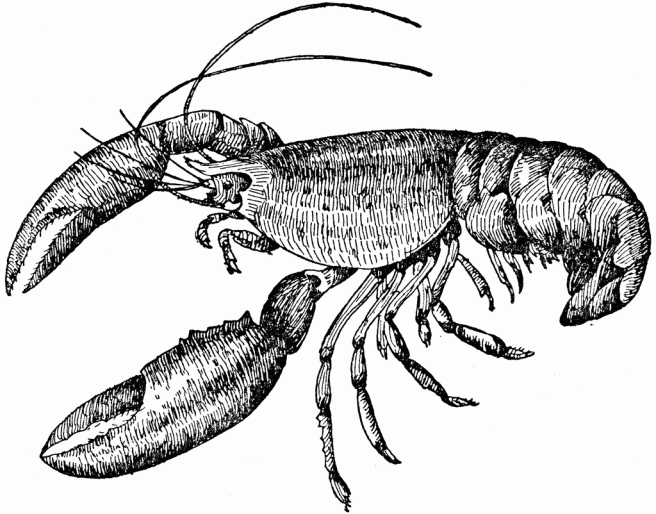
  1. Lobsters. The mainstay.
  2. Scallops. Some of the world’s best, in our humble opinion. The haul, though, is tightly regulated.
  3. Clams. While many of these are raked on sand or mud flats at low tide, others are dredged by boats at sea. They add up to the state’s third most valuable fishery.
  4. Urchins. A specialty niche making a comeback. Japanese foodies love them, but the market’s tricky.
  5. Crabs. See a previous Tendrils.
  6. Alewives, herring, and mackerel. Often caught for use as lobster bait.
  7. Shrimp. Well, not anymore, but we can keep hoping the stock will rebound.
  8. Mussels. There are some interesting attempts to establish farmed beds around here. Now that would be lovely.
  9. Cold. I’m talking about the crusty fishermen. They do bundle up in the depth of winter, though, and rarely complain.
  10. The sunrise. They head out early, all seasons of the year. Some of the views they catch are unbelievable.

Let’s not overlook salmon, a major product here, which are farmed in pens and harvested directly by special boats using tubes that work something like a giant vacuum hose. Not kidding.

Lookin’ lush

Here’s a progress report on our raised, fenced-in garden experiment this year. So far, we’ve had no further problem with the deer, although they’ve been daily visitors to the back yard and neighbors lately, especially as small apples have been falling from the gone-wild trees.

The picture shows tomato plants thriving as they’re finally blossoming in our mostly cool climate, along with basil, calendula, cucumbers, and peppers.

The adjoining bed has been producing romaine lettuce, Swiss chard, parsley, and sugar-snap peas, while the leeks are coming long royally.

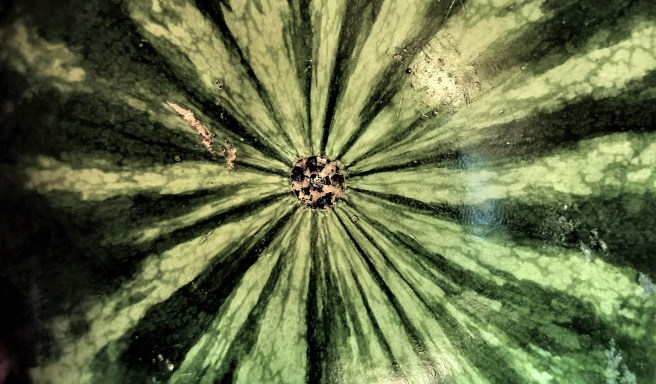
Does anything celebrate summer more than a watermelon?

And here I was about to investigate all kinds of melons, starting with cantaloupe.

That said, just consider:

  1. A watermelon is one of the few foods to be classified as both a fruit and a vegetable. Wish I could count it twice on my daily dietary requirements but guess that would be cheating.
  2. It’s a relative of both pumpkins and cucumbers.
  3. It’s far and away the most popular melon in America.
  4. There are more than 1,200 varieties, but the seedless hybrids are the only ones you’ll likely find nowadays at the market, at least in the USA.
  5. Those seedless versions aren’t genetically modified. Technically, they’re simply sterile with white seeds that are perfectly safe to eat.
  6. Watermelons originate in Africa and have been cultivated in Egypt for 5,000 years. That’s why they really do need a long stretch of summer.
  7. Based on weight, watermelon is the most consumed fruit in America.
  8. It’s 92 percent water yet rich in vitamins and contains only six percent sugar. By the way, there’s no bad fat or cholesterol.
  9. Its flesh isn’t always red – orange, green, yellow, or white are other options.
  10. In Japan they’re grown in glass boxes to maintain the unnatural cubed shape.


Our old garden has been obliterated

People used to walk down our street in Dover just to admire our garden. They told us how much pleasure and peace it gave them. It also attracted a range of wildlife, including hummingbirds, butterflies, or the occasional turkey or fox.

Throughout the year, the garden also led to many photos you can still find here at the Red Barn.

It was, by many standards, funky. The weeds were never completely controlled, but it was prolific and made good use of what we sometimes called the Swamp, after its mucky clay soil in late spring and early summer. Our pet rabbits delighted in much of what we picked there, too.

The new owners, alas, have bulldozed all that. The strawberries, raspberries, blueberries, currants as well as the raised beds and shrubbery screens – gone. Twenty-years of reclaiming the once tired soil and then dining well as a result – gone. Naturally, we’re lamenting, knowing how much more they must be spending on groceries that won’t be as fresh or tasty.

We have to recognize, of course, that we’ve left all that behind and no longer have a say in the matter.

But we still feel sad or even a tad angry. Ahhh!