Tag: Food
Clammer at work on a tide flat


Wait till the tide rolls in.
Creative leftovers

Sometimes food is even better the second or even third time around. In this case, Brussels sprouts with homemade croutons and grated cheese form a main luncheon course.
Heavenly perfection
Here’s how our Pascha repast looked last year, when the Eastern Orthodox Easter observance came two weeks earlier than this year’s.
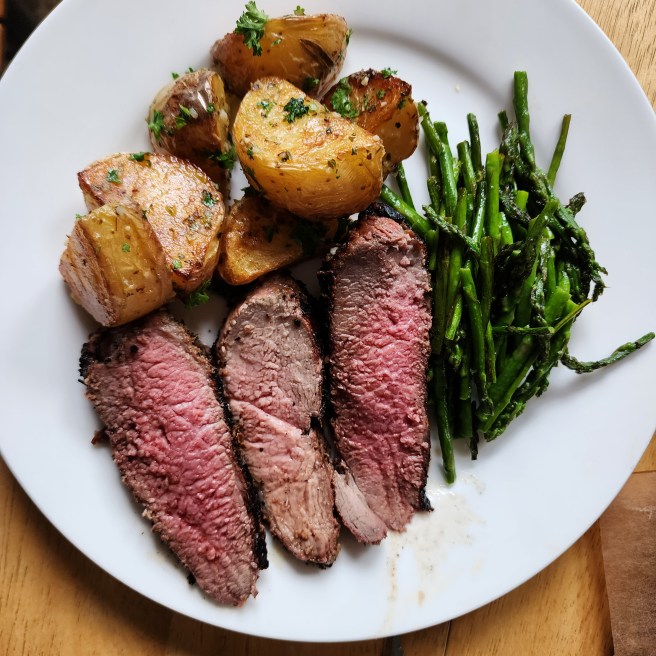
Grilled leg of lamb, medium-rare, roasted Greek potatoes, and fresh asparagus suit me as a perfect follow-up to the Eastern Holy Week observations. Or the marathon, as some justifiably refer to the sequence of services.
The quartered, peeled potatoes were coated with a mixture of olive oil, lemon juice, garlic, oregano, and fresh rosemary and placed on a small baking tray that had been sprayed with oil to make the cleanup easier. When done, the crusty exterior covered a hot creamy interior that melted in the mouth. As my late German mother-in-law would have said, this is better than God living in France.
Let me say I’m looking forward to another round today, fully aware of the glorious experience awaiting those who have observed the nearly seven weeks of strict dietary restrictions they call fasting. Truly.
No, tomatoes don’t all taste the same
The first year I witnessed the gardener in our household sprout and then transplant a dozen or so varieties of tomatoes, I was perplexed. Foolish me, I thought tomatoes were pretty interchangeable. Not so by the end of summer, when I had discovered how much each variety had its own identity. Some ripened earlier than others, a major consideration in our short growing season. Some were firmer while others were juicier. Each variety matured in its own size and shape. Trying to describe the range of flavors could soon sound like a wine tasting commentary. So far, we’ve had nothing that has delivered a hint of slightly warm asphalt, which seemed to be a plus for one wine critic. We’ll save you our own take.
Also important to us is disease and blight resistance. New England can be a difficult region for tomato growers.
Here’s a sampling of what we’ve cultivated, eaten, and even dried, canned, or bagged frozen.
- Goldie: A large, deep orange, slicing beefsteak fruit. “The perfect tomato,” as I blogged back on August 26, 2021, touting it for its starring role on my beloved sandwiches. This heirloom variety is one of the last to blossom and bear harvest for us, but it’s definitely worth the wait.
- Pruden’s Purple: Valued as being one of the first large tomatoes to mature (72 days), this firm wonder has a distinctive deep pink, ridged appearance. It also contains few seeds. The flavor is described as nicely balanced between sweet and tart.
- Brandywine: A very popular large heirloom, this one generally matures in 80 to 90 days. Many folks consider it the tastiest of the lot. Its leaves resemble potato plants more than tomatoes, and the heavy fruit means the plants need a lot of support.
- Yellow Brandywine: A gold-yellow variation created in 1991 from the famed Brandywine heirloom, this beefsteak weighs in at up to two whopping pounds a globe.
- Sungold: These tangy sweet golden orange cherry-size tomatoes are among the earliest to arrive for us – within two months, supposedly, though for us that meant early August last year – yet continued to deliver through September. Harvesting at peak can be tricky, though: a shade too early misses the glory, but a shade too late and they start to spoil. Their flavor is described as intense and sugary-sweet, a delightful addition to salads. They form in clusters of ten to 20 tomatoes on a vine. Add to it the red Glacier, another cherry tomato that arrives early and continues valiantly into autumn.
- Juliet: This small, elongated, prolific paste tomato has been a true workhorse for us. It freezes well, providing a foundation for soup and sauces throughout the winter. Lately, we’ve augmented this one with Plum Regal, primed for the end of the season; Amish Paste, a larger elongated plum tomato that also works well for soup and sauces; and Roma, an egg-shaped three-incher prized for making paste and sauces.
- Opalka: At the larger end of the paste tomatoes, this Polish entry grows up to five feet tall and has irregularly-shaped fruit up to six inches long. Tasters at Fedco Seeds described it as “an oasis of flavor in a desert of tomato hell,” “a pleasing texture and good aftertaste lingers,” “round and mellow flavor… full-bodied.” As I was saying about critical taste analysis?
- Cosmonaut Volkov: Back to the one-pounders I love for tomato-and-mayo sandwiches, this slightly flattened beefsteak is named for a Russian astronaut who died returning from space. It can go mushy if overripe, though.
- Omar: Or more accurately, Omar’s Lebanese, which was introduced in 1996 via a Lebanese college student named Omar Saab. Typically weighing in at up to 1½ pounds apiece, the fruit sometimes ambitiously reaches three or four pounds. The flavor is described as “multidimensional sweet.”
- Copper Beauty: An elongated and very tasty small tomato, this one still has lots of green in its skin when ripe, augmented by orange streaks, along with a dark red interior when sliced.
And we haven’t even touched on some fine “black” tomatoes.
Moody Dog digs

Food truck, Belfast, Maine
She calls this brunch
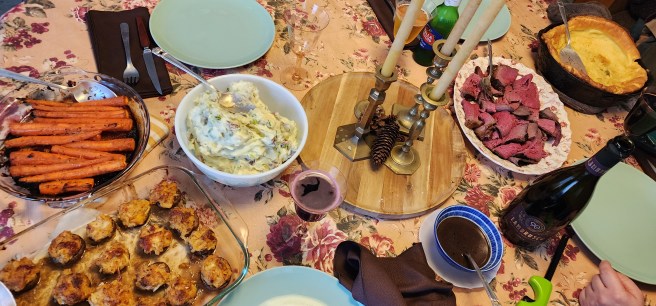
After such a spread, there will be no need for dinner later.
Sushi and me

I remember hearing the poet Gary Snyder back in the late ‘70s talking about his years in Japan and some of the cuisine he discovered, not that he exactly used the artsy menu term.
Sushi? My, how times have changed! I just wish we had a seafood bar of note here in Sunrise County.
Even if I do create a rather acclaimed sashimi.
Last of a rice noodle serving in a blue bowl

It was a really good homemade Thai dinner, thank you!
Chocolate facts, just in time for Valentine’s Day
Remind me that not all candy is chocolate and not all flowers are roses. But you might want to check out just what’s inside those heart-shaped red boxes tomorrow.
Here’s some perspective:
- Chocolate accounts for 59 percent of all candy sales in the U.S. The chocolate portion of that comes to an average of $145 a person each year.
- The average American eats three chocolate bars a week.
- The most popular time of the year to buy candy is the week before Halloween, followed by Easter, and then Valentine’s Day. Not all of that is chocolate. Think of all those little hearts imprinted with pink messages you’ll be facing tomorrow. But chocolate still weighs in big. For Valentine’s Day, it adds up to 58 million pounds – or, including all candy, $2.4 billion. Kaa-ching!
- The top day for chocolate sales in the USA is November 1, right after trick or treating.
- The most popular time of day to eat chocolate is in the evening.
- Most candy is sold after 2 pm, with peak sales between 4 and 5 o’clock.
- Online chocolate shopping now accounts for 40 percent of consumer action. What, it’s not the vending machine at the office?
- Milk chocolate is preferred by 49 percent of the American public, followed by dark at 34 percent. My favorite, white, has to split the remainder with some other subcategories.
- Three of the five biggest chocolate manufacturers are in the U.S. (Hershey’s comes in fifth, Modelez third, and Mars first.) But Europe is the biggest market.
- The Covid-19 outbreak led to a sharp rise in the popularity of fine chocolate who turned to it as an emotional comfort. The consumers were generally younger, living in urban areas, and earning above-average incomes.
Thanks especially to Max at Dame Cacao. She just might be worth a Tendril of her own.

