Price check alert

He promised lower prices. Here are ten you can bet will go up because of his promise of “lower taxes.”

  • Fuel. As in gasoline, diesel, and home heating oil. We pump and refine some in the United States, but not nearly enough to meet demand. When demand outstrips supply, as basic economics theory contends, prices go up. It’s part of what’s ironically known as a free market.
  • Coffee and tea. Imported and subject to new, stiff tariffs.
  • Vanilla. Ditto. Along with a lot of other spices and flavorings.
  • Chocolate. The beans are imported, as are some chocolate products. If you were considering cocoa as your new beverage of choice, think again.
  • Olives. Yes, we raise some, mostly California, but the U.S. is not in the top five olive-growing countries. Spain and Italy top that list. As for olive oil, which many fine cooks consider essential and which nutritionists tout as healthy? There will be suffering.
  •  Cars, SUVs, trucks, and parts. It’s a complex picture, but you can’t build new factories and hire and train workers overnight.
  • Electronics. Ditto.
  • Clothing. Check those labels. As for building factories and hiring and training workers? Once again, it won’t happen overnight.
  • Wine and spirits. Yes, we make these in the USA, too, but imports are major. There are no substitutes when it comes to discriminating tastes. And here’s another case of demand outstripping supply in a so-called free market.
  • Bananas. Most of them come from plantations in countries formerly controlled by American owners. You know, banana republics.

One place prices seem to be going down is stocks.

Applying the Tao of food

The Chinese mystic Lao Tsu, the founder of Taoism, once said, or I think he did, that when it comes to food, we should eat what’s in season and from the region where we live.

Living in a so-called temperate climate, as I have, makes the adage difficult to maintain day to day through a full year, but as a guideline, I’ve appreciated its merits. Besides, it’s not a bad concept to keep in mind when sitting down to ponder seed catalogs and ordering, and then getting the mailings and planting the seeds under grow lights, as many folks do at this time of the year.

Here are some foods as I see them applying. Many but not all are items foodies pay dearly to obtain. Others are the basic reason for gardening – or is the practice itself the reason and any harvest arrives as one more blessing?

  1. Asparagus: I came to love this herald of spring when I was living in an apple orchard. The sprouts grew wild, free for the taking, and glutting out for the month they sprang forth was a delightful challenge. I repeated the celebration with a bed or two in Dover, and do miss those.
  2. Fiddleheads: These ferns are another herald of spring and well worth the expense. We’re hoping to raise our own, as well as asparagus, as we get better settled in here.
  3. Strawberries: Just in time for a few birthdays in June …  
  4. Crabmeat: It’s available if you know where to look, but Betty’s (the best) is available only from late spring to early autumn. Fresh is definitely the tastiest.
  5. Lobsters: Again, year-‘round, but the price does drop as the waters warm. Not that they’re ever cheap.
  6. Blueberries, raspberries, currants, and cranberries: Our county leads the nation in the harvest of wild, low-bush blueberries. Cranberries are a more recent addition at a few farms. Raspberries and currants are whatever we can keep from the deer.
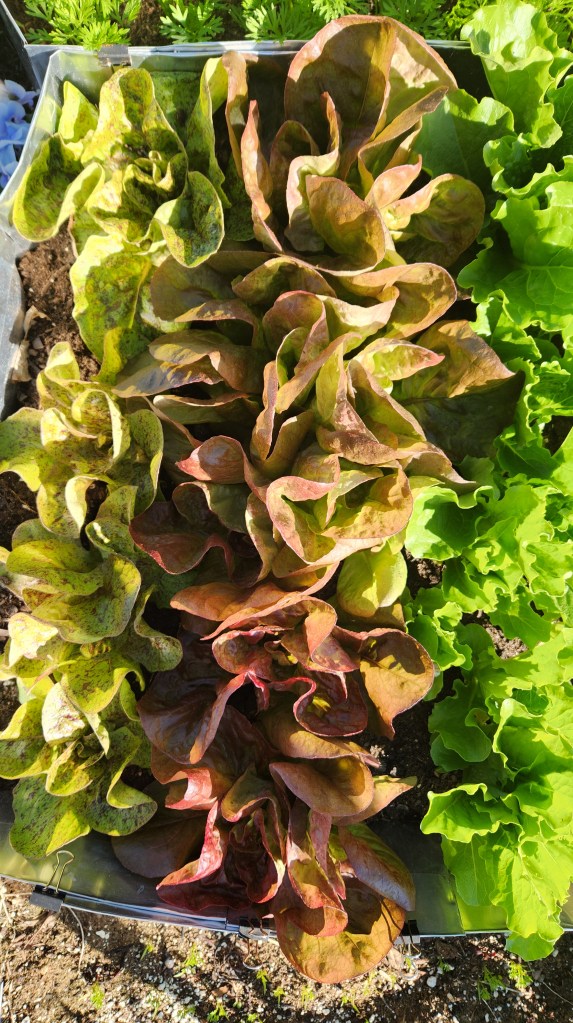
  7. Summer garden abundance: lettuce, sugar snap peas, parsley, basil, cucumbers, tomatoes.
  8. Potatoes: The skins are so tender when fresh, and the insides haven’t yet turned starchy. My, they are sweet and creamy, definitely worth the excuse to head up to Aroostook County, where culls can be a bargain.
  9. Garlic and leeks: We do store these, so the “in season” doesn’t always apply. But they do brighten up what we’re eating through the winter months.
  10. Scallops: Speaking of winter, getting these straight from the fishing boats is heavenly. Those you buy at the market or in a restaurant aren’t quite the same.

Fresh cider and pick-your-own apples, peaches, and pears were things we enjoyed in Dover but haven’t yet located here in Way Downeast Maine. We’re lookin’, though.

When it comes to daily bread, the French set a standard

Among the things we truly miss living on our remote corner of Maine is a first-class bakery, the kind that can turn out genuine baguettes and croissants.

Previous posts here at the Barn have touched on these distinctively French delights, but today the attention turns to matters of what makes something as basic as bread so marvelous.

Consider.

  1. While the roots of the baguette go back at least to the 18th century, the distinctive Parisian staple didn’t even go by that name until August 1920, when the department of the Seine regulated the product, declaring that the loaf had to have a minimum weight of 2¾ ounces and a maximum length of 16 inches and not cost more than .35 francs, making it affordable for nearly everyone.
  2. Today’s baguette has a diameter of roughly two to 2½ inches, a length of about 26 inches, but that can range up to 39 inches long, and a weight of 8¾ ounces. I’m sure the price has been adjusted over the years, even before the euro.
  3. The word itself means wand, baton, or stick. Well, from baguette to baton does make a bit of sense.
  4. French bakers were already using highly refined Hungarian high-milled flour, a compact Austrian yeast, and Viennese steam oven baking. Later ovens heated to more than 390 °F use steam injection to allow the crust to expand before setting. Vive la difference.
  5. Long loaves were already part of French culture. Some of them reached to six-feet long, resembling crow bars, in the eyes of some. Pity the poor maids trying to convey them to their master’s homes.
  6. The airy, chewy, crunchy-crust elongated bread loaves are made of basically flour, water, common salt, and yeast, perhaps with a few tweaks. We’re back to the importance of really good flour and yeast. As for the water and salt?
  7. By French law, a baguette is defined principally by its dough, not its shape. No wonder so many imitators on this side of the ocean disappoint.
  8. Sometime around 1920 (the accounts vary), bakers were legally prevented from working before 4 a.m., making it impossible to make traditional round loaves in time for customers’ breakfasts, as the Wikipedia account goes. (The bakers were also banned from working after 10 p.m.) Switching from the round loaf to the previously less-common, slender shape of the baguette solved the problem, especially since the bakers could no longer work later than 10 at night.
  9. When it comes to consumption, Algeria leads the world, with 49 million baguette loaves a day, compared to France at a mere 30 million.
  10. As far as history goes, we can revisit the classic quip of let the public eat cake when they’re out of French bread, even of the pre-baguette variety. Was Queen Antoinette out of her head? In my humble opinion, cake definitely finishes in second place.

Do I miss the goddess Caffeina?

Mugs of coffee laced with sugar and cream have accompanied me from high school on, especially while sitting at a desk writing or editing. Cutting back from my five or so big mugs a day did become an annual health goal, not that I ever pressed that hard. Working the night shift didn’t help, either.

Alas, since retiring from the newsroom, I’ve had to eliminate caffeine altogether from my diet. Doctor’s orders. My favorite drug of choice, it turns out, counteracts a daily medicine prescribed to me.

Here are a few related considerations.

  1. Tea may be the first caffeinated beverage, from 2737 B.C.E., according to one line of argument, but I’ve never found it satisfying. Sorry if you feel a need to object.
  2. Coffee beans are not really beans but the pit of a red or purple Coffea fruit. The leading producers are Brazil, Colombia, Vietnam, and Venuzuela.
  3. Was the first usage of coffee by an Ethiopian goat herder named Kaldi in 850 C.E. after he noticed his goats had extra energy after eating the fruits?
  4. Today an estimated 80 percent of the world’s population imbibes a caffeinated product daily – a number that rises to 90 percent of adults in North America.
  5. It’s also found in some soft drinks and in chocolate.
  6. Add to that cold, allergy, pain, and weight-control medications.
  7. One study found that two to three cups of caffeine coffee linked to a 45 percent drop in suicides.
  8. Significant daily consumption of caffeine in coffee or tea may also greatly reduce the likelihood of Alzheimer’s and Parkinson’s diseases. Other health benefits are reported.
  9. The United States is the leading consumer of coffee. I doubt, though, that we can blame that on the Boston Tea Party, which was a tax protest.
  10. Decaf does contain a residual amount of caffeine. Not enough, apparently, to keep me awake.

It’s not like I’m suffering, though. I must say I’ve found some good decafs for my morning ritual, sometimes abetted by French chicory. Still, there are some dull days I would really like that jolt of bitter stimulant to the nervous system.

There’s still a feast awaiting on this plate

As the calendar year ends, it’s fair to ask What’s Left in your own life as you move on for the next round.

In my novel, the big question is stirred by a personal tragedy, leaving a bereft daughter struggling to make sense of her unconventional household and her close-knit extended Greek family.

In the wider picture, she’s faced with issues that are both universal and personal.

For me, it’s somehow fitting that my most recent work of fiction returns to Indiana, the place where my first novel originated before spinning off into big city subways. The state is also home to more Hodsons than anyplace else in the world, as far as I can see, not that I’ve been back in ages.

What’s Left is one of five novels I’m making available to you for free during Smashword’s annual end-of-the-year sale, which ends January First.

Get yours in the digital platform of your choice, and enter the New Year right.

For details, go to the book at Smashwords.com.

 

Popcorn? It’s why the microwave was invented, seriously

In 1945, when American electronics expert, Perry Spencer paused in front of a power tube called a magnetron, he felt a “weird” feeling and noticed a chocolate candy bar in his pocket had melted. He decided to see the waves would pop popcorn, which they did.  

The microwave bags had to wait until 1981 to take shape and head for market.

~*~

But back to popcorn. So much good stuff popped up in my digging that today I’m doing a first at the Red Barn, a double Tendrils. The first ten will deal with the grain’s popularity, and the second on just what we’re eating as a snack food.

Here goes:

  1. By volume, popcorn is America’s favorite snack food
  2. Approximately 70 percent of popcorn sold in America is eaten in the home. The other 30 percent is eaten in theaters, stadiums, school, etc.
  3. Americans eat more popcorn than any other country – about 70 quarts of popcorn per person each year.
  4. Most of the popcorn eaten around the world is grown in the United States. Indiana recently overtook Nebraska as the leading producer, followed by Illinois, Ohio, and Iowa.
  5. Autumn is the peak time for consumption, followed by winter. Sales taper off in spring and summer.
  6. It’s cheap. Two tablespoons of kernels produce a quart of popcorn for about 25 cents. By the way, in case you’re counting or bored and looking for something to do, there are about 1,600 popcorn kernels in a single cup. Not that I’ve confirmed that.
  7. Its popularity as a concession-stand staple originates with Charles Cretors, an Ohio-born candy store owner who was so upset with a peanut roaster he had purchased in Iowa that he redesigned it, and moved to Chicago to manufacture more, leading him to create the original large-scale commercial popcorn machine in 1885, a line of products his family is still producing. His steam-powered machine was the first that could pop popcorn in its own seasonings uniformly. Fame and fortune followed its appearance at the 1893 World’s Fair (Columbian Exposition) in Chicago.
  8. In movie theaters, where popcorn’s been sold since 1912, about 90 cents of every dollar spent on the snack is profit. Its role as a moneymaker is enhanced by making people thirsty, leading to the sales of overpriced colas or water as well.
  9. Orville Redenbacher is the best-selling popcorn in the world. The brand’s founder, Orville, first grew popping corn in 1919, when he was just 12. He then went on to become an agricultural scientist who, according to the New York Times, became “the agricultural visionary who all but single-handedly revolutionized the American popcorn industry.” That was even became a household face with horned-rimmed glasses and a bow tie through his appearances in television commercials in the 1970s. As some of us still remember.
  10. It’s been a human food and ceremonial element for more than 5,000 years – basically, the full scope of recorded history.

~*~

Personally, I’m most likely to eat it during the Eastern Orthodox fast periods of Advent and Lent, after tackling the dietary restrictions one year and discovering how it filled in for snack foods I was missing.

And now I’m delighted to find out there’s no need to feel guilty about indulging. It’s actually healthy in addition to being vegan and gluten-free. Here’s more:

  1. It has more protein than any other cereal grain. More iron than eggs or roast beef. More fiber than pretzels or potato chips. Vitamins, minerals, and antioxidants, too. Most of the nutrients are in the hull or shell rather than the fluffy, white part.
  2. A cup of plain popcorn comes in at a mere 31 calories.
  3. Beware, though, of countering the health benefits with too much butter, salt, oil, white cheese, or caramel.
  4. The popped comes in two shapes: “mushroom” or the bigger “snowflake,” typically sold in movie theaters.
  5. Its one of six major maize types and come in three shapes: rice, pearl, and South American. Most commercial popcorn is the pearl type.
  6. The distinguishing trait shared by all types of popcorn kernels is their ability to create a flake when exposed to heat. Unlike many other grains, popcorn’s shell is not water permeable, preventing the small amount of water inside from escaping until the pressure to the point we hear the “pop.”
  7. Cooked popcorn expands up to 30 times its original size.
  8. Many other corns also pop, but their flakes are smaller. Additionally, some varieties of rice, milo, millet, and sorghum also pop. Some varieties of quinoa, a sacred Incan food, also pops like popcorn, as does amaranth.
  9. Unpopped kernels are called “spinsters” or “old maids.” As a guideline for quality popcorn, no more than two percent should remain spinsters.
  10. The ideal popping temperature for popcorn is 400-460 degrees Fahrenheit. A kernel will pop, on average, when it reaches 347.

This time of year, let’s not overlook strings of popcorn as garland for the Christmas tree and windows.