Eastport’s tap water last summer took on a greenish color and a definite off-taste. It got to the point that we started running everything we’d be drinking or using for cooking through an activated charcoal filter.
The explanation was that the supply came from a large but shallow lake a dozen miles away and that every summer the algae bloomed. The private company that provides water to the city then had to heighten its use of chemicals for treatment, resulting in the offensive character.
Water to the Sipayik reservation also came from the same source but was delivered via a different pipeline and was, by reports, much more troubling.
In its attempts to redress the issue, the company announced it would be using an alternative to treat the water, and I have to say we haven’t noticed the off-taste or discoloration this year. We haven’t yet seen a chemical analysis yet, however, or heard about the current situation on the reservation.
Still, public water quality is something most Americans take for granted.
Funny how often we overlook a problem, even when it has, as I hope, been clearing up.
Trying to get only three items to the dinner table at the same time had me thinking of this the other day.
It wasn’t like I had eight or nine tables awaiting some miracle, this was only me. The mathematical probabilities became rather staggering.
Quite humbly, it’s something every household more or less expects at least once a day, and it’s much more demanding than most of us assume.
My wife, bless her, is a wizard at this, as are our daughters.
But now, back to the rest of the universe.
This is one more case of where timing is everything.
It had me recalling my first visit to New Hampshire, where my traveling companion and I had to await breakfast on a one-order-at-a-time prepared by an amateur.
Next time you venture out to eat, please remember this.
There may be no excuse for much of the overpriced mediocrity that emerges after you ordered, but please, please, be aware of the skill when things do come together seemingly as expected. And do react appropriately, when the check comes.
When last summer ended, I proclaimed it my best one ever – in part because there were no complications from an employer or romantic upheavals. Instead, it was filled with new adventures, explorations along the Bold Coast and out on the waters, introductions to fascinating characters and geezers (both positive terms, in my estimation) who live here at least a goodly part of the year, plus a sequence of fascinating artists in residence combined with local painters and photographers and their galleries as well as a world-class chamber music series by mostly resident performers. Whew! And, oh yes, I had plenty of time to devote to a new book and setting up posts for this blog. I even got a new laptop, which meant importing and tweaking everything.
This time around has simply amplified everything.
The temperatures are generally cool on the island – often ten degrees less than what’s happening on the mainland even just seven miles to the west – so I rarely suffered from sweltering. On the downside, heritage tomatoes are rarely found here. Remember, in Dover I lived on tomato-and-mayo sandwiches from the beginning of August into October, some years, though in no small part due to global warming. Even so, the ocean temps here are too cold and the currents too treacherous, for any swimming, though inland lakes and streams provide a welcome alternative.
Well, that’s only half of it. Summer is when Eastport comes into its full glory. The streets are swarming, like a big party. To think, I’m experiencing the ideal of summering on a Maine island, combined with a lively artistic dimension! Never, in my wildest dreams, would I have expected that.
But all good things must come to an end.
Three-quarters of the Eastport’s population is what Mainers call Summer People. Now they’re mostly going-going-gone and we’re on the verge of getting back to our more essential state, something akin to a ghost town.
Not that we go down that easily.
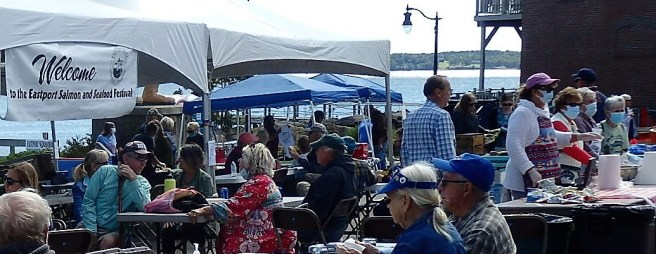
This weekend featured the annual Salmon Festival, a delightfully low-key event highlighting local musicians, galleries, and crab rolls served by the senior center and Episcopal Church on Saturday and salmon dinners on Sunday, as well as tours of the salmon farms at Broad Cove.
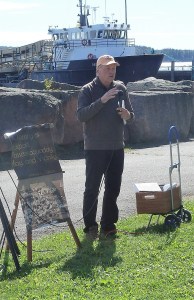
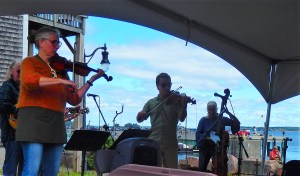
The Salmon Festival is a low-key event, centered on the waterfront..Historian Joe Clabby tells a circle at the amphitheater about the region’s rich past. One local wag calls this our “NPR festival,” in contrast to what’s coming next weekend.Celebrating local seafood, there are crab rolls on Saturday and a big salmon dinner on Sunday.And, of course, live music.
The event honors what was once the Sardine Capital of the World in its current incarnation as a center of aquaculture in the form of salmon.
But it’s also a prelude to next weekend’s blowout, the Pirate Festival.
On Saturday, a mini-flotilla, armed with water balloons and squirt guns, sailed down to invade neighboring Lubec. Next week, they’re expected to return the favor, all in good spirits.
While most of Eastport’s sardines were packed in cottonseed oil, some brands boasted of mustard, too, or of even smoking them first.
Even those that weren’t still might be smothered in a mustard sauce.
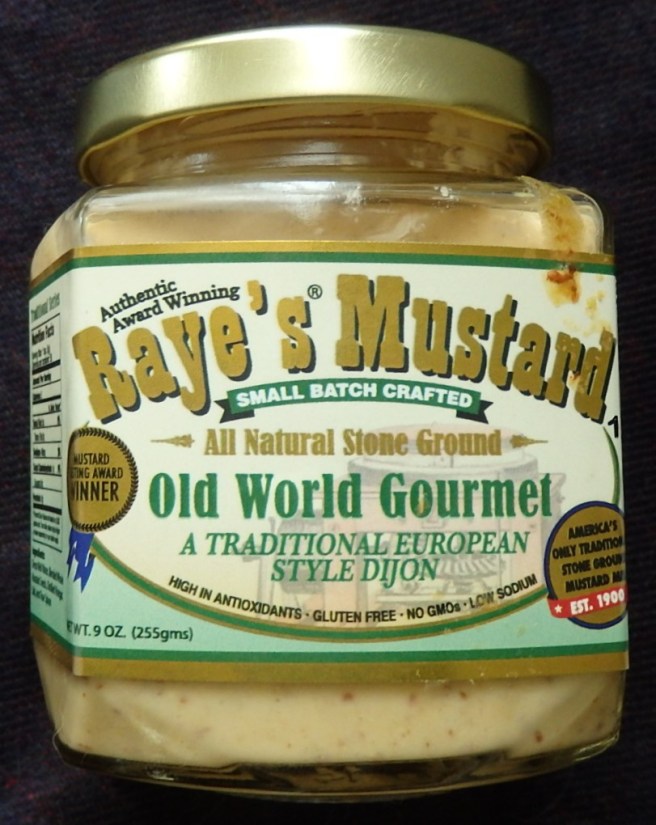
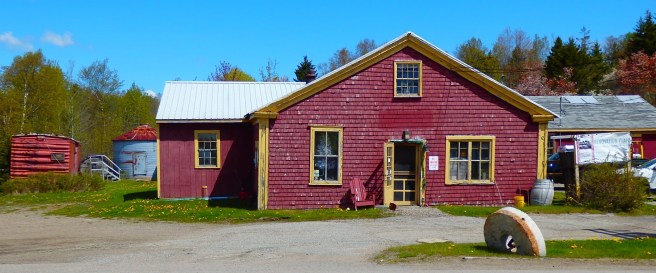
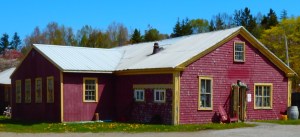
In 1900, J. Wesley Raye, the 20-year-old son of an Eastport sea captain, founded his mustard business in the family smokehouse in 1900 and moved it to its current site in 1903 to meet demand from the canneries.
Not just Eastport’s, either. Much of the family’s mustard, as the Raye’s website touts, was shipped by both rail and steamship, two means of transport long gone from the city. But, as they boast, their mill remains the last one in America to make mustard the old way. Theirs is made in small batches from mustard seed they’ve ground slowly on millstones made in France.
One of its many styles today.
If you don’t recognize the name, you might know the taste. It’s rebranded by some high-end labels.
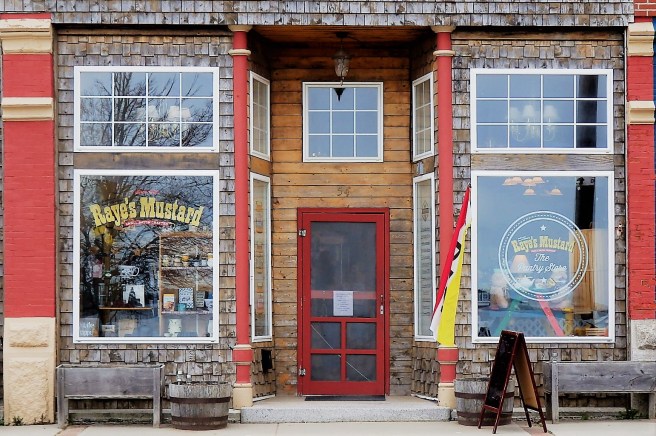
The old mill is still in operation. Note the railroad boxcar at left.Yes, there’s more.Their downtown retail store is a bright spot on Water Street, selling much more than mustard alone.
Somehow, lobsters have become identified with Maine the way maple syrup has stuck to Vermont, even though both are found abundantly in neighboring states and provinces. I won’t even get into moose in this discussion.
Here are some talking points.
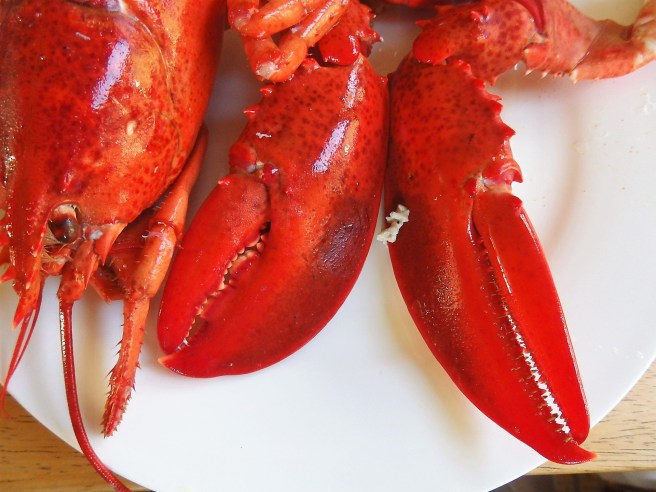
Unlike other varieties, ours are distinguished by having large claws. One claw, the crusher, is larger than the pincher.
They have clear blood.
They smell with their eight legs but have poor vision. Their four antennae help them locate food. They can also swim backward.
They chew with their stomachs, which are located right behind their eyes. They lack teeth but have a “gastric mill” that reduces their prey.
They live on the ocean floor and never stop growing, which they accomplish by molting. Some are known to be more than a hundred years old. In fact, they show no signs of aging and almost universally die of external factors.
It was once a poor-man’s dish, typically fed to servants. Impoverished families sent their children to school with lobster in their lunch buckets and an envy of the richer kids’ roast beef or chicken.
Lobster comprises 75 percent of Maine’s commercial fishery value. In 2016, a banner year, the state’s 6,000 lobster-fishers landed more than 130 million pounds worth more than $533 million.
A traditional lobster pot or trap has two sections – a “parlor,” where they enter, and the “kitchen” behind it. But for much of the region’s history, they were more likely to be harvested by hand along the shore and tide pools, where they washed up after storms.
Most lobsters are caught in the summer months, before the shellfish trot off to deeper waters where they’re harder to harvest. In Eastport, many of the lobster boats do double-duty each winter, rigged to drag the bay bottoms for scallops. A few even go after urchins.
Maine commercial lobstering is tightly regulated – more than in neighboring Canada – and licensing involves a long waiting list. You’d better apply well before your twenty-third birthday if you’re interested. Even if your dad still has his boat.
The first sardine canning in America happened in Eastport in 1876, and at its peak, 18 canneries were packed in against the waterfront downtown, along with the fishermen’s dories and fishing boats at the docks.
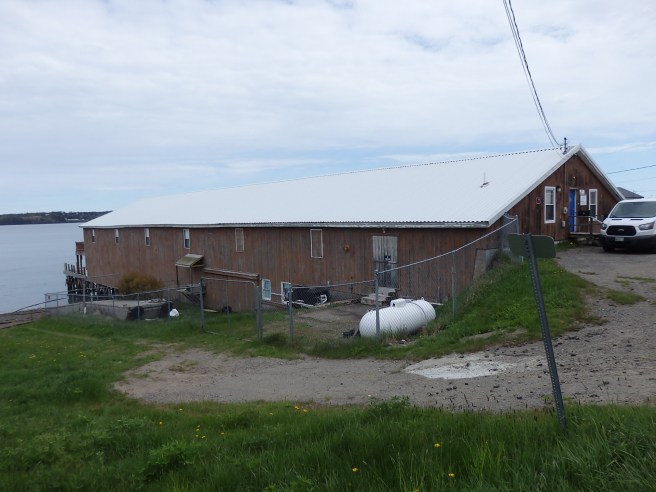
One of the few surviving cannery buildings. This one was small in comparison to others right downtown.
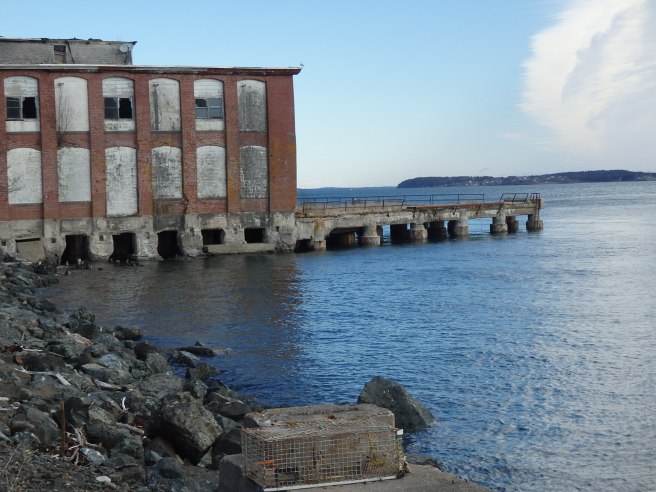
The largest of them, the L.D. Clark and Son factory, extended far into the water from the north end of Shackford Cove only a block where I now live. It was the world’s largest sardine cannery, employing 500 men and women who packed 4,000 cases of 100 cans daily when the small Atlantic herring were available.
Heads and other parts were cut from the fish and dumped into the harbor, where they were devoured by bottom-feeders that then attracted whales close to shore.
Over the years, though, the fishery was depleted, though whales can still be seen in season.
And then the market and American tastes changed.
Does anyone eat sardines anymore?
Few signs remain of the city’s once flourishing industry.
The 1908 Seacoast Canning Co. plant, which made sardine cans.
Across the country, pumpkin flavoring seems to infuse about everything on the menu come October, and something similar happens every summer in Maine with blueberries. The tourists and summer people, especially, seem to eat it right up. (Err, couldn’t help myself there.) So it’s not just lobster they come to devour.
Here are some facts about Maine’s in relation to the rest of the nation and world, mostly.
The local brewpub calls its obligatory blueberry ale Skul Clothes. The name puzzled me until I was told that’s how kids traditionally earned the money for their school clothes each year, at least before mechanized machines took over most of the patches. “It’s hard work, down on your hands and knees,” as one recent high school graduate told me. “But the pay’s good.” After that, I could tell the locals who walked in for the first time, looked at the offerings on the chalkboard, and broke out in a grin. They’d all done it.
Ours are lowbush, wild, unlike the highbush varieties cultivated elsewhere. We lead the world in lowbush production, though it’s a drop in the bucket compared to the highbush harvests of British Columbia, Oregon, or Washington state. While Atlantic Canada produces half of the world’s wild blueberry tally, that covers more than a single province – Nova Scotia is the leader there.
Lowbush berries are smaller but more flavorful, in our humble opinion.
They’re also preferred in making blueberry wine.
Blueberries are one of the few commercially-available fruits native to North America. The First Nations, some of whom called them star-berries for their blossoms and the tiny ring at their base, have been eating them for at least 13,000 years
They top the list as an antioxidant and are rich in Vitamin C and even manganese.
Wild blueberry patches are burned every two years.
Wild blueberries freeze in just four minutes.
Some research indicates they counter memory loss in aging. I’ll have to remember that. They’re also good for the heart, cancer-risk reduction, and lowering blood pressure.
I like mine fresh, with yogurt or cream. Pancakes, muffins, jams and jellies come next.
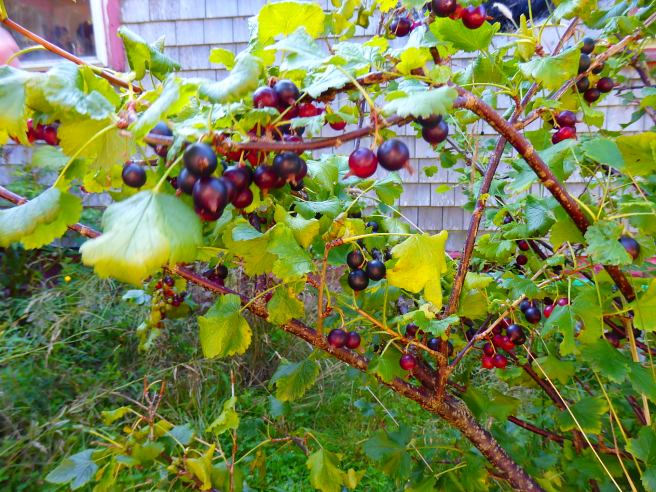
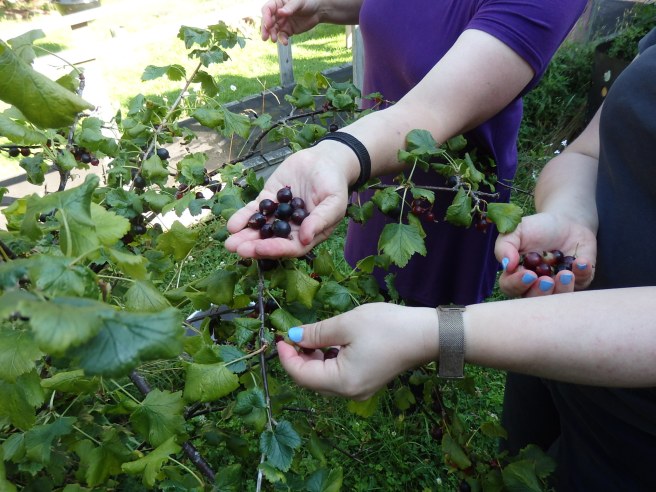
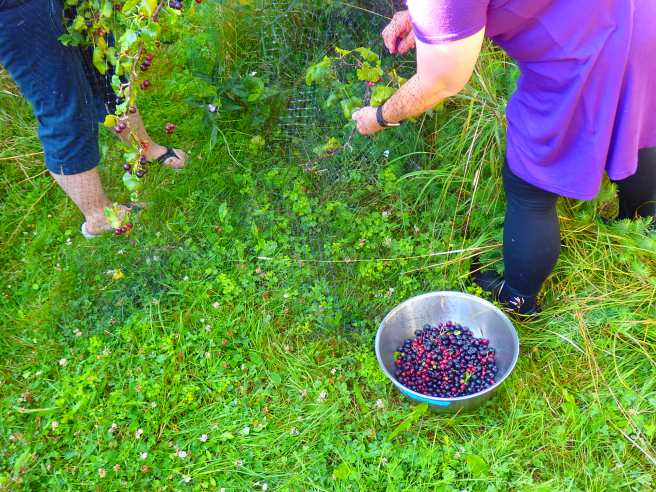
The currants we’re harvesting in Eastport are a different variety than we obtained from the conservation district’s plant sale back in Dover. They’re bigger and juicier, for one thing. And the bushes aren’t as thorny or sprawling, for another.
We got 4½ pounds from a single bush. Most of it will go into jelly.
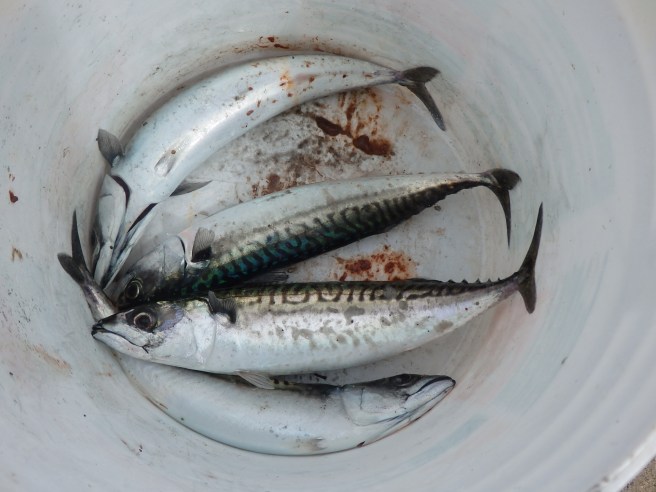
The humble mackerel – usually less than a pound apiece – is a popular fish caught around here. Its delicate nature means it doesn’t keep long, so for human consumption, it’s typically smoked for preservation. An oily fish, it tastes somewhat like salmon. More commonly, it’s used as bait in lobster traps.
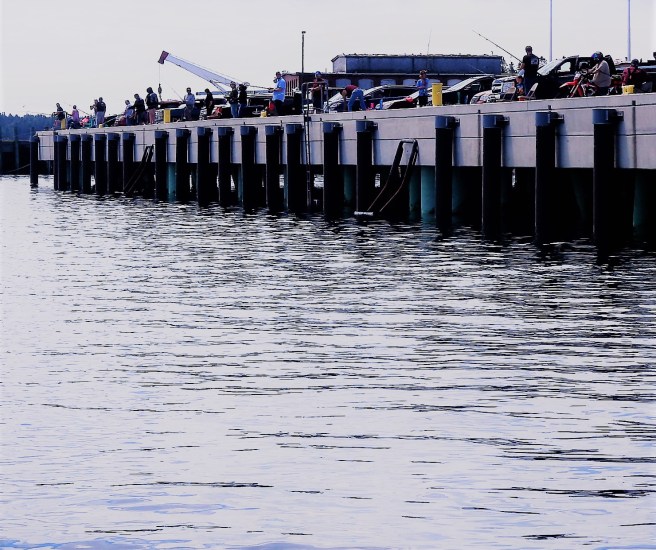
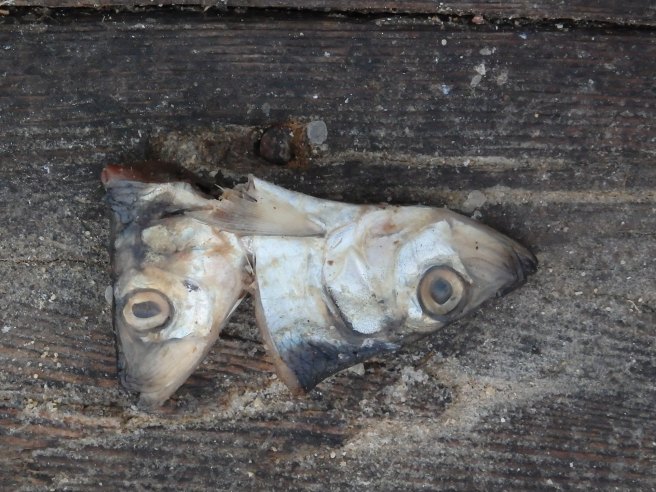
I think it’s a beautiful fish.The Breakwater is lined with fishermen.Two heads left on a pier, likely used as bait.
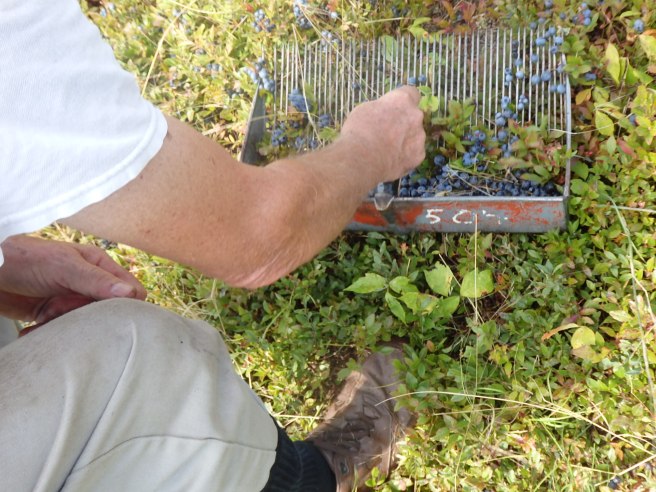
The handheld rake was invented in 1910. I can’t imagine trying to pick large quantities of blueberries without it.
What’s harvested by the ton in Washington County is not just blueberries, but wild blueberries – lowbush, laced with small pellets of complex, concentrated flavor, rather than the big, juicy, cultivated highbush kind.
What grows here, I’ll argue, is tastier and richer than the more coddled kind I had previously known and even grown.
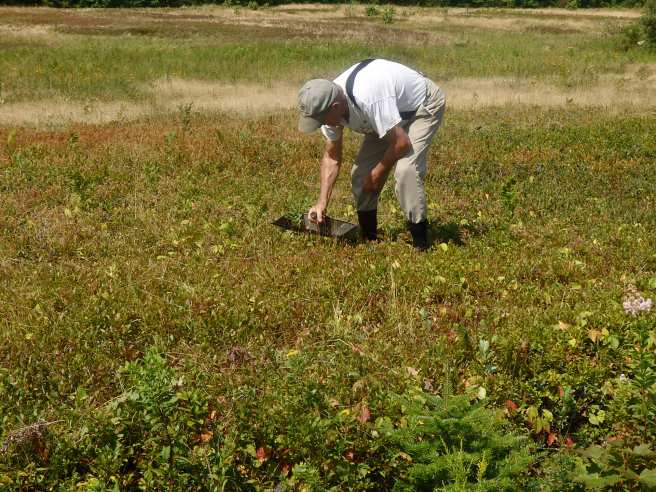
As you can see, traditional picking can be backbreaking work. But old-timers tell you it delivers better berries than the newer mechanized harvesters do.
Maine has a near monopoly in the production of the wild lowbush berries in the United States. Neighboring parts of Canada are also of note. Still, the output is only a fraction of what’s harvested from the domesticated highbush farmers in other states.
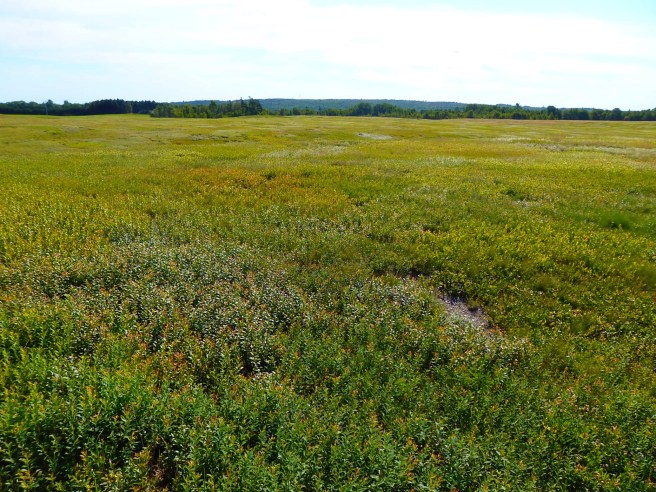
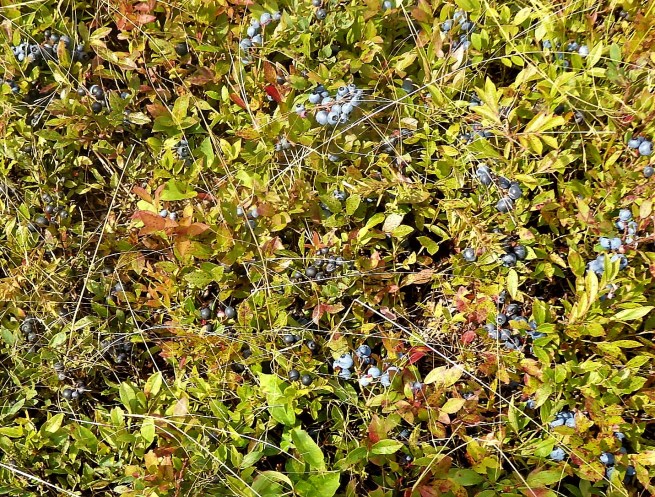
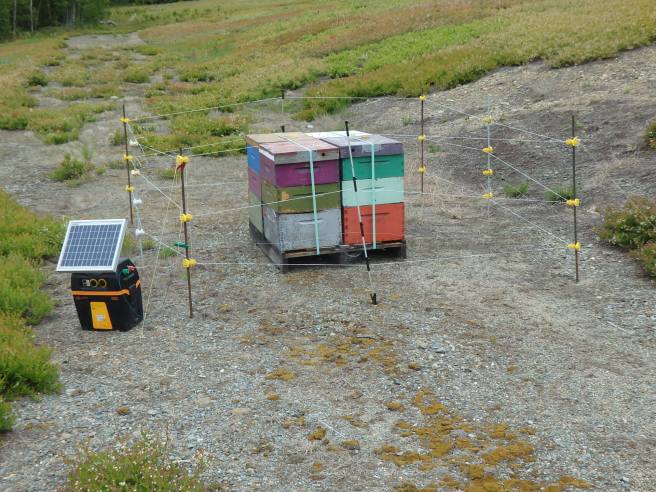
You can drive right past a blueberry barren like this and not know it’s loaded with ripe fruit.Here’s what a stop to look reveals.For a few weeks each spring, clusters of commercial honeybee hives are placed by the hundreds throughout the barrens. The electrical fencing is intended to keep bears out.
Just so you know.
What’s your favorite kind of berry? And your favorite way to eat (or drink) them?

 Jnana's Red Barn