An alternative to suburban sprawl

For a while, she yearns to live in a normal neighborhood, somewhere near the golf course, rather than in their family’s little compound between the courthouse square and the college campus.

In my novel What’s Left, her close-knit extended family revolves around a large pink Victorian house her great-grandparents purchased when the neighborhood was falling into decline. In Greek-American tradition, though, it was perfect for housing more than a nuclear family, plus any number of guests. Not just grandparents or great-grandparents, either, but siblings and their spouses and children. What a circus!

I can’t really imagine this in a typical suburb, though maybe a little further out on a farm. But then, in Cassia’s case, they’d be too far from the restaurant where they work.

I’m so glad they saved this from becoming a funeral parlor or law offices, aren’t you?

~*~

The neighborhood’s one thing. The homes within it, another.

What’s your favorite place in the house?

Ten surefire gifts

Who are we trying to fool? Selecting the appropriate gift requires an uncanny understanding of the intended recipient, and even then and in the right hands, it’s highly risky.

The closest success in this field that I recall hearing involved a coworker who was at a unique point in his love life. He wound up buying three identical items at Victoria’s Secret. Need I explain? Things were quite different after Christmas.

And even then, not everyone would want to receive one of those wrapped intimacies.

So let’s think of ten factors to consider.

  1. Does the recipient already own this? Oops! How well do you know this person, anyway? Well enough to go through their shelves or closet?
  2. Or even want it? Not every woman likes getting flowers or chocolate. Not all that many guys do, either. As for kids?
  3. The dollar signs. Some people measure your affection by your willingness to shell out on a big gift. Others see it as trying to buy their love. Gift cards, by the way, often go unused. Retailers are not a charity. Don’t go overboard, OK?
  4. Is it a suitable surprise? One they might actually use? Your grandmother will likely be surprised by that box of golf balls but never set foot anywhere near a tee. Yard sales are full of these misfires, often still in their original wrappings.
  5. Does it say something about your relationship? Some of the best gifts are things you can enjoy together. Jigsaw puzzles, for example, can keep everyone going, especially during the holidays.
  6. Not everyone appreciates receiving a homemade present, but for others, it’s the ultimate. One friend’s woodworking skills are especially anticipated. Pie boxes, anyone?
  7. There’s something to be said for gifts that won’t take up space. Things you can eat or drink, for instance. Tickets to upcoming events. (In my part of the universe, few things would beat a pair of seats at a Red Sox-Yankees game.) Museum memberships or contributions to causes they support may also be welcome.
  8. Does it improve the quality of their life? My family has edged me upward in the digital world this way.
  9. Hobby gear. Think sports equipment, cooking gadgets, sewing supplies, arts and crafts, gardening, and so on.
  10. Dream fulfillment. Was there something they wanted as a child but never got?

What other considerations would you suggest?


Why tribe? As a poet once asked … 

In my novel What’s Left, she has every reason to proclaim:

Nobody breathes a word about hippie. We’re simply ever so hip.

She and her brothers and cousins had their own style and direction, apart from whatever their parents had done. And the quip didn’t survive into the final version of the text.

Still, though, if you look to the time of the pivotal Woodstock music festival , you might ask if we were trying to be neo-mountain men or newly converted Amerindians or spaced-out yogis or cool Victorians (without the inhibitions) or liberated urbanites or … ? Well, a huge stream of historic inspiration fed into the movement, and we were willing to play with just about any wild expressive fashion.

What’s easily overlooked is how huge the role of the Gypsy – or, more correctly, Roma – was.

The very term Boho or Bohemian – as in Puccini’s opera, La Boheme, dealing with starving underground artists in Paris – has far more to do with the Roma than with any geographic region of eastern Europe. Even Brahms’ famous Hungarian Rhapsodies are code words for Gypsy violin music. As for Spanish flamenco? Ditto. Play your guitar, if you will, or dance wildly.

So underground artists are …? You got it.

And here, drafting and revising my novel I found myself forced to ask:

Why are they so widely romanticized?

And why are they so widely reviled?

As Cassia investigates her father’s reasons for moving into the extended family where she’s grown up, she digs far beyond his counterculture inclinations.

Well, for a hint, here’s something else I cut from the final version:

The scandals, according to Nita? I’m not going there. Not that any of it was bad, on the contrary. There’s just too much to delve into now. And then, despite herself, she does.

~*~

Like Cassia’s father, I did live in a rundown farm where we all split the rent. And like him, I later lived in a monastic setting, where ours was based on yoga and its Hindu writings rather than Buddhism.

Not all hippies veered off in those directions.

Have you ever wanted to live in a Gypsy wagon? How about a tree house?

How about a few firsts?

Yesterday was not only the first day of December, it was also the first day of Advent.

(Make that Advent in the Western Christian calender, which runs between 21 and 27 days before Christmas, depending. The Eastern Orthodox faithful, in contrast, observe it as a 40-day fast that began November 15 this year.)

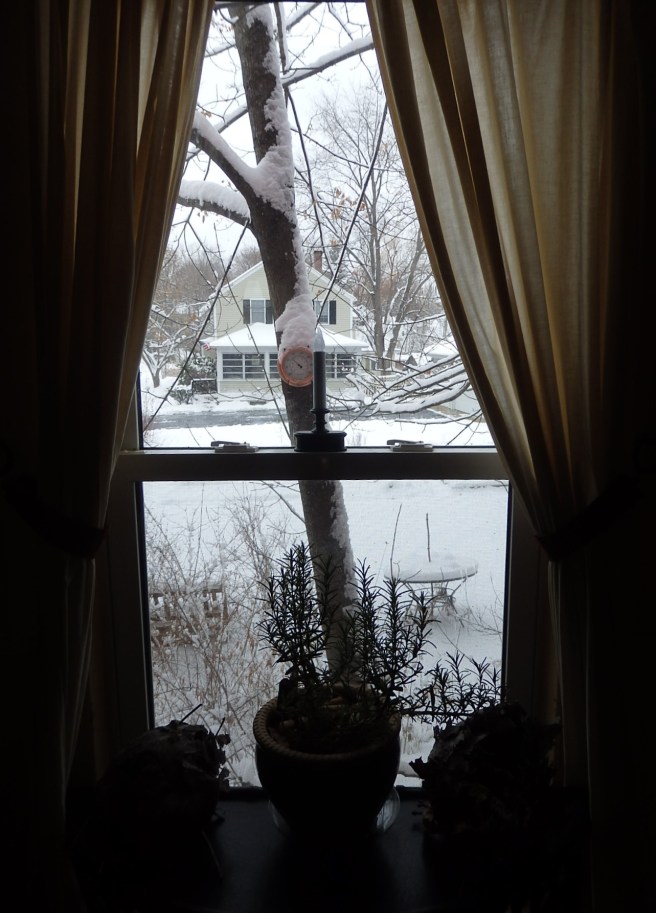
For us, our first snowfall of the year also began yesterday, and it’s already delivered seven inches, a bit under half of what’s expected by tomorrow morning.

My wife was pleased to have all of this also fall into the extended Thanksgiving Day weekend, a welcome break in what’s been a chaotic schedule.

How’s the month kicking off for you?

Snow’s piled up atop the thermometer on the tree trunk. Welcome to December where we live.


Tackling the family photos together

In the final revision of my novel What’s Left, her aunt Nita becomes an active instigator of the project that leads the adolescent girl to closely examine her father’s photographs. Another change is that Cassia’s best friend and cousin, Sandra, joins in with second opinions.

Here are some passages that were no longer needed like this in that final edition:

What happens in that process flips our usual pattern of interacting.  Strengthens our bond. Forget Theos Barney and Theos Tito – they’re usually too busy to answer my inquiries, but after listening closely to Thea Nita, I have a sense they just don’t know as much detail as she does. Not just the Baba years, either. She’s filled me in on Ari and Perry and Athina and Dida and Ilias and Maria and Stavros and Bella. She knew them all, and was old enough to see much. Even so, she’s anxious to uncover as much about them as much as I do, which adds to our working together as a team.

~*~

She was particularly close to Dimitri, too. When they were apart, from college on, they corresponded in long weekly letters that often included newspaper clippings, and she’s promised to let me examine that collection when I’m ready. There’s so much on my plate already.

~*~

Bit by bit, the puzzles fit together enough to hint at the bigger picture, even around huge gaps that remain.

~*~

Always the news hound, Thea Nita confides to me the difficulty she’s had in digging up the few details she passes on, and, as she emphasizes, some of the conclusions remain conjectural. Add to that a few documents passed down in the family and some letters we still need to translate. A timeline takes shape.

~*~

So much of what I’m telling you comes down through Papou Ilias, Thea Nita tells me, explaining how many times they’d sit down together and his observations would flow on and on in response to her questions. As she says, he obviously admired Ari and Perry – and as a philosopher, he had to be true to the line of questioning, no matter how discomforting the conclusions may seem.

Oh, I’m so glad she stopped talking like this! In the final version, she’s pretty snippy.

~*~

In assembling these family pictures, then, Cassia comes to appreciate how important the word pictures are in giving life to the visual images. Both are essential for what she’s pursuing.

~*~

As a child, I never really understood the definitions of aunts, uncles, cousins, much less how we fit together. But we weren’t close, either, and had very little in common. Do you think Cassia’s loss make her more attentive to her family connections? Does she just know too much for her age?

Does a family that meditates together glow together?

The first decade of her father’s presence in the family was one of great growth and deepening personal awareness for every member – especially before all of the children, including Cassia, come along.

For one thing, her parents’ generation is still working on its Buddhist studies together. As I noted in an earlier draft of my novel What’s Left:

You know, Baba will say one night after our family meditation, most of these enterprises wouldn’t stand a chance if it weren’t for one thing.

What’s that?

Rinpoche, the Tibetan master.

Then the room will fall into a profound reverie.

Well, it was all no doubt pretty exotic to all of them.

And then the vision got even heavier:

It’s the concept of living as a people of the Holy One, however we phrase it. A peaceable people. A peaceable kingdom. The great wisdom or enlightenment.

There was even a question of how much diversity they could manage:

Religions? Say the way a piano is a world apart from a trombone or a double bass or a clarinet, even if they rely on the same kind of musical notation? And that was before your Manoula weighed in on some wildly divergent ethnic musics based on entirely conflicting theoretical foundations.

Well, that got too esoteric, even for me! Play it as you will.

Still, not everybody in the family was so high on the Buddhist excitement:

The Temple Room relocates to the first-floor parlor next to Yiayia Athina before moving altogether to a more public location, one having chambers for our anticipated Rinpoche’s full-time residency. Yiayia Athina makes no secret of being glad to see them go. The chanting was getting on her nerves.

Oh, I’m so glad Cassia stopped talking like this! In the final version, she’s pretty snippy.

~*~

Cassia’s family obviously takes all this seriously.

What spiritual practice or source of inspiration is meaningful to you?

Looking for a natural high

Just what so intensely motivated her father-to-be to quit everything so he could retreat into monastic Buddhist practice for three years? It’s a question that’s impossible to answer fully. (My parallel experience of living on a yoga farm is the basis of my newest novel, Yoga Bootcamp.)

Still, I’m required to try. In a passage from an earlier draft of my novel What’s Left, the explanation went this way:

Thea Nita suggested another take. Your Baba yearned for the highs, she says.

What about drugs?

You don’t think that was a problem, she counters. Don’t you think I wasn’t worried, at least until Rinpoche came into the picture?

Well, I’d wondered about that with my uncles, too – that whole hippie thing?

Oh, that? Nita chuckles and admits it posed a danger, especially before she returned to town. Barney, especially, enjoyed being stoned when he could. As she says, that could present problems in a commercial kitchen.

And then? They learned they could get a natural high through meditation – if they steered clear of drugs, as they did when Baba, by then a militant practicing Buddhist, entered the scene. Besides, there was no escaping the reality we all had work to do – and it better be done right.

~*~

As Rinpoche told Cassia about her father:

He needed the lightness and even playfulness he encountered in the Tibetan Buddhism – the high, in fact – that he hadn’t found in his Christian past. To be fair, I am finding indications he was discovering that in the Judeo-Christian side, too, during his final years. What a loss, then.

Oh, I’m so glad she stopped talking like this! In the final version, she’s pretty snippy.

~*~

And then there was her mother’s presence, as Rinpoche explained:

Your Baba found his missing half in Manoula and through her, his place in this world. But he always sensed there was more to life. The rabbi here tells me that when Moses came down from the mountain, he carried two tablets. The first one was about man’s relationship to God, and the second one was about relating to each other. So your Baba was working on something like that. He sometimes referred to it as finding the right balance.

And that mountain?

It was about all that would hold him down. For now. Maybe they were well matched.

~*~

Here we are talking about religion, and I see the question turning to something unexpectedly related:

What makes you smile?
Small-time patronage

Another manifesto I cut from my novel What’s Left, is a vision of a wide community of artists who have employable day-jobs:

One night, as Nita will exclaim, Hey! We’re the biggest patrons of the arts around here! She’ll be right. We’ll have poets as bakers. Painters as mechanics. Sculptors as gardeners. On weekend evenings, there will be folk music and jazz in the restaurant, as well as Sunday afternoon chamber music recitals. Baba will change the art exhibits monthly. In time, we’ll even have to create mail-order catalogs for some of these expanding industries. And that’s the conservative forecast.

Oh, I’m so glad she stopped talking like this! In the final version, she’s pretty snippy.

~*~

Well, we can dream, can’t we? Somewhere in Nita’s discourse I hear a plea for a less ugly, less brutal society – one overflowing with harmony and compassion instead. Rather than the mass-media push for blockbusters – movies, hit songs, or bestseller books – she emphasizes face-to-face, small-scale exchanges.

Do you resonate with anything in Nita’s vision? How do we support each other? How do you support your friends? And how do they support you?

Looking for ways to include everyone

Sometimes, when you look into the eyes of desperation, you wonder what the downtrodden might be able to do to help themselves – and others.

In my novel What’s Left, her family has the resources to make some things happen, but they’re small fry in the face of the bigger issues. Here’s a passage I trimmed from the final version of the story:

Baba, of course, retreats earlier by heading to the monastery, just as all the big moves start unfolding. He returns to a different world, apart from the family core – and its true love.

Not that everybody’s talented. Barney and even Dimitri come up with odd jobs for the vagabonds who materialize around the loading docks of restaurants … the aimless hippie, too … and rather than a handout, Can you lend a hand? You know, scrubbing or raking or sweeping or helping move supplies from a delivery van – anything that then might lead to a free meal or spending the night in Barney’s old car. If we don’t have something at the restaurant, maybe there’s something else to do around Mount Olympus.

Oh, I’m so glad she stopped talking like this! In the final version, she’s pretty snippy.

I really do wish I had answers. Maybe we need to start small. Any suggestions for Barney and Dimitri in the novel, like helping unpack a truck or sweeping the walk?

What do you do to help others? Not family, but the wider community?