A ‘mild case’ can still be the sickest you’ve ever felt

Here we are, coming up on the second anniversary of the Covid outbreak here and abroad, and we’re still in the midst of its disorder. So much for that initial hope of a two-week or six-week lockdown, max, which even then unfortunately had too many holdouts from the precautions. Can we blame them for leaving the Pandora’s box open for all that’s followed?

Once that first round passed, after its devastation in large urban areas like New York City, we had a breather in which medical procedures were more clearly understood and improved and vaccines became available. We’ve even been able to gather in public again, albeit in fewer numbers and spaced apart while still wearing masks. Surface contamination is no longer a major worry, either.

Where I live, the illness has often seemed to be a distant threat. While I have friends who came out of retirement to resume long hours as medical professionals, their tales of a stress still seemed confined to largely quarantined hospitals and clinics, even though they were only just down the street. Well, I also got updates from fellow clergy who couldn’t visit patients in person, that sort of thing. Still, two years later, I knew of only two cases in our Friends Meeting, both quite mild. Further east, in remote Washington County, Maine, fewer than 3,000 cases and 43 deaths have been tallied, last I looked, though those figures have nearly tripled since November.

Still, the threat kept getting closer and more personal. The surge in the Omicron variant forced the cancellation of the final Christmas performances of our beloved Boston Revels, for example. Traditionally low-rate New Hampshire recently reported the highest per capita figures in the nation. Our twice-a-month local newspaper’s half-dozen or so obituaries now regularly mention “of Covid complications” as the cause of death. (Nobody, presumably, dies directly of the infection or is at least willing to admit that openly. Am I guessing there’s a social stigma?)

We have endured the screeching dissent and violent reactions from those who feel entitled to do whatever they want in public, regardless of any harm to others, and that seems to be spiking.

How long, though, will it take for the emotional frustration of the other side to erupt?

For starters, there’s a growing weariness among those of us who have been wearing masks and getting our booster shots, in part to protect others from suffering from the illness, while enduring the arrogance of those who pooh-pooh the odds, putting their own “liberty” above the common good, and then putting the rest of the populace at risk while expecting overworked medical professionals to come to their rescue and forcing heart attack patients and crash victims to be juggled about for unavailable intensive-care beds.

Look, I know Christian Scientists who have gotten the shots, not for themselves – remember, they generally avoid doctors as a matter of their faith – but out of a sense of social responsibility for others. In contrast, I’m sensing that many of those who refuse vaccinations are also among those accusing lower-income Americans of “entitlement” when it comes to economic and social support, rather than turning the focus to the One Percent who actually benefit financially from overt entitlement in public legislation and regulation. Are these the same ones who scoff at widespread examples of global warming and impending disaster? The willful ignorance, selfish, self-centered behavior, and bullying outrage me. And before they quote – or misquote – Scripture for their positions, I can imagine them refusing Moses’ orders to paint lambs’ blood above their doors for protection from the Angel of Death – “Who are you to tell me what to do?” – but it’s the firstborn who suffer if they don’t. Drat! I can confess a vindictive urge – you know, of the smite-my-enemies vein – but revisiting the Exodus text, I’m seeing that in only one of the first nine plagues are the Israelites exempted from the evil consequences. Pointedly, all Egyptians, not just the pagans, suffer from Pharaoh’s refusal to act in accord with Divine direction.

No matter what, in the end, reality will win out, though it won’t be selective in choosing its victims.

What happens if this affliction spreads to strike down all who haven’t been vaxxed? Costly treatments that could have been avoided will be borne by all, regardless, through Medicare, insurance companies, and unpaid debts to hospitals, more than by the defiant unvaxxed ill and dying. The workforce will continue to be impacted, too.

The Omicron variant, as we’re seeing, is also hitting vaccinated people, but with lesser impact.

We look at the statistics and hear the stories that the new variety is less deadly but more infectious, along with the note that breakthrough cases among the vaxxed hit far more gently than among the unprotected, but we need to listen more closely.

Unless a patient is in need of a respirator, the diagnosis is to stay home, there’s no room at the hospital. Good luck if you’re living alone, and good luck to the rest of the household if you’re not.

Moreover, it’s considered a mild case unless you’re hospitalized or die.

As for those “mild” cases? More than one person has been quoted as saying they’ve never felt so sick in their life.

So far, I’ve been lucky, but my family’s finally been hit, notably in their recent visit to me. My test and my wife’s came back negative, but not so for the rest, despite all their precautions.

Would coming down sick be a sufficient lesson for the nay-sayers? Or would it make them dig in more deeply in denial?    
 

The turmoil’s turned up, blowing the lid off simmering pot

Let’s take a look.

Over the past year, we’ve witnessed a range of economic jolts that seem vaguely related to the worldwide Covid outbreak, though I’d say the virus only precipitated troubles that would have been inevitable even without it.

The pandemic simply turned up the heat, as it were.

Among the headlines:

  • Soaring prices of houses, many of them going to buyers from California or New York, sight unseen. Who can afford these mortgages? None of us in our old neighborhood could have moved in today.
  • The relocation from big cities to small towns, for those whose jobs can be done from home. Will they stay or fit in? What will their impact be, especially in places that have been economically struggling?
  • A retail apocalypse in the face of rising online shopping – what’s the future of downtown or the malls? (If you’re “going to work” on Zoom, you don’t need to dress up in new clothes, for one thing.)
  • Superrich and corporate takeover of American farmlands – and mobile home parks. Another blow to the middle and lower classes.
  • Systemic problems in the nation’s health-care system, including the uneven distribution of medical services. A fourth of Americans, mostly rural, have no primary physician, and many others are afraid to use the system because of serious past racial abuses. (These appear to be the leading reason many people have not been vaccinated.)
  • The failure of “just-in time,” including the supply-chain issues that have plagued retailers and manufacturers alike. It’s also exposing the vulnerabilities of offshore sourcing to places like China and Indonesia, as well as looming national security weaknesses. (I blame the Walmart influence in shuttering American factories.)
  • While automakers have shut down assembly lines because of the unavailability of computer chips, what we found most striking was all the empty shelves during a run to IKEA, the home design line built on its international flair and savvy. Row after row, empty. So much for our shopping list and research.
  • Inflating food prices. Fuel and weather are only part of the problem. (Well, we should note climate change somewhere in here, though it has nothing to do with Covid.)
  • Customer and voter nastiness, no doubt intensified by the isolation and resentment.

~*~

More telling is the shift in the workplace, with all of the help-wanted signs for jobs that go begging. It’s not that people are lazy, but rather they’ve realized the positions are demeaning, or meaningless, and it costs them more to work than they’re paid. It’s time to admit that minimum wage is insufficient. Many apparently discovered during Covid that their jobs were costing more than they were earning, once child care, transportation, and related costs were factored in.

Add to that the fact that a certain percentage of the populace is, candidly, unemployable – in the old days, you could give them chores around the farm, but even those have been mechanized. So what can they do to still be contributing members of the wider society?

There has been a serious breakdown in the social contract that underpins democracy. And in the work ethic – or ethics, for those who look closer.

For decades now, employers have demanding loyalty but offering none of their own. Sometimes, there’s even a requirement of noncompete agreements, no matter that the worker has paid for the needed education and career. In reality, in a big company, you work for your immediate boss and colleagues and whatever satisfaction you can find – not the remote layers above. The fact is, nobody entering the workforce today will be at the same enterprise at the end of their career. Maybe public service – especially education – will remain the rare exception.

One of the more shocking reports I saw in the past year noted that only a minority of American males between 18 and 65 hold fulltime jobs – I think the figure was just a third of the total. What are the rest doing? School, prison, early retirement, or – as I’m suspecting – under-the-table ventures. They’re not all stay-at-home dads, are they?

~*~

My new community is an interesting place to watch all of this play out. The place has long been stressed economically, with few adequately paying jobs to sustain families, and that’s led to a population outflow.

Qualified contractors, on the other hand, have been booked out solid, as has been the case nationally. (See above housing sales.)

Our new old house needs tons of renovation, but we’re stymied. As my wife says, “I have money I want to give to somebody but just can’t find anyone to take it.” Well, if we had a crew lined up, there would have been the problem of getting building supplies, and then at prices twice what they’d been just months before.

We’re hoping that will all change in the months ahead.

~*~

These are all things that need to be examined closely in the months ahead, especially in the public arena like the upcoming elections, not that I expect much of it will come coherently from the candidates. The fixes, after all, aren’t easy or painless.

In a way, it’s reflected in the matters of even wearing a mask (or not) or getting the vaccine (or not). I’d say Covid has simply made more obvious the deep polarization at work in our nation – and the wider world.

We all have some important and difficult work to do ahead. We can start with small steps.


Why we’re all waiting for the border to Canada to really reopen

Having to wait 72 hours for a Covid test result – but don’t you dare delay much longer – as well as the other current restrictions have meant that the U.S.-Canada border really isn’t open, not the way it was before the coronavirus outbreak.

That’s made for a hard burden where I now live. New Brunswick is very much a part of our community. Just about every long-established family has kin on the other side of the boundary. For almost everyone, it’s meant jobs or services or shopping or even cultural pursuits. There are good reasons our local newspaper covers the two adjoining counties, which share the tidal waters and weather. The virus constraints have devastated the economy of the small city of Calais, to our north, which usually carries heavy truck traffic between the two countries as well as local business at groceries, hardware stores, and other retailers and restaurants; likewise for the town of Lubec, to our south, which has the only bridge connection for Campobello Island. Many folks also have property on the other side of the line, or maybe their boat, or even dear ones buried in cemeteries, and are cut off. You go to the dentist and realize the radio is tuned to a Canadian station, that sort of thing. It’s not all one way, either. I would be back to swimming laps in the nearest indoor pool, for instance, only 45 minutes or so distant. The nearest Costco would be only an hour-and-a-half drive off, rather than eight or nine down around Boston. We’d have some fine dining options available, so I’ve been told, as well as museums and nightlife and even festivals.

The local Passamaquoddy population has long been torn by the international division, especially the differing laws regarding Indigenous peoples. I’ve also heard how the already tightening border regulations have changed other interactions. Guys my age have told me about dating girls on the other side of the water (way back then we were all teens), rowing over to court them and then returning (merrily), something nobody could do today without being detained by the Coast Guard, Customs officials, and who knows else. (Not so merrily.)

It’s also dampened summer tourism, especially by travelers who were hoping  to continue on but couldn’t, or by Canadians who usually boost the crowds at our week-long Fourth of July revels and Pirate Festival weekend.

For me, this has been a lesson in the ways seemingly arcane regulations made in distant places can hit home personally. You know, the kind of thing you might glance over in a news story with a shrug, as I would, not anticipating a trip to Europe or a Caribbean cruise or even a cross-country flight anytime soon.

What unexpected ways have you experienced Covid restrictions?   

Ten things about water-powered grist mills

In my book The Secret Side of Jaya, her sojourn in the Ozarks introduces her to a magical vale in the woods just beyond their house. It’s also the site of a water-powered grist mill she begins to frequent in her free time.

Here are ten facts about the historic industry.

  1. The technology of arranging grinding stones goes way back in antiquity and across cultures. It could make for a Tendril in its own right.
  2. While the image of a big water wheel remains popular, driven either by current pouring from an aqueduct above or running in a millstream below, turbines ultimately proved more efficient, often placed in the cellar of the building.
  3. Mills have been powered both by water and wind, and more recently electricity, steam, and petroleum fuels.
  4. Grist refers to the grain that’s been separated from its chaff. Flour from wheat, rye, and barley, as well as cornmeal are major milled products, though far from the only ones. Chicken feed, anyone?
  5. Traditional milling, with slower grinding than today’s industrial “roller” output, produces what’s considered a coarser, nuttier, even “softer” flour.
  6. There were 5,624 grist mills in England in 1086, or about one for every 300 people. The proportion seems to hold across other times and places, including the experiences in Jaya’s story, until the late 1800s.
  7. Granite and sandstone millstones from Pennsylvania, Rhode Island, and France were especially valued in American water-powered mills.
  8. The stones required frequent “dressing,” meaning removal for sharpening. It was laborious and time-consuming, demanding a deft touch.
  9. The miller was usually paid in a “toll” set by authorities – one-eighth for corn, one-sixth for wheat, typically – otherwise known as “the miller’s take.”
  10. Quakers were the leading millers and flour merchants in early America, despite British restrictions on innovations or improvements. It was hard, labor-intensive work. I do wonder if these Friends cursed, and how.

Now I’m wondering how our utility bills stack up

With a landmass of 16,577 square miles, the country of Denmark is almost exactly half the size of Maine and has six-times the population of the Pine Tree State. Yet Denmark uses close to 10,000 megawatts of power annually, about double of what Maine uses.

If my math’s right, that means they’re using only a third of what we do, per capita.

How do they do it?

We both have cold winters with long nights. And most of us rely on fuel oil for heat.

And, for the record, nearly half of Maine is uninhabited, year-‘round, meaning the lived-in part of Maine’s about the size of Denmark. They do stay warm and keep the lights on, don’t they?

Running on the wind

One sight always catches our breath as we drive Route 9 across what sometimes feels like the fringe of civilization as we’ve known it. And, for the uninitiated, the state highway from Bangor to Calais can become pretty monotonous in its long uninhabited stretches. As they say, make sure you have a full tank of fuel before you tackle it.

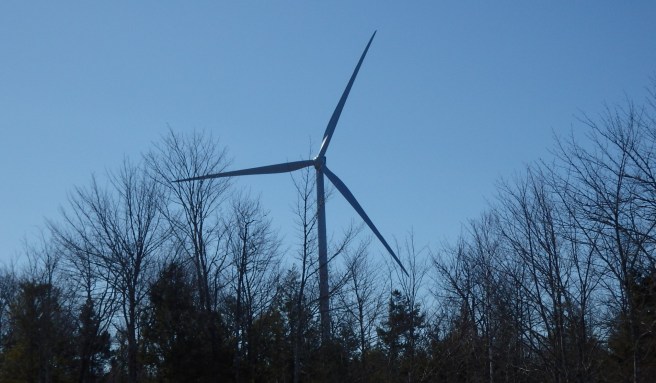
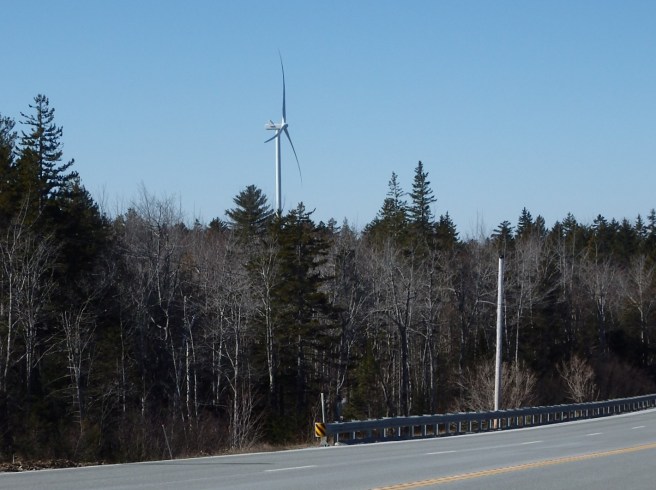
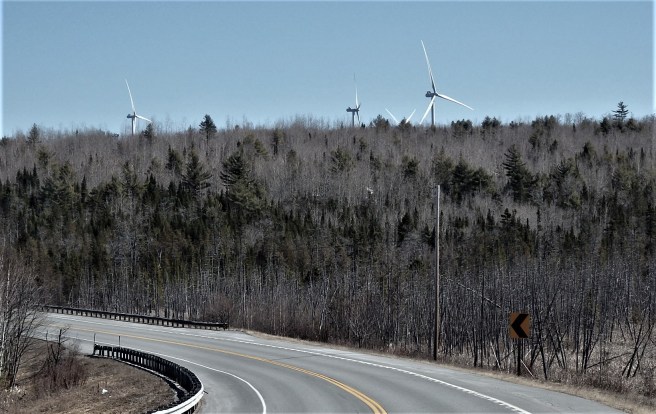
On a clear day, from a dozen miles away you might catch glimpses of a corner of the windfarms on Weaver Ridge and adjoining hills in Hancock County – I’ve counted at least 30 towers before the road dips away – but there are more tucked away in the high terrain. Still, nothing can prepare you for that first flash of the big blades turning gently in the air right in front of your face, or so it seems.

Each blade weighs 1½ tons, even though it appears svelte.

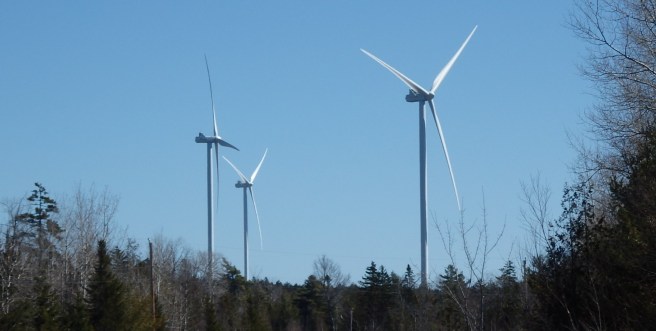
They dance gracefully – sometimes as a solo, then as a pair, or four. You spot them to your left but they suddenly show up on your right – the roadway twists along the slope. As those slip behind you, more giants rise above the hedge of forest. And all too soon, you’ve moved on.

The towers and their blades are bigger than you’d suspect. In fact, at the moment, they’re the tallest wind-powered electrical generators onshore in America, though much larger ones are projected for offshore installation.

The hub stands 382 feet above the ground – that’s more than the length of a football field – and the blade tips reach to 585 feet.

Wind generation accounts for nearly a third of the electrical production in Maine, though the state also imports a fourth of its electricity from Canada, largely Hydro Quebec.

I am baffled by the “not-in-my-backyard” opponents to similar windfarms. They still want energy for their computers and refrigerators and lighting, right?

A tractor-trailer rig could easily be parked in the gearbox or “cabin” attached to the hub.

As if these “spoil the view”? I find them mesmerizing, even enhancing as a kind of sculpture and a reminder of the currents in the air itself. They definitely look better than a toxic oil refinery – and there’s no awful smell. For that matter, they strike me as much more attractive than a television transmitter or cell phone tower as a hilltop crown. And they do remind us of the charming Dutch windmills in a much smaller scale.

The latest installation, 22 Vesta towers and turbines, cost $150 million and went into full operation earlier this year.

Sometimes they seem to play peek-a-boo as you drive.

No more Comcast!

Or Xfinity, as they also say.

I was perplexed that they kept raising the price on our broadband service, seemingly monthly, and then privately complained about monopoly abuse. We haven’t had a TV for years, but for some reason, that didn’t affect the pricing, however they tried to justify that.

Canceling when we moved, though, was a great pleasure. Besides, our new provider is $720 a year cheaper for the same service, perhaps because there’s some competition.

Not everybody’s sticking to broadband for digital access, either.

As a blogger and author, though, I’m just not ready to do all my online stuff on a smart phone. Not that the option couldn’t be tempting.


Bewildered by the big real estate bubble

Admittedly, it’s a national problem, but one that’s especially acute here in New England. Home prices are soaring. Wannabe buyers far outnumber sellers.

For once, my wife and I hit this one right.

The place we just bought, as I’ve been saying, is in a remote location, and it needs some work. There are reasons potential buyers passed on it. As one I’ve met reacted, “It was more than my husband and I wanted to take on.” But thanks to our elder daughter, we have a vision, and, as we are finding, the place feels right. Besides, the bones are good. To our surprise, our bargain bid was accepted, so here I am.

And then, the city farm we just sold is in a very hot market. Readers of the Red Barn have been following some of the reasons – small-town pedestrian-friendly scale and New England character combined with proximity to Boston in one direction plus beaches and mountains in the other directions.

We watched as real-estate prices kept rising, buffeted by only one big downturn, and wondered how young couples and families could pay the mortgages. Well, rents were going out of sight, too, as are mobile homes. Around the neighborhood, the running joke was that none of us could afford to buy our own residences at the current prices. Only it wasn’t funny.

Covid, however, ramped all that up. Many people with professional jobs found that in working from home, they can live anywhere – and in working from home, they need a home office.

The real-estate collapse I had expected didn’t happen, thanks to the federal stimulus checks, extended unemployment compensation, and anti-eviction laws. Not to say there won’t be a delayed reaction.

Still, with Covid limiting a lot of ways to spend money – dining out, movies, travel, athletic events, concerts and theaters, for starters – there may be a lot of cash in reserve. Who knows if that’s a factor.

We had nine bids in five days, all above our asking price. Some were accompanied by love letters, even an excellent loaf of homemade bread, and selecting just one from that array was difficult. As was the disappointment of those who wondered what they’d done wrong.

Some of the push is coming from people from other parts of the country, who are buying sight-unseen, like the Texans with two Mercedes whose bid for a smaller property down the street was $65,000 more than the original asking price. That had a positive influence on our own property when it officially went on sale three days later.

So where are most of the hopeful buyers in Dover coming from now?

New York and California, we’re told.

Did anyone see that one coming? Or have a clue just where it might lead?

Ten major Trump disasters

It’s so massive, it’s hard to pick where to start. Let’s try, anyway. Obama warned him to have an in-house critic, someone who could envision the worst, but Trump only laughed him off. It’s not funny. Just see where it led.

  1. His failure to accept personal responsibility or admit wrong or take criticism. See above. That’s why he appointed only yes-men and promptly fired them. Can you name any of the cabinet officers in his revolving door?
  2. Failure to accept warnings about pandemics, even before Covid-19, even before he took office, and then his failure to admit its presence and act to contain it. Much waffling and obfuscation thereafter.
  3. Repeatedly putting himself above the law, contrary to the Founding Fathers’ conception.
  4. Appointing party hacks to federal judicial benches and other public offices. That corrupting influence will remain for their working lifetime.
  5. Insulting everyone and then whining, “Nobody loves me.”
  6. Shattering environmental regulations and treaties. Just wait till Mar-a-Lago is underwater and he wants a bailout.
  7. Wasting taxpayer money on his own properties and that “wall” against Mexico. Yes, he soaked Secret Service for his overnight golf trips or Manhattan visits. Guess who was the highest paying tenant in the Trump Tower? For only a night or two a year.
  8. Alienating American allies while currying personal favor with the free nations’ enemies. Really. Even the Queen was appalled.
  9. Racist agitation that included abuse of immigration agencies against people of color. Dividing children from parents and holding them like animals in cages for months on end. Seriously.
  10. Attacking peaceful demonstrations, turning American military against the public. Seems to think it’s OK to murder unarmed black men. And then can’t understand the message he’s uttering.

~*~

On top of it all, an inability to negotiate a deal, presuming instead that insults, ultimatums, and tweeting are effective. No, they only fail. A real deal is a win-win for all. Just look at FDR for a model. If only he had an attention span sufficient for history.

Oh, the list is endless. What would you add?

Let’s get back to addressing some really big social problems

Had enough with boogie men spooking us? The last four years have only let the really big issues fester. Here are some top items that need our full attention now. All of us.

  1. Ending systemic racism in society and its underlying assumption of white superiority.
  2. Climate change. It’s real and worsening.
  3. The environment and energy. We were making progress, weren’t we? Clean air and water should belong to all, not the corporate polluters.
  4. Curbing the undue influence of political lobbyists and PAC funds. Yes, Citizens United, too.
  5. The gross imbalance of wealth in America and the demise of the middle class. Progressive tax rates could provide for many services such as health care and education – now borne privately, largely by the lower brackets – to instead be provided across the board.
  6. Also, reviving Social Security. Taxing excessive incomes at the full rate would be a start.
  7. Redress the changing realities of labor, compensation, community, and commonwealth. In short, who benefits when computerization takes over? It’s a much bigger issue than simply raising the minimum wage.
  8. Abolish the Electoral College and voter repression. Under the current system, a shade over 25 percent of the total votes – meaning a bare majority in just 12 states – could elect the president. The majority of the nation’s voters lost their voice in three recent presidential elections, with Republicans given the office. It’s still an attack on democracy and the people.
  9. Health system reforms. Obamacare was a start, but much more needs to be done, including mental health systems and, as we’ve seen with Covid-19, pandemic planning.
  10. Education systems have also gone largely unchecked. Student loan debt is a serious burden on their lives and our economy, just for starters.

Yes, we really can get the upper hand here, if we join together. But the damage has been deep and need time to repair.

~*~

What would you add to the list?