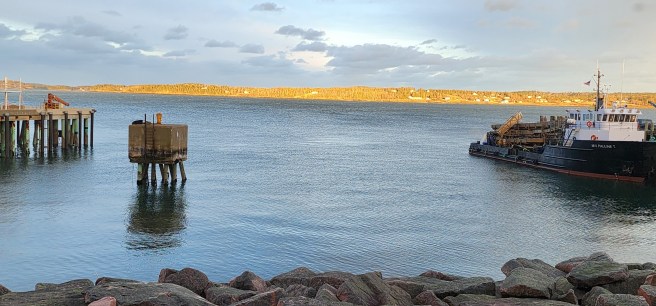
Captain John’s incredible view

As I investigated the history of the rundown house we had bought, I was puzzled by a description that placed it at the corner of Shackford and Water streets, the other end of our block. Only later did I see that as the reality until Captain John Shackford senior sold off two lots a year before his death and the subsequent appearance of Third Street, perhaps the third east/west street in his tract but remaining the only numeral street in the entire city.

I keep trying to imagine his sweeping panoramic view from that time, with the waterfront below and its wharves still in his possession, and then out over the bay and the fields around him. None of the neighboring houses existed through most of that. The lot across Water Street, down to the tides, was steep and the upper part remained attached to our property until the late 1970s or so. My, how we’d love to still have that unobstructed view of Passamaquoddy Bay, the part known as Friar Roads!

As I consider the loss, let me mention it’s what’s too often hailed as the price of progress.

At least we have some great neighbors.

As for some fresh historical perspective

Eastport has an active energy committee, which is good considering how many times we get hit with electrical outages. We live at the edge of the grid, after all, as well as on an island subject to some wild weather.

So while lunching at their Earth Day set of presentations, the man opposite me was asking about our house renovations. This is a small-town, after all, and everybody knows everything – or will.

As I explained the history of our place and some of its makeshift, even shocking, carpentry over the centuries, he interrupted me with an account of a father and son working on a project.

I thought he was talking about John Shackford senior and junior building our place.

As the two were working on the rafters, the son questioned his dad, “That’s six inches off, let me fix it.”

Naw, came the reply: “Just nail it!”

~*~

Sadly, I’m having to admit my realization of how often in my life that’s been the case.

And also, in our home project, how grateful I am that our contractor Adam would never settle for such sloppiness.

We fully intend for this house to last another 239 years.


Deer Island Lighthouse

Across the Western Passage of Passamaquoddy Bay from Eastport, Maine, this small beacon flashes red at night. It’s also a warning of proximity to the Old Sow, the biggest whirlpool in the Western Hemisphere, and mostly on the Canadian side of the channel, as you can see here in one of its calmer phases.

To explore related free photo albums, visit my Thistle Finch blog.

Finally, something the public could see

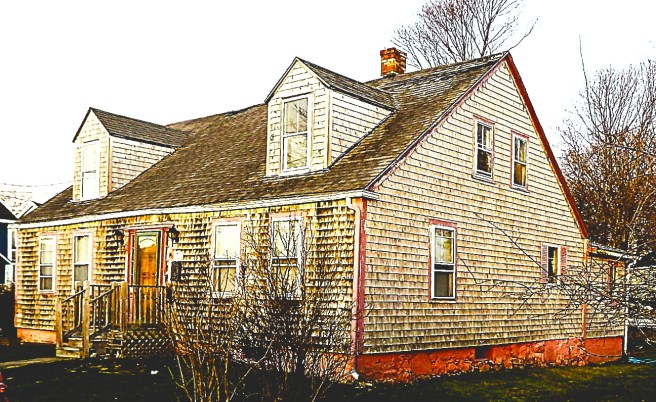
When the scaffolding around the front and side of the house came down after more than a year, the public could finally see what we had intended.

The result actually took off in some tweaks that left it looking, well, we hope for the better – things like the double windows upstairs, which I’ve discussed in previous posts.

In a small community like ours, people were bound to gawk and talk, and so far all we’ve heard has been admiration.

As it now stands.
Starting from this.

When we embarked on this project, I quipped that old-house fixes took three times the estimated time and budget, and ours (alas) has been no exception on both fronts.

Actually, more, or maybe less, if you consider the Covid whammy and inflation. Besides, we got into a great deal more than adding space overhead: many of the extra costs addressed items in our home inspection report, things like rot, wiring issues, plumbing, masonry. Oh my, it was a long list in addition to the more pressing roofing situation that concerned our insurance policy.

So much of what we paid for would be unseen: the aforesaid rewiring (throughout the house, cellar to roof), sculptural work to allow the new farming to sit atop the old (how this structure ever survived before this is a miracle), spray-foam insulation, caulking. The interior storage lofts weren’t as simple as promised but they add for architectural drama (and the name of our architect, mainly us and Adam), nor were some of the exterior efforts to preserve the Cape image as seen from the street while drastically altering the reality.

But then, when our new cedar shingling was finally finished and the construction scaffolds were removed after more than a year, how handsome, as one of the coconspirators put it. Or, from my perspective, dramatic.

I’m hoping both Anna Baskerville and Captain John Shackford, as previous residents, would approve. As well as the list of others who have left their imprint here.

Frankly, we treasure all of it.

Lorenzo Sabine was a Yankee, all the same

After running across his name repeatedly while researching the history of our old house, I decided to look him up. Lorenzo Sabine turns out to have been a remarkable character. Best known today for his two-volume, provocative 1864 book Loyalists of the American Revolution, his adulthood included an influential span in Eastport.

Here are some highlights.


  1. He was born in 1803 in what’s now Lisbon in the White Mountains of New Hampshire, with a Methodist minister for a father and roots going back to French Huguenots who arrived in Rehoboth, Massachusetts from Wales in 1643. Lorenzo moved with his parents to Boston in 1811, and then to Hampden, Maine, in 1814, where he completed his preparatory studies. His father had been taken prisoner by the British in the War of 1812 while working in a military hospital.
  2. At age 18, following his father’s death and his mother’s remarriage, he came to Eastport not long after Maine gained statehood from being a district of Massachusetts. At first, he was employed as a clerk, then tried his hand at his own business but went bankrupt, followed by working as bookkeeper of Passamaquoddy Bank and then engaging in a series of enterprises, including stints as a mercantile partner with William and Jacob Shackford, sons of the Revolutionary War veteran who built our house and much more. He shows up as a witness on many property deeds and other court records.
  3. He was editor of the weekly Eastport Sentinel newspaper to 1834, during Benjamin Folsom’s time as publisher. He was also founder of the Eastport Lyceum, and incorporator of the Eastport Academy and Eastport Atheneum.
  4. He served as a member of the Maine House of Representatives, 1832-33, and was deputy collector of customs at Eastport, 1841-43.
  5. From early childhood, he was what he called “revolution-mad,” something that grew in other directions after his move to Eastport, abutting Canada and having many residents descending from Loyalist lines. This led to his insight that “there was more than one side to the Revolution.” Prior to this “every ‘Tory” was as bad as bad could be, every “son of Liberty” as good as possible.” During the 1840s, the results of his research appeared in the North American Review, America’s first literary magazine.
  6. Quite simply, his work was not favorably received by “patriotic” Americans though it did receive support from several important historians. Lorenzo then revised and expanded his material into an 1847 book The American Loyalists, or Biographical Sketches of Adherents to the British Crown in The War of the Revolution; Alphabetically Arranged; with a Preliminary Historical Essay, erupting a firestorm of controversy. The work received a more thorough two-volume edition for its republication in 1864. You can read it online to see why it challenged many of the conventional treatments of the Revolutionary War and the tensions leading to the War of 1812 from the British side. He did, do note, receive honorary degrees from Bowdoin College and from Harvard.
  7. He moved to Framingham, Massachusetts, in 1848 as a trial judge and was elected to Congress in 1852 to fill a seat vacated by death but did not run for reelection.
  8. Appointed secretary of the Boston Board of Trade, he relocated to Roxbury and also served as a confidential agent of the U.S. Treasury Department.
  9. He was married three times, to Matilda F. Green in 1825, Abby R.D. Deering in 1829, and 1837 to Elizabeth M. Deering, who survived him. Only one of his five children survived him.
  10. He died in Roxbury in 1877 but is buried in Eastport’s Hillside Cemetery.