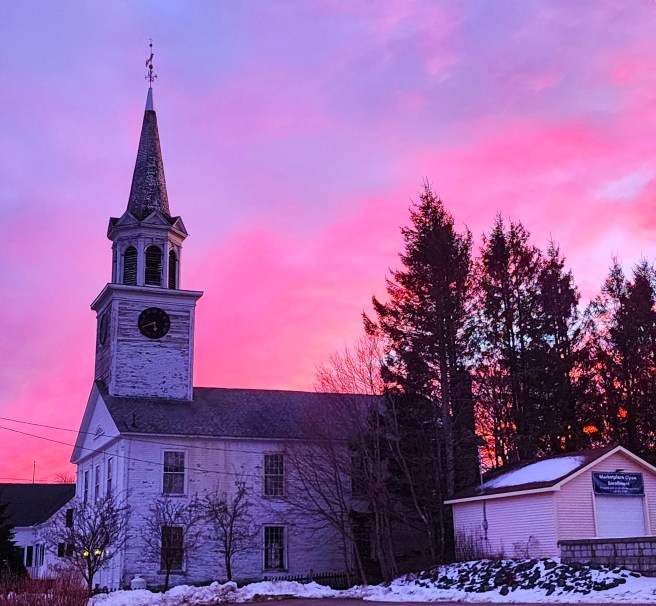
There were some positive steps for our City in the Bay last year

For a small community like ours, with just 1,300 year-round residents, though that swells in summer when the owners of second homes return, our shop owners and restaurateurs have to hustle to make their income during the summer season, long before the notorious Black Friday after Thanksgiving that other retailers rely on.

Our port’s growing popularity with the passengers of cruise ships, especially in the autumn, has provided a definite economic boost and essentially doubled our retailing season.

With that background, here are ten positive steps we saw in our local economy in 2025.

  1. Fiber optic cable came to Eastport and much of Way Downeast, providing both faster broadband connectivity as well as some healthy competition for dominant Spectrum. It’s especially important for many who work from home.
  2. The last leg of the I-395 bypass around Bangor finally opened, in time for the Fourth of July, even. (Officially, the new stretch is State Route 9 and only two lanes, but it is limited-access.) This eliminated a narrow country road link that fed into a typically congested stop-and-go suburban jag between Way Downeast Maine and the rest of the United States. It also shortened the driving time for us to get to major services in metropolitan Bangor, things that the rest of you take for granted, or for deliveries to get to us way out here.
  3. A savvy, local-oriented new and used bookstore opened downtown. It’s an inviting place to sit and read the latest. She knows her stuff and what makes our region tick. As an author, I can say how wonderful it is to be represented on her shelves.
  4. We gained a six-day-a-week bakery, the kind that makes real croissants and yummy breakfast sandwiches. Its opening overcomes the loss of our bagel shop a few years earlier, after its founders realized it was too much to tackle while still having full-time jobs elsewhere. Maybe folks will even stop lamenting a dedicated bakery that closed before the Covid shutdowns.
  5. There are solid choices for great coffee seven-days-a-week now. In addition to the bakery and the bookstore (yes!), an established gourmet coffee roaster has moved into the earlier espresso joint, this time six mornings a week instead of hit-or-miss hours. If you’re up here for a week, this will definitely brighten your day.
  6. Our fine dining options on Water Street have certainly improved. The wine bar now has a full kitchen and a masterful chef who curates a new menu weekly, featuring local sourcing while keeping the price-point in reach of us locals. Ye Ole Hookers, an upgraded incarnation of a legendary waterfront bar, also added a talented cook in the evenings, and we confidently recommend both locations for those who want something more memorable than average diner fare at the other end of the downtown. (In fairness, the Waco has stepped up its game by opening its Schooner Room with evening specials many nights of the week, too.) Gone is the motto many of us repeated a few years ago, “Don’t get hungry in Eastport on Monday.”
  7. The lobster pound returned to outdoor, next-to-the-tides seafood service after a multi-year hiatus. It doesn’t get any more iconic than this. And it is a relief to give an affirmative answer to the common question, “Where can I find a lobster dinner (or lobster roll) around here?”
  8. Ten years after the resident schooner in our harbor went down in the collapse of a section of the Breakwater pier, Eastport Windjammers (our whale watch service) once again has a schooner in its fleet. The Halie & Matthew’s day-sailing cruises are one more attraction for visitors. As an added twist, the two-masted ship was built in Eastport in 2006, so it’s also a homecoming.
  9. Passenger ferry service between Eastport and Lubec resumed on weekends. It’s a great way for tourists to view our waters and mosey around another town.
  10. Our volunteer airport opened a spacious terminal, something that can greet private pilots to our neck of the woods and assist locals who are being flown (gratis) to medical specialists in Boston, 352 miles or a six-hour-drive away. It even brings us a step closer to getting puddle-jumper commercial airline service.

Cheers to all!

So many threads have led to here

This pause in our renovations seems like an ideal time to reflect on the ways this project builds on much earlier dreams and becomes, perhaps by default, their culmination.

My junior high art teacher instilled in me a love of 20th century contemporary architecture as well as Japanese and Scandinavian art and culture. That dovetailed into Shaker traditions that had once existed just down the street from us and a county or two south as well. Plainness, exemplified by Quaker, Mennonite, and Brethren history is in my blood and bones, as I’ve learned digging into genealogy.

Add to that an appreciation for William Morris’ arts and crafts movement, which infused the bungalow I eventually owned in the Rust Belt, and my exposure to historic New England styles, including Queen Ann.

And then a sense of neighborhood, too.

Had you asked me at the outset where I wanted to live, I would have responded central city, perhaps in a high rise, or out in the wilderness, perhaps beside a mountain lake or stream. What was clear that suburban was nowhere in my preference.

So here I am in a historic sea captain’s home a block from the Atlantic yet at the edge of a funky downtown and arts scene and – utterly amazing, to me – within minutes of forest, lakes, and streams.

When I sit in our second-floor rooms, the heart of our renovation project, I have moments of feeling the best of both worlds. In following the new roofline for our ceilings, we’ve avoided creating boxes as the rooms. One criticism of so much architecture objects to “boxes with holes cut in them.” Rather than boxiness, sometimes I’m reminded of the contours within a ship’s hull or a sail overhead.

This time of year, I’m reminded, too, of the flurry of work just before the previous two Christmas celebrations. It got chaotic, up to six tradesmen at one time. We were tripping over ourselves as the rest of the family started showing up.

Throughout it all, we had the ongoing Viking Lumber deliveries, mostly with Tim driving. And our wonder at having the right contractor after all of the delays.

So here we are with the continuing surprise of the historical significance of the house, not just that it was 80 years older than it had been claimed, but that it had been so central to what has evolved here.

As our mason once asked, “How much is enough?”

For now, let’s leave it at that.

Books? Yes, we have plenty

Mine is a family of booklovers, which means we need bookshelves everywhere in our renovated home. Make that two homes, considering the younger daughter and son-in-law, too, in their new purchase in suburban Boston. To that let me add one friend, a famed author, who had so many volumes stored in his Maine barn that one corner collapsed, according to the New York Times Sunday magazine. I’m not prepared for that possibility here in our historic house.

Still, this gets painful as we prepare for triage. What volumes must each of us keep, which ones become optional, and where will all of the remainder go?

On my end, after much culling, I’m finding my eyeballs no longer support the small type in many paperbacks, many of them with binding that is crumbling.

Gee, I’d never thought it would come to this. Take a deep sigh before they are trashed.

The other partners in this move will have to explain for themselves.

As for getting our old house through future winters?

Ours has long been described as a cold house, at least through winter, even before we discovered how much heat had been leaking into upstairs despite attempts to seal that off. Now that our bedrooms are actually up there, it’s on longer considered a problem.

Or, as our contractor quipped, back then folks believed in letting a house breathe. Uh-huh. They did burn a lot of firewood.

Once we had a wood stove in place, we resolved to see how well that worked in our revamped place and make adjustments from there.

Our existing blown hot-air furnace is definitely inefficient. It even lacks an air filter. Like much of New England, it runs on pricy fuel oil. Beyond that, it’s also vulnerable to Maine’s notorious electrical outages. No electricity, the thermostat’s useless.

An obvious improvement would be turning to a heat exchanger, perhaps one tied into our existing downstairs duct work, though that would still be vulnerable to electrical outages. Or outrages, if you will.

The conversion would also work for cooling the house come summer, as needed. Not that we have many days like that, living on an island as we do.

In addition, we have those rotting downstairs sills to contend with, and the obsolete triple-track often badly out of whack storm windows and screens, plus the front and back doors.

As for cold intrusions? Who can be sure they’re really not ghosts?

We’ll do what we can at each step ahead.

We’re still looking forward to a transformed kitchen and a lot more

Under other conditions, this is where we would have started our renovations.

The kitchen, in our firmament, is the heart of a home. The one in our historic house needed some serious attention. Let me amend that, needs extensive remodeling.

The electric Montgomery Ward stovetop we inherited has a dead burner. If you’re too young to know about Monkey Wards, it was a major Chicago-based retail chain and mail-order empire that went bankrupt and out of business before Sears Roebuck. If I need to explain Sears and its Kenmore brand appliances, you really do need a history lesson. I’ll let you give me one in current pop culture in exchange. Back to the kitchen, for now. There’s no oven, other than the small tabletop convection unit we brought up with us. It’s definitely not big enough for a Thanksgiving turkey or a boneless beef prime rib, as was my birthday tradition in Dover, or even full trays of cookies for Christmas. A dishwasher is a necessity in today’s ideal world, especially when you consider my dishwashing skills, frankly, as falling short. The lack of decent electrical lighting over the sink doesn’t help. As for that lighting or additional electrical outlets? The list quickly grows. We weren’t expecting our redo to be as extensive as the one we undertook in Dover; do note, we also gleaned valuable insights from that. Or at least one of us had, the one whose opinion counts most.

Next to the kitchen was the mudroom, uninsulated and without electricity. We needed someplace to put a big freezer to augment the kitchen, garden, and marked-down grocery jackpots. The existing roof there was funky at best and leaking, along with exterior rot. New windows could point to space for new shelving, too. OK, we’ve addressed half of the mudroom checklist, for now.

The front door of the house, as previously noted, needs replacing, along with the downstairs windows and most of their sills. Anything to cut the heating bill, right?

At this point, we’ve decided to defer work on the downstairs bathroom aka the water closet.

Ditto for the emerging dining room slash crafts room with a butler’s pantry. The room which was my headquarters in the universe for five years.

And then, as for gutters? Or window dressings? Or new furnishings?

The bottom line in all of this has shifted but remains exciting, all the same.

Yet, when you’re married to one of the world’s great cooks, the state of the kitchen is a major consideration.

She and her elder daughter have some great ideas and dreams.

I, in turn, reap the benefits as these happen.


Welcome to Middle End, maybe the only one on earth

When I moved to Eastport nearly five years ago, old-timers began telling me of the intense antagonism between the North End, or Dog Islanders, and the South End, aka Assault and Battery (for Battery Street) or Sodom and Gomorrah. Their antagonism toward Lubec just to the south was the only thing strong enough to unite them.

Yes, when it came to the antagonism toward Lubec, the town to the south, they unified in their venom, which was something like the reaction of Dog River residents toward Wolverton in the Canadian comedy series Corner Gas.

Only four months ago, at a historical society forum, did I first hear that the residential section between them – where I live – was known as Middle End, a designation that many of those who grew up here had never heard yet was common in usage by others.

It’s the neighborhood containing the majority of the homes in town, much of it proposed for National Historic Registry recognition as the Eastport Central Neighborhood district. Well, it does have its merits.

Our house would be the oldest within its boundaries, built by the man who originally held title to half of Middle End. His brother-in-law, Caleb Boynton, held the other half. Shackford’s sons and sons-in-law and presumably their wives were active in developing their share, what they surveyed with numbered plots as Majorville.

A middle, by definition, is between ends rather than being an end or even having one, I suppose. For me, that leads to a quaint contradiction. Is there even another Middle End on the planet? Google maps proffer a nada.

The Eastport neighborhood is largely to the west of downtown, with a little wrapping around to the south and north, so it wouldn’t exactly form a West End. And to the east of downtown? It’s all water and very quickly beyond that, Canada.

Well, if they had only called these “sides,” but for whatever reason, they didn’t see things that way.

The End.

Captain John’s incredible view

As I investigated the history of the rundown house we had bought, I was puzzled by a description that placed it at the corner of Shackford and Water streets, the other end of our block. Only later did I see that as the reality until Captain John Shackford senior sold off two lots a year before his death and the subsequent appearance of Third Street, perhaps the third east/west street in his tract but remaining the only numeral street in the entire city.

I keep trying to imagine his sweeping panoramic view from that time, with the waterfront below and its wharves still in his possession, and then out over the bay and the fields around him. None of the neighboring houses existed through most of that. The lot across Water Street, down to the tides, was steep and the upper part remained attached to our property until the late 1970s or so. My, how we’d love to still have that unobstructed view of Passamaquoddy Bay, the part known as Friar Roads!

As I consider the loss, let me mention it’s what’s too often hailed as the price of progress.

At least we have some great neighbors.

As for some fresh historical perspective

Eastport has an active energy committee, which is good considering how many times we get hit with electrical outages. We live at the edge of the grid, after all, as well as on an island subject to some wild weather.

So while lunching at their Earth Day set of presentations, the man opposite me was asking about our house renovations. This is a small-town, after all, and everybody knows everything – or will.

As I explained the history of our place and some of its makeshift, even shocking, carpentry over the centuries, he interrupted me with an account of a father and son working on a project.

I thought he was talking about John Shackford senior and junior building our place.

As the two were working on the rafters, the son questioned his dad, “That’s six inches off, let me fix it.”

Naw, came the reply: “Just nail it!”

~*~

Sadly, I’m having to admit my realization of how often in my life that’s been the case.

And also, in our home project, how grateful I am that our contractor Adam would never settle for such sloppiness.

We fully intend for this house to last another 239 years.