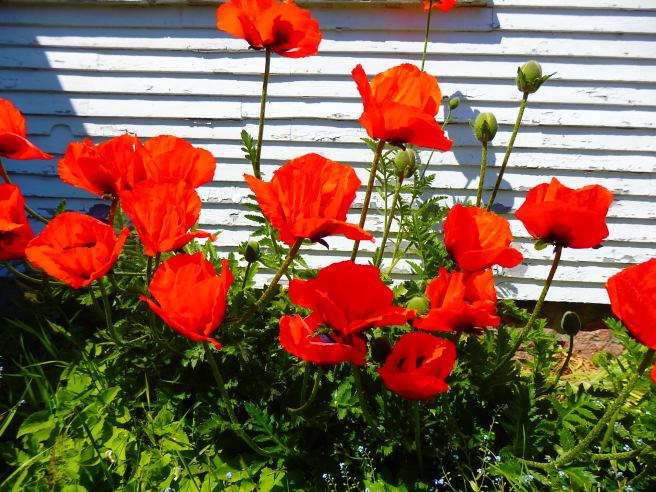
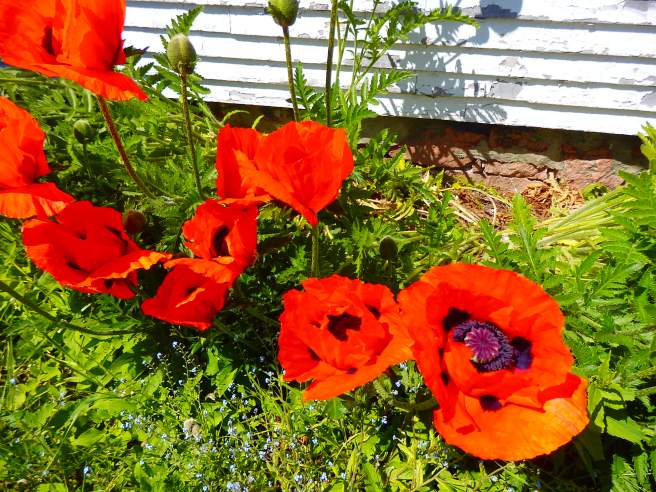
“We usually think of a Poppy as a coarse flower; but it is the most transparent and delicate of all the flowers of the field,” Celia Thaxter enthused in her classic An Island Garden book based at the other end of the Maine coast. Noting that the “Poppy is painted glass; it never glows so brightly as when the sun shines through it. Wherever it is seen, against the light or with the light, always it is a flame, and warms the wind like a blown ruby.”
After a half-page of descriptions of the color range of its many varieties, she quotes an unnamed English master of prose, “The splendor of it is proud, almost insolently so,” and then Browning’s line of “the Poppy’s red effrontery.”
Here on Moose Island, after blazing intensely, they give way all too soon.
To me, they glow like miniature suns.
How fitting, with our sunrise now approaching 4:42 and sunset around 8:19 – and nearly 17 hours of visible light.
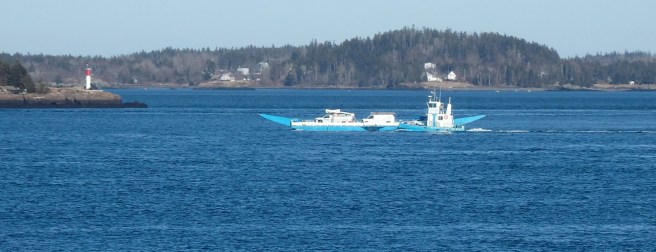
Seen from Eastport, the sleek blue workhorse runs on a schedule between Campobello and Deer islands in neighboring New Brunswick. Here it is passing the lighthouse on Cherry Island.
Devastating downtown fires were a big hazard for 19th century American cities, large and small, from New York, Chicago, Boston, Baltimore, Pittsburgh, and St. Louis down to Portsmouth, New Hampshire, and Portland and Bangor, Maine, closer to home. (For the record, San Francisco actually suffered more from the fires than from the 1908 earthquake just before them.) It’s a long list, actually, and some center cities were leveled by flames and intense heat more than once.
Eastport was one of them, with great fires in 1839, 1864, and 1886 – the last one barely missing our house but leaving the rafters spookily charred.
That blaze, in October, started in one of the sardine factories on the waterfront and spread quickly, consuming almost every building along the harbor.
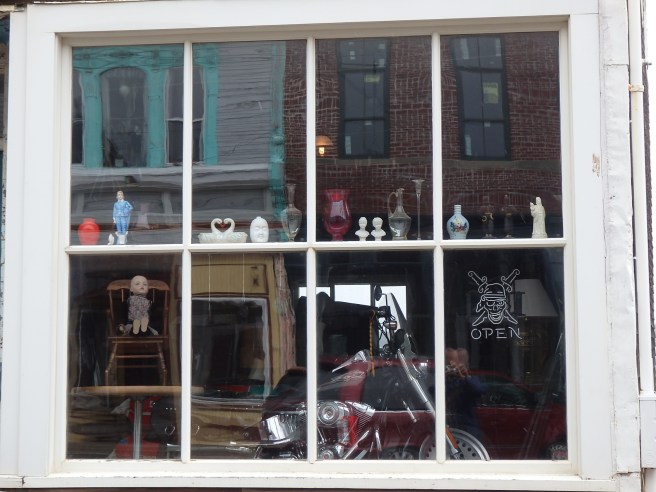
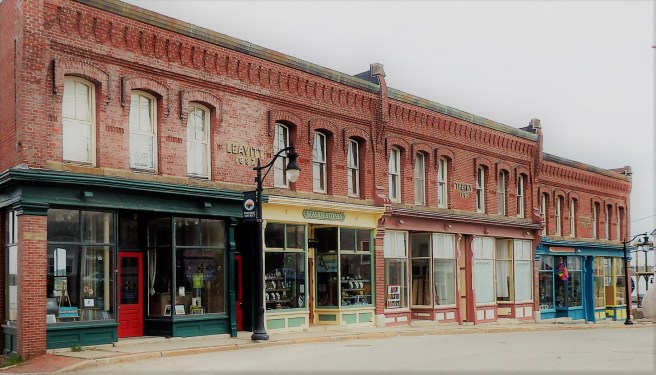
An antique store window is fun to browse, even when the shop’s closed.
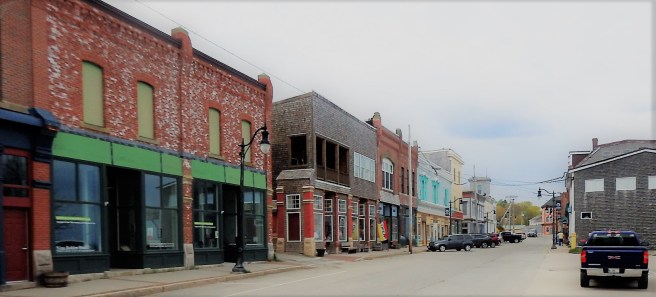
Remarkably, the city rebounded quickly, with most of the Water Street buildings completed and reopened within the next year or two – many of them designed by the same architect and resulting in a visual unity for the five-block stretch.
Today the entire downtown district is on the National Register of Historic Places.
Still, here’s what we have. Put another way, every city needs a center, and a shopping mall just ain’t the answer.
The big challenge, of course, is finding the right mix of business and residence to keep it vibrant. Eastport’s off-season populace falls short of what’s needed but just may be changing in the aftermath of Covid-19.We have art galleries, thank you.
A downtown is more than a place to shop, for one thing, though that helps. It should be pedestrian friendly, with places to stop and sit and meet folks and chat or maybe just stroll afterhours. Cafes, restaurants, and pubs help, too. A post office and banks as well. Throw in a few theaters, nightspots, galleries, churches. Then offices, hair stylists and barbers, upstairs residences, even a hotel or more.
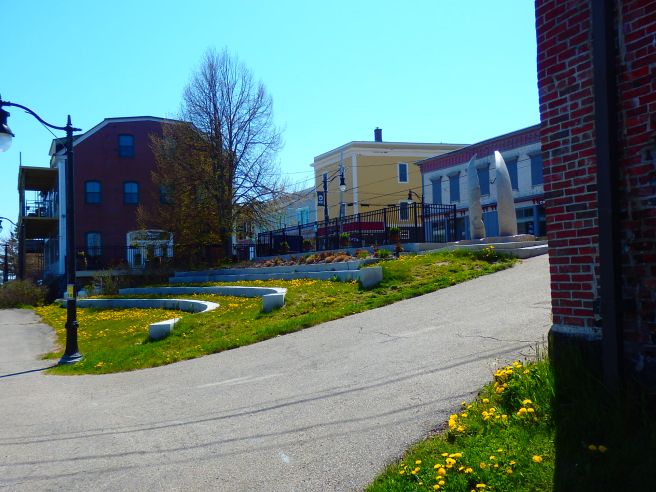
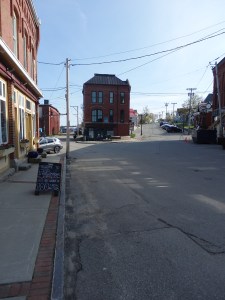
A tucked-in amphitheater overlooking the harbor actually has concerts in the summer. It also provides one more place to simply sit and relax.The street’s not one-way but should be, if we could only conveniently connect it as an easy round-trip..
Tell us something that makes your community special. Where would you take us if we visit?
And not all of it’s meant for human consumption. Some of it’s used for bait, usually for lobsters.
Along the coast we have mackerel. It’s a small fish and oily, one that doesn’t keep well, but cooked promptly or smoked for storing, it’s a lot like salmon. For sports fishing here, seems everybody’s catching ‘em, sometimes six on a line. Some folks even trade buckets of them for lobster.
Alewife. Migrates from the sea late every spring. Another small fish that needs to be cooked promptly or pickled for canning. Also used as prime lobster bait.
Herring. A century ago, these were the basis of Maine’s sardine industry.
Smelt. They’re small, often dip-netted, and can be pan fried and eaten whole. Pacific Northwest Natives called them candlefish, for their oil. Around here, they often show up on the line when casting for mackerel.
Flounder. The species includes fluke, and they like to hang out around pilings and docks – the kinds of places where many folks fish.
Halibut. Now we’re getting to the kinds of fish you might recognize on a restaurant menu or at the grocery.
Haddock. Ditto.
Turning to freshwater, we have several species of trout.
And bass. or perch.
Plus landlocked salmon. Migratory salmon are off-limits, however.
Clamming is also big when the tide’s out. Not that they’re actually fish.
My immersion in yoga and meditation in the early ’70s left me with a deep appreciation for what poet Gary Snyder dubbed the Old Ways, “the wisdom and skill of those who studied the universe first hand, by direct knowledge and experience, for millennia, both inside and outside themselves.”
It’s something quite different from simply old-fashioned, though it’s found in many different traditions. Call it spiritual, even mystical, if you will, but it often has a practical intensity as well.
I’ll even call it countercultural, across history.
One of its streams has survived among the Indigenous peoples of America, though often by a mere thread.
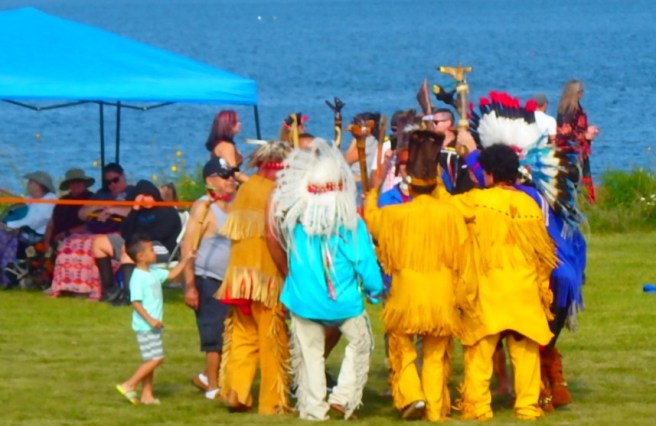
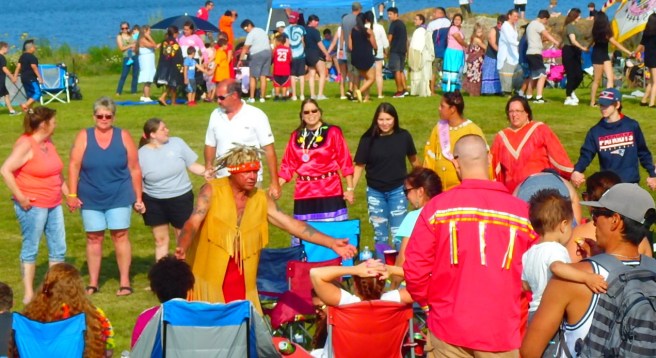
Passamaquoddy dancers in Maine.
I remember visiting Vincent and Elinor Ostrom in Indiana after I left the ashram and, awakening in the morning, sitting cross-legged in meditation on one of their magnificent Navajo carpets. (The Navajo call them blankets, rather than rugs, by the way, but I’d find them too heavy to wear or sleep under. At the time the Ostroms started collecting, these antique artworks were cheaper than wall-to-wall carpeting. Now they’re priceless.) As I opened my eyes, the lines and colors radiated out from me in a design that I could only describe as a living mandala. Its creator had been more than a weaver, then.
A few years later, I was living near the fringe of the Yakama Reservation in Washington state and delving into the mythology and artistry of the Pacific Northwest Native peoples. My longpoem, “American Olympus,” reflects that, as do many of my shorter poems and parts of my novels “Nearly Canaan” and “The Secret Side of Jaya.”
That experience, though, was cut short 42 years ago and revived only last year, when I landed in Eastport with its neighboring Passamaquoddy people – 258 households, 700 members.
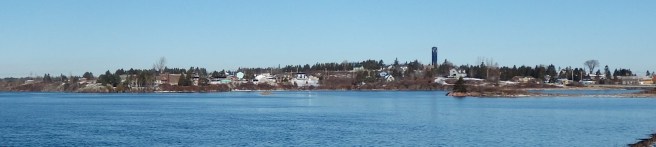
The Passamaquoddy’s Pleasant Point Reservation sits along Cobscook Bay on one side and Passamaquoddy Bay on the other.
I can’t exactly explain it, but I do sense that practitioners of Old Ways change the vibe of the surrounding landscape in a positive way. Not just American Indians, either. I’d say the same of the Amish.
One of the traits that seems to be common among these practitioners is reserve, close observation, and an economy of words. The character Marilyn Whirlwind, played by Elaine Miles in the television series “Northern Exposure,” embodied that to perfection.
There is also a sense of place as sacred, and a desire to live in balance with the land.
The word Passamaquoddy itself translates as People of the Dawn. Even Gatekeepers of the Dawn. And it definitely fits this part of the continent, on both sides of the U.S.-Canada border, which they have always spanned.
The first I had even heard of the tribe was when Fredda Paul, one of its traditional healers, and his apprentice Leslie Wood stayed with us a few nights in Dover. For me, it was a close insight into another way of thought and feeling.
So far, I’ve refrained from photographing the Passamaquoddy, at least apart from their annual powwow. Maybe I’ve learned that from the Amish, except for the powwow part.
A drumming circle is something shared across tribes. It’s a complex interaction, loud vocally and instrumentally.
For an introduction, I’d suggest touring the exhibits at the Wabanaki Cultural Center in downtown Calais. It’s free and includes hands-on displays.
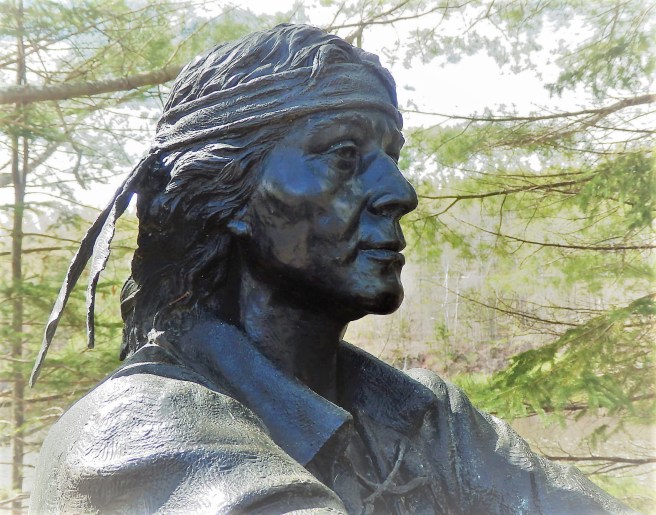
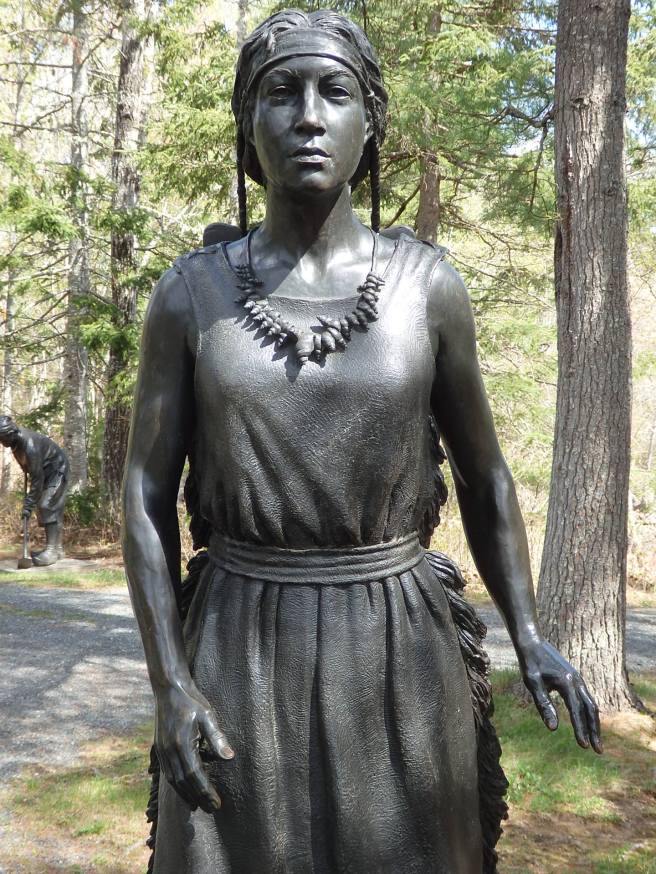
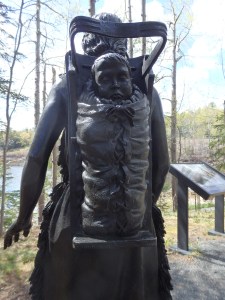
Sculptures by Ivan Schwartz and Studio EIS at the St. Croix Island International Historic Site in Calais honor the Passamaquoddy role in saving the remnant of the French venture in 1605.I do wonder about the sculptor’s choice of models. As for the clothing?And the future?Just about everyone at the annual Passamaquoddy Days celebration is invited to join in the snake dance. Saying no is not an option.
I’ve not yet been able to visit the Waponahki Museum and Resource Center on the Pleasant Point Reservation, with its work by award-winning basket makers, canoe builders, carvers, and contemporary artists, as well full-body castings of tribal members made in the 1960s.
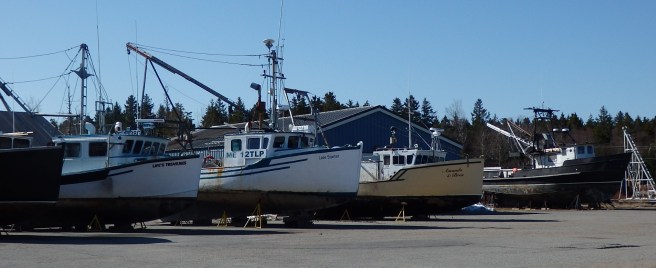
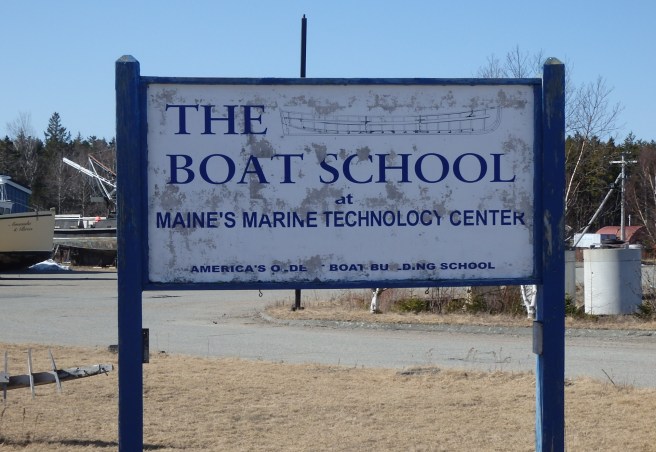
The former Marine Technology Center Boat School is adjacent to Eastport’s big boatyard on Deep Cove. It closed in 2012. As for these vessels? Likely awaiting work across the street. Some of the classes continue at Eastport’s Shead Memorial High while backers look to restart.
Supposedly the island’s infamous red ants keep the tick population at bay here in Eastport. Fire ants?
Another pestilence.
Still, I’ve learned to inspect carefully for ticks after any outing inland. Somehow, I hadn’t had to face them prior to New England.
Black flies, though, are particularly nasty. They’re tiny and attack first individually around the mouth and nose and then as swarms or small clouds that leave nasty bites from mid-April through mid-July, especially when there’s no wind or you’re away from the sea.
Yes, that sea seems to keep them away from Eastport.
The skeeters will come later.
You don’t see any of this in the L.L. Bean catalog version of Maine.
In the “Black Fly Song” by Wade Hemsworth, made famous by folksinger Bill Staines, the action is placed in northern Ontario, though it’s of little comfort to know the pests range so far across the northern forests.
The lyrics nail the misery so well, For I’m all but goin’ crazy.
The reason, of course:
It was black fly, black fly everywhere
A-crawlin’ in your whiskers, a-crawlin’ in your hair
A-swimmin’ in the soup, and a’swimmin in the tea
As the chorus goes:
And the black flies, the little black flies
Always the black fly, no matter where you go
I’ll die with the black fly a-picking my bones ~*~
It’s true, no joke.
Staines, by the way, lived one town over from Dover, where I was. Small world.
And I should note the bumper sticker: Black Flies, Defenders of the Wilderness.


 Jnana's Red Barn