Confirming our house as Captain John’s homestead

The Shackford children had their joint holdings surveyed in January 1833, with Hannah Shackford’s husband, Darius Pearce/Pierce, performing the task. A flurry of real estate transfers followed, formalizing their agreements.

By 1820, according to the Census, the sons were heads of household.

Trying to follow the transactions gets rather confusing.

William and Jacob had even gone into business together in 1833, turning their attention away from seafaring. Their dealings included waterfront between the high-tide and low-water stretches as well as bands of shorefront below our house that would be developed into wharves.

From what I see, the boys weren’t getting a family discount. In 1830, John junior paid his father $1,000 for one parcel next to his brother William’s. In a transaction dated December 30, 1831, John senior specifies a band of waterfront “partially in front of my own dwelling house,” with the sellers being himself and “my wife Elsie.”

Among the deals were one on the easterly side of Water Street “to the fence of my homestead” and then westerly to Water Street, confirming that his homestead included both sides of the road.

Of special interest to me in confirming that our house was the one John senior occupied are the two deeds conveying adjoining land along Water Street. First was a sale to Myrick Bibber, a furniture merchant, on June 13, 1839, for a lot on the southwest corner of Water and Shackford streets, and then on July 10, to Daniel Aymar for the lot between the two.

Each of them is measured to the line of “the yellow house lot owned by me.”
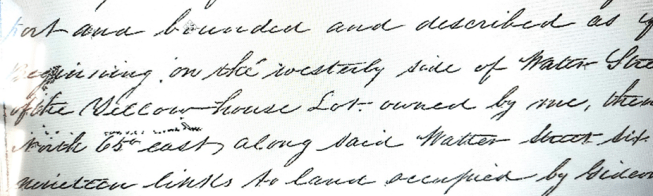
Here’s how the description appeared on the two deeds recorded at the Washington County courthouse.

I was surprised to see that he signed the deeds with his mark, X, as did his wife in several instances. New England was noted for its nearly universal literacy, both men and women.
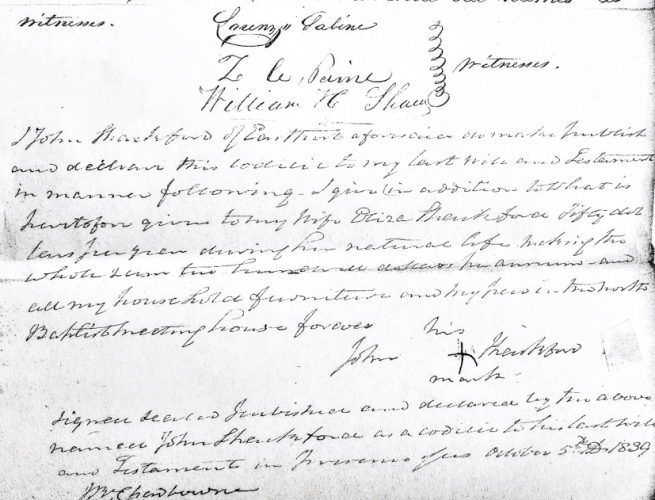
Here’s his X on his will.

Grandson Samuel Shackford said Esther, John’s first wife, “had been well reared and was a woman of superior intelligence” and that her children “were indebted to their mother for nearly all the educational advantages they ever enjoyed.” Unlike her husband, she signed some of the documents, as noted in the record, “her seal.” “School-teachers were rarely obtainable, in those days, in this then out-of-the-world. For a brief period, the services of William Lloyd Garrison’s [future] mother were secured to teach in the family” when she lived on neighboring Deer Island, Canada..

The real estate transactions indicate the children were all literate.

Esther died June 21, 1830. His second wife enters the picture rather obliquely soon thereafter.

His will of June 14, 1832, bequeathed “to my beloved wife Elsie the use during her life of my homestead or the house in which I now live, together with the lot and privileges thereto.”

Further down, it directs his six children and grandson Samuel to pay “to my wife Elsie the aforementioned annuity of one hundred & fifty dollars. And on my demise the homestead on house in which I now live with the lot come privileges pertaining thereto, and the one of which I have willed I am bequeathing to her during her life, I am bequeathing to them, my six children … in the same proportion of my other property.”

A harder to read codicil of October 5, 1839, raises the amount of the annuity to “my wife Eliza Shackford” to $200 during her natural life and “all my furniture and my pew in Baptist meetinghouse forever.”

After Captain John’s death, as Samuel Shackford confirmed, Elsie (or Elise, in his account) obtained the Revolutionary War veteran’s pension based on his service.

Elsie was later recorded in the 1850 Eastport Census as Eliza Shackford, 70, living in a household headed by Abigail Winslow, 37, along with four children — Anna E, 12; Lucy M., 6; James F., 4; and Mary A., 2; as well as Ethel Olmstead, 37, with his occupation as “gold digger” in the metal mining industry. An index to that Census listing placed Ethel as the head of household, even though he was at the bottom in the family. I am perplexed by the Winslow identity.

All of it, of course, has relevance on the house we bought.

Worshiping together, too

The Shackfords and Olmsteads had more in common than their livelihoods on and around the sea.

The oldest church in Eastport, founded in either 1798 or 1802, was the Calvinist Baptists, as some in town knew them, or more accurately, Particular Baptists, largely in line with the majority of Baptists today. That group moved into its Washington Street house of worship in 1837. (Today, it’s the Eastport Arts Center.)

The second congregation in town was the Free Will Baptists, organized in 1816 and incorporating with the state in 1820. Darius and Ethel Olmstead along with John and William Shackford and their brothers-in-law John Hinkley and John C. Lincoln were named in the incorporation papers.

Among other things, Free Will Baptists avoided alcohol consumption and, in its Northern stream, opposed slavery. As a rite, it practiced foot-washing. The denomination stemmed from the Dutch Mennoninte-influenced General Baptists in England, unlike the Baptists just down the hill. I am curious to learn how much our Shackfords and Olmsteads hewed to the denomination’s values. The General Baptists, I should point out, were earlier a strong influence on the emerging Quaker movement in Britain. My Quaking Dover book details more.

The Free Will Baptists dedicated their first meetinghouse in town in 1819, a year before the other Baptists had theirs. They were later known as North Christian Church, with the building at Washington and High streets.

Next to organize in town were the Congregationalists, 1819, and Unitarians, 1821. Roman Catholics had a chapel in 1828, early for New England.

The 1820 Census for Eastport has the brothers Darius, Ethell, and Jesse Olmstead as heads of household.

Two years later, Mrs. Darius Olmstead (Elsie Haddon) and Mrs. Ethel Olmstead (Nancy Ann Haddon) were among the charter members of the Eastport Benevolent Female Society, as were Mrs. William Shackford, Mrs. Jacob Shackford, and Mrs. John Shackford.

The Olmsteads and Shackfords obviously shared in an emerging social structure, having arrived in the Passamaquoddy region at the same time.

All of it, of course, has relevance on the house we bought.
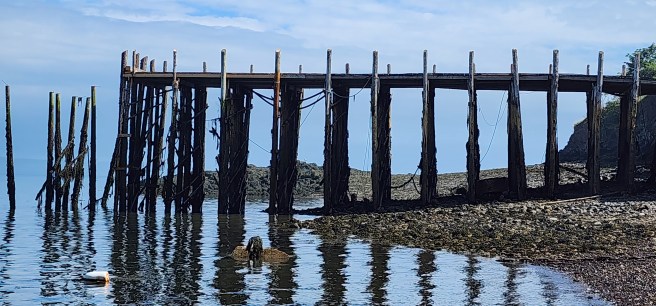
Sometimes a Dover connection wasn’t quite what I expected

One of the things about the history of my far end of Maine is seeing how much of it springs from Dover, New Hampshire.

Neighboring Pembroke, for instance, was founded by Hatevil Nutter Leighton, a descendant of both a Dover Quaker family and one of the faith’s fiercest oppressors.

Daniel Hill, the first permanent resident of Calais (1779), came there from Jonesboro, though he had been a pioneer settler of Machias in 1763, along with a J. Hill – his half-brother Japhet.

Knowing that the Hills were a prominent extended family in the Dover Quaker Meeting, I became curious and found confirmation in the fact that Daniel is thought to have been born in Kittery, Maine – on the other side of the Piscataqua River from Dover – around 1734. Close enough. Dover Friends had a neighborhood Meeting on the Eliot/Kittery town line.

But in his case, forget any Quaker influence. That was at least two generations earlier in his line, which did gravitate in and around Dover.

Daniel fought in the French & Indian War and again in the American Revolution. He was rumored to be a skilled Indian fighter. There’s even a controversy over whether he was a Rebel or a Loyalist, considering that he apparently lived for a time on the Canadian side of the border. His father, though, died in Nova Scotia in 1782, befitting a Loyalist position.

Loyalists? You’ll hear more about them later here. Please stay tuned.

A surprise dimension opened

Courthouse records go only so far in piecing together a story like this. But the names I had found did give me enough to start turning to online genealogies, Find-a-Grave posts, and related histories to augment the investigation, often including the exasperating process of eliminating possibilities before chancing upon nuggets.

A conventional telling I found repeated contained this: “Captain John Shackford died at his home in Eastport, Maine, on Christmas day, 1840, having attained the eighty-seventh year of his age, and his widow obtained a pension from the U.S. government by reason of his service in the American revolution.”

Christmas, by the way, was not observed in Massachusetts, and likely not Maine at the time, even now that it was an independent state. As many journals of the time noted, “It was an ordinary day.”

The quick mention of his widow slid by almost unnoticed. It seemed to be an error, no, considering that Esther had died a decade earlier?

My big “ah-hah!” moment came in coming across a free ebook copy of the 1888 Eastport and Passamaquoddy, a Compilation of Historical and Biographical Sketches compiled by William Henry Kilby. Of special interest was in the 506-page book was a chapter, “Captain John Shackford and His Family,” by his grandson Samuel Shackford, living in Chicago. I’ve already referred to it, but the most crucial part for me was this: “After his decease, his second wife, who was widow Elise Olmstead, obtained a pension from the United States government for his services in the Revolution.” The crucial points were that Captain John had married a second time, something not obvious elsewhere, and even better, I now had a name to focus on.

As I soon found, her name was Elsie, though it also appears as Elise, Elsa, and Eliza. She was the widow of Darius Olmstead.

~*~

The September 27, 1831, Eastport Sentinel reported the marriage of Elsie and John Shackford senior, with the Reverend Bonds officiating. In the Sentinel, her name was Mrs. Elsa, widow of the late Darius Olmstead.

Captain John would have been 77 or 78. Elsie, around 52.

She was born around 1779 in Chatham, England, to James Haddon and a presently unknown wife. He then then brought the family to Saint John, New Brunswick.

Elsie’s first husband, Darius Olmstead, was a merchant, “copartners in trade under the firm D&E Olmstead, with his brother Ethel. Between 1822 and 1825 they purchased sections of Central Wharf in Eastport from James Olmstead.

Darius died July 13, 1825, age 48.

He descended from a well-known and prolific colonial family in Connecticut., one that becomes difficult to follow in its many repetitions of Darius and Ethel across generations and geography.

In the instance at hand, Darius was born in 1776 to Aaron and Hannah Peat Olmstead.

His brother Ethel married Nancy Ann Haddon, presumably Elsie’s sister.

While Olmsteads appeared in historic roles during the American Revolution, Aaron was of the Loyalist faction and relocated to Saint John, New Brunswick, at the end of that war.

Partisan alliances aside, the border between the United States and Canada was loosely enforced. In 1798, Aaron drowned in the harbor at Eastport.

Among the children born to Darius and Elsie Haddon Olmstead was son Ethel (a name also spelled Ethal and Ethell in the records). He was born in 1814 in Eastport. Another son was named Darius.

In 1826, Eliza Olmstead, widow, and Ann Olmstead, wife of Ethel, sold a property on Key Street that Darius had purchased from John Shackford in 1810.

With the widow’s remarriage, her son Ethel, around age 16, would have become Captain John Shackford senior’s stepson.

I have nothing more on his brother.

All of it, of course, has relevance on the house we bought.