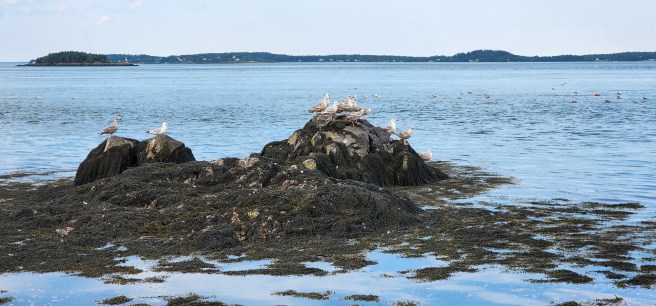
They face the wind.
Eastport, Maine.
You never know what we'll churn up in cleaning a stall
They face the wind.
Eastport, Maine.
In following the history of our house, we’ve veered off from Captain John and Esther’s children as other families added their names to the dwelling. At this point, I’d like to return to the Shackfords to give you a better sense of the family’s additional impact on the community as well as ways the town itself changed over the years. When the Shackfords first arrived, the place wasn’t even called Eastport but rather Passamaquoddy or Moose Island on Passamaquoddy Bay. Sometimes it even went by all three at once. While the sons’ and sons-in-law’s escapades during the War of 1812 have been noted, their seafaring ventures continued well after.
~*~
John junior, for instance, not only commanded the first vessel owned in the town, but he also ran the first packet in the Boston and Eastport line, “through winter’s storms and summer’s fogs.” A packet was a new concept in shipping, with vessels departing on a regular schedule, rather than waiting for a full load or a set number of passengers. The innovation could be risky for the investors or highly profitable, depending.
In a fuller telling, he “was commander of the first vessel owned in the town and commander on the first freight and passenger traffic boat established between Eastport, Portland, and Boston, and his last packet, the Boundary, the swiftest vessel on the coast after 21 years in this service, had to give place to steamships.”
The May 9, 1828, edition of the Eastern Argus announced that the schooner Boundary, 142 tons with John Shackford, master, the schooner Edward Preble, and the Thomas Rogers would be running between Eastport and Boston, stopping at Portland both directions. That gives us a date and a possible commercial association of the three vessels. After that, newspaper mentions of the Boundary arriving or departing Eastport or Boston with Captain Shackford at the helm were common.
He “knew by sight all the dangerous places along the coast, but never had more than a passing acquaintance with them, and during his long experience as shipmaster never had occasion to call upon his underwriters for a dollar. The Boundary, his last packet, so well known as the swiftest vessel on the coast, was driven off the route on the introduction of steamships, when she was 21 years old; but for 20 years after she was a staunch craft, engaged in the coasting trade.”
Coasting, should you wonder, refers to traffic that followed the coastline rather than crossing the open ocean. The swift, agile coasting schooners could easily run into trouble further out from the coast.
The December 2011 edition of the Maine Coastal News described the Boundary as having two masts and dimensions 79 by 22 by 9 feet. And, yes, she was built on Shackford Cove in 1825 by Robert Huston.
There was a legal tangle on June 26, 1826, when, as commander of the Boundary, Captain John appeared before the Boston board of alderman to respond to charges of an alleged breach of the law to prevent the introduction of paupers from foreign ports.
Captain John junior’s sons included three shipmasters: Benjamin Batson Shackford, who died in Eastport in 1885, aged 73; Charles William Shackford, master of the brig Esther Elizabeth, who with his vessel was lost at sea in the winter of 1853-1854; and John Lincoln Shackford., who died at St. Thomas, West Indies. More on him later.
John’s wife, Elizabeth Batson, came from another seafaring family. She died in 1830. Did she travel with him, as many captains’ wives and families did? I suspect he married a second time, perhaps to Eliza A. who died in Eastport on February 17, 1899, age 84 years four months five days.
When John junior died on August 12, 1866, he left no will. His obituary in the Eastport Sentinel, in the manner of the time, did not name other family members, something that might have revealed whether he had remarried after his first wife’s decease. Instead, it said, “He was a devotional man always found at prayer meetings and public preaching when he was able to be there.”
Remember, John junior grew up in the house we now own.
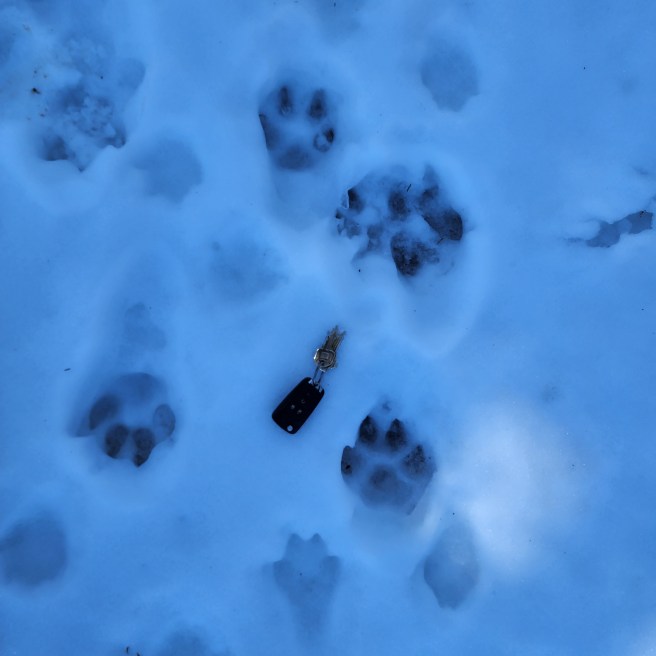
These in Maine may have been left by an interloper from Canada. My car keys give you an indication of size.

Compared to where I’m living, this is Bright Lights, Big City.
It was seen from the historic schooner Louis R. French before we set sail the next morning late last summer.
Back to Elsie’s son, Ethel Olmstead. Several accounts have him marrying Abigail C. Harrington and having the son and three daughters, as recorded in the Census. She may be the Abigail Harrington born September 4, 1815, in Eastport to Andrew Harrington, who came to Moose Island from New Brunswick.
Another Loyalist connection?
Ethel’s gold-digger occupation noted in the Census leads us to the California Gold Rush. He died July 22, 1852, in San Francisco and is buried in Golden Gate cemetery, a potters’ field (the gravestone name has been transcribed as Esther and the birth date is 1812 by one source), although Yerba Buena is a second possibility. Both lines of argument have the same date of death but no cause. Natural or violent? Did he go by way of a sailing vessel around treacherous Cape Horn or perhaps crossing Panama? Perhaps working on one of the Shackford vessels? It makes more sense than a wagon train crossing the Prairie, considering the distance from Downeast Maine to the Oregon Trail and then points west. As for a cause of death? We can only speculate.
The Gold Rush angle thickens with the death of Major Ethel Olmstead of Calais, Maine, on March 15, 1856, at age 70, in El Dorado County, California. “No road leads up to the grave and the few trees and bushes surrounding the grave hide it from the outside world” outside the historic gold mining camp of Wild Goose Flat on the east side of the North Fork of the American River in the Sierra Nevada Range.
I do love the description of his final stop, “southerly from Rattlesnake Bar and easterly from Horseshoe Bar.” Those may be watering spots more than places in the river, should you wonder. Perhaps that’s gives you an idea of how widely some individuals traveled from the easternmost homes. His second wife, son, and daughter all continued in California after his death. In Calais, he had been a blacksmith.
This Ethel turns out to be the uncle of the Ethel of our house. I’m guessing neither of them struck it rich.
Since both Abigail and her son James were living at the time of the house sale to the next owner, more questions remain.
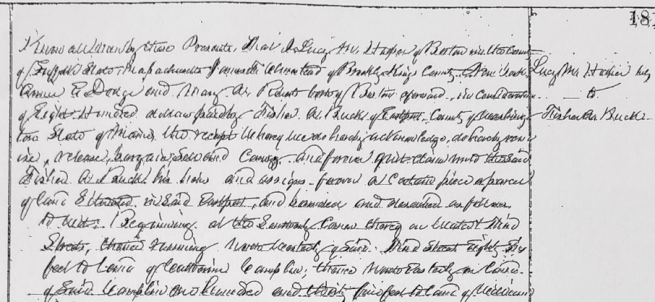
I’ll also note that having additional residences in Boston and New York was not uncommon for shipowners or captains, so I do wonder about Lucy Hooper’s husband’s occupation. One more thing to check out, when I can.
Curiously, the recording of that deed did not include a book-and-page citation to a previous sale, leaving me stymied on furthering the property’s earlier history. Still, as you’ve seen, I finally connected the line.

Streams take off.
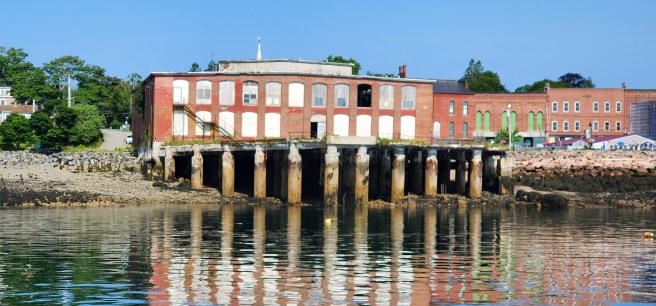 The legs of the former American Can Company factory on the Eastport waterfront are revealed at low tide if you’re out on the water. To see what’s behind them, go to my photo album, Can Factory Caverns, at Thistle Finch editions.
In a transaction dated December 27, 1859, Elise purchased the property from the Shackford estate heirs for twelve hundred dollars. In addition to Captain John senior’s sons Jacob, John, and William and daughters Esther and Hannah, grandson Samuel Shackford,, and their spouses as the sellers, we find the name Myrick D. Bibber, the furniture merchant who built at the corner of Water and Shackford streets around 1840.
Note that daughter Sarah Shackford Lincoln is not mentioned in this agreement (she died in 1846). In December 1841 she had sold “my right title and deed [?] to the estate of my Father John Shackford, late of Eastport” to William Shackford and Bibber.
In the 1860 Census, the household was enumerated under Elsie’s daughter, Abigail C. Olmstead, 46, dressmaker, personal value $15 or $1,500 — the script is difficult to read. Elsie — or Eliza, as the Census recorded her — was 83 and had a real estate value of two thousand dollars.
The household also had boarders: storekeeper Peter Kane, 21; Sarah Leighton, 72; and Sophia Gleason, 67.
Ten residents in our house would be tight, even if the two ells attached at the time had living space.
An inventory of Elsie’s estate was ordered in August 1868 after she had been declared non-compos mentis and placed under the guardianship of her step-grandson John S. Pierce [Pearce], by way of Hannah Shackford Pearce.
Her death, October 19, 1868, was reported in the Eastport Sentinel as “Mrs. Elizabeth, relict of the late Captain John Shackford, 78 years.” The age would correspond to Elsie’s.
In 1880, her daughter-in-law, Abigail Olmstead, was recorded as age 65 living in the household of her youngest daughter, Mary A. Roberts, 31, in Boston.
The linkage to Fisher Ames Buck and later owners was finally apparent.
That sale was by Abigail’s daughters.
 It’s a striking breed, seldom seen outside Scotland.
Here’s a small flock in neighboring Robbinston.
I really do think the ram in front should have a cartoon quip balloon attached. Any idea what he’d say?
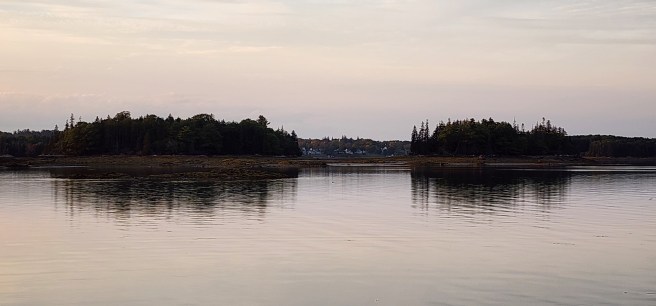
A gap between two islands presents a quick glimpse at the town of Castine beyond. A landscape explored from the water connects places in a much different sense than you get from land.
That’s one of the lessons I savored aboard the historic schooner Louis R. French last summer.
Remember, so much of Maine is water.

