At a recent online writers’ conference, I was convinced to bite the bullet and release my novels at goliath Amazon in addition to the alternative ebook retailers where they’re already available. As I began pondering the new hurdles and strategies, I looked at Hometown News as a first offering.
A few years ago I had replaced the original cover, which sought to convey a sense of an idyllic small town where children could grow up safely, at least at the onset, with another of more urgency, reflecting the broader sense of the ultimately dystopian novel.
The new photographic image, though, was problematic.
The flames coming out of the residential window had the emotional message I wanted to convey, but they kept eating up the title and author credit, no matter which color I tried.
So I came up with this, trying to employ a trendy design element:
Returning to it now, though, I still felt an unease. The solution, in the end, was to make the artwork a bit smaller to give it more impact. Got that? It doesn’t make sense, but here’s how I’ve gone:
By the way, it’s now also available in paperback and Kindle at Amazon, as well as at Smashwords and affiliated ebook retailers.
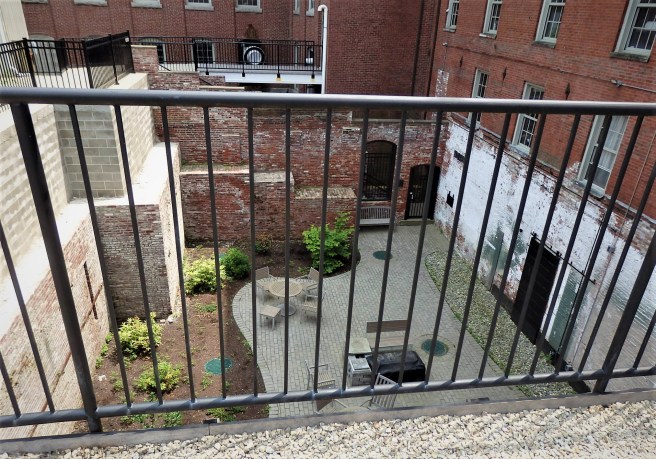
We had to wonder the background of this building in Eastport, Maine. Could have been a factory, maybe fish processing, or a warehouse. Turns out to have once been the world’s biggest sardine cannery. The potential also intrigues, should anyone take up its restoration before it collapses into the tide.
As I’ve looked with delight at the renaissance of my small city’s downtown, one modeled in part on Jane Jacobs’ then revolutionary attack on urban renewal back in the ’50s, I am a bit bothered by how much of it is now based on a commercial cookie-cutter concept known as mid-rises – five-story stick-frame construction above a steel-frame pedestal that’s then given a brick or similar exterior facing.
It’s happening all over the country, actually, and not just in the heart of a city, either. Even here in Dover, we’re seeing something similar happening about a mile south of downtown as an over 50s-something neighborhood called Pointe Place with rents that astound me. Who can afford it? Some retirees, apparently. It’s a downtown within a doughnut, in effect. You can’t really walk there from anywhere else.
Of course, the Covid-19 pall casts a big shadow over these developments, but some observers say it might encourage more people to move from big cities to smaller communities like ours. We’ll have to be patient and see what actually unfolds.
As I’ve argued here in various forms, I’d rather have a real city center abutting organic neighborhoods, one with a funky fringe of mixed-use buildings, unlike apartment complexes surrounded by parking lots along the major highways or shopping strips.
What we definitely have here in Dover is the attraction of a river that rises and falls with the tide, as well as the historic mills once renowned for their calico and now serving as entrepreneurial incubators and housing.
Call it atmosphere and scale.
~*~
As Dover’s emerged as New Hampshire’s fastest growing city, the bulk of the new downtown residents are presumably singles and child-free couples, either young professionals or older folks who want the amenities of living close to restaurants, parks, and public events.
The retail and professional rentals are a larger concern, though, especially as many small merchants find themselves at a disadvantage against Amazon. Take the local hobby shop as an example. And that’s even before the bigger threat of coronavirus hit the entire economy.
Even so, these projects haven’t been on hold.
The new Orpheum takes shape downtown, matching the height of the old Masonic building to its east and the old Strafford Bank across from that. The spire at top left is city hall, a block away from the back of the new building in what was previously a parking lot.The Robbins Block storefronts are now gone and a five-story Orpheum is rising in their place. The hardware store, lower right, is still there. From the top left are the library, community center, and district court.
The old block may look charming in the photo, but the buildings were rundown and unwelcoming to pedestrians, as was the sprawling parking lot behind them. There was also a traffic bottleneck that’s being eliminated.
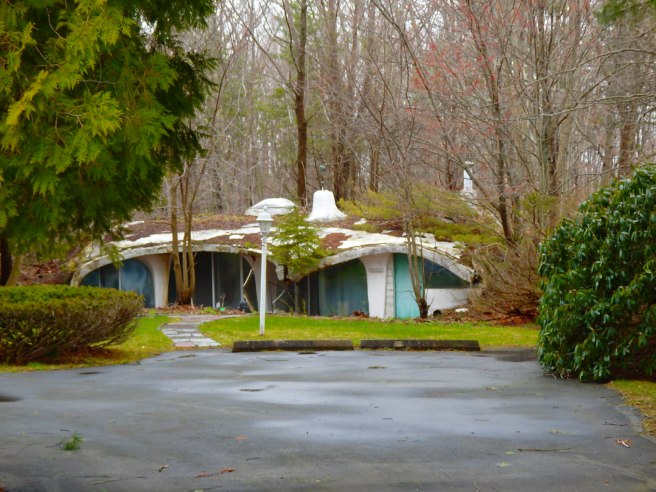
I must have passed this a thousand times before finally noticing it tucked in beside an older farmhouse. The return of foliage will soon have it completely hidden.
For the Eastern Orthodox, today ushers in 40 days of Pascha, or Easter. It’s not a one-day event, but the joyous response to Great Lent, culminating in the feasts of the Ascension and Pentecost.
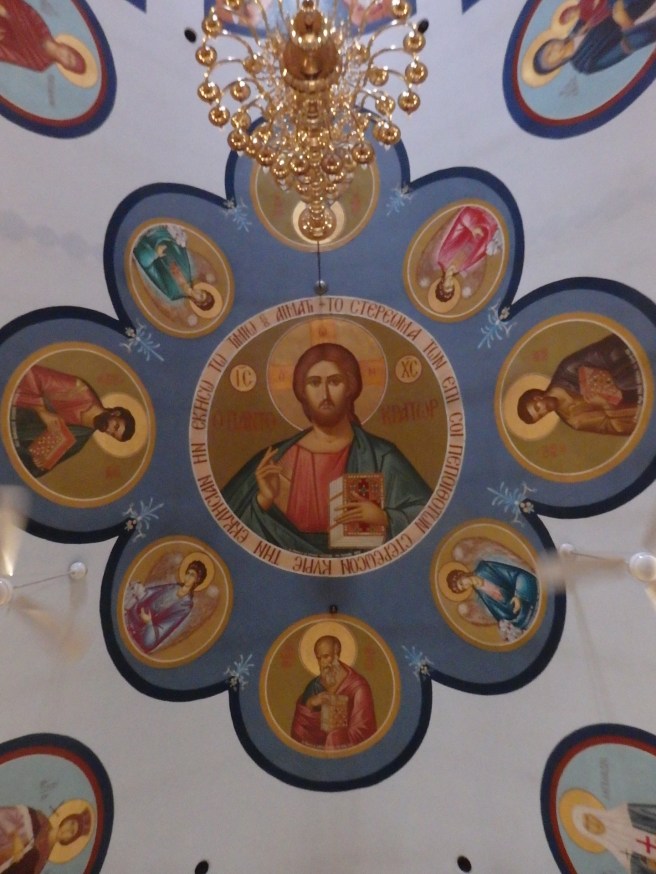
The center of the ceiling in an Eastern Orthodox house of worship typically displays a large icon of Christ Pantocrator, or Ruler of the Universe. Here is the image from Annunciation Greek Orthodox church in Dover, with four angels and what I presume are the authors of the four gospels. Every time I look up at that face, the thought arises, “I could follow that man.”
The Swedish retailer of low-cost home furnishings, appliances, cookware, and the like is a magnet for folks trying to make the most of tight spaces like apartments. Say a challenge like a 400-square-foot apartment.
Even if you have an old five-bedroom home like ours, the interiors can be challenging. IKEA has frequently come to our rescue. Yes, some assembly is usually required, and I can attest it’s not always idiot proof, but overall, we’ve been pleased with the results.
The closest IKEA superstore to us is located south of Boston, and since deliveries aren’t cheap, it’s worth the four-hour round-trip, even if you get lost inside once you’re there, as I have. The cafeteria, by the way, is quite the bargain.
Are you one of those intrigued by the small-scale living space displays in the IKEA superstores?
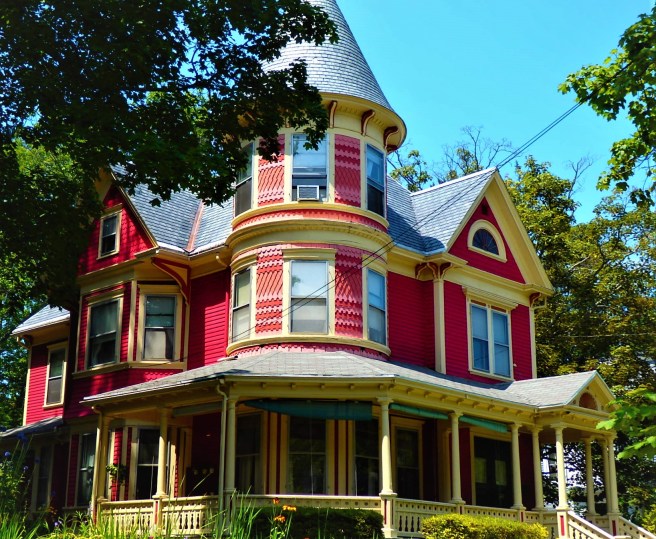
Of the witch-hat houses I’ve seen to date, this comes closest to the shape I envisioned for my novel What’s Left. I like the way the top room in the tower connects to the attic rather than the master bedroom. Now, if the place were only pink to match the one in the story.
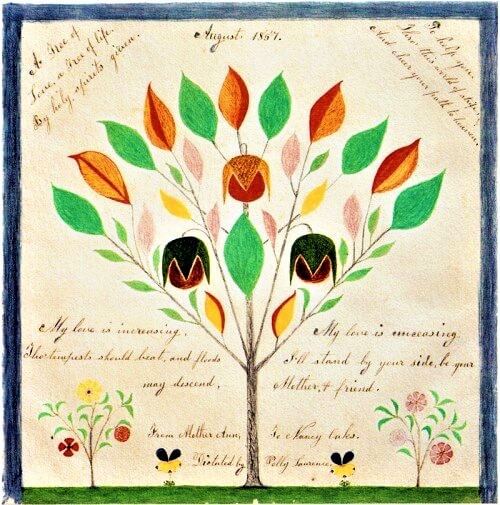
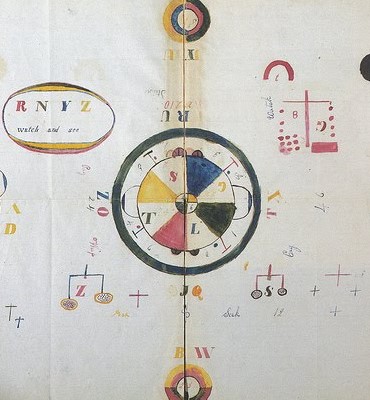
In my novel NEARLY CANAAN, Jaya searches in her spare time for an means of personal expression that isn’t quite poetry or prose but somehow truer to her spiritual stirrings. After I finished drafting the book, I came upon an exhibit of Shaker gift drawings and writings channeled by one member of the monastic community to be presented to another. Sometimes these would also originate as song, and an unique form of musical notation also arose.
Here are a few examples.
Spirit Message from 1843 appears to be a random series of letters or perhaps a new language akin to speaking in tongues.
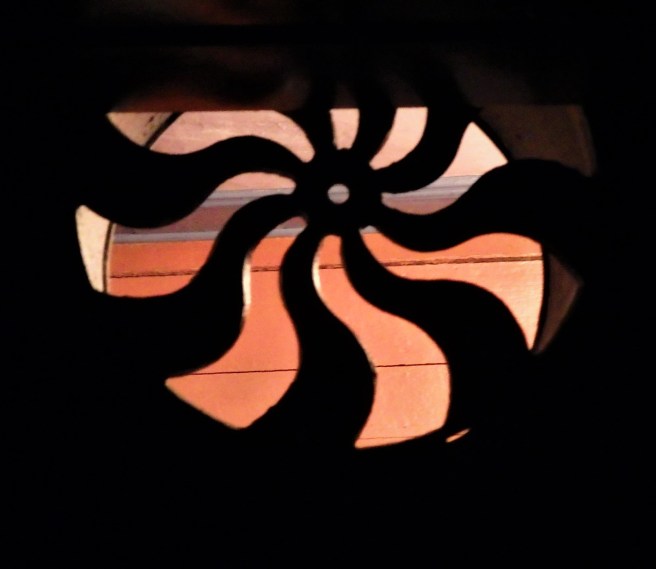
The metal grating in the floor of our second-floor bedroom at an Airbnb makes for a fascinating image, but it has a far more practical side. Back when heat came from a central wood- or coal-burning stove, getting the rest of the house warm was a problem. Hence, the hole in the floor.







 Jnana's Red Barn