KEEPING IT NEAT

Barb Knowles of the blog saneteachers has nominated me for a Real Neat Blog award, and I thank her for the nod. If you’re not yet familiar with her site, let me tell you that anyone who knows what an Oxford comma is ranks high in my book — especially after all of those years as a journalist when I couldn’t use them on my paying job, contrary to my own standards. Here, though, things are different.

Allow me to confess, though, I’m of mixed mind when it comes to these awards. On one hand, WordPress (especially) is filled with marvelous bloggers who deserve wider recognition. On the other hand, I’ve found that trying to nominate others can be, well, embarrassing when you find they’ve already received that award somewhere in their past, even before coming up with fresh questions.

A while back I resolved to pass on these things, but then the temptation of participating can be fun. And then there’s that matter of time itself, which on this end will soon involve some major home and garden projects. Alas.

So here I am, looking at the seven questions, which I’ll tackle. But for now, I’ll wait before nominating others or coming up with seven new questions for them. Unless, of course, you’d like me to nominate you (go ahead, be bold and ask). After all, if you’re dropping by the Barn, you’re already cool — in all due humility. Any volunteers?

real-neat-blog-award1Here goes:

If you were alone on a deserted island with only one book, which would it be? 

Make it the Bible. Not for the reasons most folks would assume — like what God’s trying to tell us. Rather, there’s plenty to chew on here about just being human, pro and con. And Wycliffe and Tyndale (those courageous early translators) do shape our English language, more than Shakespeare, actually. Your followup question would be which translation to pack, and there I’m stumped — I use many, each one adding nuances to the close-to-the-grain sources. By the way, are we to assume it’s a long stay on that island?

What is your favorite color and why?

Blue. Intense electric blue, the shade befitting Aquarius, the color of the clearest sky. Or its cousin, cobalt, the call of the North Atlantic on a clear day a few miles from where I live.

I like favorites, so what is your favorite song?

Since you didn’t ask about symphonies or sonatas or operas or chamber works, I’ll look at song as something that’s sung — in a form other than the traditional A-A-B-A musical form plus verses. (Bet you weren’t expecting that response!)

As a baritone in a choir, I’d put Sicut cervus, a Palestrina motet from the Renaissance, up there, along with a fuguing-tune anthem, Euroclydon, by the Colonial American William Billings.

Now you have me wondering about having the whole choir on that desert island. The plot thickens.

If you could make a memory, what would it be?

Our first grandkid. Leading to my learning to change a diaper. (I jumped in as a stepfather, later in the game.)

If you could join a TV show (present or past) and be a new character on that show, which one would you choose?

Mozart and the Jungle could use a third conductor. Maybe a sane counterpoint, mentor for Rudolfo? Or maybe just to send the older one back to Cuba?

What’s your ringtone?

Ringtone? Tracfones have them? Mine’s whatever I inherited back when.

Where were you born?

Ohio.

BAD BOYS, GOOD GIRLS

As I said at the time …

Came across a fascinating insight a while back, something that might continue our “bad boys/good girls” dialogue. The writer, a mother, was observing that even in second grade, teachers automatically divided the class into bad boys and, you guessed it, good girls. By extension, then, coming as this does around the time that most boys are undergoing their sexual and emotional separation and twisting away from Mother, a different path from the girls’ formation, the very model of boyhood becomes, by definition, to be bad! To be a “good boy” is in effect to be a sissy, a girl. To be bad is to push the limits, be independent, be a leader, take action, grow up fast.

Perhaps this is when the boy really needs the mentor figure Robert Bly envisions, to take the boy into wilderness beyond the camp. Maybe it was the same writer (newsroom means little time to read closely, and often not to make a printout either) who was warning that American society has a real time bomb in the making as boys are being subjected to some very confused expectations and accusations. To be virile is taken to translate as promiscuous; strong, as violent; and so on.

Incidentally, David Hernandez’s “Bruises” demonstrates one side of this boy/girl outlook marvelously: when you were a child, did girls ever compare their signs of toughness like this? (So who are the “bad girls”? Tomboys? Or loners at the edge, exploring their own imaginations? Diane Wakoski has pursued this as well as anyone I can think of, but the field still seems wide open!)

Oh, well, I can only open these issues in a poem; resolution comes somewhere else!

~*~

Blue Rock

My collected poems are available in Blue Rock. The ebook’s free in the platform of your choice.


NO NOSTALGIA

There are people who feel nostalgia for the ‘50s or early ‘60s. Not me – except for the high culture, which was still deemed important — I was glad to see them go. Those decades, despite all of the lofty aspirations in some circles, really were confining and laced with hypocrisy and denial.

What I lament losing most in the decade of civil rights and hippie movements that followed, though, is a side that gave a sense of hope in its spiritual, political, and social justice yearnings. But not the narcissistic or hedonistic excesses that too often accompanied the movements.

To be honest, that stretch of my history had its own pluses and minuses … and a lot of lonely heartbreak. Seeing it honestly, then, means accepting both sides and their lessons. As well as continuing the mission.

ABOUT THE TIME WE’D THOUGHT WE’D HEARD IT ALL, SOMETHING WOULD COME UP

One thing about being in the news business was how much that we covered was more or less routine. Yes, there were the variations on the given theme, but you could easily fall into a formula in covering them. Think of elections or a football game, for instance. Somebody wins, somebody loses, and you quote from both sides.

There would also be developments that simply fell outside the realm of what we’d covered, and when I started out as a journalist, community tastes were stricter than what now fills the coverage. Pedophile priests and sexually abusive parents, for instance, were never mentioned. Ditto, the private lives of politicians. And pit bull dog attacks were way off in the future.

Not so now, and it’s one of the reasons I burned out editing the low-life stories. After all, not even Hustler magazine would have touched much of the grossness that was now appearing even on the front page.

My goals in journalism were far loftier than soft porn, even in a courtroom setting.

~*~

Still, I was surprised how many times I felt I’d seen and heard all the basic stories, only to be hit by something that seemed completely new.

One of them was the arrest of one of our sportswriters on charges of pimping. Ouch! A professional with children? Somebody we knew?

And then the other day a report took that a couple of steps further.

Seems a man responding to an advertisement for a “social-type service” went to a local motel room only to be met by the woman, as expected. But there he also discovered another man and a pit bull dog, neither of them anticipated on his end.

In the ensuing events, as the story goes, the customer was beaten and robbed before escaping and being chased bleeding and naked by the pit bull into the parking lot before a phone call from the front office summoned police. (There was also something about brass knuckles that were tossed aside in the fray, but let’s stick to the basic outline.)

I keep wondering about the old “honor among thieves” code among outlaws. Aren’t there supposed to be some strict standards of behavior involved? Even among crooks, doesn’t a double-cross draws contempt, as does betrayal? In the case of prostitution, for instance, doesn’t that mean the pimp remains out of sight – or better yet, out of the room? And no dogs, unless they’re part of the, uh, proclivities of the john?

For the record, prostitution was not among the charges mentioned in this case. I raise the issue here more in the theoretical sense of illicit dealings. We could as easily substitute drug purchases or any number of other monetary exchanges. Remember, basic standards are assumed or the economic trade falls apart. Nobody would answer an escort-services listing if this was common practice.

So here we are with the new twists being the presence of the second man and the chase by the pit bull, only to find the ultimate recourse falls back on the police and criminal justice system.

As I said, it’s not your everyday news story. I’m left wondering how we would have handled such a police report in the “old days” or whether we would have published it at all. Or even if things like this even occurred back then.

REFITTED FOR HOUSING

Before:

At least the work had begun.
They saved the smokestack.
The fire escape was still holding on.

An abandoned mill, built on a railroad spur and relying on steam power, has found new life as affordable housing. Now touted as Woodbury Mills, it has 42 “apartment homes.” It’s one of several repurposed and renovated mills in the city.

And after:

Detailed touches.
Detailed touches.
The street side.
The street side.


TURNING TO THE WORD

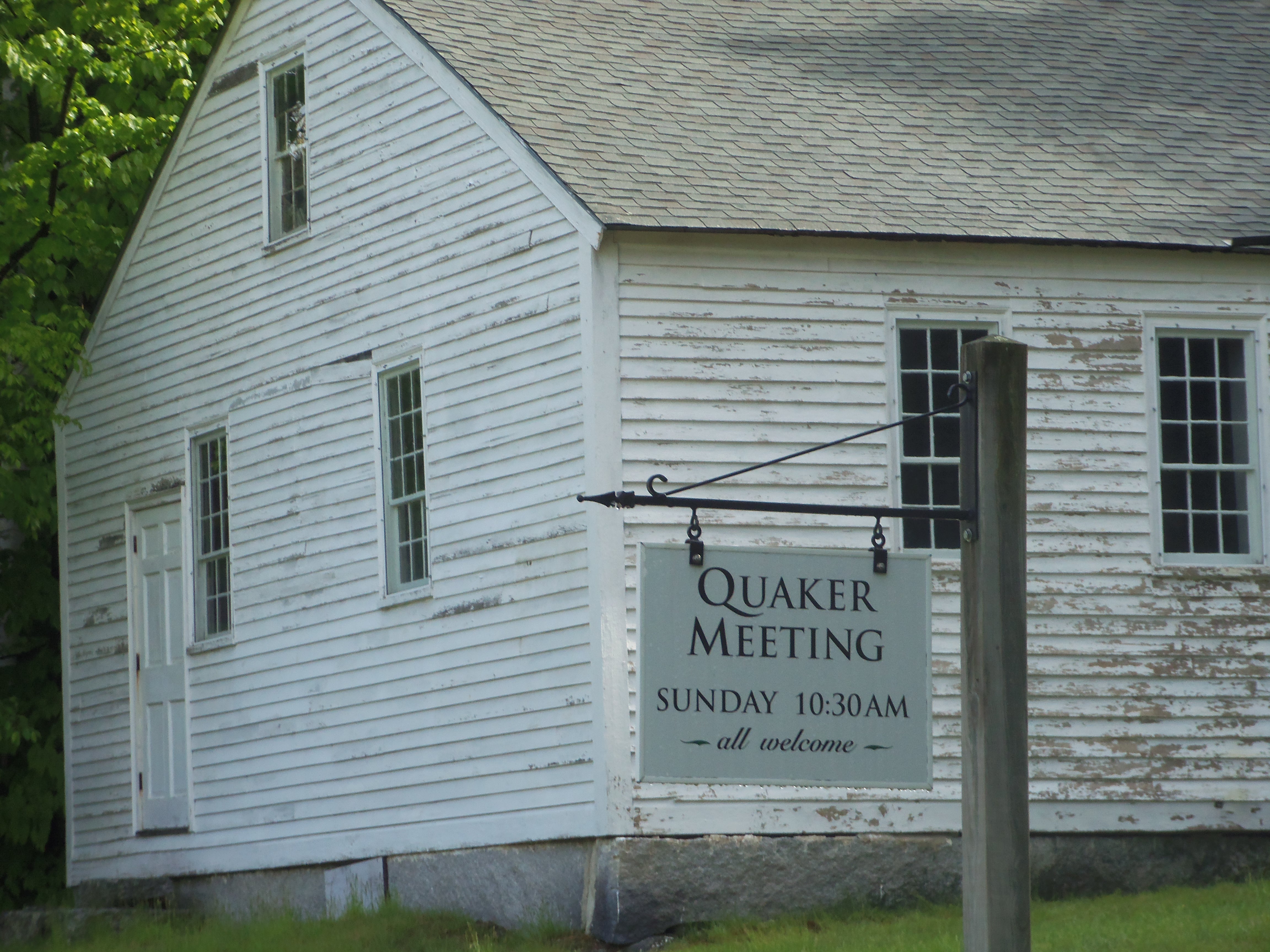
Historically, Quakers understood the Word of God to be Christ, rather than the Bible. This insight, drawn largely from the opening of the Gospel of John, is one of the central differences between Friends and most Protestants, especially those of the Calvinist strands. Sometimes people will use “the Living Word” to distinguish between Jesus and Scripture, though I usually sense their usage soon becomes blurred.

I raise this not so much for theological argument as for an understanding of how we Friends individually interpret our experiences of the Divine. In the Gospel of John, the concept of Christ is also identified with the image of Light, which we often repeat in our Quaker circles. What interests me is the spectrum of experiences that can happen within that comprehension. At one end we have the ancient problem of a divinity so remarkable and expansive its name cannot be spoken (sometimes represented as YHWH, or pronounced in translation “the word of God” or simply “the Holy One”); at the other end is one so personal it knows “every feather” and “every hair” and is often felt as the person of Jesus. That is, something abstract and universal, on one hand, and something intimately present, on the other. Both can be overpowering and awesome.

In either case, Friends have reported this as Christ present amongst us, “coming and come.” In either case, Friends have discovered no need for an interpreter (trained preacher or priest) between us and the text, other than the Spirit or Light by which it was written. In either case, Friends have known a living and growing, continuing revelation. In Friends’ experience, the book is not closed but miraculously unfolding. This Word is quite different from approaching Scripture as a series of laws to be arrayed and obeyed. It’s what calls us to be a Society of Friends, rather than lawyers – a world of difference, indeed.

Light 1For a detailed overview of the metaphor of Light in its early Quaker manifestations, go to my chapbook here.


GETTING BEYOND LIKE OR DISLIKE

One of the secrets to living a richer life comes in learning to evaluate experiences beyond a simple like or dislike – especially on first encounter. So many of the delights of living are found in acquired tastes. Returning to a challenge for new insights. The critical examination and perspective.

So it’s been with the opera, so much classical music, visual art, beer and wine, even literature I’ve come to love. To say nothing of Holy Scripture. Or the places I’ve lived. To be honest, there are often stretches in a long hike I might admit I don’t like, especially if the insects are biting and the incline’s steep, no matter how much I’m enlivened by the entire outing.

Somewhere along the line, I’ve learned to distrust what comes easily. In living with a piece of art, you may realize fatal flaws behind the initial flash, or to your continuing delight you may find the revelations expanding.

Part of the transition comes in learning to see value in ambiguity and paradox, or to find riches in the shadings of gray beyond simple black and white. It’s not an argument for self-torture or meaninglessness, but rather a willingness to suspend disbelief long enough to consider many other dimensions.

Yes, I like pizza. But, as an illustration, I never would have discovered the joys of manicotti if I’d insisted on the familiar pie that one night.

At the moment, I’m cracking open the Bartok string quartets by means of repeated listening and finding such beauty beneath their outward gruffness. Any examples you care to add the list?

A NEARLY PERFECT NOVEL

Way back in my senior year of high school, I remember a moment when our English teacher invoked the dictum that all fiction requires conflict – and my immediate contrarian reaction blurted out, “No, it doesn’t!” My objections were gut-level rather than coolly reasoned and certainly wouldn’t have held up to the novels that were capturing my attention at the time – Brave New World, 1984, and Animal Farm. Yet seeded somewhere in my aesthetic, the low-key, nonviolent approach to a story lingers. Few of us, after all, are parties to a murder, which is a key component of so much fiction. And Kurt Vonnegut’s advice to take a nice character and inflict the worst possible calamities on the poor soul still offends my spiritual proclivities, never mind so many passages in the Bible. Yes, I’ll now admit that true character can be shaped and revealed in intense confrontations and struggles. That is, conflict.

Still, my own entries to date have focused on day-to-day realities drawn from my own observations – attempts to comprehend contemporary social interactions, even if they appear to be history by the time the words finally appear in public.

~*~

In retrospect, my admiration of so much of Richard Brautigan’s output probably arises in the laid-back meandering of his hippie-era characters and their encounters. Think of Trout Fishing in America for starters.

~*~

More recently, Nicholson Baker has emerged as my favorite embodiment of the nonviolent sensibility. You could argue that nothing happens in the first 50 pages of The Incredible Story of Nory, and yet the tension is already mounting. To construct a successful novel on a father’s bottle-feeding session of an infant (Room Temperature) or a short escalator ride (The Mezzanine) is artistically courageous. Book of Matches, meanwhile, takes off on the simple premise of sitting by a fire in the predawn hours of deep winter – it could almost be blogging.

His latest volume, Traveling Sprinkler, pretty much slipped under the radar, yet impresses me as a nearly perfect example of the no-major-conflict novel. His main character, the minor-league poet and anthologist Paul Chowder, faces nothing more challenging than the question of whether his ex-girlfriend will return to him as he muddles through middle age. Yet along the way, Baker weaves in ruminations about the American health system and public education, the advantages of rhyming in song lyrics in contrast to poems, aspects of recording technology, basics of bassoon performance, collectors’ perspectives on lawn sprinklers and related outdoors gear, experiences of Quaker worship, and some travel pointers for Portsmouth, New Hampshire. Billed as a sequel to The Anthologist, it stands well on its own as a rich and deeply personal tapestry. What could be better? Even without a slew of dead bodies?

TURNING THE TABLES

Something I ask among Friends, from time to time: What would you be if you weren’t Quaker? It’s an insightful exercise, unearthing answers that point to individual tastes in worship, spiritual practice, and friendships.

My answers have changed over the years – from Judaism to Zen or Unitarian to Mennonite (of the faster variety) or maybe even Eastern Orthodox (for the Greek dancing and music as well as the mysticism and discipline). I know strongly, too, what I would never be – and we’ll leave those unnamed. Look deeper, and you may see what is most precious to you at this point in your spiritual journey; perhaps it’s the richness of the story or tradition, the social witness in the face of injustice, the emotional response to music or even dance, the warm embrace within a disciplined community, the comfort of a timeless dimension, even a particular aesthetic. The fact is that we can be fed, in stretches, by practice with other faith bodies, especially through those periods where we find ourselves conflicted within the our own stream. We can learn, too, from their experiences and sometimes come away with something that enriches our own way.

The exercise can also help us greet visitors who come through our door, acknowledging that they, too, bring something to the service, even if it’s only for one morning. I see, too, how the question demonstrates the great variety of responses within our own circle, as we return to worship and work together.

DESPITE MY USUAL OBJECTIONS

I’ve previously posted on my distaste for art that cloyingly celebrates artists as geniuses. Too often, I simply find these to be self-pandering and incestuous, even before we get into the reality that many great artists are seriously defective humans, at least in their interpersonal relationships.

But I’ve found myself swept up in two music-related video encounters that prove the exception to the rule.

The first is Amazon’s 10-episode sweep of Mozart in the Jungle, which despite my initial misgivings of the heavy sex-and-drugs emphasis, moved on into an often surreal criticism of the classical music industry as well as a fantasy of its artistic and life-enhancing possibilities. Equally impressive, its increasingly engaging characters are refreshingly cast warts and all – knocking ’em off their pedestals despite their sycophant handlers. I’m anticipating a second season.

Likewise is Dustin Hoffman’s top-flight directorial debut, the 2012 movie Quartet, set in a retirement home for musicians on a lavish British country estate that is in financial peril. Here, the real drama pivots on issues of aging and relationships sustained or damaged over the decades more than the concert hall or opera house itself. Success, as we see, often comes at a high personal cost.

What I love about both entries is the way the stories can be extended to universal experience rather than setting the musicians apart as an Olympian class. Indeed, the charismatic young conductor of Mozart, Rodrigo, moves repeated to take music to the streets and working-class neighborhoods – his people and roots – with magical turns in the idiosyncratically constructed story.

Here’s to people, then, as they are, no matter their field. And to the down-to-earth insights and discoveries we share along the way.