OH, FOR HONEST VIRTUE IN PUBLIC PLACES

No, not all politicians are like that. Let’s get that clear. I’m tired of that line of defense from people who vote for the kind of people we wind up with in Dennis Hastert.

The fact is we’ve had virtuous people – and still do – who devote their lives to public service rather than private gain. Frequently, at a high personal price – and often as the targets of vicious character smears, which too often attack the innocent family as well. And, to be candid, these principled individuals can be found on both sides of the political aisle.

Still, after decades of hearing the Republican Party portray itself as upholding “family values” and other high Godly virtues, here we go again. For that matter, of hearing the party that’s pressed vigorously to defeat monogamy among gays – you know, the “marriage issue” – now shown in more light.

Yes, I’m referring to Dennis Hastert of Illinois, being indicted on diverting millions from his banking accounts in transactions calculated would avoid money-laundering scrutiny. That, in itself, is a very serious charge for someone who’s supposed to be keeping the system clean and accountable. Think of shady accounting or the ways secrecy feeds into lies.

As disturbing for me is the fact that a former high-school wrestling coach could have that kind of money sitting around. As for making it in real estate investments, let me point you to Plunkett of Tammany Hall, a classic of American politics, where George W. Plunkett offers his definition of “honest graft” as buying land you know is going to be quickly repurchased at a much higher price for a public project. The strategy made him very wealthy. You might also say it was crooked. And, essentially, it traded on secrecy.

Of course, in the Hastert case, the plot thickens with the allegations of homosexual pedophilia involving a former high school student.

Remember, Hastert became Speaker of the House in the debacle of thrice-married, twice-divorced Newt Gingrich. Family values?

Remember, Hastert became Speaker of the House of Representatives in part because Gingrich’s intended successor, Rep. Robert L. Livingston, had to step aside amid revelations of extramarital affairs. Oops!

And Hastert’s been outspoken in his opposition to what? Those other folks … never, of course, what he might be doing in private.

The charges and allegations against him retain the caveat that they remain to be proven in court.

Still, we could construct of a long list of false public voices contrasted to private realities in recent American history. (Bloggers in other parts of the world can add their own, for our edification.)

For me, the biggest scandal is the falsehood of pontificating self-righteousness. Yes, that’s what angers me the most. We’re back to secrecy, of course. And the ways it’s been used to intensify partisanship in public decision-making, rather than admit diversity and wisdom to the process.

And to think, this man was second in line to the presidency. Right after the vice president.

Now that’s scary!

TAKING WHOSE TIME?

Got a rejection letter last week. All authors, and especially poets, are used to them. What was striking for me was that I hadn’t sent off any hard-copy submissions in the last three years. Repeat, THREE years.

As I’ve explained, a while ago I shifted over to online-only submissions as a consequence of much higher acceptances that way and of simplifying the difficulties of trying to maintain duplicate sets of files. (One for online, and a duplicate for hardcopy.)

So it took the editors of this particular journal more than three years to decide? What’s their problem? No wonder they’re feeling swamped!

This also touches on the issue of exclusivity in sending out work for publication. In the old days, meaning when I started, you didn’t dare send your work simultaneously to different periodicals. It was more a kind of serial monogamy. Or serious business.

Although the hard-and-fast requirement started melting, I stayed with exclusivity more as a matter of keeping track of what was out where – but I did keep an unmentioned caveat: after six months, if I’d heard nothing, it was fair game to send out again. In more than a thousand acceptances, I don’t recall more than a half-dozen cases where this became a problem.

Suppose I could look up the five poems to see if they’ve been published elsewhere in the interim, but frankly it’s not worth it.

You might have even seen them here, at the Barn.

NEW ENGLAND COLLEGE ART MUSEUMS

Some of the best art museums in the country are found at New England’s universities and colleges. In other parts of the country, the larger ones would be the region’s jewel. But here they often sit in the shadow of some pretty powerful competition. Some, like Harvard, charge admission, but others are blessedly free.

A crown jewel at Harvard.

Here’s a sampling from our travels and travel plans:

  • Yale University Art Museum, New Haven, Connecticut: Reopened after extensive renovations, this is quite simply the best university art museum in America; possibly, the world. And admission is free.
  • Fogg Museum, Harvard University, Cambridge, Massachusetts: This newly renovated jewel delivers a fine array of Old Masters, although I’ll emphasize its Turner, Blake, and Whistler for variety. Admission ($15) includes the Sackler and Busch-Reisinger boutique galleries, now under one roof for the first time, thanks to a contemporary, glass-pyramid roofed addition by Renzo Piano Building Workshop.
  • Smith College Art Museum, Northampton, Massachusetts: I wasn’t braced for the magnitude of this collection when I zipped out for an hour lunch break during committee meetings just down the street. I’d run into examples from its collection in art books (it has five Childe Hassam paintings on display), but its range of Impressionists and outstanding regional and American landscapes is worth the whirlwind, even before getting to the old European masterpieces. Am I off-base in thinking this display nearly rivals Harvard’s?
  • RISD Museum, Providence, Rhode Island: As the collection for the Rhode Island School of Design, New England’s premier art school, the museum is smaller than one might expect, with a respectable sampling of earlier eras, often masterworks by lesser known artists.
  • Williams College Museum of Art, Williamstown, Massachusetts: An unanticipated but celebrated gem in the western part of the state. We’re told it’s worth the trip.
  • Hood Museum of Art, Dartmouth College, Hanover, New Hampshire: Wonderfully diverse, with uncommon awareness of the Americas and Africa, it mounts an impressive array of special shows and is part of the Hopkins Center for the Arts.
  • Bowdoin College, Brunswick, Maine: Small, with some emphasis on the regional past and the founders’ roots in its permanent collection. Renovations unveiled in 2007 more than doubled the exhibition space, moving the entrance to a glass cube to one side of the building and opening the basement level, where visitors now begin their tour. The special exhibits make for some exciting use of the facility — a recent trip for me included a focus on Marcel Duchamp and his influence, downstairs, as well as prints by Dutch master Hendrick Goltzius, upstairs.

WRIGHT AND MORE WRIGHT

The Zimmerman House in Manchester, New Hampshire, is one of the few Frank Lloyd Wright structures in New  England. I remember chancing upon it on an evening stroll and thinking, "It's either by Wright or one of his students."
The Zimmerman House in Manchester, New Hampshire, is one of the few Frank Lloyd Wright structures in New England. I remember chancing upon it on an evening stroll, looking at the lights in the windows, and thinking, “It’s either by Wright or one of his students.”
Now owned by the Currier Museum of Art in Manchester, New Hampshire, it's open for tours.
Now owned by the Currier Museum of Art in Manchester, New Hampshire, it’s open for tours.
Just a block away, though, is an example of his more mass-produced Usonian project.
This one's still a private residence.
This one’s still a private residence.


NEW ENGLAND ART MUSEUMS

A fitting fanfare as a welcome in Manchester. It moves in the wind.

Growing up in the American Midwest, I had the impression that New England was, well, uniformly cultured. Moving here at the end of the roundabout route that emerged, however, I was surprised to discover how unevenly that Culture was distributed. It was essentially centered in Boston. Or more specifically, Huntington Avenue in the city’s Back Bay neighborhood, in the Theater District, Museum of Fine Arts Boston, and Symphony Hall, plus Harvard Square in Cambridge across the Charles River.

For perspective, New England has only one major-league professional orchestra, the Boston Symphony, compared to eight in the Midwest – Cleveland, Cincinnati, Detroit, Chicago, St. Louis, Kansas City, Milwaukee, and Minneapolis. (Well, maybe seven these days, after the disastrous events in the Twin Cities.)

The underlying reason, I’ve sensed, arises in the historic ownership of New England’s economic base – the textiles mills, especially, along the rivers and streams – by the fabled Boston Brahmins. In other words, while New England’s products sold around the globe, the profits flowed into Proper Bostonians’ mansions, and these, in turn, endowed the great cultural institutions.

*   *   *

The Currier Museum of Art in Manchester, New Hampshire.

The region’s art museums, on the other hand, provide another slant on this legacy. I’ll argue that the largest, wealthiest galleries are not always the most exciting; when it comes to art collections, quality is often based on the gifts of a few insightful, daring donors. Since we frequently visit museums when we travel – and art museums, especially – here’s an overview of what we’ve found. Admittedly, we’ve missed some.

  • Museum of Fine Arts Boston: The Grand Dame comes with a stiff admission fee and all the air of a leading museum, and her strengths are impressive, indeed, especially in Impressionist painting and Asian artifacts. But there are also some glaring gaps, especially in Old Masters. The new American Wing has at least brought one shortage up to snuff.
  • Isabella Stewart Gardiner Museum, Boston: A block away from the MFA, Isabella’s quirky “playhouse” on the Fenway is one you either love or hate. With its galleries circling an impressive indoor garden, her idiosyncratic assemblage is displayed exactly as her will demanded; undisputed masterworks are left hanging between many third-rate paintings, detracting from the experience. Still, the egotism, pro and con, remains staggering.
  • Worcester Art Museum: Considering the current economic condition of New England’s second-largest city, the collection comes as a delightful, comprehensive surprise. From its powerful pre-Columbian gallery on the top floor through the Americans and the Old Masters below, visitors will find themselves richly rewarded. One small room featuring New England’s Childe Hassam and Edmund Tarbell is both confident and moving, an example of the wise presentation throughout.
  • The Wadsworth Atheneum, Hartford: The glory here is the large collection of American Illuminist paintings (a term I prefer to the Hudson River School), but the routing through the rest of the otherwise impressive collection becomes jolting. We are not led smoothly around, but rather thrown from dark Colonial rooms into brilliant Modernist department-store presentation and then back into dark caverns again. Senselessly disturbing.
  • Peabody-Essex Museum, Salem: Originating in the “cabinets of curiosities” ship captains were expect to bring back for display in their hometowns, this institution’s transformation into a vital force is a model of building upon a clearly defined mission. Recognizing Salem’s role as a principal port in historic China sea trade, the collection focuses on Asian art (both the works manufactured for export and works intended for native use) and on the region’s seafaring riches. I love the bowsprits and captain’s logs as much as the Korean and Japanese galleries. Many of the special exhibits have been incredible. Surprisingly, it claims to be among the 20 largest art museums in the country, based on its holdings.
  • Currier Art Museum, Manchester, New Hampshire: Here’s a moderate-size museum that has a wonderful sampling of art history, some renowned pieces from the 20th century, and justifiable pride in the Granite State’s own artists and traditions. Well worth revisiting.
  • Portland Museum of Art, Maine: Its Impressionist collection is a major coup. New York wept when the key donations were announced. Need we say more?
  • Farnsworth Art Museum, Rockland, Maine: Quite the surprise in a small working-harbor town on Penobscot Bay. Lively works of our own time, with a focus on Maine … and not just the Wyeths. Alex Katz, for instance, has helped the collection make some impressive purchases. We were delighted by a recent major show of Shaker artifacts, mounted with assistance from the only surviving Shaker colony, the one at Sabbathday Lake in New Gloucester.
  • Ogunquit Art Museum, Maine: This small, seasonal, seaside museum made its way into our hearts with a special exhibit of Edward Hopper paintings that turned out to be made on and around the site.

QUAKER STREET

Note the yellow sign, "Pavement ends." It really does feel like a slower place.
Note the yellow sign, “Pavement ends.” It really does feel like a slower place.

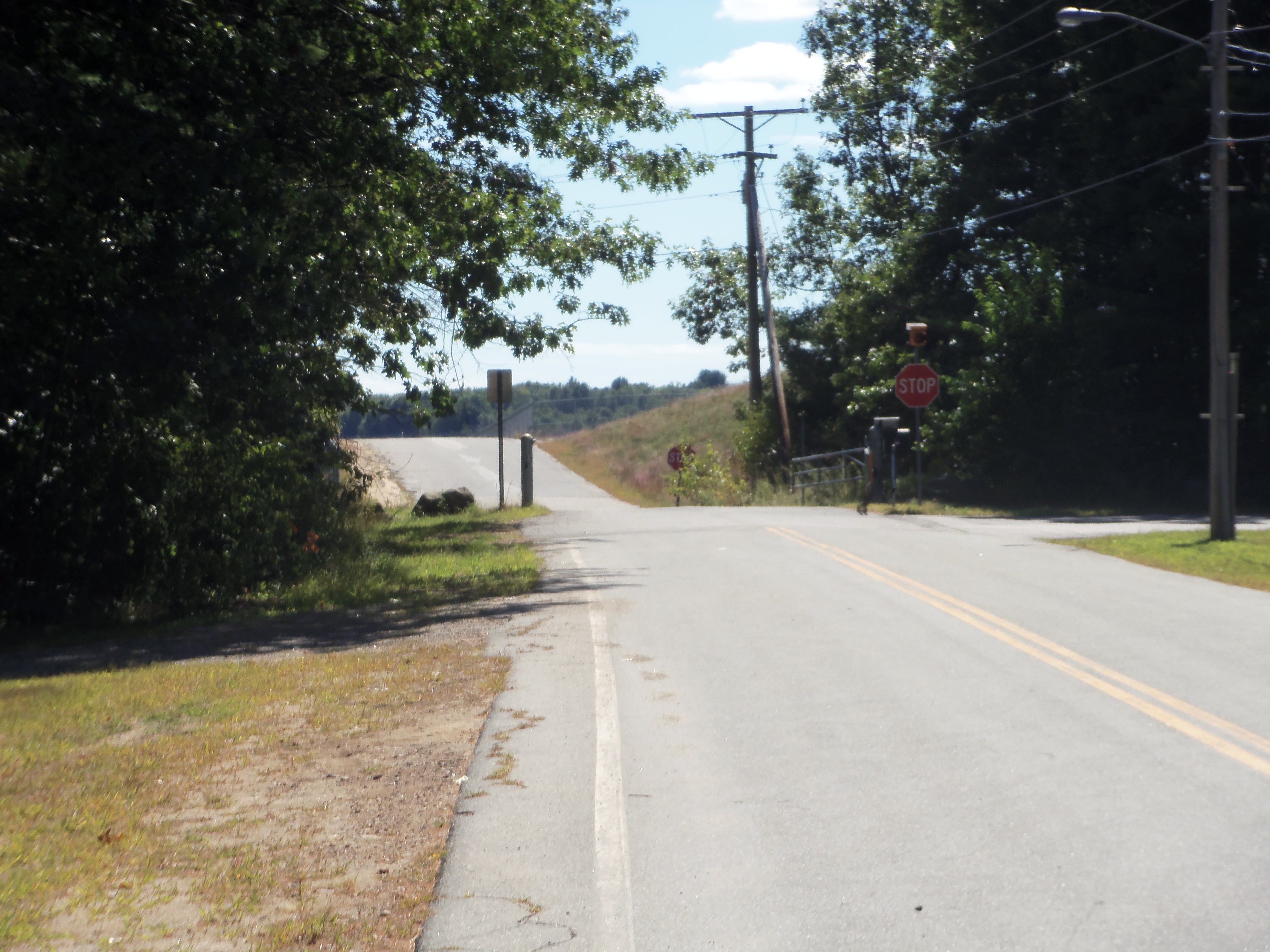
Taking its name from an old use of “street” as “neighborhood,” the stretch is also known now as the Quaker District. It’s up in the hills in a remote corner of Henniker, New Hampshire.

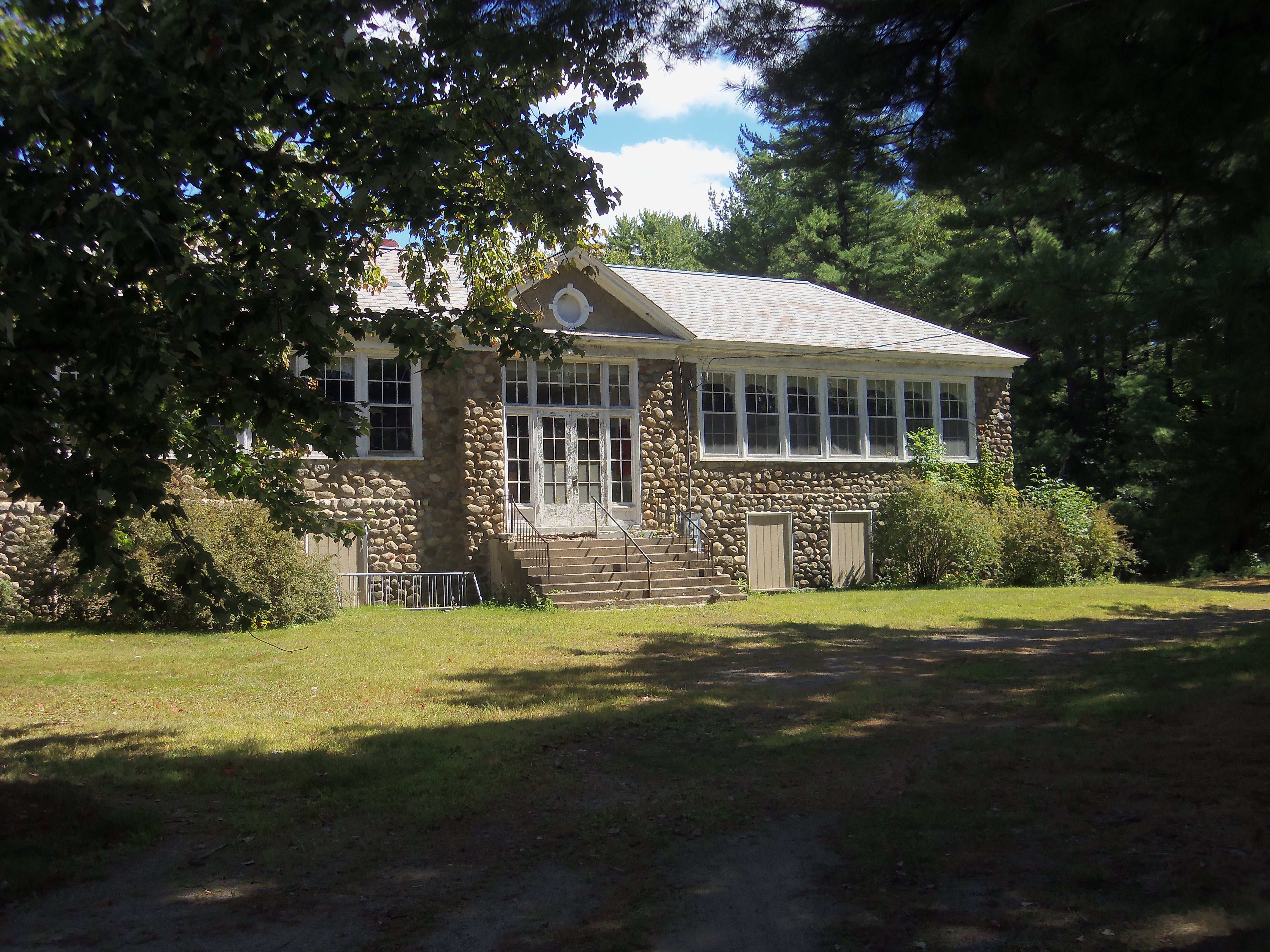
The road approaches the old schoolhouse.
The road passes a small Quaker burial ground next to the old schoolhouse.
As the sign on the schoolhouse says ...
As the sign on the schoolhouse says …
The center of the village was the Friends meetinghouse, which is still in use.
Many headstones in the burial ground use the old Plain dates.
Many headstones in the burial ground use the old Plain dates. The “3rd mo” is Third Month, or March.
Around the corner.
Around the corner.


WHAT WAS I THINKING?

Every writer, we can presume, has plans for the next work – or several. Tackling them, of course, can be another matter altogether, especially if the schedule’s already full, even before we get to the overdue house and garden projects. Or some equivalent.

Listen to other writers, by the way, and you’ll hear just how much of that schedule now focuses on marketing, including social media, to push already published work instead of doing the, well, not exactly “fun” part (it is, after all, work) but the passionate core that prompts the entire enterprise: drafting and revising. The very thing that makes us writers.

For me, much of that has also involved moving four decades of serious writing, however experimental, into the public access where adventurous readers might find the volumes. Places like Smashwords.com and my Thistle/Flinch site here at WordPress. To be candid, the backlog was inhibiting my ability to forge ahead on new work – not exactly writer’s bloc, but something more like claustrophobia? Having the remaining novels in the pipeline for ebook publication is a huge relief.

Let me repeat, though, about the necessity of marketing and how that should be the focus.

What’s taken root over the past several months, though, is another novel. One that just might pull my Hippie Trails series together a half-century later. That is, something that covers far more than just ’60s and ’70s. Am I crazy?

Well, maybe. What’s shaping up is far different from anything I’ve previously undertaken.

For one thing, I’m starting with an overarching structure – something approaching an outline, rather than my usual setting forth on a journey to see where an image or character or idea will lead. And then there’s little autobiographical here; it’s largely new territory, apart from tying up some loose ends from the earlier novels. The dictum, “Write about what you know,” gets readjusted to “Write about what you would like to know,” meaning more about certain ethnic groups I’ve encountered, businesses I’ve brushed up against, spiritual practices, histories, desires, losses. I’m even beginning with a commercial genre in mind, which means drafting from a perspective and in a voice far from my own.

I’m not sure this is a work I’ll actually finish. It may be too difficult. Or it may become more of a collaboration, perhaps with a circle of beta readers set at liberty to edit at will. (Have I ever written of my theory that what we know as Shakespeare was the product of a circle of very talented improvisers, whose inventions were recorded by the playwright? Almost a committee, if you will, except for his imprint on the final version.)

Different from anything else I’ve done to date? How about needing to finish a draft of the last chapter, along with a stretch of the opening, before writing anything else? Or heading off with 80 or so pages of notes for the middle, plus questions to pursue? It’s certainly driven by the characters and events that turn in directions I’d normally avoid.

What I do know from experience is how crucial it is to sit down at the keyboard when these juices are flowing.

THE ATTRACTION OF FERNS

As I said at the time …

It took eight springs in this household before we were finally greeted by a sequence of designed abundance. First, the pussy willow cuttings. Then the succession of flowering: snow lily, crocus, hyacinth, daffodil, forsythia, marsh marigold, tulip, forget-me-not, sweet woodruff, rhododendron, iris, mountain laurel. Accompanied by asparagus, rebounding after a season of root virus.

That’s not to say that any of it’s as orderly or magazine perfect as my wife would like. One neighbor jested our style’s too organic for that. Actually, it’s more like our budget.

Still, it’s quite an improvement over what we encountered when we first moved in and discovered most of our property was wet clay and neglected. Some portions had been landscaped with black plastic covered with gravel, which only worsened the water problems – extending to our cellar. Other portions were heavily shaded, with several nasty box elders and then a dead elm to be taken out.

While most of the garden has been my wife’s project – leaving to me the actual construction of raised beds and pathways, as well as the composting – I lay claim to a few exceptions: the asparagus bed and two small, heavily shaded panels behind the lilacs. The latter, each about forty square feet, are separated by a wood-chip passage. In our first year here, I shoveled off the gravel and dug up the plastic on one side of the pathway and began our attempts to plant ferns in the beds. Later, I dug up the pathway itself, removing the plastic and replacing the gravel with wood chips. The other panel would follow a year or two later.

I envisioned the footpath leading between two lush expanses of fiddleheads – woodland greenery right at home. A taste of deep forest.

The reality was that nothing wanted to grow there. We enhanced the soil repeated. Bought a few commercial fern varieties, which never quite caught on. My wife stuck in some other plants – lilies of the valley, wild ginger, lungwort, jack-in-the-pulpit – and they’ve taken hold. We transplanted ferns from the woods behind our best friends’ house at the time. Next year, I dug up more from along my commute, as well as the first of several seasons from another friend’s forest. Even so, come springtime, squirrels or slugs would mow down the rising green scrolls, while the surviving fronds remained tenuous and “went down,” as they say, earlier in the summer than I would have liked. In other words, forest undergrowth is hardly as natural as it would appear.

But this spring was different. In the older bed, the ferns came in thick and gorgeous – and after a few of the first fiddlehead stalks were leveled, we encased the plants in chicken wire to ward off predators. It worked. In the newer bed, which still has plenty of room to grow, one can see progress. “It’s where the other bed was last year,” we say, meaning we expect it to catch up. No, it’s not the uniform deck of fiddleheads I expected, nor is it the waist high ferns of a forest where a friend lived last year. Rather, it’s a celebration – at least six varieties (we’re not technical; fern identification is quite tricky) – with Rachel’s other plants and a few star flowers and Solomon’s seals thrown in.

* * *

What fascinates me is the variety of the fronds themselves, and how they now spread through in the bed. Some are fine-toothed, while others are broad. Some are bright green, while others show more blue or red. Some shoot upward, while others spray outward. If some are finely etched, others are painted with a broad brush. There are degrees of delicacy, fragility, and geometric interlocking arcs and angles. While the asparagus comes to replicate a tall fern with its feathery fronds, it spikes from the ground, unlike the uncoiling fern stems. This unfurling, in fact, seems to suspend time in space, especially in a few precious weeks when spring is taking hold. There’s something modest in the way ferns float only a foot or two above the ground or the way they crowd in along a wall or fence; something amazing, too, when they take hold in a boulder or cliff. When I gaze at my two fern beds, I must acknowledge that despite all my labors, this is what I have, or at least what’s survived. It wasn’t the plan, exactly. Maybe that’s what makes it all the more remarkable in my eyes.

A bigger question asks just where my fondness for ferns originates. I don’t remember them from the woods in my native Ohio or boyhood backpacking along the Appalachian Trail. I acknowledged them in the glen at the back of a farm I inhabited while living Upstate New York, and later at the ashram in the Pocono Mountains of Pennsylvania. I do remember being stung by the scorn of a Californian while hiking in southern Indiana, and then being enchanted in the array within rainforest in Washington State. Returning east, I kept Boston ferns in my apartment windows, vowing if I ever owned property again, I’d have ferns.

So memories and associations fit in here. Tastes of the past, and souvenirs of discovery. A reminder, too, of how forest touches my soul. My wife is moved more by flowers. I, by the gentleness of ferns.

LOOKING FOR THOSE LOCAL DISTINCTIONS

As I said at the time …

Greetings again from this old mill town along the Merrimack River.

There is still a special feel to an octavo-size, typeset journal – a unity of design and purpose carried throughout – even in this era of desktop design and photocopy wizardry. A major challenge, whether it’s in shaping a literary journal like yours, a daily newspaper, or even an old-fashioned country dance, is simply: what can we do to make our own locale distinctive?

An example: a few years ago, the New England contradance scene was becoming generic: you’d drive for miles to a village town hall only to find the same faces and same pieces you had faraway the week before. Fortunately, that seems to be changing as different callers, musicians, and promoters are striving to put their own distinctive signature – and a local stamp – on each venue. So there’s your challenge!

I’m struck by the fact that even familiar voices from our round of journals seem to sound different in varied locales. If you’ve ever been around paintings, as I was when married to an artist, and seen a piece go from her studio to our living room to an art gallery to a major museum, you would be amazed how different it appears it each setting. Publishing is the same.

INTO THE GREAT PLAINS

To grow a leafy tree requires more than thirty inches of rainfall or its equivalent each year. If you drive west across the United States, you can cross an imaginary line that passes through the Dakotas, Nebraska, Kansas, Oklahoma, and Texas, and beyond it deciduous, or leafy, trees are quite rare. Soon, so are conifers, the evergreens. Irrigation becomes a fact of life if you want to raise food or flowers or even a lawn.

The Great Plains eventually pass into desert – and you might be surprised to discover that most of Oregon, Idaho, and Washington state is actually desert. The rainy belt is little more than a thin band along the Pacific-facing side of the Cascade and Olympic mountains.

Quite simply, it’s a different world from the one most Americans know.

~*~

As for the Great Plains, let me recommend Kathleen Norris’ Dakota. It’s a unique and marvelous book.