EVERYTHING HAS A PRICE?

Driving back from the coast along a rather honky-tonk stretch of highway the other night, my headlights flashed across this sign:

INTEGRITY
— —
FOR SALE

At least, that’s what I think it said. The two blanks, I’m finding, may have said Residential Brokerage.

Still, considering our public life today, the message is disturbing.

How do you read it?

LIBERATING IN THE END

A central question facing compositional artists of all stripes (in contrast to performing artists like actors, dancers, and musicians) is the matter of determining when a work’s finished.

How do you know?

Is just out-and-out satisfaction a measure? A trusty one? Hmm.

Let me suggest some others.

Sometimes it’s a sense that you just can’t go any further with it. And if it’s in a state beyond notes and fragments, maybe that’s it. You’ve hit a wall, a property line, or just the shore or riverbank. So you stop. Period.

There are times, admittedly, when you think something’s finished and put it aside only to find, on returning, it needs more – revision, for starters, and maybe additions and major restructuring. (A friend spoke the other evening of drafting a memoir in the third-person and then redoing it in the first-person, the kind of change I’ve done in some of my fiction. And Brahms had an early symphony that became a piano concerto, if I recall right.)

Working under a deadline can simplify matters. Time’s up! Next!

Nice, if you happen to have an advance or pipeline of delivery or the concert’s coming up.

Novelists might even find doneness appears as the time they find their focus obsessing with the book under the one they’ve been tackling.

Some poets will say that once it’s published, they can let go of it. Finito!

~*~

In the bigger picture, the “finished” question isn’t just about having a manuscript ready. For a writer, it’s ultimately about landing the work in a reader’s hands. A place where a dialogue can begin. And getting that manuscript from a polished draft into circulation can be a huge, energy-depleting limbo, especially if your life is filled with competing claims on your time.

In short, you can either focus on seeing that one work through to publication – or you can create the next one, while the inspiration’s still hot. For me, as I tried to balance my writing life with a journalism career, personal relationships, spiritual practice, and so on, I wound up with a huge backlog of finished material. At least I’d wisely not put off the writing for retirement, as had a number of colleagues I’d known – none of them ever managed to fulfill that dream.

What I did find, though, was that the unpublished work became a burden of its own. Its emotional weight inhibited new work. Why bother? It even had a way of twisting my sense of identity – who was I then and who am I now? Think, too, of the relationships that fed into one work – and the people I’m with today. As in lover or spouse.

So the experience of having my book-length works finally being published brings the “finished” consideration across yet another threshold – the matter of being liberated. I can let go of trying to hold that memory, treasuring that epiphany, honoring that friendship.

Should I have just trashed them long ago and moved on into other, non-literary endeavors? Just think of the hours that could have been directed instead to overtime pay, which would make my retirement more secure. Or travel or …

Maybe it’s just a case of hoping for acknowledgement. Hey, here I am!

Still, it’s what I’ve done.

What I have is a feeling of being true to a responsibility carried to its completion at last. What happens from here is, well, liberating any way it goes.

UP NIMBLE HILL

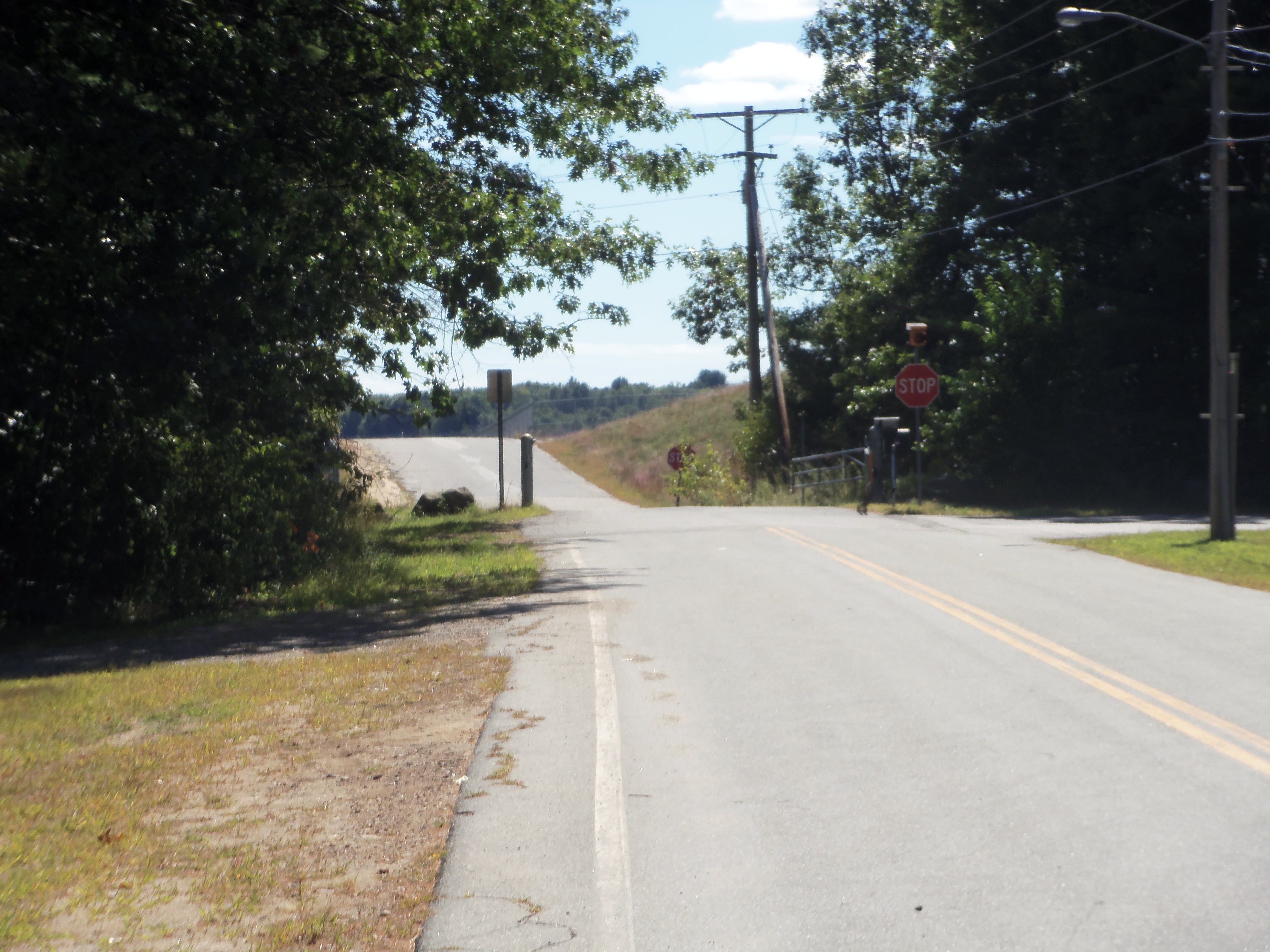
Nimble Hill Road is quite a contrast to the congestion around the mall and big-box stores on the other side of the turnpike.

The town of Newington, just over the bridge on our way to Portsmouth, is easily misunderstood.

With a 2010 population of a mere 753, it often appears to be little more than the Spaulding Turnpike exits to the mall and big-box stores plus a few apartment complexes and a section of the Pease International Tradeport industrial park.

It also has a major electrical generation plant contributing heavily to the property tax base – a major, major factor for any municipality in New Hampshire as it addresses public finances.

The town is also surrounded on three sides by tidewater, including ocean docking on its eastern edge.

But the place was also severely impacted during the Cold War when the U.S. Air Force used eminent domain to acquire 4,255 acres to construct an air base (now turned into the industrial zone) mostly in Newington. The noise of bomber-sized jet planes taking off and landing did little to enhance the neighborhood as a place to live peacefully in those days – the frequent interruptions even forced the grade school to find a quieter setting. After all, its runway, now used by commercial, private, and National Guard flights, is among the longest in New England.

Given those factors, few people would have much incentive to take the Nimble Hill Road exit from the turnpike.

As it turns it, the road presents some classic New England just before culminating in a dead end near the runway. The historic district is a treasure.

Here’s a taste of what you’d see.

The 1725 parsonage includes a salt-box addition as an early renovation.
A cannon is part of the town monuments near the center of the Parade where the militia practiced. More Newington men served in the Siege of Louisburg (13) and War of 1812 (12) than in World War I. The background includes the well-funded library and 1712 meeting house, said to be the oldest in New Hampshire. (Hope they mean oldest in continuous use, since I know of two Quaker meetinghouses that are now private residences.)
The elementary school fell victim to loud noise from Air Force bombers.
The 1872 Old Town Hall once also housed the school.


YET ANOTHER PILE OF OBSOLESCENCE

Years ago my father gave me a small metal cabinet with 18 one-inch-deep plastic drawers, each 2.5-by-6 inches. It was intended to hold screws, nuts and bolts, and other small items for the household repair shop – but mine wound up in my studio, where it holds small items of the writer’s trade. An artist’s pencil sharpener, push pins, souvenir fossils and flakes of mica, fountain pen cartridges, staples (for the stapler), a measuring tape, clothespins, business cards, foreign coins, colorful paperclips in both small and large sizes.

The last item – three of the drawers, in fact – recently stopped me cold.

Not so long ago, or so it seemed, I started collecting them at the office as we went through the mail. My literary work at home included a hefty dose of correspondence – not just submissions, either – and the bright-color clips seemed a much brighter option than the usual shiny steel in circulation.

As I gazed on them this time, though, I started to wonder what I’ll really be doing with them. Submissions are all done online these days, as is most correspondence, even of the personal streak. Maybe I’ll clip materials together when offering a workshop here or there, but I’ll never go through my stash.

Add to that the manila envelopes and cardboard backing, the loud bursts of colorful folders and binders, even the three bottles of typewriter correction fluid.

Not too long ago I wanted more filing cabinets, but as elder daughter informs me, folks can’t even give those away these days. Besides, I stopped printing out manuscripts long ago. Talk about downsizing?

Makes me wonder what’s next to go. Not that I’m really comfortable with any of these changes.

BACK AND BACK AND BACK

As I said at the time …

You’re home once more, with many fresh laurels, I hope. On my end, the computer’s fixed and I’m dancing with some frequency again. At least between some heavy allergies. (Birch pollen at the moment; pine comes soon.)

I’m still in shock from Sam Hamill’s “To Eron on Her Thirty-Second Birthday” – she’s always a twelve-year-old tomboy in my memory! Impossible, it seems. And that was back when I was still married and my wife studied painting under John Bennett’s wife, Ellensburg, Washington … back in his Vagabond days. Small world. Am still trying to figure out when and where I heard Bill Stafford read. Yakima Valley College, I believe. Will the parts of my life ever come together?

Yes, you certainly are a moon-child, with all of the sign’s gentle humanity. Violet, a variant of purple, the cancer-sign’s color. Star, like the moon, of the moody night. Well-named, it seems! For whatever reason, more of my serious relationships have been with women born under the sign of Cancer than with any other; in fact, there have been no Gemini or Libra, which are supposed to be a natural fit for me. Go figure!

~*~

My, what ancient history this, too, has become!

HIGH STREET STYLE

On one corner.
On one corner.

Situated at the mouth of the Merrimack River, Newburyport, Massachusetts, has a historic harbor and charming brick downtown – one that echoes many others in New England, for that matter. Its residential neighborhoods are likewise filled with a range of fascinating details from many historic styles. But for me, the real glory is High Street, built at the height of the lucrative whale oil business. Interspersed among the dominant federal-style houses are some other fine examples. Here’s a sampling.

Colonial.
Colonial.


Lingering Georgian, without many of the distinctive details.


Greek Revival.
Greek Revival.


Greek Revival Temple, here a former church converted to private residence. It has an attached matching garage.


Second Empire.
Second Empire.


Gothic Revival.
Gothic Revival.


Georgian "Colonial" Revival
Georgian “Colonial” Revival

FEDERAL ROW

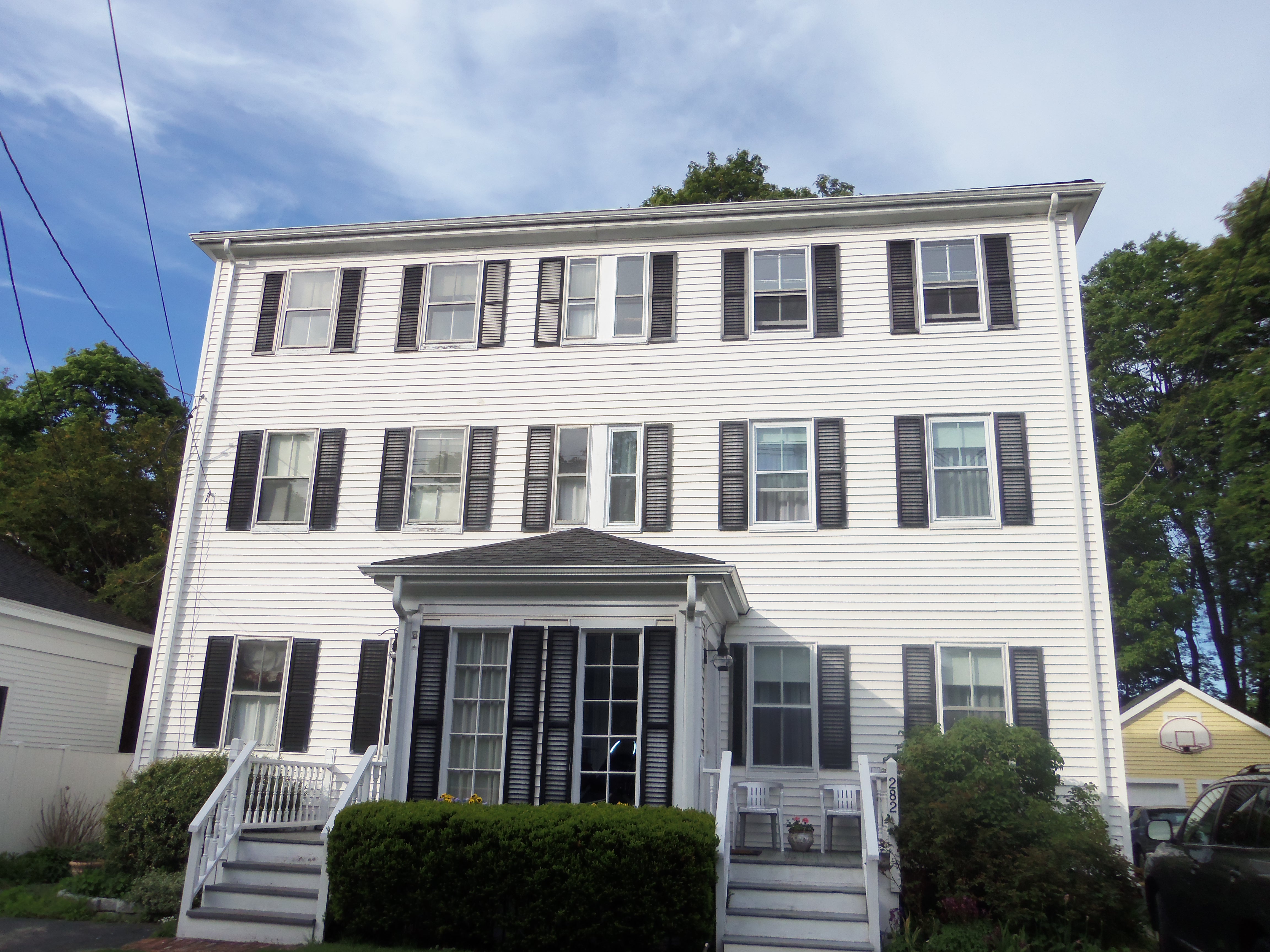
100_0939The federal style of architecture flourished from the 1780s into the 1820s, and you’d be hard-pressed to find a finer sampling of it than in Newburyport, Massachusetts – especially along High Street. Here are a few examples.

100_0942

100_0936

100_0945

100_0925

100_0921

100_0884


OH, FOR HONEST VIRTUE IN PUBLIC PLACES

No, not all politicians are like that. Let’s get that clear. I’m tired of that line of defense from people who vote for the kind of people we wind up with in Dennis Hastert.

The fact is we’ve had virtuous people – and still do – who devote their lives to public service rather than private gain. Frequently, at a high personal price – and often as the targets of vicious character smears, which too often attack the innocent family as well. And, to be candid, these principled individuals can be found on both sides of the political aisle.

Still, after decades of hearing the Republican Party portray itself as upholding “family values” and other high Godly virtues, here we go again. For that matter, of hearing the party that’s pressed vigorously to defeat monogamy among gays – you know, the “marriage issue” – now shown in more light.

Yes, I’m referring to Dennis Hastert of Illinois, being indicted on diverting millions from his banking accounts in transactions calculated would avoid money-laundering scrutiny. That, in itself, is a very serious charge for someone who’s supposed to be keeping the system clean and accountable. Think of shady accounting or the ways secrecy feeds into lies.

As disturbing for me is the fact that a former high-school wrestling coach could have that kind of money sitting around. As for making it in real estate investments, let me point you to Plunkett of Tammany Hall, a classic of American politics, where George W. Plunkett offers his definition of “honest graft” as buying land you know is going to be quickly repurchased at a much higher price for a public project. The strategy made him very wealthy. You might also say it was crooked. And, essentially, it traded on secrecy.

Of course, in the Hastert case, the plot thickens with the allegations of homosexual pedophilia involving a former high school student.

Remember, Hastert became Speaker of the House in the debacle of thrice-married, twice-divorced Newt Gingrich. Family values?

Remember, Hastert became Speaker of the House of Representatives in part because Gingrich’s intended successor, Rep. Robert L. Livingston, had to step aside amid revelations of extramarital affairs. Oops!

And Hastert’s been outspoken in his opposition to what? Those other folks … never, of course, what he might be doing in private.

The charges and allegations against him retain the caveat that they remain to be proven in court.

Still, we could construct of a long list of false public voices contrasted to private realities in recent American history. (Bloggers in other parts of the world can add their own, for our edification.)

For me, the biggest scandal is the falsehood of pontificating self-righteousness. Yes, that’s what angers me the most. We’re back to secrecy, of course. And the ways it’s been used to intensify partisanship in public decision-making, rather than admit diversity and wisdom to the process.

And to think, this man was second in line to the presidency. Right after the vice president.

Now that’s scary!

TAKING WHOSE TIME?

Got a rejection letter last week. All authors, and especially poets, are used to them. What was striking for me was that I hadn’t sent off any hard-copy submissions in the last three years. Repeat, THREE years.

As I’ve explained, a while ago I shifted over to online-only submissions as a consequence of much higher acceptances that way and of simplifying the difficulties of trying to maintain duplicate sets of files. (One for online, and a duplicate for hardcopy.)

So it took the editors of this particular journal more than three years to decide? What’s their problem? No wonder they’re feeling swamped!

This also touches on the issue of exclusivity in sending out work for publication. In the old days, meaning when I started, you didn’t dare send your work simultaneously to different periodicals. It was more a kind of serial monogamy. Or serious business.

Although the hard-and-fast requirement started melting, I stayed with exclusivity more as a matter of keeping track of what was out where – but I did keep an unmentioned caveat: after six months, if I’d heard nothing, it was fair game to send out again. In more than a thousand acceptances, I don’t recall more than a half-dozen cases where this became a problem.

Suppose I could look up the five poems to see if they’ve been published elsewhere in the interim, but frankly it’s not worth it.

You might have even seen them here, at the Barn.