A door is more than a wall on a hinge.
 Strolling Dover: for more, click here.
You never know what we'll churn up in cleaning a stall
A door is more than a wall on a hinge.
Strolling Dover: for more, click here.
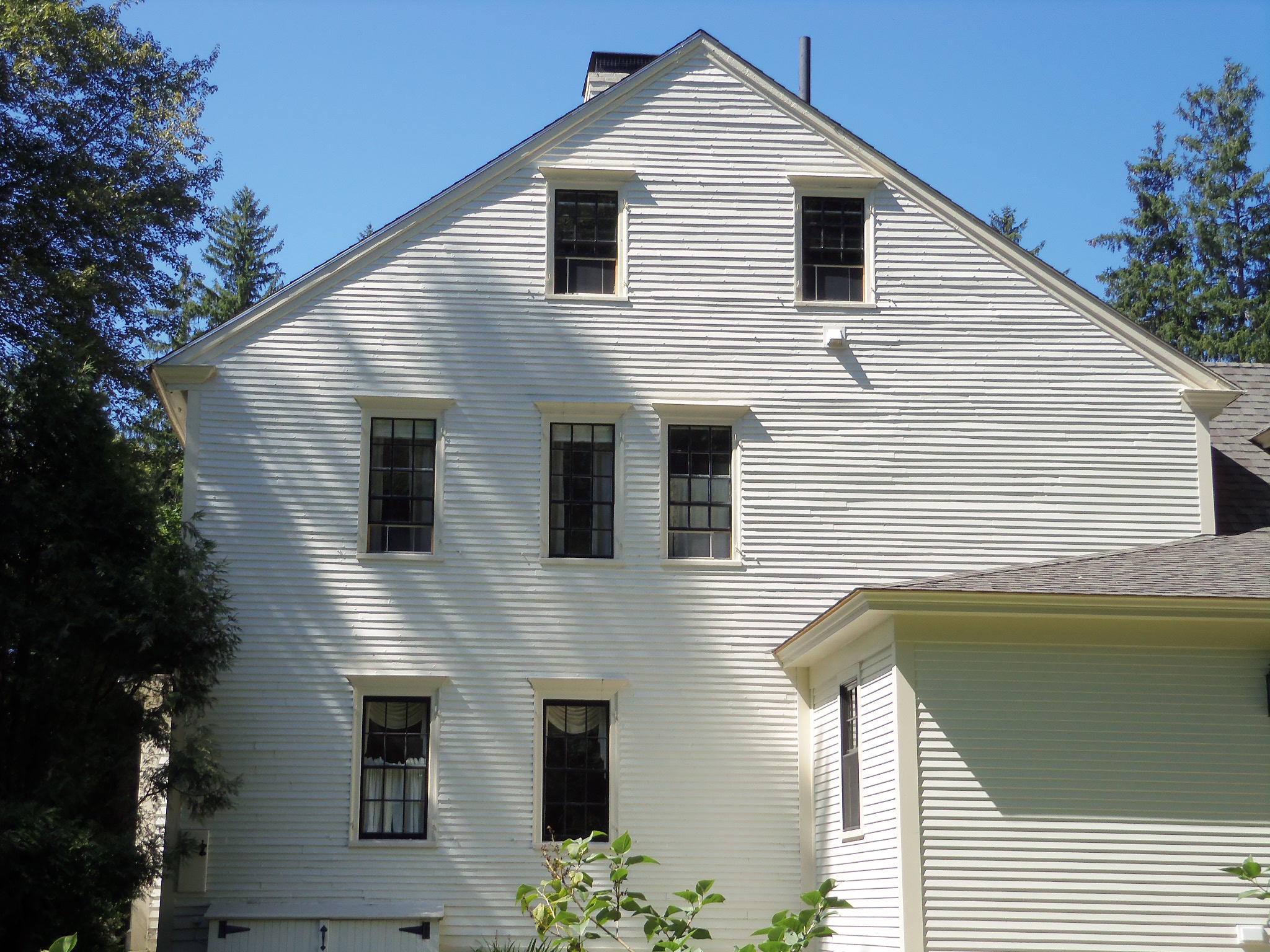
Here’s an example of the “Colonial” style, which flourished 1720s-1780s.
With its large central chimney and central hallway, a Colonial house started out with a symmetrical layout.
 Strolling Dover: for more, click here.
There were times I’d joke, “I’m the most conservative person around here,” back when I worked for what was often called an ultraconservative newspaper.
In some ways, I’m not that far from the Amish, at least in my sympathies, and you can’t get more conservative than that. Apart from my electronics gear and some original artwork, my household at the time was plainer than some of the old-order Mennonites I visited. I’m appalled by waste of any kind, and have been frugal by choice and necessity. You can guess what kind of cars I drive — it took me a long time to accept air conditioning over rolled-down windows. In the political sphere, I’m very much in favor of cutting government spending in the one place it’s truly bloated and out-of-control. (The part that doesn’t get audited.) In the realm of the mind, I love old-fashioned music (classical, opera, folk, jazz) and serious literature – the lofty visions of civilization I believe should be preserved for the future. Conservation and ecological awareness and sustainable economics and small-is-beautiful enterprises – don’t they all fit a true conservative outlook? And then there’s the garden and hiking and camping, all back to basics. My personal finances tend toward debt-free, apart from the mortgage and car payment. These days, many of my clothes come from yard sales. Gambling is out of the question. All that before we’d get to the radical Christian perspectives from the Bible (not legalistic mind you, but prophetic).
None of the candidates insisting they’re conservative seem to fit the daily description, even while insisting everyone conform to their political label. Long ago, I learned to look at actions more than words when it comes to trusting a person. Do they match up?
I just wish they’d call their strand something else, something more accurate. Or change their direction to fit the broader picture.
Decades ago, after hearing mention that my family had Quaker roots in North Carolina, I began the genealogical detective work that now fills my Orphan George Chronicles. Although I’d independently come to the Society of Friends and become a formal member, I was surprised to hear that my family had been Quaker and that there were Quakers in North Carolina – my, have my eyes been opened!
In the genealogical work, I chose to begin with my great-grandparents – people I’d never met in the flesh.
But when my father died, the focus shifted. I realized only one person remained who might be able to fill me in on questions of his childhood and parents, and that was his “baby sister.” That would mean getting to know her – and her parents – without all of the filters that had always been applied by my mother, who had issues of her own. (Oh, for these family dynamics!)
It became a rich and fascinating project, given all the more incentive when we met my aunt and her husband, a retired university dean, at the airport. It was a first-time encounter for them and my brood, yet he swept up my younger one in his arms and proclaimed, “It’s so good to have another Democrat in the Hodson family!” The party activist suddenly had a favorite uncle. Make it great-uncle-by-marriage if you will, he got the crown.
At that point, my aunt remarked that Grandpa’s slogan, painted on all of his trucks and on the calendars he mailed out each year, was “Dayton’s Leading Republican Plumber.” She promised to send a photo of the vans all lined up on the street. “You didn’t know that? It was even on his stationery and bills.” This was something I’d never known, although he did sign one of his last notes to me as “formerly Dayton’s leading Republican plumber,” a comment that long puzzled me. Through much of the spring and summer I wound up following up on her reactions and insights to her childhood and adolescence, which to my surprise (the word of the day) paralleled my own, especially in regards to their now-Methodist church, the denomination I grew up in. At last, I could finally look directly at my grandparents through all the memories and scattered bits of data I could assemble, as well as all the material I already had, doing genealogy. It was like being given a key, at last.
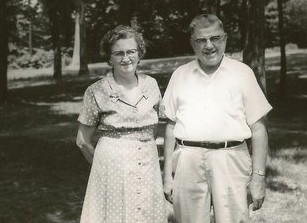
My aunt suggested I correspond with a surviving first-cousin Dad’s age, who wound up also contributing memories, and the result was a remarkable project, not quite memoir but more a realization of finally knowing my grandparents, pro and con, for the first time – years after their deaths – as well as questioning many of our ingrained expectations: just what are grandparents supposed to be, do, or look like, for instance. Unexpectedly, I reconnected to more feelings/memories from their house on McOwen Street than to the house I grew up in on Oakdale Avenue. Some of the stories that turned up, like my dad’s desire to be a sports writer or a big chicken dinner Grandpa arranged to help pay medical bills for one of Mom’s best friends, are priceless. From an intellectual perspective, the project also illuminates the difficulty of knowing – it often meant triangulating something in the middle of three often contradictory sets of perceptions. More importantly, to some extent, I’ve finally been able to reconnect with more than a few fragments of my childhood.
From my end, there’s little I’d say was happy in all of that childhood. But there are things I can finally claim and appreciate, and even rework or rewire. Much of my adult life, as I’ve found in Dad’s genealogy (Mom’s is entirely different, and far more gothic than she ever would have admitted) has been a matter of reclaiming many of the values and practices Grandma and Grandpa rejected in their move to the up-and-coming industrial city. I never knew that my Hodson ancestors were Quaker or that Grandma’s were Dunker (Church of the Brethren), very close to Amish and oh-so Pennsylvania Dutch. But they rejected all that, with some values somehow surviving, however invisibly.
Some discoveries still amaze me. The fact that Grandpa accomplished all he did with nothing more than a grade-school education, for one thing.
Or that his two best friends in adulthood were both a decade older than himself, and both died within a year – one of ALS, the other in a car collision. Since he was the youngest of three sons, I wonder about the dynamics.
There’s much, much more I’ve uncovered along the way. As you can guess, it’s a long story. Today would have been his birthday.
 Strolling Dover: for more, click here.
 For more, click here.
Much of my career as a professional journalist involved designing newspaper pages, looking for ways to attract a reader to a story while also fitting the headline, text, and accompanying photo into what were often challenging spaces around jagged stacks of ads.
With a solid high school background in visual art itself, I came to the graphic side of design with a deepened appreciation for illustration, logos, advertising campaigns, letterheads, magazine covers, and, of course, book jackets – and I could be sharply critical of what I saw presented to the general public.
As I remember photojournalism guru Chuck Scott scoffing as he looked at a prissy photo-essay page, “That looks like art director work! Give me something more direct!” Or something like that. The point was, he didn’t want fussy or cute.
I’m the same way. Keep it clean, for starters. Have a strong graphic image. And keep the type to a minimum.
The cover to my first published novel suffered from the cut-up approach. It just looked klutzy, despite the best intentions of the lotus pattern imposed over a photo. And the second entry, from an early ebook venture, never really had a cover.
So the opportunity to work with Jeremy Taylor on my Smashwords edition covers gave me a chance to put my concept into play. A strong photo with little more type than the title and author.
The photos were purchased from inexpensive stock collections and selected as an indirect homage to Richard Brautigan’s playful portraits from his Avon series back in the hippie era. His covers remain some of my favorites.
Let’s not forget ways ebook fronts differ from regular paper editions. They’re smaller, thumbnail size, really, with little room for blurbs or the like. It’s one quick look rather than turning the volume around in your hands and reflecting, however briefly.
So that’s what we have there.
When I reinstated my own Thistle/Flinch imprint as a PDF ebook line here at WordPress, the cover design fell to me, for all of the budgetary reasons you’d expect in offering free editions.
Again, I’ve stuck to the basics – strong graphic image, minimal type.
What’s been fun for me is working within a Word program rather than venturing out, say, into Gimp or beyond. That is, in light of the constraints on my time, I’m sticking with basics.
As a writer, though, I’d had no need to play with colored type or pages, much less insert photos. I’m old-fashioned that way, viewing this action as a typewriter, mostly. Even my WordPress blogging fits closely with my print-publishing orientation.
Well, you can see what I’ve done. I rather like it. And it’s been fun. Care to take a look at the full lineup?
~*~
See what’s available as Smashwords and Thistle/Flinch.
In college, I went through a soul-searching crisis that questioned whether we could justify subsidizing symphony orchestras or opera companies or art museums and the like in light of the economic inequities in our nation and world. And then I noticed how much of an entertainment industry flowed through the ghetto and Third World, too. That is, everybody has art (even those old Quakers, in a few restricted forms) — it’s not necessarily about money but a need for expression. And all of the emotions and aspirations that go with it. As well as the big bucks, for the big jobs.
In my trials after college, I eventually found myself moving among Friends and then, in time, a few who had grown up under the old restrictions that banned fiction, theater, and even music. Harsh as the old discipline was (and I could have never lived under it), there was also a valid criticism – especially of the superfluous nature of so much of the artistic effort and the egotism so rampant in its ranks.
Maybe the early Friends saw, too, how much the arts were a function of the royal court and its fashions. Or a gilded church. Even the way arts were used to veil the upper crust from the populace and its labors. It turns outs the original Quakers were also picking up on a dialectic from the earliest days of the Christian church, one that contended acting arose in counterfeiting thoughts and actions, many of them of an evil nature.
Within the memory of Quakers, at least, the fine arts have come a long way from the 1650s, pro and con.
Still, proscribing many of the arts did focus Friends on other matters, including abolition and nonviolence. It channeled creative energy into mathematics and science, architecture and industry, poetry and journalism (“We Friends only read true things,” as one Quaker purportedly said, regarding a neighbor’s stack of novels). Go ahead, tally the other fields.
On the other hand, how much of our own focus is deflected by our apparent indulgence? Or how much of it is enriched and deepened?
So how do we make peace with that seemingly artless side of our legacy? Let me suggest we begin with a consideration of “only true things” in our practice. Back to the deeper expression, the part that reflects Truth that goes beyond quantifiable facts. We might even begin with questions of quality or justice or compassion. And then, as they say, the plot thickens.
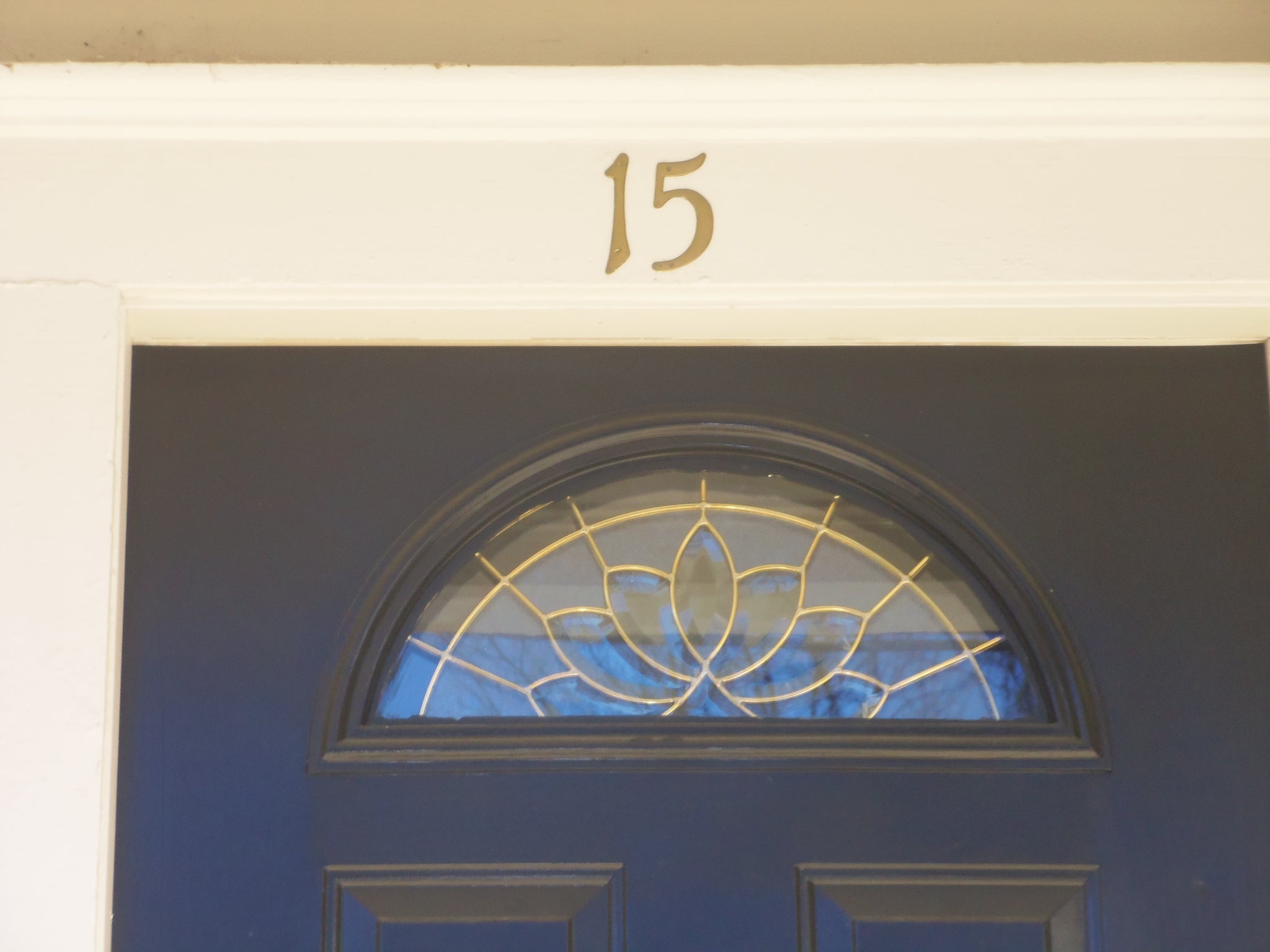
A solid door yet there’s natural light in the hallway.
 Strolling Dover: for more, click here.
Think of these poems as an almanac for the year, a monthly calendar of not just rows of days and weeks but also the centuries of New England.
Where the past peers into the present and future.
And you peer back.
 ~*~
~*~
For your own copy, click here.
 Jnana's Red Barn