FARM GIRLS

“Those aren’t bulls, they’re steers”
she corrected from the passenger seat.

Now a waitress at the country club.
“I bet you get some pretty far-out passes.”

“More than that!” She giggled.

Here she was living with a man
in a hotel in town. He was a Mohawk

who raised horses and died
two days after landing a paying job.

“I guess I’ll never go back”
– to the farm, to the city –
it didn’t matter.

~*~

Sometimes it’s the Baptist upbringing.

~*~

She couldn’t understand why her parents
were still together. Thought her mother

once had a lover. She’d hear kissing
after being sent to bed, after her father’s

best friend had come over. Now
he couldn’t stand him.

There was a big waterfall on their farm
which they had to sell.

And she told me
she had laryngitis the previous week,

making me wonder
if I should have kissed her good-night

so much.

To continue, click here.
Copyright 2015

A DESERT AND A SEA

A hundred miles inland from the nearest port, we encountered a three-legged tree. Until looking closer after being told the house beside it was built a century earlier by a retired sea captain, you’d have no clue a whale jaw had been leaned against the young trunk, where they grew together.

Irrigated, of course, this being desert.

The question remained. Who was farther from true home?

For more insights from the American Far West and Kokopelli, click here.


ECHOES

“Jim’s one of our young flashes,”
a production chief told his wife
when all three paths crossed in the grocery.

To which, you might add, “in the pan.”

~*~

“I wish I could have gone to college.
I wanted to be an engineer.”
said the unshaved man in a Salvation Army pullover.

There are a lot of older people in college classes,
his nephew tried coaxing.

“I have no money,” came closing in like a curtain.

~*~

An elderly mother and middle-aged daughter
argument escalated in the sedan
in the doughnut shop parking lot.

They’d no doubt discussed this before.
At last, opening her door, the daughter repeated:
“Let’s go in and drop the subject.”

To continue, click here.
Copyright 2015

THEN THERE’S PERFORMING IN PUBLIC

Can I really be coming up on my fifth year in the choir that’s evolved into the Revels Singers? Hard to believe, especially when I hear the astonishing, velvety sound around me in rehearsal — one that’s getting even crisper as we develop.

The only experience I’d had before joining was Mennonite a cappella hymns sung in experienced circles and then later some Quaker ad hoc four-part chorales. Working with the Boston Revels organization has been a much more intimidating and rewarding challenge, especially for an untrained singer who had only some background in violin.

One thing that has surprised me is how hard it is to hear myself. Leaving a new message on the telephone answering machine (remember those?) always came as a shock. Whose voice was that, anyway? It was lower and thicker than what I hear in my head. Add to that the reality that we don’t hear ourselves snore – how can that be? I’ve learned to recognize the vibration in my throat but never hear an actual sound. What a mystery!

As a singer, what I sense more is a vibration than hearing an actual voice. At least that’s the best I can describe. I hear the voices around me instead and adjust to them as needed. And, yes, I hear the times when we’re full and rich in all our glory.

I do recall an event a few months ago when we were in the sanctuary rather than the adjacent room of the church where we practice. We formed a big circle around the pews and were singing in mixed formation but, as it turned out, I was the only bass in my quarter of the room and so, when we had a line to ourselves, I heard my voice arching out to the center – like a fishing line being cast into water, as I recall. It was thinner and lighter than I expected. Hmm.

Another big surprise has come in the experience of performing, in contrast to rehearsals.

We practice in a room of fine acoustics and have a good time together as we move closer and closer to some higher standard. We gain a familiarity in that space and probably react to it. And rehearsing is always filled with interruptions as we reexamine a passage to tweak something, explore other possibilities, correct our pitch, or simply make it better or more convincing.

Each performance, though, is a unique experience. It feels quite different from what we normally do.

Since I’m not confident enough to give up my printed score – my memorization has always been faulty when it comes to words and music. I’m always rewriting them as I go, so on stage I need to have room to open my book. That, as I’ve learned, is not always a given. Nor is sufficient light. And even when both are adequate, there are times when I look down on the page with a sense that I’ve never, ever seen this piece of music before. How many times have we rehearsed it? Well, I am getting better at memorization, just in case.

You never really know quite what to expect, but each time you’ll discover something new. This really does put everything to the test. Outdoors, especially, can be difficult when it comes to hearing the others. You have to trust the director and, if you’re in a decent position, what you see of the others.

No matter what, though, the performance turns into an altered state of consciousness. I’m focused on our conductor, my colleagues, the music and lyrics, and to a degree on our audience and setting – and for a give span of time, we’re in a corded shell, as poet John Dryden once described it. (Somehow, I’d rather have that as chorded shell, but there I go revising.) We begin, we are, we finish. Leaving the stage, we grin at each other. That was … fun, yes, along with something quite different and inexplicable.

All that practice seems gone in such a short time. Well, it is like preparing a feast, especially if you consider raising your own ingredients. I love it when we have an audience that leaves feeling well fed, even euphoric.
NEXT!

Caterpillar, one of the legendary periodicals in 20th century American poetry, set out with an intriguing premise – that three years was about all a literary journal could do before repeating itself or exhausting its commission. (Never mind that it went twice that.)

Somehow, Friends have found that for some offices, three-year terms work best; while they may be extended, six years becomes the upper limit. After that, the officer rotates into a new place of service.

The Red Barn’s been at it five years now – launching its four subsidiary blogs along the way. And for those of you who’ve been blogging much longer, you’ve truly earned my respect. It’s a lot of work, no doubt about it.

~*~

This past year, especially, has been intense as I’ve released some long pent-up emotions and thoughts about polity in action. (Remember, though, my degree was in political science, and I entered journalism with a sense of public service that was, in a psychically bruising degree, thwarted to the corporate profit sheet.)

So here we are, in face of the thugs who’ve been attacking our free speech and American values. However the election turned out.

And I’m still fired up, even if I’m looking at a more leisurely pace in the year ahead.

GIVING VOICE TO A UNIQUELY AMERICAN MUSIC

The demands of settling the New World left little time for the first waves of immigrants to attend to the fine arts. Unlike Europe, with its ongoing traditions, America had no courtly patrons or vested institutions. No Lorenzo de Medici or cathedrals, for instance. In fact, many of the Protestants looked askance at the vanity running through many of the arts or questioned the truthfulness of entertaining fictions. The Puritans banned theater, after all, as well as social dancing, at least until yielding where I live on New England contradance. The Quakers and Baptists went further, forbidding music from their worship services altogether.

Something had to bend and, over time, did. Slowly native voices took shape in literature, painting, and music, mostly. To us today, these “primitives” can be refreshing encounters.

In music, much of this impulse surfaced along vocal lines. (Little wonder, considering the rarity of instruments and teachers.) And out of this came a desire for choral music, a community activity of a social nature.

In the absence of trained musicians, though, some music masters, mostly self-taught, opened workshops known as “singing schools” and eventually created a unique notation style we know as “shape-note” scores. These pages have the staves, time signatures, sharps and flats like the scores generally used today, but rather than having the notes themselves be round, some are square or triangles – and each of those markings designates a fa, so, la, ti, do – an ancient foundation for singing.

When singers pick up a hymn from a shape-note book, they run through the music the first time by using the words fa, so, la, ti, do rather than the lyrics, which are introduced once the singers have their musical lines and harmonies in place. And away they go.

Boston tanner William Billings (1746-1800) is regarded as the first American choral composer, and increasingly as an original, even startling, voice. His four-part “fuguing tunes” of one voice after another embracing and embellishing a phrase create bright polyphonic tapestries on Biblical and patriotic texts. Henry Cowell, a major 20th century American composer, has argued that had we heeded Billings rather than later reformers, we would have had a unique serious American musical tradition much earlier than we did. Other observers have said that hearing Billings is like encountering the wonders of music for the first time. I’d agree. While Billings, himself a singing-school master and publisher, did not employ shape notes, much of his music has survived in that style.

In Virginia, the Mennonite Joseph Funk (1778-1862) created a seven-note system still in use among Mennonites and Brethren. Many of those hymns were published in both English and German. (I have several editions of these volumes.) The crossroads where he lived and is buried is now known as Singers Glen. It’s a lovely site.

Best known today is the Sacred Harp, taking its name from a 1844 tunebook once New England choral singing took root in the American South. It’s a loud, lively, even raucous style of four-part a cappella activity – with many of the hymns composed by Billings, in fact.

Historical purists can argue whether shape-note music should be performed in the Sacred Harp style or in the more lyrical piety of the Mennonites and Brethren, which I favor. What I do know is the joy we feel as a choir when we take up pieces from this stream, as well as how difficult and challenging they can be. For the record, we use standard notation, rather than the shape-note scores. No need to further confuse us.

For related poetry collections, visit Thistle/Flinch editions.

A RATHER CHECKERED CAREER

For someone who has engaged in a writing life his whole adulthood, I’ve had a rather checkered career as a reader. After a precocious outburst in the classics – Robinson Crusoe, Tom Sawyer and Huckleberry Finn in second- or third- or fourth-grade (not as class assignments, of course – who knows what we were reading there), I found myself largely oblivious to fiction. My attention turned to history and biography (the Landmark series, especially) and then science and politics. Non-fiction, with a sense of content. Fiction came later, in high school, curiously through political fiction – Brave New World, Lord of the Flies, 1984, rather than any of the traditional British canon. Throw a little Shakespeare in, and I was off – into journalism. (Let me mention that Huck Finn was much harder reading in my junior year of high school than it had been when I was younger; as a novice reader, I wasn’t tripped up by the strange spellings of dialect.)

In college, for whatever reason, I developed a passion for Samuel Johnson. Not for his moralizing as much as the sarcasm, I’d say, as well as a fascination with the baroque richness of his style. Maybe it was just the force of personality projecting from the writing. And then came Virginia Woolf, Kurt Vonnegut, Richard Brautigan, Jack Kerouac … the widening stream.

Surprisingly, a major turning point occurred in the span when I had the fewest opportunities to read – my years living in the ashram, a monastic community in the Pocono mountains of Pennsylvania. Out of the practice of meditation and reflection, however, I began to approach literature in a new way. The quietude opened poetry to me, both as a reader and a writer. The experience also introduced me to mythology, with the Hindu stories being more fantastic and meaningful than anything I had encountered in the Greek and Roman stream. Later, I was able to leap from this into the stories of the Bible as well, returning me to my previously unknown roots.

Others have written of being a promiscuous reader. I wouldn’t say I’m addicted to reading that way – at least, not any more. One of the ashram exercises, in fact, was a “reading fast,” meaning written words, rather than food. It’s all a matter of focus. That is, when I’m eating, I want to choose to concentrate on my food rather than a text. When I’m traveling, I want to see where I’m going. (Airport terminals, on the other hand, or stretches before takeoff, are another matter — they are among those place of limbo.) Later, when the newspaper first comes off the press, I found I could no longer focus on the stories – not after a shift of heavy editing. If anything, my head was so full of disjointed stimulation I needed to slow down to savor what I’d already encountered. For that matter, I prefer walking to jogging, with its restoration of a natural pace. I rush too many places and deliver on too many deadlines as it is. When I enter someone’s home for the first time, I must take care to pay attention to them more than the spines on their bookshelves. Now what were you saying?

I read, then, with greater focus these days. More selectively. I can no longer have classical music playing in the background. (It used to provide a barrier for noise from my family or neighbors.) Now, I immerse myself in what is before me. The text, then, as in scripture.

~*~

Out of all of this, my own work emerges. As a writer, I strive to create a linear progression. That is, the parts must advance is some sort of logic. Curiously, in my own work, I am often inspired by a Hegelian model – thesis, antithesis, synthesis – as drawn from cinema theory. On a wider scale, my earlier interests surface in new ways, resulting in something more akin to a matrix or spiral or collage than a straight line. I have been called a Mixmaster, with good reason. On top of it all, in my many moves about the continent, I’ve found myself exploring the soul of each place – something wine aficionados consider, in a smaller range, when they discuss terroir.

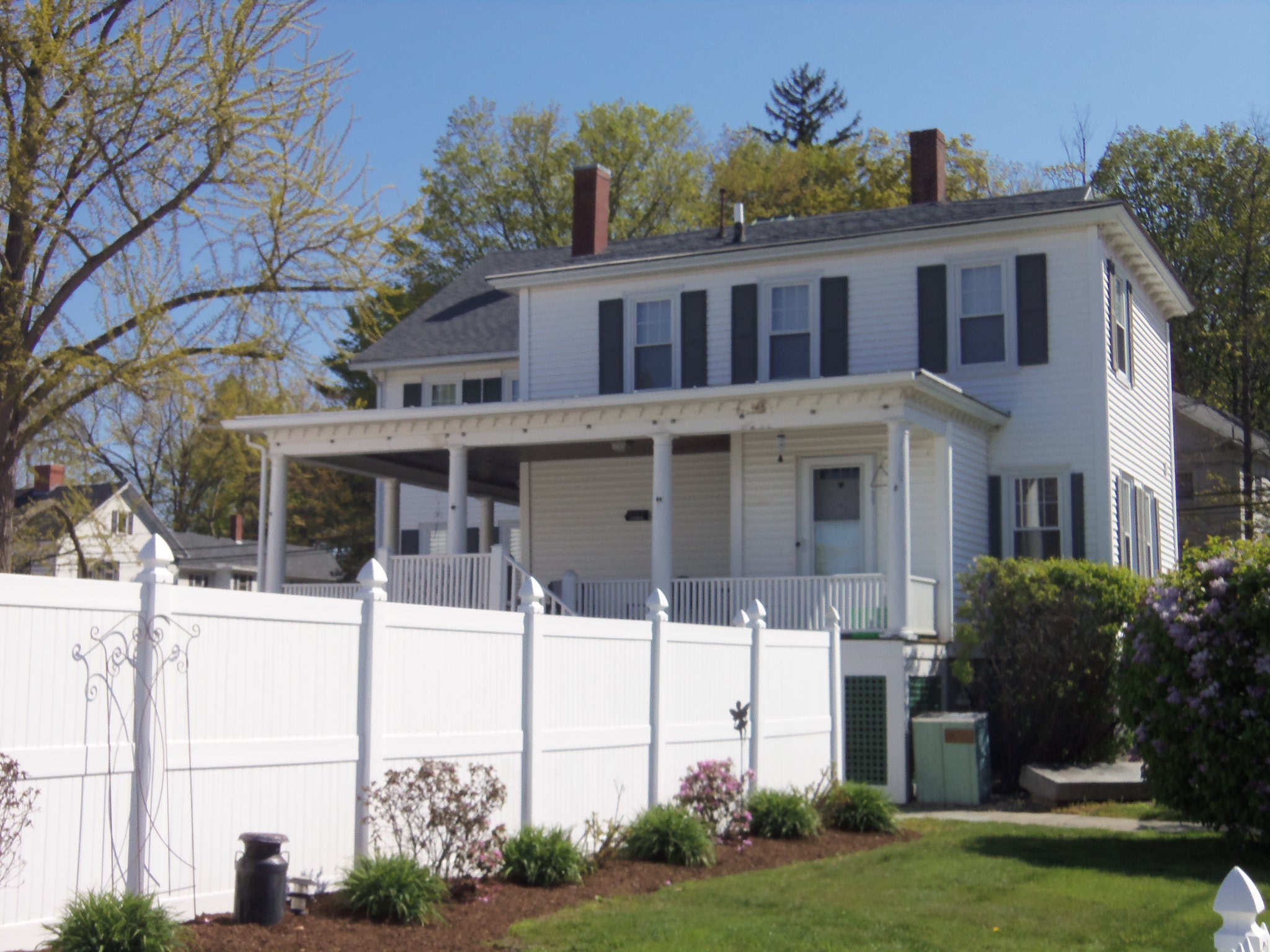
LOOK, WE KNOW WHAT WE MEAN BY A ‘NEW ENGLANDER’ STYLE HOUSE

Around here, if you mention New Englander as a style of house, everybody knows what you mean. Gable end to the street, perhaps a bay window beside the front door, typically two full stories and a usable third floor. Not Greek Revival, except in a stripped-down way with some carpenter gothic touches, and definitely not Colonial Revival. Modest, middle-class – maybe even working class – sometimes even as a duplex.

But try looking it up and the best you can find is an accusation that it’s New Hampshire Realtor BS.

Well, that’s where we live. Ours seems to be from the 1890s.

~*~

My poems on the challenges of renovations, repairs, and relating as a husband are collected as Home Maintenance, a free ebook at Thistle/Flinch editions.