Should we be offering pizza by donation?

As long as I’m reflecting on our Christmas gift-giving (why not, it’s time to start planning for the next round), I should mention our new Ooni Kanu 16 outdoor pizza oven from England. What, not Italy? Or Greece?

The second time she spoke up from her laptop and uttered the words, “I’d sure love to have one but (sigh) it’s beyond our budget,” adding, “I can dream, can’t I?” I knew it was time for the rest of us to put our conspiratorial resources together.

After several miscommunications on our end, we got the order off, knowing it wouldn’t arrive in time to be wrapped up and put under the tree, so we came up with an amusing announcement envelope to cover us in that part. My crude cartoon slowly kicked in and generated a grin.

The said item arrived in February, big relief, and we can see why it was such a hot item last fall, even before the international shipping delays kicked in.

The oven can sit on a table, for one thing, and be fueled by charcoal, wood, or propane, which can fire it as high as 900 degrees Fahrenheit, cooking a pizza at a lower setting in minutes.

We can finally find a pizza in Sunrise County that matches our high standards. Deep-dish and thin are options. And it’s not limited to pizza, either. I’m thinking of a Vietnamese dish that would glory to such instantaneous blazing.

Well, this has required me to take one more step into 20th century technology, specifically 20-pound propane tank use. As for grilling, I’m sticking to charcoal.

Now, where do we stock up on unused pizza boxes?     

New phone, just as my old camera was dying

Just putting those two items in the same line sends me spinning, as if it’s natural they should ever be synonymous.

Let me proclaim I’m a true conservative, unlike those pretenders using that label. Not that I’m ever confined to tradition.

Take gift-giving in our household, for example, it doesn’t always happen on the intended date, whether Christmas or birthday. And I should point out (again), that it’s often a conspiratorial effort.

One example I’ll give is my new cell phone, which they’d been threatening to impose on me for several years now. They’d given me the previous one maybe a dozen years earlier, replacing the flip phone I had accepted only in case of a midnight emergency somewhere in the wilds of New Hampshire on my commute home from the newsroom.

So much for the history. Perhaps you remember I happen to be somewhat of a neo-Luddite, in no rush to learn yet one more new technology. I’m more interested in spending those hours doing something at hand other than retraining on a new device, like an endless loop of abuse.

Our move to the island was heightening the rationale that I really needed to upgrade. T-Mobile’s coverage here is spotty, and often nil off in the neighboring wilds, and whenever my text messages were arriving through Canada, which was often, they’d get turned into zip files that took forever to download. Photos were even worse.

Blogging, by the way, had prompted my photo shooting hobby years ago leading to the purchase of cheap Kodak point-and-shoot, which they eventually pressed me beyond by having me unwrap the Olympus that has provided many of the visuals here at the Barn. Over the past few years, my wife and elder daughter have been insisting I could do better with a good cell phone, and their many fine photos had me reluctantly agreeing. It’s just that I have a workable system going, ya know, and already have thousands of shots that need further sorting. Can’t I finish that first? Besides, shouldn’t photos be taken by cameras?

Well, no.

Last Christmas, everybody piled on the upgrade-Jnana bandwagon.

I didn’t know I needed the little LED ring to illuminate my face during Zoom meetings. OK, I finally “got” the idea that the lamp was supposed to clamp onto my laptop and glow on me, but I found that bright light in my was face annoying and visually taxing. But that lamp is rather nifty attached to the little bookshelf over my desk, and other Zoom participants have expressed their preference for the warm light setting rather than the clinically cold one. So maybe I’ve needed it.

Nor did I know I needed a short camera tripod, but there was the “lobster” in one of the next boxes I unwrapped. OK, cool, it would work for my Olympus, but what about the next two – the remote selfie button and the macro-micro lenses, both definitely cell-phone attachments?

That’s when they broke the news to me that time was up, the new phone was definitely included, or would be, as soon as they could haul me up to Calais to sign up, something that finally happened in late April.

As you might imagine, I was in no rush, but my Olympus was starting to act wonky. The zoom lens (yeah, zoom as in getting a closer look rather than pressing mute or chat) was getting stuck and failing to deploy, meaning my real, albeit digital, camera wasn’t working. Change would be inevitable, even if I am no longer pressing for a return to film, which I could never afford, anyway.

Off to the UScellular store we went, and I was instructed not to look at any of the prices. I’m still shocked by what we were paying for the family plan we were on, now that it’s been revealed to me.

OK, the new phone, a Galaxy S22 Ultra (does that impress you?), is a vast improvement over the S4 or earlier model it was replacing. The latter had no trade-in value, except maybe to a collector of obsolete technologies. The sales associate was rather kind in calling it a classic and keeping her laughter lighter than a sneering snicker.

Only after we were in the car and on the way home did my wife tell me my new phone retails for a thousand bucks. That’s enough to frighten me from touching it. Oops, a figure oil smear! And kids wear these in the pocket behind their butts? I’m never going there, I’m toting mine securely in the pocket of my messenger bag, next to my nitro pills. Keep your hands off.

Flash ahead, Slim and I are getting acquainted, gingerly, and I’m starting to play with the camera half, too. Hate to admit it, but I’m impressed.

Now, what am I supposed to do with my old phone and my old camera? I can’t just junk them, can I?

Reassessing ‘Porgy and Bess’ as an opera

Let’s just say it grows in my estimation every time I hear or see the Metropolitan Opera’s production.

There’s so much packed into its 3¼ hours that the full story can seem unwieldy and overwhelming, but I’m thinking maybe it actually needs to be longer, have more air to allow digestion, with a dinner intermission and perhaps jazz dance/combo interludes inserted at key points in the narrative.

Porgy is not simply the best American opera to date, contrary to the Vienna dismissal of it as a “folk” opera, but, yes, I’d now place it among the top ten ever, in a global view. The grander the reach, the more likelihood of imperfections. Guess where I am on that spectrum?

Quite simply, has any other produced so many hit tunes, especially as jazz standards? Composer George Gershwin held Georges Bizet as an idol, yet has anyone else spawned so many classic offerings from a single stage work? Not even Bizet, nor anyone else I can think of. Just a single hot tune would be considered success. And his have proved incredibly flexible and addictive.

Gershwin had already had a string of Broadway stage successes, but he wasn’t resting on his laurels. No, he agonized over this work and his previously stifled artistic visions. Make that ambitions.

Has anyone else so successfully addressed the realities of drug addiction or prostitution?

Courtesan, as in La Traviata, seems downright respectable in comparison. Bess is raw.

Does anybody else agree Eric Owens and Angel Blue deserve Tonys and Oscars for their performances?


An Indigenous presence at hand  

My immersion in yoga and meditation in the early ’70s left me with a deep appreciation for what poet Gary Snyder dubbed the Old Ways, “the wisdom and skill of those who studied the universe first hand, by direct knowledge and experience, for millennia, both inside and outside themselves.”

It’s something quite different from simply old-fashioned, though it’s found in many different traditions. Call it spiritual, even mystical, if you will, but it often has a practical intensity as well.

I’ll even call it countercultural, across history.

One of its streams has survived among the Indigenous peoples of America, though often by a mere thread.

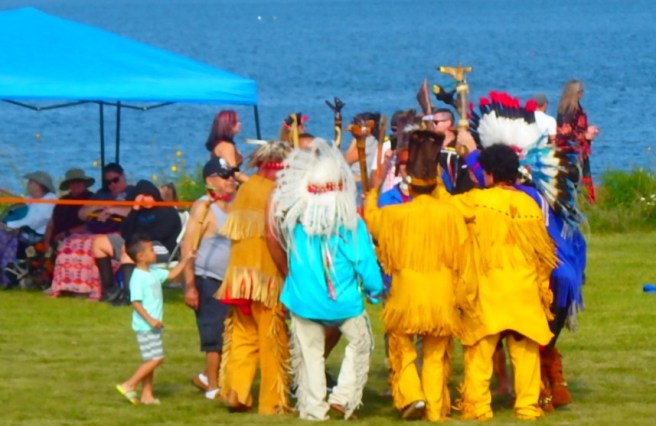
Passamaquoddy dancers in Maine.

I remember visiting Vincent and Elinor Ostrom in Indiana after I left the ashram and, awakening in the morning, sitting cross-legged in meditation on one of their magnificent Navajo carpets. (The Navajo call them blankets, rather than rugs, by the way, but I’d find them too heavy to wear or sleep under. At the time the Ostroms started collecting, these antique artworks were cheaper than wall-to-wall carpeting. Now they’re priceless.) As I opened my eyes, the lines and colors radiated out from me in a design that I could only describe as a living mandala. Its creator had been more than a weaver, then.

A few years later, I was living near the fringe of the Yakama Reservation in Washington state and delving into the mythology and artistry of the Pacific Northwest Native peoples. My longpoem, “American Olympus,” reflects that, as do many of my shorter poems and parts of my novels “Nearly Canaan” and “The Secret Side of Jaya.”

That experience, though, was cut short 42 years ago and revived only last year, when I landed in Eastport with its neighboring Passamaquoddy people – 258 households, 700 members.

The Passamaquoddy’s Pleasant Point Reservation sits along Cobscook Bay on one side and Passamaquoddy Bay on the other.

I can’t exactly explain it, but I do sense that practitioners of Old Ways change the vibe of the surrounding landscape in a positive way. Not just American Indians, either. I’d say the same of the Amish.

One of the traits that seems to be common among these practitioners is reserve, close observation, and an economy of words. The character Marilyn Whirlwind, played by Elaine Miles in the television series “Northern Exposure,” embodied that to perfection.

There is also a sense of place as sacred, and a desire to live in balance with the land.

The word Passamaquoddy itself translates as People of the Dawn. Even Gatekeepers of the Dawn. And it definitely fits this part of the continent, on both sides of the U.S.-Canada border, which they have always spanned.

The first I had even heard of the tribe was when Fredda Paul, one of its traditional healers, and his apprentice Leslie Wood stayed with us a few nights in Dover. For me, it was a close insight into another way of thought and feeling.

So far, I’ve refrained from photographing the Passamaquoddy, at least apart from their annual powwow. Maybe I’ve learned that from the Amish, except for the powwow part.

A drumming circle is something shared across tribes. It’s a complex interaction, loud vocally and instrumentally.

For an introduction, I’d suggest touring the exhibits at the Wabanaki Cultural Center in downtown Calais. It’s free and includes hands-on displays.

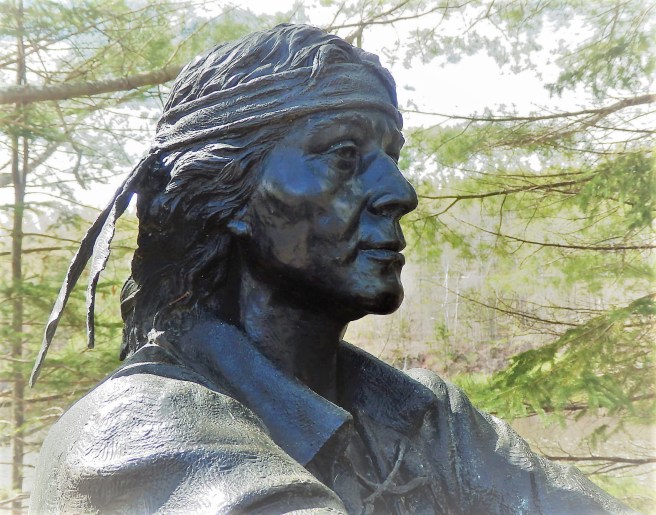
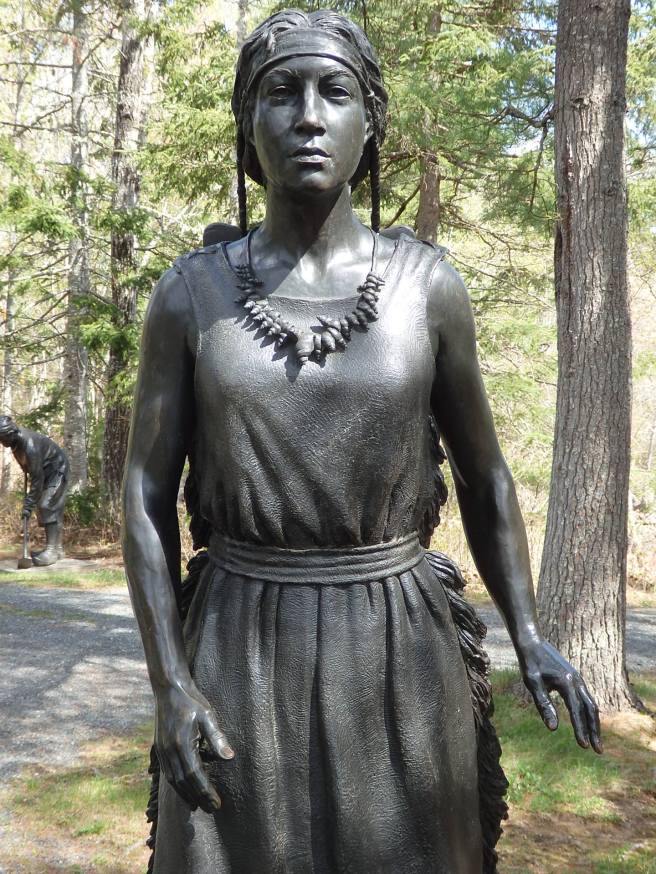
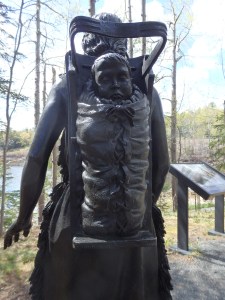
Sculptures by Ivan Schwartz and Studio EIS at the St. Croix Island International Historic Site in Calais honor the Passamaquoddy role in saving the remnant of the French venture in 1605.
I do wonder about the sculptor’s choice of models. As for the clothing?
And the future?
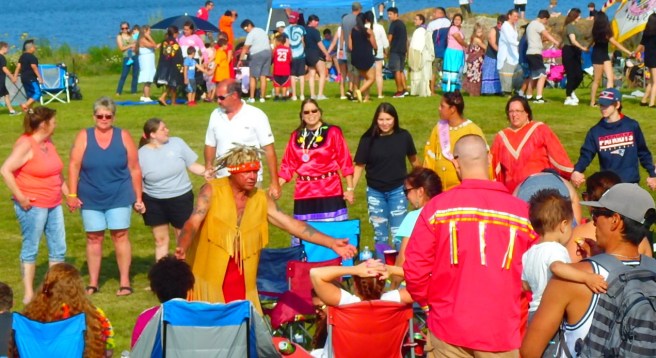
Just about everyone at the annual Passamaquoddy Days celebration is invited to join in the snake dance. Saying no is not an option.

I’ve not yet been able to visit the Waponahki Museum and Resource Center on the Pleasant Point Reservation, with its work by award-winning basket makers, canoe builders, carvers, and contemporary artists, as well full-body castings of tribal members made in the 1960s.


Don Draper and the life I thought I’d be living

My first awareness of the Mad Men television series, about a decade ago now, came in my daughters’ outraged question – “Was there really that much sexual abuse in the workplace back then? They’re making that up, aren’t they?”

They were incredulous at the blatant sexism and racism of the time I grew up in, even after I confirmed it was there.

What they described was confirmed and more in my recent binge viewing of the series. Let’s just say I was quickly emotionally engaged in the show.

Growing up in the Midwest, I was repeatedly told I belonged in New York rather than in my hometown. Advertising was, in fact, one of the career paths I was considering, and like journalism and publishing in general, Manhattan was still the center of the universe.

Watching the presentations reminded me, to some extent, of the first offices I worked in, even in Ohio. And Don Draper, the advertising creative director at the core of the story (I started to say “heart” but he is rather heartless), reminded me of some of my livelier bosses as well as a kind of ideal of what I was aspiring to or perhaps was being groomed for, at least before the hippie influence kicked in.

Yes, there was cigarette smoking everywhere, and liquor – and functioning alcoholics. (Should I say “functioning alcoholics who smoked”? Or is that too redundant?)

There were also some incredible secretaries, who were far more than typists. The best held the office together, far more than the corner office they reported to.

Let’s just say that the workplace changed drastically in the years since, in part through the digital revolution.

~*~

The show also hit close to home through the father of my best friend in high school, who was a vice president in a boutique advertising agency, one titled with the initials of the three of the partners’ surnames. Not that he was anything like the ad men in the show. Through him, though, I learned of the intricacies of billing, production challenges, deadline crunches, marketing analysis, and purchasing print, broadcast, billboard, and direct mail access – things that were touched lightly on, if at all, in the plots but still a factor.

And during college and the first year after, I was exposed to families that could well have mingled with the Drapers – executives, attorneys, and politicians, plus their wives and children of the late ‘60s and early ‘70s.

~*~

My daughters were swept up in the show’s fashion mindfulness of the ‘50s and early ‘60s but unhappy with the styles as the chronology moved on in the final seasons. We can argue there.

My biggest criticism is of the cheap shots taken at hippies, falling into stereotypes rather than the more carefully crafted type studies up to that point. In doing so, the writers and producers lost an opportunity to more sharply critique the cynical, superficial world Draper and his colleagues inhabited. The tone of these segments, quite simply, was out of line with the rest of the production.

Even so, I was devastated by the final episode.

Could that have actually been me? Thank God, I escaped.

Ah, yes, it’s orgy season again!

Not to disappoint you, but I’m referring to Harvard University’s radio station WHRB-FM, which does stream online, should you be interested.

Its orgy season is a tradition that occurs during finals exams’ week (plus), originating when one student who was so elated at surviving the tests that when he went into the studio, he celebrated its end by playing all of Beethoven’s symphonies, on 78s, in order.

How modest that seems now. A year and a half ago, the station played everything Ludwig ever wrote in honor of an anniversary.

Bob Dylan received a similar accolade a few years ago.

This year Franz Schubert’s in the focus, more than 120 hours, by the way, which creates a smaller orgy of its own for the baritone Dietrich Fischer-Dieskau, who was acclaimed for his many, many recordings of the many lieder, or songs.

In fact, when his daughter was asked what her daddy did, she quipped, He makes records. So many, in fact, he’s among the most recorded artists ever.

My late German mother-in-law would have been out of this world over this orgy.

Well, as I post this, the station’s just getting going.


Just made my unanticipated theater debut

Eastport may be small, but its lively arts scene includes the Stage East company, with some rather lively programming.

At the moment, for example, they’re preparing a world-premiere musical for performances next month.

It’s the kind of place where you quickly get to know half of the town, too, so I wasn’t surprised to get an email from the director Thursday morning, even if its contents were unexpected. Could I participate in a play reading that evening and the next two nights?

An original work, the winner of the company’s inaugural playwriting competition?

I’d never done anything like that before, but in a pitch-in kind of community like ours, you learn to step up when asked, and so I replied fine. Honestly, I felt honored, and it couldn’t be too different from a poetry reading, right?

The initial reading was fun, both times through the one-act play. Better yet, my part was the shortest of the four and the least complicated. And then I learned we’d be doing it in front of a live audience the next night, meaning last night, and again tonight.

The playwright is Wilder Fray Short, a Bowdoin College senior and soccer fan, and the one-act play is In the 45th, about sibling rivalry and a lot more.

The competition, open to young full-time Maine residents and including a week-long residency and $1,000 prize, itself honors the late Jay Skriletz, the company founder, prolific playwright, and believer in social change.

To which I’ll add, it was an amazing experience and if you’re anywhere nearby, show up tonight!

Brisket and a hunk of binge viewing

Somehow, this past winter I got struck by a sustained sense of cabin fever. Should that be “stuck”? To my thinking, that’s not necessarily a “bad” thing and was not unexpected, given my relatively isolated situation combined with the continuing Covid precautions and the usual northern New England long nights and winter snow, ice, sleet, and unassisted general deep cold. I do believe there’s value in periodically clearing some of the clutter from one’s life and regaining a sense of direction, and I have found a huge difference between solitude and loneliness, so here I was.

Mostly, I was feeling a bit directionless, having completed a big revision of the Dover history and wanting to move forward with its publication but not yet having clarity on exactly how that would go. I mean, as books go, this was one more niche item, not likely to hit the bonanza list, no matter how original the findings. Emotionally, then, I was feeling stuck, not my best mental state. It even leads to fidgetiness.

Breaking that up was a visit by family – or should I say invasion – that included time with movies and TV series on the 40-inch screen I usually leave dark. Me? I’d usually read and listen to the radio. I’ve tried to avoid television series, seeing them as addictive couch-potato time-sucks.

A year ago, though, they hooked me on the first season of Mad Men, which we had on DVD. Whew! I was free only after admitting there is some quality writing and performing available and losing a full weekend in full immersion.

This Christmas, they hooked me with Murders Only in the Building, which again fortunately had only one season.

But during a return visit a few weeks later, we shared a phone conversation with the daughter in California who had just made our son-in-law his favorite meal for his birthday, and that mention of brisket led to my memories of being introduced to the cut as a Jewish tradition by my almost parents-in-law, if only, and those stories now had us sitting down in front of streamed episodes of The Marvelous Mrs. Maisel. The fam scooted off, leaving me to catch up on all of the available seasons, and I’m now miffed I have to wait for more on the way. I hate being left dangling. Worse yet, I was told Prime had the remaining Mad Men episodes – so I caught the final six seasons in a bit over a week, how many hours did I squander there? And the last two of Mozart in the Jungle plus all but one season of the Secret Diary of a Call Girl, which was quite sassy but not nearly as hot as touted. There may have been another series I’m overlooking.

Said family was highly amused by my engagement with works they deeply appreciate, but I am still appalled the hours I lost and by one more manifestation of my obsessive side.

For the record, I’m blaming the younger daughter and her brisket for this latest outbreak. Now, just when is the last time I’ve had a slice of one?

What do you suggest I stream next?

A trail of misunderstanding and betrayal

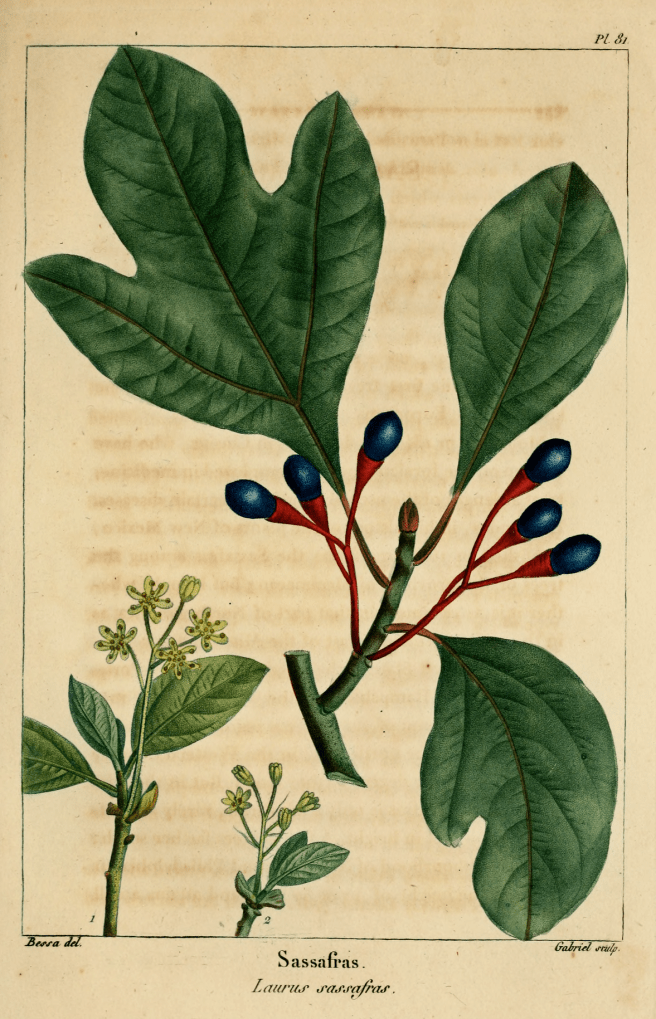
Martin Pring, after becoming the first known European explorer of the Piscataqua River in 1603, then continued south to Cape Cod, where his party engaged in harvesting sassafras tree bark and roots, “a plant of sovereign virtue for the French pox,” as he elaborated in his journal. It was highly lucrative back in Europe and would handsomely repay the Bristol investors backing his journey.

French pox, do note, was what we now call syphilis. If only it worked as a remedy or a cure.

Sassafras was also touted as “good against the plague and many other maladies,” as well, just in case. And you thought it was merely a “tonic” served as tea or the flavoring for root beer?
During their six weeks ashore at Truro, Pring’s crew built a barricaded encampment. It was often visited by as many as 60 Wampanoag at a time, sometimes bringing different kinds of food to the party.

In one instance, in response to the playing of a kind of guitar, groups of up to 20 broke into dancing in a ring and singing “lo, la, lo, la, la, lo,” which works when you don’t know the words. For his part, the young musician was rewarded with gifts of tobacco and pipes, fawn skins, and snake skins up to six feet long, “which they used for girdles.”

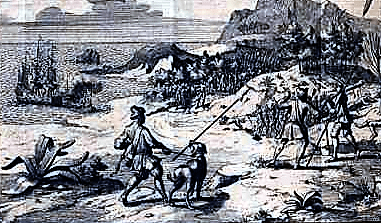
But it was an uneasy relationship. Pring’s two mastiffs in particular terrorized the Natives. Anytime the sailors felt threatened, they’d release the big canines. As Pring recorded, the Wampanoag were more afraid of the two dogs than they were of 20 men.

The tension finally exploded when about 140 “savages armed with their bows and arrows” approached the barricade and a “a piece of great ordinance” was shot off in response as a warning and call to arms.

Recognizing that they’d worn out their welcome, the Englishmen quickly packed up and scooted off behind the protection of the mastiffs and set off for home while the Wampanoag set a mile-width of forest aflame and chased the ship in their canoes.
Of course, we’re never told what so soured the relationship. I doubt that the mariners were very tidy or respectful in their ravaging the forest, and I suspect that may have had something to do with their reaction.

Still, when the Pilgrims arrived in 1620, remains of Pring’s palisades were still visible.

What do you imagine had so enraged the Wampanoags?

Whatever it was, it seemed to set the pattern for much of what followed.

~*~

The episode is rarely told in American history, and, when it is, it’s quickly skimmed over.

Like so much of the New England record that follows, we’re rarely given the Natives’ side of the events.

One thing we can be sure of, though, is that there were huge differences in expectations and values, to say nothing of hygiene or manners.

For instance, as I’ve heard, the Wampanoag word for “treaty” translates as “making relatives,” which is hardly what English settlers had in mind for their part. Far from it. Something similar no doubt happened when the colonists “purchased” land from a sachem.

As the Wampanoag believed, “the land knows you,” more than the other way around.

Quite simply, from their end of these transactions, they were betrayed.

~*~

These days, residing in Downeast Maine – that is, Passamaquoddy country, which stretches over into Canada as well – I’m learning of another series of these one-sided deals.

Joe Clabby’s excellent A History of Eastport, Passamaquoddy Bay, and Vicinity chronicles much of the federal and state maltreatment, misrepresentation, and mismanagement regarding the tribe and its members. One instance, by no means the most outrageous, is this, from 1950: Indian Agent “Hiram Hall allowed the state to charge the Passamaquoddy Fund $8,000 per home for home construction (the homes are worth only $2,500).” This came more than a year after the tribe requested that the state remove him for misappropriation of state aid, favoritism, and disinterest in tribal government.

Driving to and from Eastport, I pass many of these houses, now in serious need of repair. Don’t blame the residents.

As I relate in my new book New England relations with the Natives got off on the wrong foot, starting with the kidnapping of Squanto and four  others. (Virginia hadn’t done any better.)

Shame, shame, shame.