Wilting as they lose local awareness

As a newspaper editor, I was often startled in looking at coverage from the other side when something I was affiliated with was subject to a story. Or even more startling, when I was quoted and seeing how it looked it print.

It was like working in a restaurant kitchen and shipping dishes to the dining room and then, on a night off, going in for a celebratory dinner.

Seeing a report through the readers’ viewpoint really could be eye-opening. It’s not the “names-is-news” philosophy that many small-minded editors and publishers pursued, either. That approach could be even more boring than reading the phone book. Remember those?

The backbone of most of American newspapers has been the way they connect with their local communities. As one wise editor once told me, it should be news of local interest, rather than just happenings in the place itself. I spent much of my career trying to open parochial outlooks to an awareness of the wider world, both directions, and I do believe that can happen and even be exciting.

When I was calling on daily newspaper editors across the Northeast as a syndicate features field representative, I was surprised by how few of the papers gave a taste of a unique nature of each of the communities. Many of the editors thought of local news as city council and school board meetings plus high school sports scores. As I argue in my novel Hometown News, the real stories – the kind that come home – are found elsewhere and require more reportorial digging. That’s one reason I’ve long advocated local columnists (real writers, not dilettantes, though skilled amateurs are welcome). Few papers had even that much.

When former U.S. House Speaker Tip O’Neill famously proclaimed “All politics is local,” he understood those roots.

~*~

A decade after I’ve left the newsroom, I’m directly experiencing that again, or more accurately, its lack.

In the past 20 years, the number of people employed in newsrooms at American papers has dropped about 60 percent. That leaves far fewer people to write about what’s happening or even be aware of what’s going on at the grassroots level where they live. Much of the nuts-and-bolts editing is being done in clusters far from the paper itself, removing another layer of local nuance and understanding.

In my case, in my participation in events celebrating the 400th anniversary of the founding of Dover, I’m seeing the local paper is doing far less coverage than I would have expected. Not after the family that owned it for generations finally sold out to a media conglomerate.

That disconnect isn’t just print media, either. New Hampshire Public Radio no longer originates any content in the Granite State, as far as I can see. Two decades ago, appearing on one of its shows would have been a natural for a local author like me.

Quite simply, it’s disappointing and a bit scary.
Thinking of Tim Gunn and those young fashion designers

Binge watching the episodes of the runway project, I’ve been struck by how many times his sage advice included basic English words the younger generation totally missed.

Well, words that seem basic in our household.

Look, kids: A big vocabulary takes you from black-and-white to full, vivid color. And then beyond. It’s full of nuance and possibility. A spice of life, even.

It’s kinda like that fabric store you raid. And one more reason your mentor on the show is as remarkable as he is.

Our feisty orchestra has played its last concert

Last weekend the Passamaquoddy Bay Symphony Orchestra ended its run on a wild note. Our 30-some member ensemble tackled Hector Berlioz’ sprawling, opium-inspired Symphonie Fantastique in a program that also included a world premiere and a Mozart piano concerto.

It was, as usual, a daring combination.

Our sprawling county has a tad over 30,000 residents, many of them seniors, mirrored by a similar demographic in neighboring Canada. And you’re going to draw sufficient skilled musicians from that as well as a supportive audience?

Yet that’s basically what happened.

The amateur band, augmented by professional freelance “ringers,” has largely been an extension of Norwegian virtuoso violinist Trond Saevurud, its highly-charged conductor. What we’ve enjoyed are bracingly refreshing performances where impulsiveness and driving passion overcome any shortcomings in perfection or “the” definitive interpretation. It’s vibrant music-making and thrilling.

But now, after a dozen years at the helm and as the orchestra’s godfather, he’s stepping down to spend more time back home in Scandinavia.

Add to that the lingering impact of Covid, which has impaired all the performing arts. Here, the border closing cut off players and supporters on the Canadian side of the line. So much for the slogan “two countries, one orchestra.” Some musicians refused to be vaccinated and instead declined rehearsals and performances. Some concertgoers avoided live events in the intimate spaces the ensemble called home. It hurt.

A resurgence of local virus outbreaks canceled two of the three performances of a recent set of concerts, and that undoubtedly hit the finances hard. (I really was looking forward to Tchaikovsky’s first symphony, which I’ve never heard live, unlike a dozen or so renditions of his last, but I couldn’t make the remaining slot.)

That leads the PBSO to a crisis. Officially, the full ensemble is going into hiatus. Perhaps the organization can regroup, rebuild, attract a new music director, perhaps redefine itself and its mission. More likely, it will dissolve.

Locally, it’s also emblematic of how fragile our communities are. Sunrise County has high poverty levels. We’re don’t have deep pockets, either, the kind based on global conglomerate headquarters or old money. Fewer people are available for public service, especially as volunteers on city councils, school committees, town select boards, or the like.

Churches, too, are stretched thin.

You can no doubt think of many other civic interactions where you live, too.

So that’s the score for now.

To those who say God wrote the Bible, let me reply as a writer

If He’s so perfect, why didn’t He do a better job of it? (See any masculine references here as traditional and object to them as you wish.)

Even in Hebrew, so I’m told, many key passages are unintelligible. As for the King James English, which many Protestant fundamentalists hold as inerrant (meaning flawless, perfect, unblemished), let me object. There’s a lot of clumsy translation – and outright mistranslation. Add to that the ways our own language has shifted in the centuries since. (To wit: I find myself having to retranslate many key Quaker writings from the mid-1600s on for modern readers, even those with PhD credentials. Those early Friends were conversant with the KJV lingo. Does thee understand?)

For perspective. When’s the last time you read Shakespeare? Without relying on footnotes?

More to the point. He (yes, He, in the current argument) certainly could have used a better editor, in any language. As for revisions? Let me contend that no work of language is ever perfect, it is ultimately a human artifact. Including the arcane collection known as The Bible.

For me, the best we have in those pages is all the more exalted because of that edge of imperfection and decay. It allows humanity to creep in. I’m thinking of some very cutting-edge contemporary poets, actually.

My fascination with that divine text has turned to the struggle to accurately record our own, very personal, experiences of the Holy One. Name it as best you can. And, from the other direction, the ways our own lives have reacted to the struggle from our own first-hand encounters with those haunting great mysteries.

I’ve come to see – and treasure – what we have in that book more as a set of deeply personal journals of individual and group experiences, including their failures, than as any set of how-to steps to eternity.

Blogging isn’t your only life, is it?

Are any of you amused by fellow bloggers who apologize for not posting during a hiatus in their otherwise self-imposed publishing schedule?

I am. And remember, my career as a journalist was filled with pressing newspaper deadlines where missing by a few minutes could be costly.

Blogging, in contrast, has none of those pressures, at least for most of us. I doubt that any of our followers is drooling in anticipation while awaiting our next post on whatever schedule we follow. Like every Wednesday or Friday, who’s counting? The important thing is to have something to say, usually gleaned from real life.

That’s assuming you have a routine. You do, don’t you?

In the bigger picture, I can think of some voices I miss, unfortunately long gone from the scene. Ones who even erased their contributions when they closed up shop. But they always appeared when they had something to relate, and it didn’t matter what day or week we were in.

Still, we post and/or schedule as best we can. We’re our own boss here, right?

And for the more inquisitive of us, when we fall behind your postings, we’ll catch up when you show up next round.

This is, after all, ultimately about sharing the joy and wonder or challenges of life where we encounter it.

And yes, even that “do wish you were here.”

For the record, I still regard many of you as pen pals. Remember what that was?

Now, to try to catch up with all that’s been happening on this end. That’s one thing I’ll admit can be frustrating.

There has to be great music

What would you look for in moving to a new community? It’s an interesting mental exercise, even if you’re staying in place.

What we’re seeing when we look at Eastport is the reality of how ephemeral much of what its attraction for us remains. Quite simply, people are a big part of what makes this place so special, and most of the population here skewers toward the gray end of the scale. Who’s in the wings to step up when they move on?

Our young director of Stage East, Mark Macey, for instance, is heading off to London on the theater fellowship. It puts a dent in the scene.

For me, having a Quaker Meeting is a central factor. Ours is small, older, and spread over a wide geographic area. It’s precious while it lasts.

And, as you’ve seen on this blog, natural wonder in the outdoors is important.

Let me add to that music, usually especially in a classical vein. Eastport is especially blessed on that front.

For example, before I had even met John Newell, his influence became a swing factor in my moving to Eastport. Other family members were already on board for relocating, but I was less ready to uproot, no matter the natural wonder of the place. But then, during a visit, I saw a poster for an upcoming Quoddy Voices concert and sensed this was no ordinary community chorus. Its repertoire was much like the one where I was singing in Boston – except that we didn’t yet have a piece in Chinese. Mandarin? (Which our conductor there did speak.) I also appreciate the fact the Down East ensemble is not auditioned and was told, at a small store downtown, that they’d likely really welcome another male voice. (Whew! I can’t imagine auditioning, only the fright.)

Flash ahead to actually living up here.

During the Covid lockdown, I joined the ensemble as it continued to rehearse via Zoom. At least it kept us in shape, and I did see how much fun everyone had together. But how would we sound when the time came?

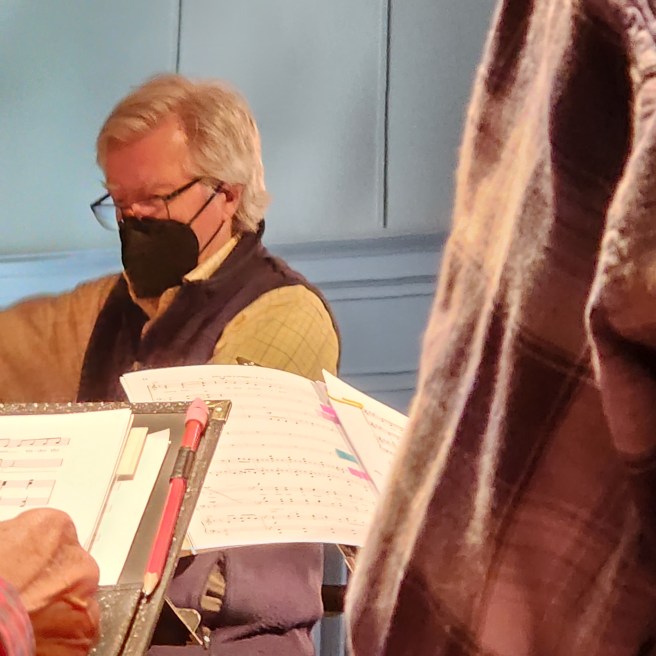
Here’s a surreptitious shot of John Newell rehearsing Quoddy Voices. We were so grateful the masks came off most of us for the actual concerts.

Quite simply, at our first in-person rehearsal post-Covid, I knew from the first two chords out of our mouths in warmup that this was home. After my first concert with the group, I especially appreciated an aside from another bass-section member, “We’re so happy to have you,” or something to that effect. It’s a much smaller chorus than my previous one, and thus more demanding.

Quoddy Voices is, of course, John’s dream and labor of love. Like my previous directors, he’s meticulous yet patient, a published composer, an excellent keyboardist, a clean conductor, and someone with fine senses of humor and delight who also genuinely cares about his singers and colleagues. (George Emlen and Megan Henderson deserve posts of their own. Note to self.)

How perfect!

But, after ten years at the helm of the chorus, he and his wife are relocating to be closer to family for much of the year.

One thing about singing together is the personal warmth people often develop. The right director can be especially admired, for many good reasons.

John will be missed, of course, and warmly remembered. Many thanks to him for all he’s given to us and the wider community.

If you want to see more of our feelings, visit the Eastport Arts Center’s Facebook site.

We do hope he’ll be back often, perhaps even singing under our next director, someone we know is also a Character in his own right.

Meanwhile, from here to September we have a gap in our Monday night schedules.

White supremacy was there all along

Maintaining a unique group identity can be perilous, no matter how necessary.

The necessity side, at its best, has to do with trying to make progress, improve justice and physical comfort, live healthier, counter the corrosive forces of status quo and lethargy, be smarter, and so on. Put it any way you want, things in general could be better, and even thinking something like that will set you apart from the status quo of broader society.

On the other hand, humans are social animals. We need others as family, friends, colleagues, cohorts. We even need them to share our stories, histories, songs, and place on this earth. Relax, right?

It’s a complex calculus, then, around the world.

What I started to see in researching my book on a Quaker community in New England, though, was a blatant arrogance within the Puritan wave of immigration. I suspect similar sides are apparent in the Spanish settlers to the south or the French to the north, or, well, back in the Old World, all the way to China. Even one tribe over another.

I’m trying to look at this clearly.

The English, of course, knew they were superior to the French, who I gather saw it the other way around. (Insert proper expletive and spit appropriately.) And they were both superior to the Spanish or Portuguese or Italians, according to this scenario.

Germans? Not really on the scene in earliest settlement in America, far as I can tell, though the Dutch of New Netherlands add their own twist.

Remember, the English also looked down on the Scots and Irish, as well as the Welsh and Cornish.

Sounds to me like the old game, King of the Hill.

The comedian Eddie Izzard has an insightful riff on this where he says it all comes down to a flag. If you have no flag, you have no claim to your country or land. So, here, I’ll stick mine in the ground and this place is mine.

That does make for a short ride on the papal Doctrine of Discovery. Look it up, if you must.

What I’ve seen in my research is how this air of superiority made equitable dealings between the Europeans and the Indigenous peoples impossible. There was no eye-to-eye even exchange. Even the concept of farming was viewed as more productive, and thus superior, than the Native hunting and gathering use of a piece of land.

Well, I could argue that God preferred a wild-game offering over grain in Cain vs. Abel, Genesis chapter 4.

You know, quality over quantity.

As for equality? We have our guns and Bibles.

Which points to another distinction: written language. I’m a writer and a reader. You expect me to not take sides here?

Still, in the New England story, the English weren’t shy about labeling the Natives as “barbarians,” “savages,” and “heathens.” Never mind many of the practices of the English and French, who not only offered bounties on scalps – Native and the other side’s European – but also indulged in the practice themselves. As for heathen? For the Puritans, with their Calvinist inclination of proclaiming themselves God’s Elect, most other Christians were also lumped in that group, perhaps at a slightly lesser degree.

Many of the consequences, however, have been tragic, for all sides.

In some theology, pride is a sin, right? Ahem. (Hopefully, in contrast to justifiable self-esteem.)

Well, as some among us might note, I’m proud to be a humble Quaker. Not that we didn’t fall into that trap of feeling superior, too.

There’s plenty of work for all to do on this issue. I’ll leave my end of the discussion at that, for now.

What revelations will turn up in Dover’s early public records?

In preparation for Dover’s 400th anniversary, dedicated volunteers have been poring over early records. In many cases, these served both the town and its tax-supported church, back to the 1600s. Many of these have been digitized and posted on the City of Dover website, but they can be very hard to read.

Even so, they’re being transcribed for release as part of this year’s big celebrations.

Moreover, in the light of scholarly advances, these hold the potential of drastically revising an understanding of our legacy.

I think it will be exciting.

I’m having fun preparing PowerPoint presentations

In general, when it comes to new tech, I’m pretty much of a neo-Luddite. I prefer to stick to the tried-and-true rather than chasing after every new twist and trying to master it before it’s obsolete by the next wave.

I still haven’t stepped up to host a Zoom session, for heaven’s sake. And we’re definitely not E-Zpass users when it comes to highway tolls, either.

Preparing visuals to accompany my public presentations related to my new book, Quaking Dover, however, has me beaming.

The first leap was in learning to connect a laptop to a slide projector – you know, so folks could watch a slide show on a big white screen or a wall.

From that experience, I realized the shots really needed to be all of one size. Some pictures I was discussing ran off the screen, while others were too small. That led to the PowerPoint format.

My initial outing with PowerPoint was with the Whittier Birthplace Museum’s virtual lecture series back in January. There, I was amazed to discover how much I could enlarge a detail from a photo without having it pixilate. Individual signatures from a Quaker marriage document, for instance, could be displayed prominently. The size of the photo in hand wasn’t an issue, either. Up we go!

I’ve been at it again, this time for presentations at the Dover Public Library on March 22 and the Pembroke (Maine) Historical Society on April 18, as well as a third in July via the Falmouth Friends Meeting on Cape Cod. All will be streamed, by the way, if you’re interested in participating. (Do mark your calendars.)

It’s getting easier with each round, and I’m learning how to easily copy a PP slide from one production to another. Yay!

Fun? I’m finding it downright exciting. Hope you do, too.

Town meeting and grassroots democracy

New England’s annual town meetings are often hailed as an epitome of participatory democracy, but I have yet to hear an examination of how they mutated from the original Congregational churches’ model of self-governance, back when the town and Puritan parish were one.

As long as voting on town affairs was limited only to males in good standing with the local congregation, up to two-thirds of a town’s households were excluded from the deliberations.

In New Hampshire, that wasn’t the case, even after Massachusetts annexed the colony. What happened then, I’ll venture, is that the Quakers and Baptists tempered the deliberations in the future Granite State in ways that eventually seeped elsewhere.

Quakers, or more formally Friends, served as a loyal opposition, one that wouldn’t take up arms in its cause but that would nonetheless hold firm to its convictions. Like the Baptists, they also believed in a separation of church and state.

The Quaker practice of conducting community business in a monthly session meant seeking unity on an issue without ever taking a vote. A vote, after all, would create a minority. Instead, when differences arose, due consideration might produce a synthesis – not a compromise. The former would be superior to either of the earlier positions. The latter would mean settling on the lowest common denominator.

Crucial to this process was the Meeting’s clerk, carefully listening to all involved.

A skillful town moderator, so I’ve heard, needs similar abilities.

I’m curious to hear how this played out in Rhode Island and on the Cape, where Friends and Baptists were also an influence.

Do note, the Puritan colonies had none of the toleration of Maryland, New Jersey, Pennsylvania, or New York to the south and west, yet they lacked the town meeting heritage.

I do want to hear more.