Anyone else remember when “long-hair music” referred to classical?
Back before rock went psychedelic?
You know, back with the Beatles?
You never know what we'll churn up in cleaning a stall
Anyone else remember when “long-hair music” referred to classical?
Back before rock went psychedelic?
You know, back with the Beatles?
“Rebellion to tyrants is obedience to God.”
Guess this falls under the commandment against worshipping false gods and gets amplified in the resistance to the many evil kings, queens, and emperors in the Biblical narrative.
As I’ve previously posted, social critic Tom Wolfe was perplexed that the hippie era didn’t produce any great novels. He’s wrong, of course, starting with Norman Gurney’s deceptively modest Divine Right’s Trip.
Reactions to earlier Red Barn posts suggested that many of the most influential books were nonfiction, including Wolfe’s own Electric Acid Kool-Aid Test but extending to Zen and the Art of Motorcycle Maintenance and the Whole Earth Catalogs and a whole lot more.
But there was notable fiction, beginning with Edward Abbey, John Nichols, and Richard Brautigan.
More recently I’ve come across ebooks at Smashwords that attempt to reflect the wide variations in experiences of the era.
One, for instance, takes a hermit’s perspective in retreating to the mountains outside Los Angeles. Another, the trials of being an activist. Yet another, the life of sex and drugs. And then there’s the spiritual trip. We even have descriptions of living the life in the deep South. You get the picture. Hippies came (and still come) in many varieties. No one size fits all, and I doubt any one novel could cover the range.
Naturally, I have my own fiction entries yet to be considered.
To get a taste of what I’ve been reading, see the book reviews at my Jnana Hodson at Smashwords page.
Got any related books to recommend?
With all of the college students furloughed home to study online, it’s hard to believe the last time American campuses shut down was springtime a half century ago. Make that the ONLY time.
It was different, though, in several key ways.
The kids weren’t told to pack up and go home. No, we stayed together rather than scattered.
The strikes came from the students and then faculty as a protest against administrators and national events, rather than orders from the top-down.
They were triggered by the slayings of unarmed students at Jackson State in Mississippi and Kent State in Ohio by police and national guardsmen. (Sorry about the pun.)
There were other factors as well.
For those who are interested, my novel Daffodil Uprising covers much of that experience.
~*~
What’s happening today reflects a much different generational divide.
We shared a dream, and our career options appeared wide-open, though they chilled greatly in an economic downturn later that spring. We felt a hippie kinship across much of the nation. And we were angry.
By the way, we weren’t burdened by tuition debt, much less one we’d likely never be able to pay off over our working lifetime.
~*~
At the moment, the generational divide I’m watching is an attitude many have that Covid-19 is just for old folks (like me) or those with preexisting conditions (like some younger people I’m worrying about). Some of them think they’re immune or won’t get truly sick. As one I overheard saying, “I’d take a coronavirus for the team.” Oh, dear.
Let’s get real. I’ll go back to that report from France, where half of the intensive care beds were occupied by people under 30.
Still, there’s much more in this generational divide that’s simply festering. We ignore it at our own peril. What’s your take?
As she asks her aunt Nita for details about the hippie era, she gets an earful. Here’s a passage that was condensed before the final version of my novel, What’s Left:
You know, peace and social activism. Environmental and ecological awareness. Racial and sexual equality. Sustainable economics. The whole spiritual revolution, including yoga and meditation. Education reform. Well, I miss the music – the fact it got lost in time. Don’t forget the health and nutrition angles, either – not just natural food and vegan. Farmers markets? We’ve certainly been participants on that front.
Weren’t there some communes around our Mount Olympus?
They’re hanging on, actually. The survivors turned into cooperative housing, where the members own their own homes but share the land. An interesting concept. Land trusts, too.
Thea Nita, you know how Theos Tito rants from time to time about the Establishment’s interference with the counterculture?
You mean, beginning with the CIA’s role in moving hard drugs into the country to undermine the peace movement? And Big Money’s work to undermine radical economics? Sure.
What do you make of it?
It’s another big book waiting to be written.
So we come back to politics?
Yes, Cassia. The nation’s divided by the fact we won’t look openly and honestly at the experience. Why should we be embarrassed by our hippie identity? Our antiwar righteousness? Our desire for liberty? There’s no real public dialogue, and that’s a disgrace.
~*~
OK, open up: Do you think the hippie generation should be embarrassed?
~*~

We were wide-eyed and innocent as doves though not wise as serpents, as the Bible would add.
We had room for exploration, certainly, and for some of us that included yoga or Zen. Hitchhiking was part of the scene, too. I touch on those in several of my novels.
I realize that in posing the question as “yogis,” I’m focusing on a corner of the hippie experience. The dream I’m thinking of is a better world for everyone, and not just a few who wanted to drop out altogether.
I don’t see that among today’s youth, who have good reason to be more cautious about the future. Besides, they’re shackled by college debt, an outrageous amount compared to their income realities.
But it’s not all economic. I’d say much of the current malaise is spiritual.
Without that element of hope and universal love, how can we possibly overcome the forces that are dividing and oppressing us?
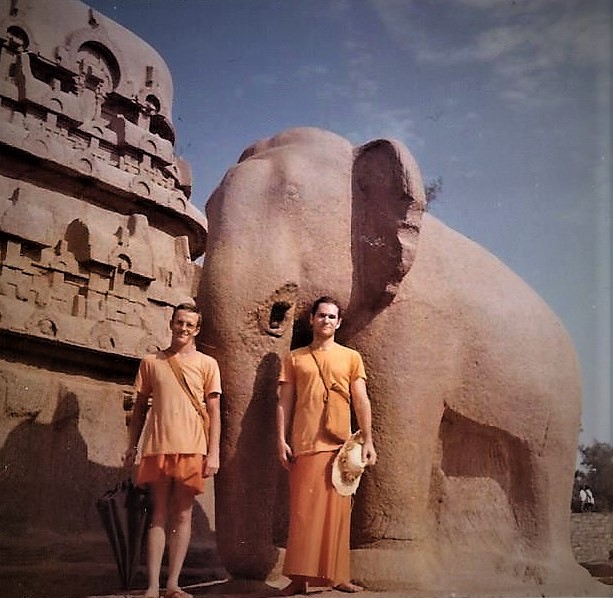
As young yogis living at the Poconos Ashram in Pennsylvania, Bhakta and Jay made a pilgrimage to India in December 1973. It was Bhakta’s first trip to the source of the religious tradition and Jay’s second. Unlike many young American and European aspirants who moved to India to study with a guru, they were teaching and practicing on a rundown farm not far from New York City. Their daily encounters in the household they shared resembled much of what I describe in my novel YOGA BOOTCAMP.
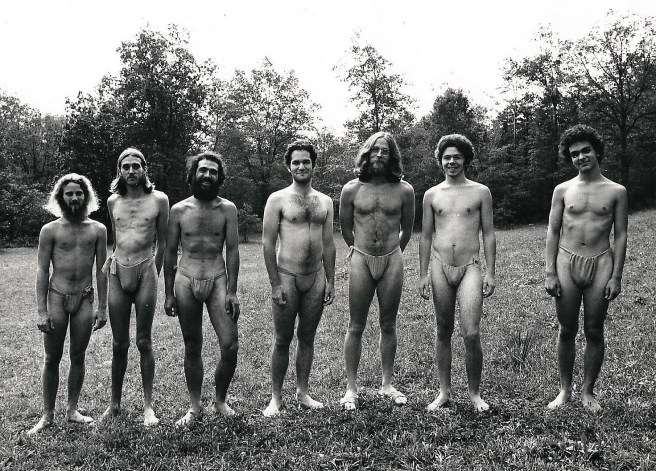
My novel YOGA BOOTCAMP describes the events of being initiated into brahmacharya and being given the two strips of cloth cut from the guru’s robe as our new underwear, supposedly to restrain our male sexual impulses. As a bit of real-life evidence, here we are at the Poconos Ashram in Pennsylvania in mid-1972. The girls found it highly amusing, especially since we were all living under celibacy.
My novel Yoga Bootcamp stirs up more curiosity. Here are ten facts.
My novel YOGA BOOTCAMP describes group meditation as a central discipline in the daily life at Big Pumpkin’s ashram. As a real-life example, here’s a photo taken at the Poconos Ashram in mid-1972. I’m struck by how young we all look and the fact that most of us could sit in a full lotus position. Makes my knees hurt just thinking of it now!

 Jnana's Red Barn