No, gardening is NOT ‘relaxing’

You’ve no doubt heard cliché quips about the stress-relieving blessings of having your own garden. I want to know, compared to what? A day at the beach or in the mountains? Kicking back with a brew on a deck overlooking the river? Listening to music or dancing? Sunbathing on your own deck? Reading a book?

Maybe you’re one of the newbies who decided the year of Covid, with its upsets to the food chain, would be a good time to lay in your first home produce. Welcome, and good luck. Now, for the learning curve.

Veteran gardeners to some degree enjoy what they do, the way any obsessive does, and the activity does provide a common topic for conversation with an in-crowd, or one that’s “in” at the moment. Otherwise, it’s usually old folks looking for some diversion.

Either way, don’t consider relaxation to be among the benefits.

Here are ten reasons gardening is going to raise your blood pressure instead.

  1. Weeds. You can never stay ahead of them, especially if you’re growing organically, which is your ethical alternative. I could do a long list of these nasty invaders alone. Weeding usually comes down to triage, depending on your available time and anger.
  2. Weather. It’s either too cold or too hot, too wet or too dry, and not just for the plants. For you, too, when you’re out there. And watering, in our city, costs a fortune.
  3. Woodchucks. They can mow down your beds overnight. Squirrels, as a subcategory, can also take quite a toll. Even our beloved birds can wipe out most of our berries.
  4. Garden slugs. We have clay soil, and the slimy (expletives) proliferate, taking bites out of everything in their path. You should see what they do to strawberries, for starters, as well as the tomatoes.
  5. Heartbreak. Something you’re really anticipating instead croaks prematurely. There’s always at least one sacrificially crop each year. Sometimes it’s a perennial that died off over the winter. Sometimes, something entirely new.
  6. Heavy harvests. Crops that survive usually roll in like a flood. How much zucchini can you eat at once? Do you really have time to home can or freeze the rest? How much can you actually give away? You bring it inside and watch it start rotting on a kitchen counter, which points back to Heartbreak.
  7. Skeeters, sunburn, and bleeding scratches. Remember, those raspberry and currant bushes have stickers, as do the roses … especially the wild roses that pop up as stubborn weeds. They’re not alone, either.
  8. Your knees and back. You’re not doing sets of hatha yoga asanas while you’re out there, often in cramped spaces where you’re trying hard not to crush the plants around you. Plus, you’re getting older. Let’s not overlook all those muscles you didn’t know you have, or the ones you wish you still did.
  9. Long lines and crowds at the nursery. Even if you order your seeds from your favorite catalogs at the beginning of January, something’s going to be out of stock. Besides, you’ll need something, maybe six-packs of a plant that died under your grow lamps or a bag of vermiculite, which means heading to the greenhouse same time everyone else is. Circling around the parking lot just trying to find a spot is a huge aggravation.
  10. Expenses. Even without factoring in the cost of your own time (I argue it’s not free), you’ll find that your produce and flowers can be pretty costly. Yeah, you’re already paying property tax, but don’t overlook that when you’re being realistic … that’s part of the reason you bought or rent a place with some ground, right? Good tools aren’t cheap, either (now where did you last see that trowel you need now or the nozzle to the hose?), and cheap tools break pretty fast. Cheap? Neither are those bags of everything from potting soil and starter mix to fertilizer and peat moss. Oh, yes, you may need to replace that hose and, while you’re at it, pick up another soaker hose to try to save on that water bill. And you’ll want rolls of plastic or bales of mulch hay or bags of bark to keep those weeds down, and skeeter spray and band-aids and more gasoline for the weed-whacker and …

All that said, before adding guilt or shame to our list, let’s return to the amazing taste of asparagus or strawberries or real tomatoes sped straight from the garden to the plate. There’s no other way to get this. We’ve really earned it.

Would the novel work with a Covid-19 twist?

One of the joys of publishing ebooks is that they can be updated easily and quickly.

So I had a flash, maybe while I was in the shower, and wondered what would happen in What’s Left if Cassia’s father died of a coronavirus complication instead of an avalanche.

It was tempting until I started realizing that it would have to be an entirely different story. She couldn’t grow up, for one thing, not unless I wanted to project that into the future, up to 30 years from now. Right now, everything just a year from now’s looking fuzzy.

And it couldn’t work with the premise of her having to go back through photo negatives – we’ve been digital too long now. As for the hippie, Buddhist, or AIDS epidemic dimensions?

The very thought, though, has me looking at some of the daily news reports through fiction-oriented lenses. Who are the villains and who are the heroes? Where do you want to set this – the White House, an intensive-care unit, a multi-generational household? What focus would you take? Would it be romance, young adult, sci-fi, fantasy, children’s?

I don’t see myself getting to this anytime soon, but good luck to any of you who feel free to tackle a Covid-19 big tale. There are certainly plenty of angles to consider.

Ten ways faith communities are being hit hard

The Covid-19 shutdowns are reminding many of us how much of religious practice involves community interaction.

Yes, personal practice is also essential – we could easily build a list of ten examples – but it blossoms and bears fruit in our interactions.

Here are ten ways those are being impacted by coronavirus.

  1. Communal worship. It’s a coming together in celebrating and compassion. For now, we’re coping with a substitute, one without the touches of shaking hands, hugging, or kissing. We’re not even in the same room.
  2. Streaming our services. Across congregations, we’re finding this to be a mixed bag. It’s definitely not the same as being together in person, but members who live at a distance or recovering from illness or suffering chronic debilitating conditions are welcoming the opportunity to be better connected again. Attendance for morning vespers or the like is also up.
  3. Pastoral visits. Hospitals, especially. Pastors, priests, ministers, rabbis, and other leaders deeply miss being able to comfort those in pain or be with those who are dying, especially.
  4. Funerals and memorial services. On hold, when family and friends could feel the support the most.
  5. Weddings. Baptisms, too?
  6. Choirs. It’s more than just making harmony together, though you do come to feel a special kinship with your fellow singers.
  7. Committees. OK, we are continuing via Zoom, maybe more than ever. But it’s more awkward, and I miss sharing the snacks.
  8. Study groups. This can be done online, but it’s less personally revealing and interactive.
  9. Church suppers and soup kitchens. There’s a reason that Jesus and the disciples are always eating in the New Testament. As one rabbi I know explains, it’s because they were Jewish. Let’s honor our connections through food, when we can.
  10. Festivals and other fundraisers. These require advance planning and working together. Again, food’s often involved and sometimes ethnic identities, too. My favorite ones feature dancing, and that leads to joining hands.

I do want to mention a renewed appreciation for the medieval tradition of anchorites, women who lived in isolation in the church tower itself and prayed unceasingly for the members’ well-being. These days, their writings seem especially meaningful.

OK, there’s no bingo on my list. What else am I missing?

And now, gardening is all the rage

In this time of social distancing and shelter-in-place, many of us would go stir crazy if we couldn’t get out for long walks. Seeing so many other people also out strolling – with or without their dogs – has been a bright side of our lives lately.

Where we live, a highlight of those treks has often come in checking out others’ gardens, landscaping, and flowerbeds. I don’t know about you who live in apartment complexes or high-rise developments, but I’m curious. Maybe something out on the deck, if you have one?

These days, I’m seeing a lot of raised garden beds going in. Fresh wood, reminding me of the time we were just getting started here. (Some of my earliest posts told of the reasons for raised beds when dealing with northern New England’s clay soils.) You’ve no doubt heard the stories of folks who have recently decided to grow their own food in the face of Covid-19.  Maybe you’re even one of them. Part of it, of course, is a concern about breakdowns in our food-supply system or even long lines just to enter the supermarket. Another might even be boredom, as in give me something new to do. From questions we’ve been getting from neighbors and passers-by, they’re really green and in for a lot of surprises, some of them harsh disappointment but a few real treats, too.

We could see this coming when some of our favorite seed catalogs announced they were running out of supplies and would not be selling to new customers; they felt it crucial to serve their longstanding commercial growers first and foremost, followed by their devoted regulars. Fair enough, that’s long-term loyalty. At least, seasoned as we are, we had our orders well in hand by mid-February.

As you know, gardening is a staple of the merry-go-round here at the Barn, but my posts aren’t the detailed advice kind for beginners – more just a taste of the experience, no pun intended. I’m hoping many of the neophytes will discover those of you who post expertly on growing and harvesting. You’re such an encouragement, truly.

Maybe we’ll get them in for the long haul, too, when it comes to things like composting (remember, those two cute bunnies you’ve been seeing featured here are big helps on that front … plus they prompt me to weed daily, just to keep them supplied in greens, which they then convert into their little composter pellets).

And, I should note, we just installed a new colony in our beehive and are anxiously waiting to see it the queen takes hold. If all goes well, our honeybees will be tending pollen in gardens in a radius of up to five miles.

Should we warn people what a few tomato plants can lead to?

Zoom? Ten takes on group meetings online

By now, you’ve probably had your fill of Zoom or GoToMeeting or Skype. (Any others I haven’t heard of?) They’ve become inescapable, it seems, and essential.

Here are ten takes from my end.

  1. We don’t look good, folks. Everybody looks older. More wrinkled. Distorted, too. (There are reasons actors use so much makeup!)
  2. We spend too much time on trying to figure out what we’re doing. It’s not just the agenda, but mostly about getting settled, figuring out who’s “here,” and tweaking our settings. It’s a real problem when we have only 40 minutes total.
  3. Tech confusion. Are you muted or not, why isn’t this or that working, that sort of thing.
  4. Remembering to cover or uncover the camera
  5. We sound wobbly. That, and all the awkward pauses and unintentional interruptions. Oh, yes, and all the ambient noise if a group is mostly unmuted.
  6. The moderator is very important. Though trying to chair a meeting and simultaneously man the controls is a bit much. We really need a “producer” for that.
  7. Selecting who’s to speak next. Do we raise a hand to the camera or press the little hand button instead? How about the Chat function? Are we unmuted? This gets difficult once the group gets bigger than a handful and the moderator has to keep scanning the panels that were offscreen.
  8. We get to “visit” in others’ homes. Often, the scene is an individual’s dining area or study, but we’ve also been outdoors on a porch and down in the cellar (which looked and sounded more like an Apollo space mission). It’s been fun seeing other sides of our friends this way, though often the lighting’s not so hot. (See Point 1.)
  9. Remembering to “attend.” Or to send the invitation out to all in time. Somehow, we’re losing track of time, even the day of the week, in this self-isolation.
  10. Doesn’t work as well on smart phones or tablets. No, you really do need a laptop, PC, or large screen for optimal control.

What stands out from your encounters?

For the first time since 1661, we won’t be gathering face-to-face

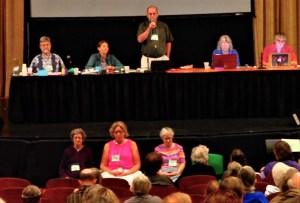
The clerks’ table in a previous year in Vermont. The presiding clerk, standing, is flanked by reading clerks and recording clerks as he attempts to summarize the “sense of the meeting” and recognize Friends in the auditorium who wish to speak to the item at hand.

The top level of governance in the Society of Friends is the yearly meeting, so-named because it gathers once a year in decision-making sessions. The constituent local congregations, in contrast, are termed monthly meetings, since they gather in business sessions once a month. (Yes, it’s confusing, since we sit together in worship at least once a week as well.) Everyone active at the local level is welcome to participate in the annual sessions.

Rather than having a single overarching yearly meeting, ours exist independently, originally on a regional basis. Something like the various strands of Eastern Orthodox, for that matter, with the Greek Orthodox and Russian Orthodox the best known of many.

Among Quakers, New England Yearly Meeting is the world’s oldest, founded in 1661, and was held in Newport, Rhode Island, until 1903. Since then we’ve gathered for a week each August on college campuses or other residential sites around the six-state region. In my time here, that’s been Hampshire in Massachusetts, Bowdoin in Maine, and Castleton in Vermont, and I’ve heard tales of the years the event was held in a camp on Lake Winnipesaukee in New Hampshire.

It’s a solemn and joyous occasion, one that many participants – and many families – schedule their work vacation time around. It’s something like a huge class reunion, too, where you reconnect with many people you hold dear. And living in a college dorm, as most of us do, it’s not uncommon to find that random pairings among those of us who go solo turn into regular roommates, year after year.

So I’m still stunned by the announcement a few weeks ago that we will not be meeting in person this summer, due to the coronavirus. Yes, we will be attempting something online, but it won’t be the same.

Among the faces and late-night conversations I’ll be missing.

Just as jarring is the more recent cancellation of summer sessions at Friends Camp in Maine. For many of our kids, it’s a highlight of their year, and friendships they form there sustain them through high school and college. As one of our neighbors says, a camper who became a counselor, the news is a bummer.

Amen.


Greetings from the bunker

Unlike many journalists, who lust after the scoop – to be hailed as the first to the punch in revealing the newest surprise in a hot ongoing drama, especially – I preferred to wait for the dust to settle a bit so we could discern the bigger picture. Yes, I was still competitive, but too often all the latest clamor struck me as confusion. What’s REALLY going on here, rather than who’s speaking the loudest or all that, is what I wanted to hear.

(Actually, with the presence of ’round-the-clock cable news and Internet connections, it’s gotten much worse. Just look at how the current resident of the White House stirs up something fresh before the outrage of his last errant lunacy can even sink in.)

The Covid-19 situation is turning into something similar. Who can keep up with the story? There are so many elements, not just the latest numbers or locations.

We’re definitely facing some ominous long-term impacts here, and we’re not getting much clarity yet.

A big exception has been voices like the Atlantic, as well as the New York Times and Washington Post.

~*~

For me, many of the biggest issues emerge around the question:

Who’s going to pay for this?

Wall Street still hasn’t factored in the debt load, unless maybe as inflation. Make that HUGE debt load and HUGE inflation, unless the wealthiest five percent of the population come to the rescue, whether they want to or not. We can look at their gains via tax cuts as longterm loans to be repaid royally now.

As a few of the clairvoyants have noted, many of the problems now emerging have been long simmering and coronavirus is merely bringing them to the fore.

Student debt loan would be one, especially if bankruptcies become widespread.

The future of retailing would be another. And the entire medical system.

The lack of antitrust action in the face of cable operators, Amazon, Walmart, and the like would be yet another.

We get glimmers here and there, but little in the way of big pictures, which are ominous.

As one voice emphasized, we do have socialization in America, but not for the people. We’ve privatized profits while socializing risks for big corporations. That’s not real capitalism. Just watch as they line up for a bailout at the public trough. Keep an eye especially on the ones laying off people and closing plants while taking the aid for themselves and their overpaid top executives. How about tying any aid to an exchange of stock placed in public trust funds, for starters?

By the way, is anyone else aghast at the Donald’s insistence on putting his signature on those relief checks, as if he’s paying out of his own pocket? Such bombast!

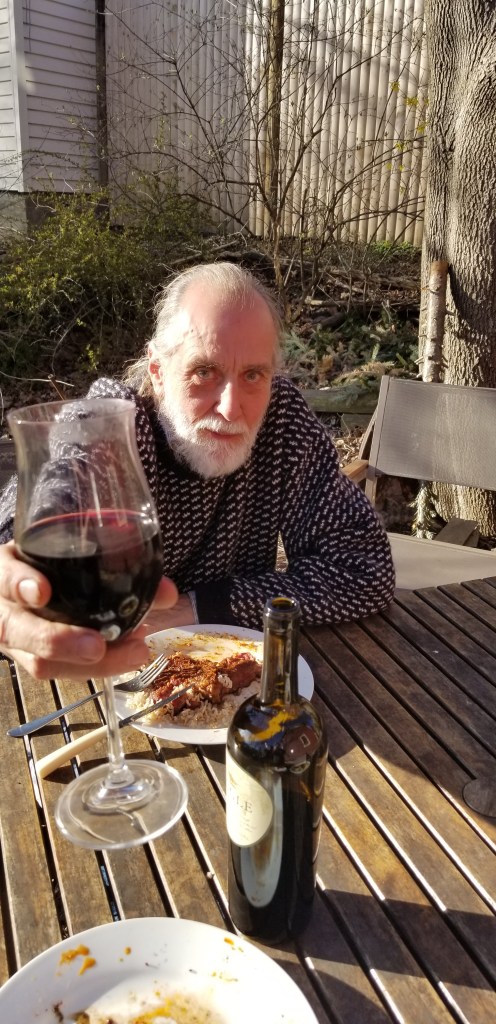
Well, we can’t go out to dine, but we can get an early start on grilling in the Smoking Garden beside the barn. Cheers!

~*~

One canary-in-the-mine-shaft question of mine asks:

How will performing arts organizations survive this shutdown?

For me, they’re essential components to society. The artists have trained all their lives for what are often marginal wages, and the supportive structures are not easily created. Rebuilding audiences will not be easy, especially in the face of damaged incomes in general. Yet they’re crucial to the fabric of civilized community.

Unlike sports, the arts don’t have huge advertising revenues. They reflect a number of similar services that make our communities better places to live, no matter how modest their seeming place in the overall scene. We need to make note of them, too, and redress the suffering.

~*~

Is anyone else watching the impact as Covid-19 spreads from the big cities into the suburbs and rural areas – that is, from urban (which also translates as black and immigrant and blue) into red-district Trump country? The virus is no longer a safe distance from “them,” or what was originally dismissed as a liberal hoax to tarnish their cult leader, and instead clearly appearing as a cruel reality. We’re back to the already fragile state of health care in rural America, for starters.

~*~

The fact is, at the rate Covid-19 cases were initially multiplying, we could have had 40 million infected people by Easter, had we not gone into quarantine. As I almost quipped back then:

How would the nation’s funeral industry cope with an extra 450,000 corpses?