Care to look at people around you carved in stone?

What would your obituary say about you? What would you say there, if asked? Before you reply, pay attention to everyday stuff and your aspirations, especially what you love. Note as well how others see you. Besides, how do you fit into your neighborhood or wider community? Feel free to exaggerate, reflecting everyone else.

As a human, you assume a cluster of identities – some of them chosen and changeable, others immutable. My grandfather, for example, proclaimed himself Dayton’s Leading Republican Plumber, invoking a host of other identities as well: Protestant, Freemason, middle-class, married. “Grandfather” wasn’t high up in his awareness, from my perspective. Being male or female or teenaged or elderly, on the other hand, are simply givens. And the history of what we’ve done or failed to do cannot be altered, except in our own perceptions and retelling.

The range of identities is astounding. They include but are not limited to race, religion, nationality and locality, occupation, family (household and near kin to genealogy itself), education and educational institutions, athletics, hobbies and interests, actions and emotions, even other individuals we admire, from actors and authors to athletes, politicians, and historic figures. They soon extend to the people we associate with – family, friends, coworkers, neighbors. And, pointedly, our phobias and possessions.

Curiously, it becomes easier to say what we are not than what we are specifically. That is, set out to define yourself in the positive and you’ll find the list rapidly dwindling, while an inexplicable core remains untouched. Turn to the oppositions, however, and the list becomes endless. I am not, for instance, a monkey. At least, most of the time.

Sometimes, moreover, a specified negative becomes truly revealing: “I am not a crook,” for instance, as the classic revelation.

Behind the masks of public life – our occupations, religious affiliations, social status, economic positions, family connections, educational accomplishments, and so on – each of us engages in another struggle, an attempt to find inner balance and direction for our own life. As we do so, we soon face a plethora of interior and exterior forces that must be reconciled. We get glimmers into this struggle – both within ourselves and within others – in statements that begin “I am” and “I am not,” as well as “I have been,” which recognizes the history and habits we accumulate and carry with us. There are also the voices – “he remembers” or “she insists” – that also recur in our lives, defining and redefining ourselves both within, as conscience or the angel or devil on our shoulders, and without, as any of a host of authority figures and friends or family members.

All that brings us around to my latest poetry collection, Hamlet: A Village of Gargoyles. There, many of the imaginary individuals profiled are identified by occupation while their confessions typically reflect the more  intimate concerns of their lives – relationships, activities, even the weather. These are, then, overheard snippets more than public proclamations.

Hamlet, of course, is a small town or a village as well as a famed play. In this collection, the inhabitants are profiled in five acts of two scenes each, plus intermissions and intermezzos. They’re even exaggerated, the way a stone carver would in creating gargoyles and grotesques.

Listen carefully – especially when others talk of their romantic problems or other troubles – and another portion of a mosaic appears. This collection of poems builds on such moments, constructing a community as a web of each its members. Sometimes, a place appears; sometimes, a contradiction; sometimes, a flavor or sound or color. Even so, in this crossfire, we may be more alike than any of us wishes to admit. We may even be more like the part we deny. Our defenses wither. Our commonality, and our essential loneliness, are revealed.

Just think.

Having originally appeared in literary journals around the globe and then as chapbooks at Thistle Finch editions, this collection of poems is now available in your choice of ebook platforms at Smashwords.com and its affiliated digital retailers. Those outlets include the Apple Store, Barnes & Noble’s Nook, Scribd, and Sony’s Kobo. You may also request the ebook from your local public library.

The move unites the poems in a single volume, rather than a series of ten smaller chapbooks and ten broadsides, and makes them available to a wider range of readers worldwide.

Welcome to town, clown.
Can a seemingly random note change known history?

Somewhere in the past I heard about a kind of public journal that wasn’t overtly personal but carefully recorded by devoted individuals. News items, witty thoughts, chance encounters, weather observations might fill them.

Recently, I came across one of those, the Record Book Kept by Daniel C. Osborne (1794-1871), Quaker and Banker. The copy was online at the Friends of Allen County’s website – the highly regarded genealogical center at the public library in Fort Wayne, Indiana.

What especially interests me is that he was a member of Dover Friends Meeting in New Hampshire. His entries provide fresh insights on the life of the congregation and the broader community, both the subjects of my book, Quaking Dover.

A record book, as this one demonstrates, is a collection of random accounts the individual found fascinating or significant. Daniel’s, for instance, has entries on the manufacture of watches in U.S., John Jacob Astor’s will and estate, the popular vote for president 1848, the wife of president Franklin Peirce president-elect, population of the states 1855, English Bible translations list, executions for murders, steam boat accidents and Atlantic Ocean steamers lost, even the royal family of England – most of those notations are on distant events – but they accompany family genealogies and other things closer to home.

Daniel, a son of Marble and Mercy (Nock/Knox) Osborne, operated an iron foundry and was later president of the Strafford Bank, now part of TD Bank. He lived in a Georgian Colonial style home his father had built adjacent to the Quaker meetinghouse, where Daniel continued as an active member while the congregation aged and declined.

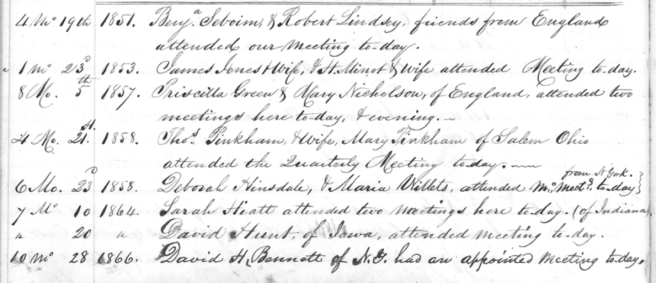
These entries note visitors from other locations to Dover Friends Meeting, perhaps all of them in traveling ministry.

Although his penmanship was impeccable, I’m not confident in my ability to decipher it clearly. Even so, I find his records filling in details I’m not sure I’d uncover otherwise. The family genealogies, for instance, have details otherwise lost from the Quaker records when an individual “married out of Meeting,” was “disowned” for other reasons, or moved from the area.

The accounts of deaths, mostly around Dover but sometimes including U.S. presidents, the Marquis de Lafayette, or soldiers at Lexington, Massachusetts, also name neighbors who weren’t Quaker. Perhaps they were even involved in business dealings with him. Notations in the margins point to a surprising number of suicides and, especially, drownings. One 53-year-old man was killed by his own father. Mention of the passing of Quaker evangelist Joseph John Gurney reflects the branch of Friends that Dover followed while that of Congregational minister Lyman Beecher indicates an openness to religious liberalism.

Notations of family marriages point to a much broader interaction of Dover Friends with fellow Quaker families in Rhode Island than I had suspected, including the Wilbur family, prominent in a schism in the yearly meeting, through no blame of their own. I’m guessing it’s because so many attended what’s now the Moses Brown School in Providence.

I wasn’t expecting this tidbit.

Of special interest to me is this notation, “10th mo 22, 1864. Israel Estes of this City, died this day, aged 64 years. He was a lineal descendant of Joseph Estes, who died in Dover Neck in 1626, coming over with Edward Hilton, in the first vessel, and had lands assigned to him as early as 1631.” If true, it would add another person – and, obviously, eventually a wife – to the settlement before the Puritan invasion that multiplied the frontier settlement now known as Dover. As the history stands now, Thomas Roberts was the only other person who arrived with Edward, and they were followed a few years later by brother William Hilton.

It would also place the origin of the surname in America at Dover rather than Massachusetts.

Well, that’s what I get in a first sweep through the record book. I suspect there’s much more to glean.

Some sterling libraries I’ve encountered

No, not the Library of Congress or Manhattan’s flagship facing Bryant Park, though I’ve been in both, or even Boston’s impressive Copley Square hub. Two of those were unable to put their hands on the volumes I was seeking and had no idea where they’d gone.

Instead, let me praise some other collections that have given me joy. Unless otherwise specified, they’re public libraries.

  1. The Lilly Library at Indiana University in Bloomington. It’s one of the premier rare book compilations in the New World, with impressive rotating displays in the front gallery and, for the more adventurous, access to original materials in the reverential reading room. Samuel Johnson’s Ramblers, John Jacob Audubon’s bird books, and Gary Snyder’s poetry broadsides are a few of the treasures my fingers and eyeballs explored there, along with a lingering fondness for African violets that graced its sills. The earliest books published and the much earlier manuscripts are often breathtakingly beautiful, even when you don’t understand the language.
  2. Indiana University graduate library. On a much bigger scale, it was a wonder, opening in my senior year. Hard to imagine just how much came into my purview there, back before the Internet, especially in regard to esoteric sides of contemporary poetry as well as the pioneering field reports from the Bureau of Ethnology in the American Far West. When I returned to campus as a research associate, I had faculty access and borrowing privileges.
  3. Dayton’s classical record collection and librarian. As a youth, I wasn’t the only one she guided to fantastic discoveries. Not just classical and opera, either. I still recall a very early Bob Dylan album that supposedly never existed.
  4. Case Western Reserve Historical Society. Sitting near the Severance Hall and the Cleveland Museum of Art om University Circle, the society’s genealogical collection is justly acclaimed and proved to be a great help when I set out to research my own roots. Much of the material was donated by the Trumbull County public library in Warren, Ohio, where I was living, and while that meant driving an hour away, I still have to admire the wisdom in assuring that the materials could be more appropriately curated and made more widely available. The local library, I should add, was solid – it even had a hardbound copy of John Kerouac’s first novel – the one before he became Jack.
  5. George Peabody Library, Baltimore. With its visually stunning ante bellum or art deco atrium (what I remember could be either), the collection itself was once part of the adjoining Peabody music conservatory. Its genealogical collection was impressive but didn’t match my areas of research. Still, it was delightful just to sit in that airy space.
  6. Binghamton, New York. There was something timelessly proper about this institution fronting a green.
  7. Fostoria, Ohio. Its straight-shooting director, Dan (if I recall right), cut back on the number of best-sellers on the racks and invested instead in paperback copies of more timeless books, which he then had turned into hardbacks. The savings in cost added up. For a small blue-collar town, 16,000 population, the collection had surprising depth. For me at the time, the range of the Tibetan Buddhist volumes was unexpected. Somehow, one donor had even presented a beautiful translucent marble wall for a big part of the front of the building.
  8. Camden, Maine. The picturesque town of 5,200 year-‘round residents triples in the summer, including a large dose of old-money wealth. The town was one of the few did not have its building donated by philanthropist Andrew Carnegie in the late 1800s. When, over time, its celebrated 1927 Colonial-style brick home demanded expansion, the result was a much larger space underground in the neighboring park. The 1996 result is quite striking and delightful, almost an homage to hobbits, in fact, with the older building still sitting like a hat overhead. As one measure of the town it serves, I’ll point to the opera section of the CD collection, much of it donated by patrons. It seems to have everything and then some.
  9. Needham, Massachusetts. The large paintings by N.C. Wyeth overlooking the tables in the periodicals room was reason enough to stop by.  He called the town home.
  10. Swarthmore College, Pennsylvania. Being able to access William Wade Hinshaw’s filing-card drawers of typed extracts from Quaker Meeting minute books is a genealogist’s dream come true, as is the ability to examine historical microfilm pages from Ireland and England without having to leave the country.

Oh, my. I could add more. The North Carolina Quaker Meeting minutes archived at Guilford College, for one. The Chester County Historical Society’s library in West Chester, Pennsylvania, for another. The community outreach in Watertown, Massachusetts, or Dover, New Hampshire, or the Peavey Memorial here in Eastport, Maine, for yet more. Meanwhile, what do we do a digital library? Consider Earlham College in Richmond, Indiana, with its online historical trove of Quaker writings presents both the original page and a readable transcription to flip among. As a researcher, it’s quite amazing to be able to read these books and tracts in the comfort of your own home rather than having to fly to London or some other distance for the only available copy.

Or complaints about some others where I’ve lived.

In my estimation, a good library is an essential component of public social vitality.

Just in time for the new political season

My series of polemic political poems – they’re not exactly protest songs, but I wouldn’t complain if they were – has moved from Thistle Finch editions to Smashwords.com, where they’re now available in a range of ebook formats, hopefully for a wider readership.

In the transition, the poems are now presented in a single volume rather than six shorter chapbooks.

These blasts of alarm and rage, 1976-2008, are an emotional mirror of events leading up to today, a not-so-distant past that’s been intensifying toward devastation. Let them stand as a call for personal honesty and engagement, too.

Take heed, if you will.

For me, this also presents the excitement of my first book release since September/October ’22, when Quaking Dover appeared. It comes with an admission that these poems are largely spontaneous, as in combustion, and sometimes sophomoric. I’ll ride with that, considering the fervor of adolescence, including ambitions.

While the poems are rooted in recent history and its headlines, they’re more pertinent than ever.

Having originally appeared as six short chapbooks, this collection is now available on your choice of ebook platforms at Smashwords.com and its affiliated digital retailers. Those outlets include the Apple Store, Barnes & Noble’s Nook, Scribd, and Sony’s Kobo. You may also request the ebook from your local public library.

Please take a look.

Reflecting on ‘people from away’

That is, PFAs, as we’re known among the locals.

I haven’t encountered the negative reaction some report, but feel myself among those warmly welcomed.

Part of it is, I believe, an openness to approach what’s here without wanting to totally “improve” it. I mean, if you can’t stand the smell of cow manure, you shouldn’t move into farm country. Or, for much of Maine, the stench of a paper mill.

That doesn’t mean we don’t have a lot to contribute, but we need to be respectful in acknowledging what’s attracted us as well as the dirty work that needs to be done. You know, the equivalent of washing dishes.

Or loving someone warts and all.

As for a film society’s choices

The Eastport Arts Center was a major factor in my decision to relocate here. Quoddy Voices is one of its constituent groups.

Another was the Northern Lights film society, which only recently resurfaced but greatly diminished after the Covid hiatus.

I’ve found its offerings invigorating and sometimes disturbing. The deep discussions that follow the showings are especially valued, even for the recent Carnival of Souls and Night of the Living Dead horror vein.

What was perplexing was that the society was essentially two people, one a veteran of its 47-year history, give or take a few seasons.

They were asking those of us who kept coming each week for our input regarding possible selections from the two vendors available to us. Learning of the licensing hurdles for presenting movies even at a nonprofit arts venue was daunting. I’ll spare you the details.

I will, though, share my response to the possibilities and the situation we’re facing.

~*~

As I wrote:

Seems to me our thinking about the film society comes down to building a larger audience. That, in turn, adds considerations of “branding” – the image the public has – as well as the types of films we air and even our geographic range of appeal.

What do we show this week that will bring people back for our next film? That is, what’s our continuity or identity? What has them awaiting the next round? Are we an “art” films circle, an awards-driven following, a sensual experience sharing group? Do our screenings enhance or compete with other arts ventures in the region?

If we’re limiting ourselves to two showings a month, let me suggest making those the second and third Sunday evenings of the month. I’m feeling there might be a “bounce” in favor of that second showing, perhaps even with some common thread for the month. Let me also push for 6 pm so more viewers from throughout Washington County can readily attend. (Note, too, the problems of getting anyone out on a Sunday night, plus the competition with the winter Sunday afternoon series at the arts center and Stage East matinees.)

My thinking is that we might get some synergy and energy that way, especially in getting the word out. The Tides comes out on the second Friday (we might have occasions when the showing falls a week before that).

Orchestras and live theater companies have long relied on season subscribers but have been finding, even a few decades before Covid, that the model was eroding. Festival programming – a cluster – has been one alternative that’s created excitement and ticket sales. I’m seeing that as something that might work with the second/third Sundays model, perhaps even giving us the option of adding a fourth Sunday for a suitable extension.

That said, we are also shaped by the collections of our two distributors.

At the first, I’m steering clear of the traditional art films for now – the Italian, French, German, Japanese, etc.

Instead, I’d look at the USA (not Hollywood, for the most part, which is the global conglomerate movie center) and three Canadian films, many of them documentaries, and at the Latin films – Mexico, Cuba, Spain, Portugal, Brazil. Viridiana stands out on that front. Washington County has a large and largely overlooked Hispanic population.

Cluster options here: Orson Welles, Robert Downey Sr., Chaplin and Harold Lloyd, silents The Freshmen, The Kid Brother, The Most Dangerous Game, and King of Kings (if we can keep a straight face), Norman Mailer, John Huston (Under the Volcano and Wise Blood).

Among the docudramas etc.: A Brief History of Time (Stephen Hawking), Burroughs: the Movie, Don’t Look Back (Dylan), For All Mankind (astronauts), Gimme Shelter, God’s Country (Louis Malle), Jimi Plays Monterey or Monterey Pop, Louie Bluie, Multiple Maniacs (John Waters), Eating Raoul (Warhol).

Titles that catch my attention: The Baron of Arizona, The Beales of Grey Gardens, Border Radio, Buena Vista Social Club, Cameraperson, Carnival of Souls, Chop Shop, Clean Shaven, Desert Hearts, Detour (possibly anchoring an international film noir survey), Dillinger Is Dead (OK, it’s Italian but still), possibly with I Shot Jesse James, Drylongso, The Honeymoon Killers, Push Cart Man, Paris Texas (yeah, it’s French), A Poem Is a Naked Person, Poto and Cabengo, Routine Pleasures, Smooth Talker, Slacker, Sweet Sweetback’s Badass Song, Symbiopsychotaxism, Twin Peaks, Thank You and Good Night, and The Watermelon Woman.

Looking way ahead, sometime it might be fun to do a festival based on Japanese Godzilla fixation.

And then, at the other: For the most part, these offerings strike me as highly commercial creations most people stream at home. Still, American audiences look for star-power rather than directors, so this might provide some extra punch for attendance. That said, some offerings to consider: Barbie, Oppenheimer, Gran Turismo, Joy Ride, Insidious, Tar, Asteroid City, Dear Evan Hansen, The Little Mermaid (with ArtsWalk), The Outfit, Samaritan, The Black Phone, and Cruella (if it’s not too Disney).

~*~

Well, we’ve had a second meeting and set a course for the next year, one that seems to be generating a buzz. We’re focusing on one boffo film a month, with both a matinee and evening showing, and tying the offerings into other events happening in town, when possible.

The first one is indeed Barbie on the Thanksgiving weekend.

Asking us singers for our suggestions was a bit unnerving

One of the unanticipated developments in my life after I retired from the newsroom was that I became an amateur choral singer, first as a charter member of Revels Singers in Boston and now with the much smaller but no less excellent Quoddy Voices.

In that, I’ve been blessed to work under four incredible music directors and also experience a few other fine conductors, each bringing something unique to the enterprise.

Still, the newest vocal maestro is truly one of a kind, yet still of the highest standards.

When he stepped up to the task in September, he handed out stacks of sheet music from four or five different sources, a very wide range of repertoire, maybe 30 pieces in all.

We set about sight-reading these, and I found myself getting teary as I recalled earlier experiences. Leadbelly’s “Bring Me a Little Water, Sylvie” was a staple of the Boston Revels’ autumn equinox Riversing along the Charles River, and backing up our teens’ choreographed routines was always exciting. “Wild Mountain Thyme” always ended the spring equinox concert, with David Coffin leading the audience gathered into a large circle, holding hands. “All God’s Critters (Place in the Choir)” raised many other memories, especially of Quaker children but also with the composer himself, who lived just outside Dover. And then there was Sweelinck’s joyous “Hodie,” my introduction to polyphony at the opening of the second classical concert I ever attended, the Roger Wagner Chorale around 1960. Never, ever, would I have imagined actually singing that – well, not until the past few years.

~*~

While I’m relatively new to being a member of a musical ensemble, I can say it’s a remarkable identity to assume. We expect to be followers, even with our own grumbling in the back row.

And that’s where Gene threw us a curve ball this fall. He wanted our opinion in what pieces we want to do, including those on our upcoming holidays concerts.

As others said, “The conductor’s always come in with the the pieces and said this is what we’re going to perform. Let’s get started.” To which, in our new situation, they added they were feeling a bit disoriented and perhaps even dismayed.

Well, he did want us to rate the pieces before us, something like a homework assignment, so here’s what I added to my ratings sheet:

“I’m guessing that many of the others will be leaning toward pop/rock songs they’re familiar with and find fun. As you see, I lean the other way, looking for pieces that stretch me to explore and achieve more. Looking at scores from the bass line is a fresh perspective. The tenors and ladies typically get most of the action while we’re stuck in the basement. (No pun intended.) Or even sidelines. I don’t mind holding a drone note in modal music, including Eastern Orthodox services, but what I’ve seen in the pop/rock harmonies seems pretty rote, uninventive, or shallow with little to hold my continued interest, especially if we were to do some deep rehearsal.

“On the other hand, doing one-time run throughs, perhaps with an audience, could be a fun community event, our own version of a pops concert. Summertime, even?

“Or even a hymn sing?

“Still, you asked, and thanks for that. And you’d still get my vote if we were selecting a music director. (My, that was an experience with my previous choir down in Boston.)”

~*~

I am happy to report that the Renaissance and other classical repertoire that I favor came in at the top of the stack, but there’s also a healthy blend outside of my usual comfort zone. The process did cut into our concert preparation time, but I’m confident we’ll catch up.

This really is a fun group to be part of, and that runs top to bottom and back up. I’d say things are percolating.