Ready for a few recent thoughts arising from all of our teleconferencing (trademark?)?

(By the way, I’m wondering if that “?)?” is a first in the English language.) (Along with opening a writing in a parenthetical mark.)

To the point: After all of this time Zooming, specifically, I’ve finally found a visual background that works for me, almost a stage setting.

In our new old house, my workstation is in what’s also my bedroom rather than somewhere up in an attic. In common with many New England homes, there’s no closet, so when the laptop’s camera is in its usual, sharp focus, my hanging clothes are in full view.

How embarrassing. Or candid. At least I’m not naked, in all my senior-citizen glory.

I’ve played with several photographic backgrounds as alternatives, but they do use up valuable bandwidth, sometimes even interfering with the signal or pixilating my face, and they get wonky if I so much as twitch.

Moving myself and the said laptop to another room gets complicated, especially when I need to reach for a book or paper (back in the earlier room) for reference. New lighting conditions are an additional consideration.

Do we all need a stage manager or producer or even a dramaturge working on our behalf, much less sound engineers? I hope not!

So the solution, where low-tech me is? Voila! Or amazement. I chanced upon the “blurred background” option on the Zoom toolbar and like it. In fact, it can even look dramatic, keeping the focus on (drumroll, please) me. Maybe I’ll keep it.

~*~

As long as we’re on the subject of Zoom, does anyone else find conversation or dialogue unnatural and awkward? There’s hesitation when we’d simply join in and then jump out contrasting to talking over each other because we have no eye contact or other non-verbal cues regarding each other. There are times I’m sure I come off cold simply because I’m stepping back to listen yet other times I no doubt seem rude piping up the same moment others do, like drivers all trying to enter an intersection at the same moment.

By the way, I do think our faces are appearing in a less harsh light than we did earlier in this transition.

For a while, it seemed we were all at less ten years older, children excluded. We looked ghastly.

~*~

I’m also discovering there are many people I recognize more by the sound of their voice than by their faces. Maybe it’s a consequence of joining a new community in the age of Covid, but there is a world of difference between individuals unmasked on my computer screen and masked (or not) somewhere out in public, often miles out of context.

How has your Zooming changed? Any advice to share? Or off-the-wall particulars?

Post Office and old Customs House

Anchoring one end of Eastport’s main street downtown is the Post Office and former Customs House.

Though the Customs role has moved closer to the Breakwater but not so the mail, especially this time of year..

The building still bespeaks of a special authority and order.
From the water, it’s a landmark.
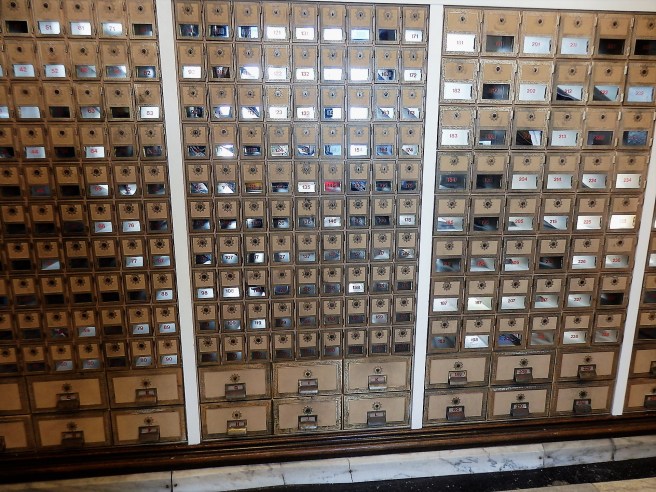
And inside, the post boxes are pure vintage.
As is the staircase up the tower.


Dealing with the off-season in a tourist town

Come the first touch of chill here, and three-quarters of the population begins to vanish. Those folks quietly pack up and return to their primary residence, as have the many tourists. It rather reminds me of living in a college town, but in reverse.

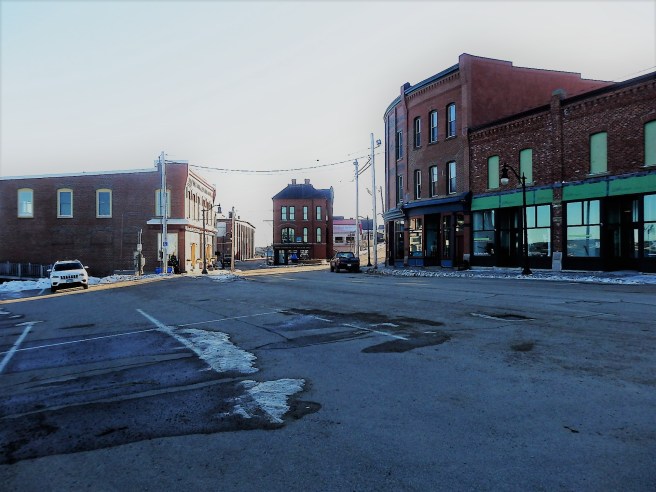
Downtown Eastport in the off-season. The Tides Institute and Museum sits in the old bank building in the center of the scene.

The waterfront and downtown are no longer crowded and festive. Many of the stores, galleries, and eateries are closed up, as are the whale watch, water taxi, and passenger ferry to Lubec. By Halloween, roughly two stores, a diner and a restaurant plus a gallery or two remain open downtown, plus the IGA, two banks, and Family Dollar over on Washington Street.

It makes for a challenging business model, trying to pay the rent and all on a four-month retail prime time. Here the highly watched Black Friday, the make-it-or-break-it financial hurdle of American retailing, doesn’t wait till the day after Thanksgiving but probably hits sometime around the beginning of August.

I have to admire the entrepreneurs who manage it anyway, especially those who stay open through the slim volume of the two-thirds of the year when Eastport’s remote fishing village nature is most prominent.

It also means a lot of do-it-yourself involvement. If you want to see movies, you join the film society. Music? Pitch in with the choir or orchestra. Theater? You guessed it. Dining out? One of the neighboring towns must be having a church supper. Seriously.

And you turn out for others.

Yes, it means more work than just sitting on the sidelines, and with a small population, keeping things going can be a struggle.

But one thing I’ve noticed. It doesn’t take long to be appreciated when you take part.


What happens when a journalist attempts a novel

It used to be said that every newspaperman had a novel inside him, waiting for release. (Yes, male. Women reporters and editors were a definite minority. My, how times have changed!)

Frankly, I rarely saw any literary ambition around me. Few in the business read fiction of a serious sort, much less poetry. There were, though, a couple of playwrights. More recently, however, I know of two colleagues who have self-published – one a mystery, the other a political intrigue.

Yes, we’ve had notable exceptions, with Edna Buchanan, Ernest Hebert, Carl Hiassen, and Tony Hillerman topping my list. (Hemingway wasn’t considered much of a reporter in his six-month stint in Kansas City, and earlier giants often cited reflect a much different kind of journalism than what’s been practiced from the rise of the last century.) The crush of daily deadlines is exhausting, and fiction requires an entirely different approach and sensibility to the telling of a story. Journalists are conditioned to put facts first, usually without any concern for feeling, and to be professionally neutral, reflecting the quest of objectivity. These stances place the reporter at a distance from the subject, no matter how fascinating. Journalists also tend to put action ahead of the actors. Most of the resulting novels leaned toward the crusading reformer slant of the Front Page tradition – Down with corruption! – or maybe sports, either way, with the emphasis on the game more than the inner mindset of the players.

Well, there was also one editor-in-chief who took a popular genre novel and did a paint-by-numbers kind of rewrite over it. I think it was a Western, but I’m no longer sure. His connections got it published, and his success led to a half-dozen more. He was sheepish about the whole thing, though. It was more like a game, I suppose.

I wasn’t typical. My first love was the fine arts beat, for one thing. Since jobs there were scarce, I wound up on the copy desk. No matter how much I love politics, I find meetings boring. Press conferences, even more so. My most satisfying post was heading up lifestyles sections. Long story, as you’ll see in Hometown News. Maybe I was mostly a misfit who happened to do some things extremely well.

News writing, for the most part, is supposed to sound anonymous. Short sentences, limited vocabulary, a structure with the most important details at the top and the rest in descending order. As a writer or editor, your craft can soon become dulled. As an editor, one of my skills went to headlines, trying to relate a story in as few as four or five words. I’ve written hundreds of thousands of them, and I can see the distillation as an element of poetry. In my personal writing, I often reacted against the broader restrictions – I wanted a richer range of diction, more accurate language, more varied sentence structure (yes, I love long threads that work), and often more background on the story itself.

Turning to fiction, I’ve learned the importance of withholding details until later in the tale, things like not including first name, middle initial, and last name when introducing a character, much less his or her age and address. As for my poetry, I’ve preferred experimental and edgy, where the image or fractured expression might open into its own ambiguity and potential.

I do remember the first time a poetry publisher reacted to my submission by saying how delighted he was that my work wasn’t what he expected from a journalist. He had received enough to develop a negative opinion, one I fortunately didn’t fit.

My novel “Hometown News” was drafted during my third break from the news biz, when I was approaching 40 and gave myself a sabbatical after two years calling on editors in 14 Northeastern states as field salesman for a major newspaper syndicate. Driving between my calls on the local papers and seeing their newsrooms from the other side of the desk, so to speak, gave me plenty of time to reflect on the industry and then augment what I had collected in my own career. At many papers, as I saw, the managing editor or his equivalent was gone in a year, and with each one, I’d have to start grooming a new connection all over again. Many of them had telling histories of their own. Many of their towns looked like bombed out shells after World War II, their industrial might boarded up or rusting. I kept notes. Many of their skirmishes reflected my own.

Later, developing my novel in a series of routine days set months apart, “Hometown News” gave me an opportunity to see what I could do with creating a computer-generated novel. I set a framework for the day and randomly inserted 80 to 120 markers I could hit with search-and-replace items for each round. There were many other places that had to be manipulated manually, but it the attempt was fascinating, the way working a thousand-piece jigsaw puzzle is.

The result was something like a Jackson Pollock painting, a theme-and-variations curiosity but not compelling reading. Through a series of revisions, I kept the bones but layer by layer added flesh and muscle to bring certain characters to the fore while the dystopian theme deepened.

Thirty-four years after starting out on the work, and seven years after its publication, I am struck by the story’s prescient warning of the collapse of a once very profitable business for the dominant voices, not that our salaries reflected that. What I saw was entire communities under attack, and they still are – not just their daily mirror.

The newsroom I present is a blend of five I’ve worked in over the years – another one was much smaller, and the remaining one was simply different. When you get a group of news folk together and we start talking what one spouse called Bodoni-Bodoni, after the typeface used for many headlines, we all have insider war stories. I hope “Hometown News” gives you an idea how ours translate.

Ring around the Shead gym

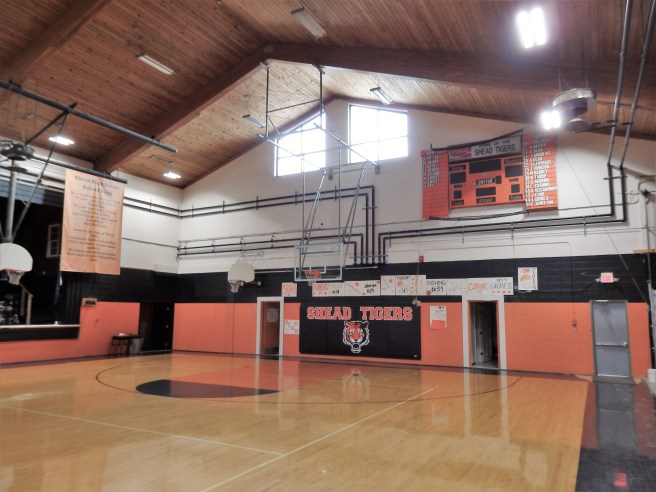
I used to joke that I swam laps to keep my doctor happy, but that ended with the outbreak of Covid. And then I moved to the remote fishing village, one without even an outdoor pool, and, in a routine checkup, my new doctor expressed concern about my blood pressure readings. On reflection, I realized I wasn’t getting enough physical exercise. I wasn’t even climbing stairs the way I was in the old place. And then I learned that the local high school gym is open to walkers on weekday mornings through winter. Voila! I’m now joking that I walk the black track around the gym floor to keep my doctor happy.

Why walk around the mall, even if we had one?

Better yet, there’s a rumor that we seniors are even going to get some exercise machines here, once the basketball season’s over. Remember, nearly half of the school’s enrollment is on the boys’ and girls’ teams.

How many other high schools are that inclusive?

By the way, keep this up, we just might start referring to the place as the Shead Seniors and Senior High School. Those kids should be honored.


Come on down to where the town really connects

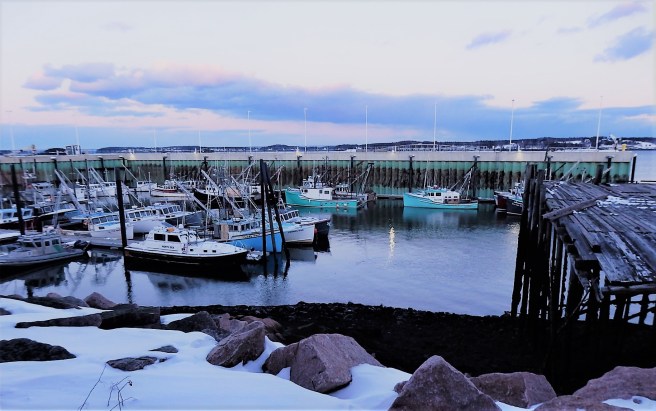
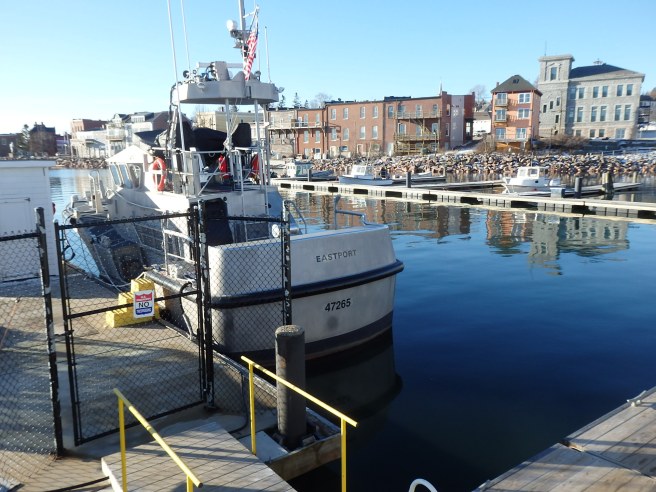
Locally, it’s known as the Breakwater, rather than the town pier or wharf or dock or safe harbor. And it’s the heart of Eastport, the centerpiece and focal point, as well as the home of the commercial fishing fleet and U.S. Coast Guard station.

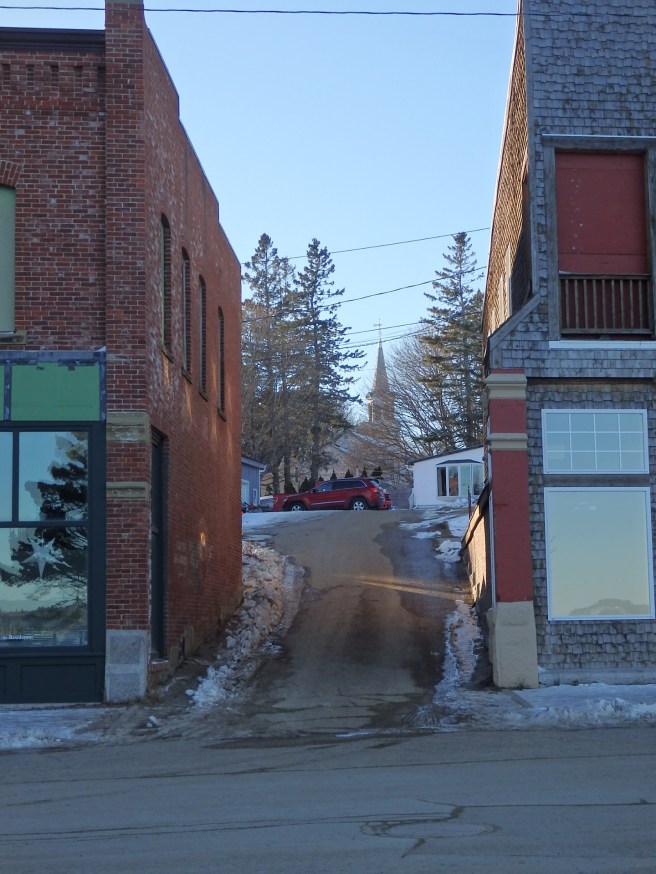
It’s snuggled up right next to our small, struggling, and potentially quaint downtown. Here’s how it looks from the walkway this time of year.

It even broke down and collapsed in the winter of 2014, taking a few fishing boats with it.

Rebuilding was another matter. Officially, it reopened in September 2017, though details may have been completed later. The versions differ, up to “two winters before last.”

Eastport has the deepest natural harbor in the continental United States and is said to have rivaled New York’s in shipping at one point. I’ve seen photos of a cruise ship tied up here, and it truly overwhelmed the dock and town in its size.

The waterfront has – and had – other piers, with pilings that can still be seen – the old vaudevillian appearing steamship dock, for one, or the more recently gone Northeast Marina and Fuel Depot, as prominent examples. And, yes, definitely, what was once the world’s largest sardine cannery, as well as a solitary brick shell from the era still standing over the water with some folks hoping for a redevelopment before it caves in.

Significantly, there is the Cargo Terminal, our industrial shipping complex at Estes Head just around the bend. It has both high security and tractor-trailer traffic, so you don’t stroll around there.

Still, the breakwater at the end of Sullivan Street beckons us, even with its seemingly perilous heights above the water at low tide.

And here’s how downtown looks from the Breakwater.

A ‘mild case’ can still be the sickest you’ve ever felt

Here we are, coming up on the second anniversary of the Covid outbreak here and abroad, and we’re still in the midst of its disorder. So much for that initial hope of a two-week or six-week lockdown, max, which even then unfortunately had too many holdouts from the precautions. Can we blame them for leaving the Pandora’s box open for all that’s followed?

Once that first round passed, after its devastation in large urban areas like New York City, we had a breather in which medical procedures were more clearly understood and improved and vaccines became available. We’ve even been able to gather in public again, albeit in fewer numbers and spaced apart while still wearing masks. Surface contamination is no longer a major worry, either.

Where I live, the illness has often seemed to be a distant threat. While I have friends who came out of retirement to resume long hours as medical professionals, their tales of a stress still seemed confined to largely quarantined hospitals and clinics, even though they were only just down the street. Well, I also got updates from fellow clergy who couldn’t visit patients in person, that sort of thing. Still, two years later, I knew of only two cases in our Friends Meeting, both quite mild. Further east, in remote Washington County, Maine, fewer than 3,000 cases and 43 deaths have been tallied, last I looked, though those figures have nearly tripled since November.

Still, the threat kept getting closer and more personal. The surge in the Omicron variant forced the cancellation of the final Christmas performances of our beloved Boston Revels, for example. Traditionally low-rate New Hampshire recently reported the highest per capita figures in the nation. Our twice-a-month local newspaper’s half-dozen or so obituaries now regularly mention “of Covid complications” as the cause of death. (Nobody, presumably, dies directly of the infection or is at least willing to admit that openly. Am I guessing there’s a social stigma?)

We have endured the screeching dissent and violent reactions from those who feel entitled to do whatever they want in public, regardless of any harm to others, and that seems to be spiking.

How long, though, will it take for the emotional frustration of the other side to erupt?

For starters, there’s a growing weariness among those of us who have been wearing masks and getting our booster shots, in part to protect others from suffering from the illness, while enduring the arrogance of those who pooh-pooh the odds, putting their own “liberty” above the common good, and then putting the rest of the populace at risk while expecting overworked medical professionals to come to their rescue and forcing heart attack patients and crash victims to be juggled about for unavailable intensive-care beds.

Look, I know Christian Scientists who have gotten the shots, not for themselves – remember, they generally avoid doctors as a matter of their faith – but out of a sense of social responsibility for others. In contrast, I’m sensing that many of those who refuse vaccinations are also among those accusing lower-income Americans of “entitlement” when it comes to economic and social support, rather than turning the focus to the One Percent who actually benefit financially from overt entitlement in public legislation and regulation. Are these the same ones who scoff at widespread examples of global warming and impending disaster? The willful ignorance, selfish, self-centered behavior, and bullying outrage me. And before they quote – or misquote – Scripture for their positions, I can imagine them refusing Moses’ orders to paint lambs’ blood above their doors for protection from the Angel of Death – “Who are you to tell me what to do?” – but it’s the firstborn who suffer if they don’t. Drat! I can confess a vindictive urge – you know, of the smite-my-enemies vein – but revisiting the Exodus text, I’m seeing that in only one of the first nine plagues are the Israelites exempted from the evil consequences. Pointedly, all Egyptians, not just the pagans, suffer from Pharaoh’s refusal to act in accord with Divine direction.

No matter what, in the end, reality will win out, though it won’t be selective in choosing its victims.

What happens if this affliction spreads to strike down all who haven’t been vaxxed? Costly treatments that could have been avoided will be borne by all, regardless, through Medicare, insurance companies, and unpaid debts to hospitals, more than by the defiant unvaxxed ill and dying. The workforce will continue to be impacted, too.

The Omicron variant, as we’re seeing, is also hitting vaccinated people, but with lesser impact.

We look at the statistics and hear the stories that the new variety is less deadly but more infectious, along with the note that breakthrough cases among the vaxxed hit far more gently than among the unprotected, but we need to listen more closely.

Unless a patient is in need of a respirator, the diagnosis is to stay home, there’s no room at the hospital. Good luck if you’re living alone, and good luck to the rest of the household if you’re not.

Moreover, it’s considered a mild case unless you’re hospitalized or die.

As for those “mild” cases? More than one person has been quoted as saying they’ve never felt so sick in their life.

So far, I’ve been lucky, but my family’s finally been hit, notably in their recent visit to me. My test and my wife’s came back negative, but not so for the rest, despite all their precautions.

Would coming down sick be a sufficient lesson for the nay-sayers? Or would it make them dig in more deeply in denial?    


Why we’re all waiting for the border to Canada to really reopen

Having to wait 72 hours for a Covid test result – but don’t you dare delay much longer – as well as the other current restrictions have meant that the U.S.-Canada border really isn’t open, not the way it was before the coronavirus outbreak.

That’s made for a hard burden where I now live. New Brunswick is very much a part of our community. Just about every long-established family has kin on the other side of the boundary. For almost everyone, it’s meant jobs or services or shopping or even cultural pursuits. There are good reasons our local newspaper covers the two adjoining counties, which share the tidal waters and weather. The virus constraints have devastated the economy of the small city of Calais, to our north, which usually carries heavy truck traffic between the two countries as well as local business at groceries, hardware stores, and other retailers and restaurants; likewise for the town of Lubec, to our south, which has the only bridge connection for Campobello Island. Many folks also have property on the other side of the line, or maybe their boat, or even dear ones buried in cemeteries, and are cut off. You go to the dentist and realize the radio is tuned to a Canadian station, that sort of thing. It’s not all one way, either. I would be back to swimming laps in the nearest indoor pool, for instance, only 45 minutes or so distant. The nearest Costco would be only an hour-and-a-half drive off, rather than eight or nine down around Boston. We’d have some fine dining options available, so I’ve been told, as well as museums and nightlife and even festivals.

The local Passamaquoddy population has long been torn by the international division, especially the differing laws regarding Indigenous peoples. I’ve also heard how the already tightening border regulations have changed other interactions. Guys my age have told me about dating girls on the other side of the water (way back then we were all teens), rowing over to court them and then returning (merrily), something nobody could do today without being detained by the Coast Guard, Customs officials, and who knows else. (Not so merrily.)

It’s also dampened summer tourism, especially by travelers who were hoping  to continue on but couldn’t, or by Canadians who usually boost the crowds at our week-long Fourth of July revels and Pirate Festival weekend.

For me, this has been a lesson in the ways seemingly arcane regulations made in distant places can hit home personally. You know, the kind of thing you might glance over in a news story with a shrug, as I would, not anticipating a trip to Europe or a Caribbean cruise or even a cross-country flight anytime soon.

What unexpected ways have you experienced Covid restrictions?   

Reasons to like Watertown, Mass.

Greater Boston is comprised of many suburbs that were originally Colonial towns out in the country. As a result, much of the metropolitan area today retains a village feel in addition to its cosmopolitan chic.

Each town – or, in many cases, now city – is different, however subtly.

Let me illustrate with Watertown, where my choir rehearses.

  1. It’s on the Charles River, which once powered its paper mills and other factories. Today the river has lovely parks and pathways, as well as crewing teams practicing out on the water in season.
  2. The impressive Arsenal produced military armaments from 1816 through World War II. Today it’s a shopping district, and its restored antebellum commander’s mansion is a kind of museum.
  3. Settled in 1630, Watertown soon became the seat of the Whitney family of invention, investment, and horse-breeding fame.
  4. It’s largely overshadowed by neighboring Cambridge and the Harvard crowd. The famed Mount Vernon Cemetery, the first garden style burying ground in America, 1831, is usually thought of as being in Cambridge, when it fact it lies mostly in Watertown, with a who’s who of famous Americans buried in its rolling grounds.
  5. Watertown has a wide ethnic range of residents, mostly working class or professionals.
  6. The Armenian Library and Museum of America is well worth visiting for exhibits that acknowledge many genocides beyond their own. Watertown is the third largest center of the Armenian diaspora in the United States, surpassed by only two cities in California.
  7. When it comes to cheap eats, I think it definitely beats hipper Cambridge. Some of the best Chinese I’ve ever had was in a modest storefront in Watertown Square, and I’m really sold on the Iranian takeout just up the street. But we also like Wild Willy’s.
  8. The Perkins School for the Blind, founded in 1829, is the oldest such institution in the U.S. and is world famous. It manufactures its own machine to record text in braille. It moved to Watertown in 1912.
  9. I really like the public library, which even has its own coffee shop.
  10. The Gore Place is an opulent summer home built by a man who a fortune in speculating in Revolutionary War debt.