Where creativity and community meet

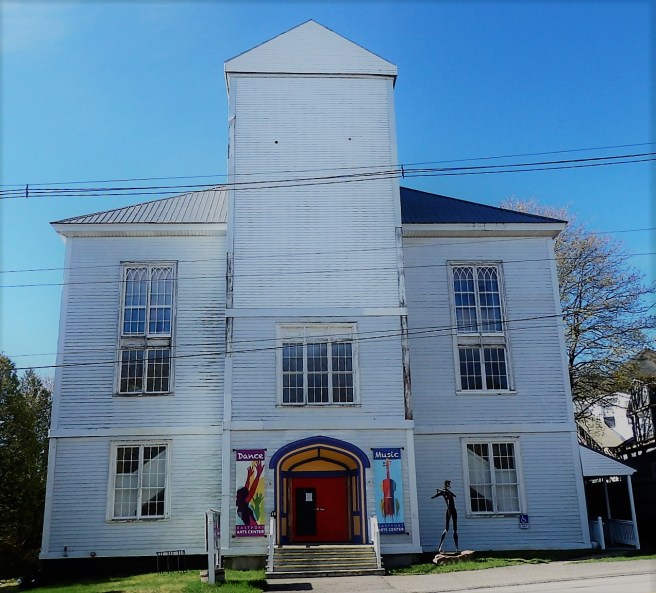
That’s the slogan of the Eastport Arts Center, housed in the 1837 Washington Street Baptist church after that congregation moved up the road and renamed itself Cornerstone Baptist in 2005.

Eastport Arts Center, Washington Street.

Only two blocks from the waterfront downtown, the center is the home of the Stage East theater company, Northern Lights Film Society (how I’m awaiting its reawakening from its Covid hiatus), Quoddy Voices, Passamaquoddy Bay Symphony, a series of visiting musicians in many genres, lectures of all stripes, and even yoga and New England contradances. Its activities range from performances and rehearsals to exhibitions and workshops, physical fitness and dance, open mics and communal meals. It’s also available for rental.

Upstairs features a 106-seat theater/concert hall, while downstairs has an open community gathering space, gallery, and commercial kitchen.

The venture itself was spearheaded by the eight artists who cofounded the Eastport Gallery on Water Street, which by 1990 had become a hub and magnet for creative spirits in town. The gallery remains a constituent organization member of the center.

I’m especially glad it’s all just a short walk from my doorstep.

Quite simply, I see it as the heart of the community, something that makes Eastport unique. Recent Sunday afternoons have hosted a delightful cycle of music, discussions of visual arts and local businesses, historical insights, and even free mustard.

Across the country, one institution often dominates the culture life of the wider community. In Cincinnati or Cleveland, for instance, I’d say it was the symphony orchestra.

In New Hampshire, was the New Hampshire Symphony, before its demise, or the Currier Gallery of Art.

What’s the biggest cultural influence where you live?

Just made my unanticipated theater debut

Eastport may be small, but its lively arts scene includes the Stage East company, with some rather lively programming.

At the moment, for example, they’re preparing a world-premiere musical for performances next month.

It’s the kind of place where you quickly get to know half of the town, too, so I wasn’t surprised to get an email from the director Thursday morning, even if its contents were unexpected. Could I participate in a play reading that evening and the next two nights?

An original work, the winner of the company’s inaugural playwriting competition?

I’d never done anything like that before, but in a pitch-in kind of community like ours, you learn to step up when asked, and so I replied fine. Honestly, I felt honored, and it couldn’t be too different from a poetry reading, right?

The initial reading was fun, both times through the one-act play. Better yet, my part was the shortest of the four and the least complicated. And then I learned we’d be doing it in front of a live audience the next night, meaning last night, and again tonight.

The playwright is Wilder Fray Short, a Bowdoin College senior and soccer fan, and the one-act play is In the 45th, about sibling rivalry and a lot more.

The competition, open to young full-time Maine residents and including a week-long residency and $1,000 prize, itself honors the late Jay Skriletz, the company founder, prolific playwright, and believer in social change.

To which I’ll add, it was an amazing experience and if you’re anywhere nearby, show up tonight!

Mortality and the passage of time

Realizing I really did need to get some regular physical exercise last winter, I finally caved in and ventured into the senior center for fitness class twice a week. It took three friends to nudge me into it, and it’s embarrassing to have to admit what 50 years of neglect have done to my body. I’m a long way from my yoga glory. Well, I’m also the only male in the circle, not that it inhibits the lively, enlightening, and laughter-riddled banter that occurs while we’re plodding through the routine. Their hour-plus dialogue could fill a hit sit-com or bestseller novel, if only I could find a plot. Well, much of the running commentary there is also about ailments afflicting folks in the community, sometimes leading to offering rides to their specialists or food deliveries – what I’ll call “good gossip.” And, oh yes, I much prefer to refer to the place as the Old Firehouse, skirting around the stigma of “senior center.”

That has me recalling an aside years ago when our managing editor told of a phone call he’d received from a reader complaining about being referred to as elderly.

“How old are you,” my boss asked and was told 78. “I see,” was the best he could respond with.

After that, I always struck “elderly” from news copy, along with “little” from child or kid.

Getting older is a multistage passage, most notably with the skin and stiffening joints, but the physical changes are only part of the experience.

One part is an awareness of being on borrowed time. Even when I was editing obituaries, I noted how many of the deceased were younger than me, and that was a little more than ten years ago.

Moving around the country has lessened some of the impact of aging, since I haven’t had to watch us grow older together. My high school classmates, for instance, will always never be more than 18 in my mind. Ditto for others left behind, they’re all frozen in time, even the few who are still in correspondence.

So another part is hearing that more of these colleagues of my generation are passing – a situation akin to personally knowing more people who have had been diagnosed with Covid and the recognition that it’s not just multiplying “out there” somewhere – that is, knowing only the abstract – but close at hand.

I recently posted two memorial minutes of Friends I worked with clerking Dover Meeting and have been reflecting on others in my Quaker circles.

Now I get word of the passing of an esteemed reporter who was six years younger than me, and somehow it hits more than those from the workplace who died earlier. To my surprise, it has nothing to do with how close we were in our daily interactions. (He and I weren’t, apart from a comment or two in passing. I should note that he produced “clean copy,” requiring little editing, and that meant little interpersonal friction.)

In his case, I think the blow comes as a sense of an end of an era. He carried institutional weight in covering the New Hampshire’s political scene and soared nationally during the first-in-the-nation presidential primary. With the decline of newspapers in general, his replacement at the statewide Union Leader will never achieve such prominence or influence.

Deer are everywhere in this city

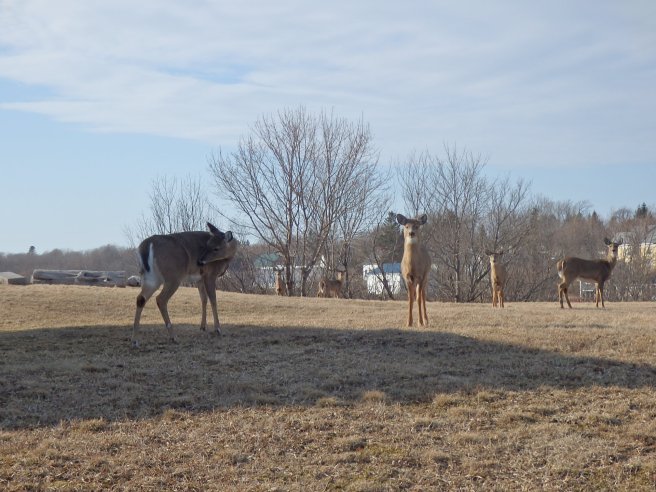
Eastport is a city, after all, and many of the homes are packed in close together. Not that it matters to our local wildlife.

Here’s one in our driveway.
And crossing over to our neighbors.
They frequent a large lawn overlooking Shackford Cove and the sea.
This yard’s only a few blocks from downtown.
And these critters are just a block from the Breakwater.

They’re so much a part of the place they even have their own Facebook page, Deer Eastport, and it is very active.

No matter how cute, though, they’re a gardening challenge. As are the raccoons.


Be among the first to read my new book … for free!

If you’re a reader of ebooks and fascinated by history, I’d love for you to get an advance copy of my new book, Quaking Dover.

In fact, as a follower of this blog, you’re getting a limited-time invitation to pick up a copy of the book for free.

Check it out at Smashwords and its associated digital ebook retailers.

All you have to do is speak up in the comments section of this post, and assuming that your address includes an email (visible only to me) or other contact info, I’ll send you a coupon to download the book in the digital format of your choice within the next 30 days.

It’s one of the advantages of ebook publication at Smashwords.com.

In the world of commercial book publishing, a printed edition typically appears in an Advanced Reading Copy run that allows reviewers, bookstore dealers, and other insiders a chance to hop on before the official publication. In the meantime, the author and editor have time to make fixes and set the stage for an auspicious opening day, one boosted by the buzz of the ARC readers.

So what I’m doing is the equivalent for a digital edition.

The release date on this book isn’t until September 8, but folks who preorder now can get in the front of the line at half-price. That strategy is one step for boosting the book in the crucial first-week sales algorithm.

Today’s offer, however, gives you a chance to own a copy now. In a way, you’ll even be getting involved with the preparations for the tiny city’s upcoming 400th anniversary.

My hope, of course, is that you’ll be excited by my story and happily post a brief review or two in response. If you don’t like it, of course, you can tell me directly and we’ll still have time to rectify that. It won’t even change my perception of you (insert Smiley Face.) From your end, it’s a no-risk proposition.

From my end, I might even gain a fan.

Now, who’s first?

What a joy to be finally rehearsing together in person

I had no idea how we’d sound as an ensemble or even whether I’d measure up. Officially, I’ve been a member of the choir more than a year now, but all of that time, we gathered only on Zoom. We soon learned to mute ourselves for even the warmups, and our director did accomplish a miracle in taking our individual home-recorded stabs at two pieces and blending them into a virtual performance that wound up sounding better than we had any right to expect, especially considering my horrid best efforts. I simply assumed he used only the finest voices in his studio note-by-note studio wizardry while mercifully sidelining the rest of us or at least me. I wouldn’t say that any of the other pieces recorded before Covid really offered a clue of what we’d be like now.

So Monday night was a kind of debut for us, our return to weekly live, in-the-flesh rehearsals at the arts center, nary a laptop in sight.

When we sat down in our semi-circle, just 15 of us, I had reason to be dubious. For starters, like the population in general around here, our median age skewers topside. Voices do change as they age. For another, a small body like this leaves no room for error, each member is more exposed and requires more precise breathing than we’d face in a group of 50 to 80, as I’d been privileged to have before. Five individuals were absent, all with decent excuses. Twenty can make for a fine professional chorus, but we’re amateurs of varying degrees.

I’d already met one of the basses and knew of a third, the one who can hit notes four steps lower than I’ll ever manage even with a heavy cold. And then, praise be, I was introduced to a fourth section member. Go team!

We were all masked as a Covid precaution, but even after ordering special singers’ coverings, we had no idea how freely we’d be able to breathe and enunciate.

I didn’t even know how well I could follow our conductor. You get adjusted to different styles of leadership and expression. On Zoom, he was always trying to juggle a keyboard, a score, maybe a screen-sharing insertion or a recorded track, plus beat time and throw cues to the little squares at the top of the screen while we wound up a half count off the beat as a consequence of delays in transmission or electronic hiccups.

All that was now irrelevant. Taa-taa! The time of launch arrived. We got our first pitch and then the upbeat, and when we opened our mouths and uttered the first notes, everything melted gloriously. And that was just in warmup exercises.

When we turned to the pieces we’ve been practicing at home, we were joined by a pianist who had already impressed me with a recent recital. Our director could turn his full attention to leading us cleanly and expressively. Yes, his mask prevented his mouth from conveying the words, but not every conductor does that anyway.

There were rough edges and other imperfections, but there was also a palpable feeling of support through the presence of each other and a certainty that we can accomplish what needs to be reached in time for two concert performances a month from now.

It’s exciting. Making music with them was one of the big reasons I had moved to Eastport. I liked their repertoire, akin to what I’d done in Boston, and I like the fact I can walk to our performance space. Learning something new about music, my own abilities, and us as a community is invigorating.

What are you especially enjoying as we come out of Covid restrictions?

The Tides Institute as a vehicle of preservation and change

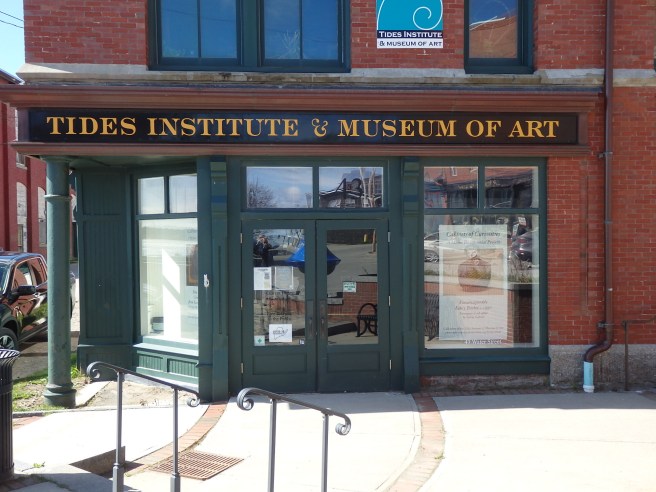
The catalyst of re-envisioning Eastport is the Tides Institute and Museum of Art, founded in 2002 by director Hugh French. Its mission has been in acquiring and presenting wide-ranging collections of artworks and historical documents reflecting the coastal region, as well as educational and preservation efforts that include eight significant buildings in the town – four of them in the downtown district – and guest artists residencies each summer.

The leadership is rounded out by French’s wife, Kristin McKinlay, who is director of exhibitions and the StudioWorks residency program, and by Jennifer Dolanski, Artsipelago/program specialist, plus eight trustees, only one of them living in Eastport. The others reside in places like Boston and New York City.

There are also concerts in its 1818 church that housed the Free Will Baptists, plus other events at its 1828/1829 Seaman’s Church, which housed the Congregationalists.

Oh, yes, every New Year’s Eve there’s the maple-leaf drop at 11 pm Eastern – midnight for our Canadian neighbors – followed by the giant sardine an hour later. Both the maple leaf and sardine were commissioned creations.

I suppose TIMA was inspired in part by the Island Institute, founded in 1983 to help Maine islands from Portland to Acadia tackle pressing environmental and socio-economic issues. The Rockland-based organization’s impressive publications include the annual magazine, Island Journal, as well as data analyses to guide public policy. Its focus is on sustainable livelihoods and communities in changing times that include rising sea levels, bringing together marginalized communities, and economic survival.

The heart of the enterprise is in a former bank on Water Street downtown.

In contrast, for now, TIMA’s focus seems to be more on art and architecture, principally – especially the small downtown on the National Register of Historic Places.

In essence, it’s building a future rooted in the past but not stuck there. It’s really the way every art moves, too, no matter how revolutionary some of the leaps may seem.

Renovation of the former Masonic lodge downtown is designed to house additional exhibition space and perhaps mixed use upstairs.

I do have to wonder whether TIMA has taken on too much. The restorations appear to have stalled, perhaps before Covid set in, and both of the churches need significant repair, inside and out. The institute has, all the same, helped distinguish Eastport as a fine arts center in a visually stimulating setting in Maine, an identity that may attract new residents in a time of national population change.

Frankly, it was one of the things that lured me here, as well as my wife and elder daughter.

Remembering a dear Friend

One of the cherished traditions among Quakers is the creation of memorial minutes for members who have served the Meeting faithfully.

The minute is a unique document. It’s neither an obituary nor a eulogy. Rather, it attempts to candidly reflect the movement of the Divine Spirit in the individual’s life.

Here is a recent example.

Earl ‘Chip’ Neal

(December 9, 1945-June 25, 2021)

When Chip Neal brought his family to Dover from Maryland in 1978, they loved everything about their new home except the proposed construction of a nuclear power plant in nearby Seabrook.

He had been hired by New Hampshire Public Television to do a nightly news show, having worked his way up from entry-level floorman in a pioneering community college television station to cameraman at WETA in Washington and then director/producer at Maryland Public Television.

Across the Granite State he became known for the segments he produced and hosted on “New Hampshire Crossroads,” where spent many years traveling every corner of the state bringing unique New Hampshire features and people to a statewide audience. It was in one of those stories that he coined the phrase “Yankee yard.” His curiosity was sweet-tempered and non-judgmental. He also produced segments for the popular weekly “Windows to the Wild” outdoors adventures series featuring Willem Lange.

Although he attended the University of Illinois during the Vietnam era, he did not earn a degree until he worked at the University of New Hampshire for NHPTV. He graduated from college the same year his daughter, Amanda, graduated from high school.

He never aspired to go into management. Rather, he always preferred to be hands-on, something son James inherited.

That was reflected in the family’s old farmhouse near the Cochecho River, where they began rearing a few chickens, sheep, and honeybees. After aligning with the Clamshell Alliance opposing the Seabrook Station, he realized the activists he admired the most were all Quakers, and soon he, too, was worshiping in the old meetinghouse, along with children Jamie and Amanda, while his wife Nell continued at First Parish just down the street. Over time, as she felt her spiritual growth being nurtured more through connections with Friends, she, too, became part of the Meeting.

Their social life included visits by boat with other Quaker families living downstream or around Great Bay. Inspired by what he had read about the Amish and a “why not” attitude, Chip determined to try a barn-raising of his own, resulting in a merry one-day celebration that did, indeed, accomplish the task.

Chip was commissioned to create a private documentary profiling Silas Weeks, who had been instrumental in the reopening of the Dover Friends meetinghouse. The interviews, now available on YouTube, remain a touching intersection of the faithful lives of both Silas and Chip.

Many of the qualities of Chip’s spiritual life also infused his professional career. A fellow producer noted that Chip possessed a brilliant communication talent in short-form and long-form storytelling. He not only saw the heart of a story, he let it speak for itself, time and time again. Where most producers tended to interpret meaning for the viewer, Chip had the unending patience – and absolute stubbornness – to never let that happen in his work. Thanks to his relentless focus, firm discipline, and above all a fabulous sense of humor, time and time again he would dig down until he found the light of truth hiding inside the most humble to the most exalted story, and to let it shine like a diamond in the wide open, all on its own, available and meaningful to the viewer.

As he grew and matured, he more and more thought deeply and broadly about events and phenomena, all with a spiritual bent. Often, this led to rising in the middle of the night to write down his ideas and insights, sometimes as haiku with a snap.

He emphasized the necessity of being centered in the present, explaining, “Life is that thing you’re doing right now.” From that, he had an ability to view difficulties from the side and then provide helpful alternatives to the knot before us.

During his terms as clerk of Dover Friends Meeting, Chip would stand after the closing of worship with the shaking of hands and then, gazing around the room, say simply, “Thank you for sharing your spiritual journey with us this morning – whether spoken or unspoken.”

He loved serving as clerk and treasured Quaker process, especially taking sufficient time in our labors together.

The advance of Parkinson’s interrupted his service to family, Friends, and the wider world, but not his presence. He had often reminded us that in trying to reach a destination while sailing, one had to constantly make adjustments – tacking.

He was also fond of a Navajo prayer:

All above me peaceful,
all below me peaceful,
all beside me peaceful,
all around me peaceful.

He passed over peacefully on June 25, 2021, in the comfort of his wife, Nell.

Memorial minute approved by Dover Monthly Meeting, November 21, 2021
Tiger Radio, named for the school mascot

Our local radio station is licensed to the high school. Seriously. And it’s as quirky as KHBR-AM 570 in the legendary TV series “Northern Exposure,” even without Chris Stevens as the DJ. Or I’d contend, even more.

The television show never got into young people, for one thing, but there aren’t many in Sunrise County, where the seven public high schools together have about 200 graduates a year, half of them from just two schools. A private academy adds another 100. It’s a long stretch, by the way.

Pointedly, Eastport’s Shead Memorial High has only about a hundred students, down from 300 a few decades earlier, and a faculty of 11, some of whom also teach at the junior high or elementary. The principal serves all three. The school proudly proclaims its emphasis on personalized education, which I applaud. What’s obvious is the incredible student-faculty ratio.

One big challenge is in trying to find ways to lure more of the younger generation into staying put here. Maybe the economic tide is changing in that direction.

In the meantime, the radio station gives them an opportunity to learn production skills. In fact, the station started out as a school club in 1983 and took off from there. Throughout the day, the station’s IDs feature the different kids, however bashfully, and it’s charming.

Much of the programming is a stream of music, a mix of blues, jazz, rock, country, bluegrass, and more, I’m assuming streamed from somewhere. Yes, and there are public service announcements as well as the honor rolls and other local touches. Truly. And then the DJs kick in, including some of the kids, with surprisingly sophisticated tastes.

They’re not the only ones.

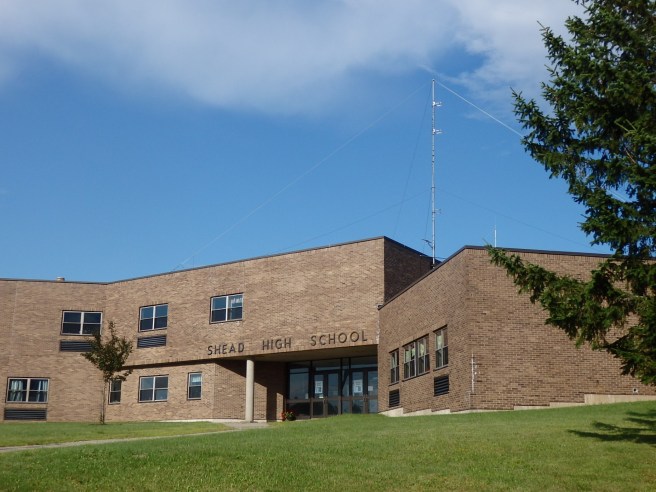
The station’s modest tower sprawls over the high school. Here it’s seen from the front.
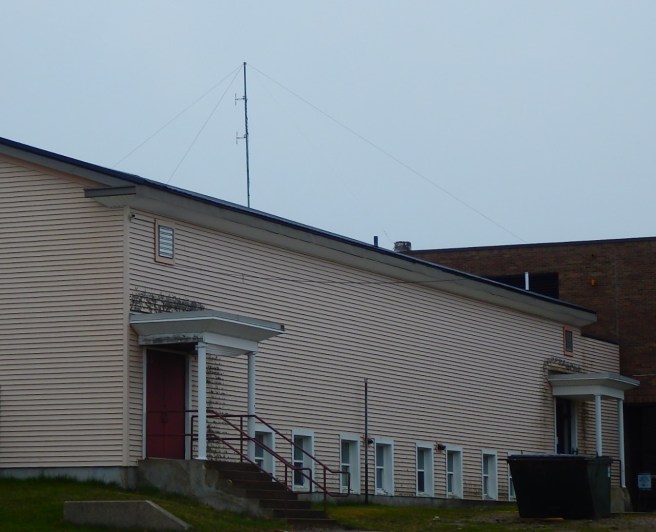
And from the back, by the gym.

The local demographics skewer sharply upward, and volunteers at the station are welcome. In fact, they create much of its most distinctive programming. As I was saying about do-it-yourself participation?

There’s Cracklin’ Jane, with only 78 rpms, a weekly theme, and radio dramas from a golden age, including commercials for brands that no longer exist. And others like Sam’s Caffeine Café, yes, it’s redundant, but mostly acoustic Americana two mornings a week; the Bass Lady’s informed insights into anything with a bass line, Chloe’s folksy Friday afternoon transition; Firedog’s Electric Doghouse, Boldcoasting; and the like.

Well, this is a town filled with eccentrics and geezers. Its low-power radio station reflects that. And to think, it all started as a school club in the ’80s!

I think of it as Radio Free Eastport, broadcasting to the free spirits on and around our islands.