
Seaside village
You never know what we'll churn up in cleaning a stall
It’s like a state fair in the hippie, organic, granola-mind reality. There’s no midway with carnival rides, for sure, but for truly inquiring-minds folk, it’s an autumn equinox slash harvest-time celebration.
Yes, let’s declare a true Thanksgiving, minus turkeys.
Shortened in its post-Covid resurrection, this year’s gathering in Unity, Maine, is the premiere event of the Maine Organic Farmers and Gardeners Association (MOFGA), and runs Sept. 23 through 25.
Now that we’re living in Maine, we can identify as members and look forward to attending, even though in New Hampshire we were surrounded by devotees. Yes, it’s that boffo.
As an aside, I can attest to enjoying my best-ever souvlaki ever, from a wood stove, no less, at an earlier fair. Gee, and I hate standing in line. It was worth it.
This is definitely a hippie-vision positive manifestation of the radical mindset of nirvana. And there’s no honky-tonk.
This year’s poster will no doubt be displayed on a wall of our new abode.
See you there?
Eastport’s tap water last summer took on a greenish color and a definite off-taste. It got to the point that we started running everything we’d be drinking or using for cooking through an activated charcoal filter.
The explanation was that the supply came from a large but shallow lake a dozen miles away and that every summer the algae bloomed. The private company that provides water to the city then had to heighten its use of chemicals for treatment, resulting in the offensive character.
Water to the Sipayik reservation also came from the same source but was delivered via a different pipeline and was, by reports, much more troubling.
In its attempts to redress the issue, the company announced it would be using an alternative to treat the water, and I have to say we haven’t noticed the off-taste or discoloration this year. We haven’t yet seen a chemical analysis yet, however, or heard about the current situation on the reservation.
Still, public water quality is something most Americans take for granted.
Funny how often we overlook a problem, even when it has, as I hope, been clearing up.
Most of Eastport’s small population resides in a semicircle around the Breakwater downtown. Quoddy Village stands apart, separated by a narrow neck around Carrying Place Cove. It also fronts Half Moon Cove, with a dead-end road to the former toll-bridge to the mainland. The place feels like an island of its own and is easily overlooked when you drive into town. The highway skirts it, and what you see is mostly former industrial, rusty, and all that.
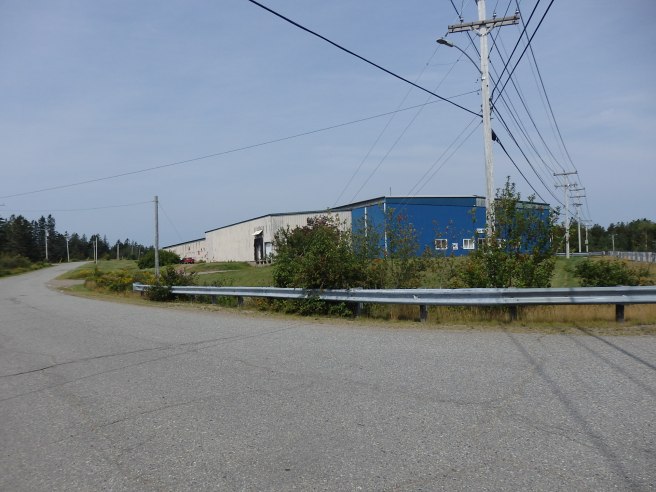
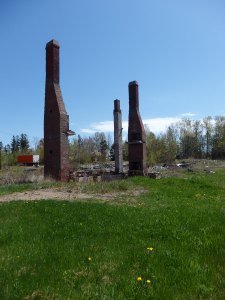
Until 1935, this was farmland, but then an ambitious but ecologically disastrous public works project took off, one to dam up most of Passamaquoddy and Cobscook bays to transform their vast tidal energy into electricity. A large but confusing working model of the engineering proposal can be viewed at the historical society’s gift shop in downtown Eastport. (The room-size three-dimensional map is water in and water out, mostly. If you don’t already know the area, it’s baffling – and the presentation is aimed at today’s tourists. I still think it would make for a really interesting model railroad layout.) The short-lived boondoggle’s most lasting contribution, apparently, was the causeway connecting Eastport to the mainland by filling in a former railroad line. No more toll bridge and longer loop. Oh, yes, and it also had a noticeable negative impact on the Old Sow, the world’s second-largest whirlpool, perhaps even pushing it more into Canada.
Significantly, the project needed housing for its estimated 5,000 workers, and that led to the construction of Quoddy Village.
Even though the plug was pulled a year later on what would have been the world’s largest tidal dam – it did require Canadian cooperation, among other things – 128 single-family, two-family, and four-family houses had been constructed, along with three large dormitories with dining rooms for single workers, plus a fire station, a hospital, a heating plant, a school, a large mess hall, and a large administration building that included a theatre, library, and sub post office. In other words, a small city unto itself. Even though the homes had been designed as temporary, many of them are still occupied today. Still, for a brief time, the village was home to a thousand people.
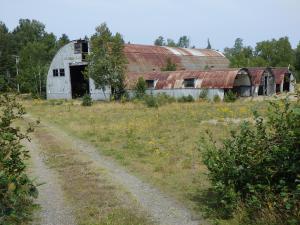
From 1938 to 1943 the National Youth Administration used Quoddy to train 800 city youth a year in vocational trades. It was also a Navy Sea Bee base named Camp Lee-Stephenson during World War II.
And then? It morphed into a residential neighborhood.
Its best-known attraction today is David Oja’s colorful and eccentric Bazaar, a gift shop that includes what’s arguably the best gourmet wine and cheese selection in Washington County. Think of it as a blast of Puerto Rico, Brooklyn, and Provincetown rolled into one. Who knows what the original function of the building was, we can be sure it was not nearly anything like this.
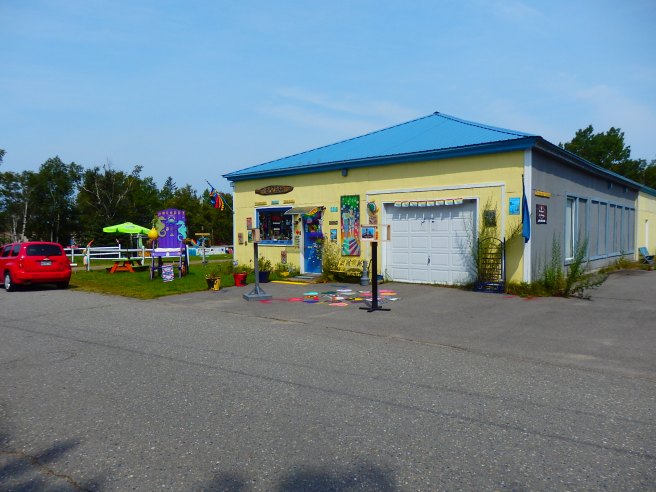
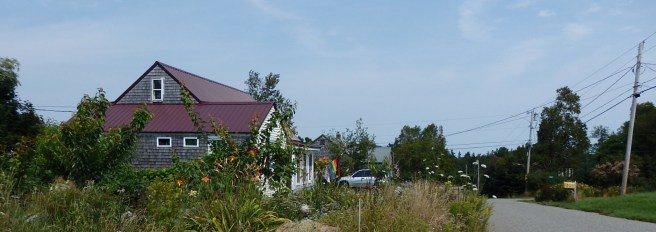

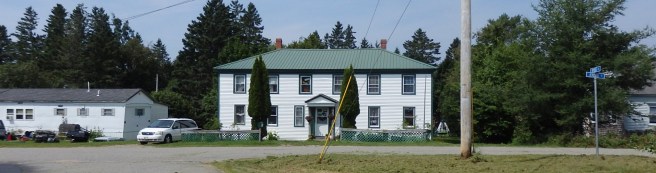
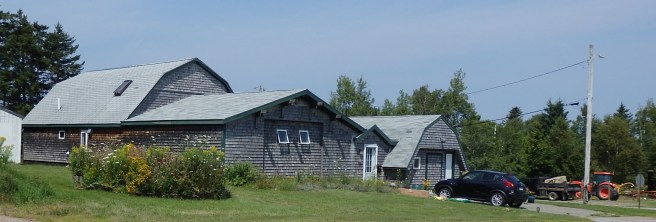
Is this funky? Or what?
We’ll be back in rehearsals starting Monday night, and it’s looking exciting.
Quoddy Voices will be preparing Henry Purcell’s “Ode to St. Cecilia’s Day” and works by Florence Price, Randall Thompson, and John Rutter, among others, for a program to be performed twice at the Eastport Arts Center before Thanksgiving.
Excuse me while I start vocalizing. Don’t want to sound rusty.
Yeah, yeah, yeah, everybody these days is touting a book. But my Quaking Dover really is different, starting with its contrarian take on New England history.
Let me proclaim: Quakers are NOT extinct!

Besides, there are good reasons they’re the oldest independent congregation in a future state that’s itself in a town that’s the seventh-oldest in America.
These things go WAY back but are still with us.
Look, I’ve spent two years researching, drafting, and revising this for publication.
If you’re tech-savvy, you’ll go for the ebook edition, which goes worldwide today.
Otherwise wait for a month, when the print version goes live.
Go for it! Pretty please?
Popped into the Chamber of Commerce the other afternoon, thanks to the Public Restroom Inside board set up out on the street, and immediately found myself awash in pirates.
They were assembled for some kind of banquet, which I later learned was one of the fundraising murder mystery dinners in advance of our pirate festival.
I can report it was well attended.
This time, it’s a Not in My Backyard reaction triggered by opposition to a wind-energy farm 20 miles offshore because it “would spoil the view.”
From what, the yacht?
Get real!
I’m sure they wouldn’t be as vocal if it were a coal-fired plant going up near neighborhoods next to industrial wastelands – the places poor people live.
The people and the places they’re trying to escape, along with the shared responsibilities and real community. And poor people are largely envisioned as Black, no matter that many are white.
Well, the NIMBY crowd might pipe up if they can see the development from the expressway into town. Heavens!
The fact is that if we want electrical power or sewers and water or trash removal, it all has to happen somewhere. Shipping it off to the less fortunate rings sour in more ways than one.
Less fortunate, indeed.
Just don’t try to put them in you-know-whose backyard.
As long as I’m reflecting on our Christmas gift-giving (why not, it’s time to start planning for the next round), I should mention our new Ooni Kanu 16 outdoor pizza oven from England. What, not Italy? Or Greece?
The second time she spoke up from her laptop and uttered the words, “I’d sure love to have one but (sigh) it’s beyond our budget,” adding, “I can dream, can’t I?” I knew it was time for the rest of us to put our conspiratorial resources together.
After several miscommunications on our end, we got the order off, knowing it wouldn’t arrive in time to be wrapped up and put under the tree, so we came up with an amusing announcement envelope to cover us in that part. My crude cartoon slowly kicked in and generated a grin.
The said item arrived in February, big relief, and we can see why it was such a hot item last fall, even before the international shipping delays kicked in.
The oven can sit on a table, for one thing, and be fueled by charcoal, wood, or propane, which can fire it as high as 900 degrees Fahrenheit, cooking a pizza at a lower setting in minutes.
We can finally find a pizza in Sunrise County that matches our high standards. Deep-dish and thin are options. And it’s not limited to pizza, either. I’m thinking of a Vietnamese dish that would glory to such instantaneous blazing.
Well, this has required me to take one more step into 20th century technology, specifically 20-pound propane tank use. As for grilling, I’m sticking to charcoal.
Now, where do we stock up on unused pizza boxes?
(back when she was still living)
(as for the person who would wear it?)
 Jnana's Red Barn