Sitting down to do our annual donations

Rather than making most of our charitable contributions ad lib during the year, we’ve adapted a new strategy since moving Way Downeast.

This is the time of the year when we decide what we’re supporting and then make those payments.

The process means deciding between giving smaller amounts to a wider range of organizations or instead sending somewhat larger amounts focused on a few recipients.

Mailing those checks off always feels good, though we also wish we were sending more.

We’re stuck in fog, fog, fog

While I had heard that these stretches of a surrounding blur of dense gray could linger weeks here, I assumed folks were talking about March or maybe late November, not the height of glorious summer.

And then a friend told me of one summer in Lubec, a few miles over the water to our south, where it hit every day, often without any splash of sunshine.

It does dampen the emotional wellbeing of many.

As much of the nation – and world – suffers under recording-breaking heat, we’re having many days when the day’s high has barely reached much above 60, as in Fahrenheit. Only a few readings have even broken as far as the lower 80s. I’ve worn my beloved Hawaiian shirts only three times, and my shorts are still in the bottom drawer of the dresser. If you’re wondering, unlikely as that is, I’m not one of those guys who goes bare-knees in January, believe me.

Much of this has been accompanied by weeks of fog – morning and late afternoon through the night, especially – but sometimes without break during the day as well.

I’ve stopped reminding people that Seattle experiences something like this six-months straight every year or that San Francisco is accustomed to watching the ground-hugging clouds return every afternoon.

We do live on an island, so the temperatures just seven miles away on the mainland traditionally run ten degrees warmer, but those are still much more reasonable than the hellfire raging elsewhere.

None of the wider extremes should come as a surprise. True prophets had forecast them a half century ago, and we are running on those projections, contrary to the decades of denials and resistance of capitalist naysayers and their puppet politicians. Remember, too, it was “climactic instability” rather than mere “global warming.”

So, on a more mundane level, on those partly-cloudy to partly-sunny days in the forecast, we jump onto running the laundry early and then getting it promptly out on the line to breathe, and I attack the lawn with the mower as soon as the grass dries sufficiently. Not that I’m the only one, not by a longshot.

When I did live in the Pacific Northwest, I was in the interior desert with dreams of escaping somehow to a writing life somewhere along the coast, maybe in a cabin in British Columbia or Alaska.

Something like this, perchance.

Oh, those clean starched white dress uniforms

The 350 U.S. Navy sailors who descended on Eastport for our extended Independence Day festivities were the first to uphold the longstanding tradition since before the Covid pandemic.

They were a welcome contingent in our small community, often appearing in their pristinely ironed white uniforms, which do look impressive even though, as I was told, they can be a challenge to keep clean. You have to lean way over while eating, for instance, to keep from spilling anything on yours. Not that we noticed any dirt when they marched as a big bloc in the grand parade Tuesday afternoon. At least the sailors and officers who fielded teams in the very messy cod relay contest the previous day were more practical in their dress.

What they got was a six-day taste of small-town America having summer fun.

As the police chief reported, “the Fourth of July was relatively quiet, aside from a couple of fights involving sailors … which were handled by the crew from the Navy ship.”

Wilting as they lose local awareness

As a newspaper editor, I was often startled in looking at coverage from the other side when something I was affiliated with was subject to a story. Or even more startling, when I was quoted and seeing how it looked it print.

It was like working in a restaurant kitchen and shipping dishes to the dining room and then, on a night off, going in for a celebratory dinner.

Seeing a report through the readers’ viewpoint really could be eye-opening. It’s not the “names-is-news” philosophy that many small-minded editors and publishers pursued, either. That approach could be even more boring than reading the phone book. Remember those?

The backbone of most of American newspapers has been the way they connect with their local communities. As one wise editor once told me, it should be news of local interest, rather than just happenings in the place itself. I spent much of my career trying to open parochial outlooks to an awareness of the wider world, both directions, and I do believe that can happen and even be exciting.

When I was calling on daily newspaper editors across the Northeast as a syndicate features field representative, I was surprised by how few of the papers gave a taste of a unique nature of each of the communities. Many of the editors thought of local news as city council and school board meetings plus high school sports scores. As I argue in my novel Hometown News, the real stories – the kind that come home – are found elsewhere and require more reportorial digging. That’s one reason I’ve long advocated local columnists (real writers, not dilettantes, though skilled amateurs are welcome). Few papers had even that much.

When former U.S. House Speaker Tip O’Neill famously proclaimed “All politics is local,” he understood those roots.

~*~

A decade after I’ve left the newsroom, I’m directly experiencing that again, or more accurately, its lack.

In the past 20 years, the number of people employed in newsrooms at American papers has dropped about 60 percent. That leaves far fewer people to write about what’s happening or even be aware of what’s going on at the grassroots level where they live. Much of the nuts-and-bolts editing is being done in clusters far from the paper itself, removing another layer of local nuance and understanding.

In my case, in my participation in events celebrating the 400th anniversary of the founding of Dover, I’m seeing the local paper is doing far less coverage than I would have expected. Not after the family that owned it for generations finally sold out to a media conglomerate.

That disconnect isn’t just print media, either. New Hampshire Public Radio no longer originates any content in the Granite State, as far as I can see. Two decades ago, appearing on one of its shows would have been a natural for a local author like me.

Quite simply, it’s disappointing and a bit scary.

Still the talk of the town

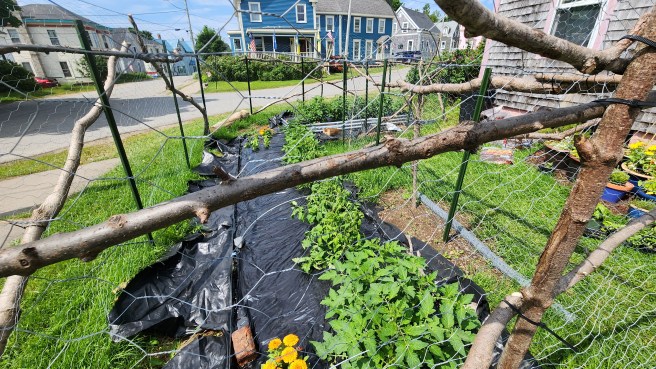
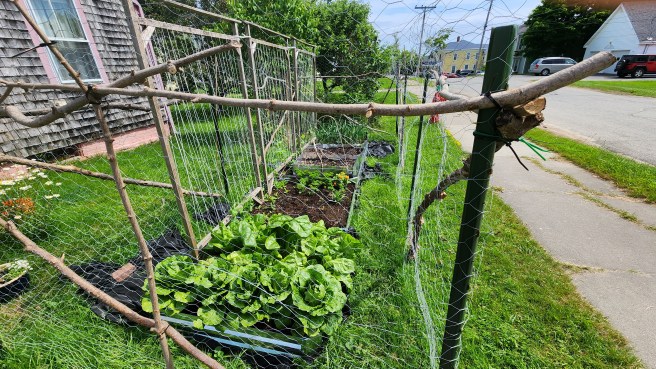
So far, so good. The deer haven’t yet pushed the garden fence over or managed to get in despite the chicken wire.

That, in itself, gets a lot of the locals coming by to take a look at my fortifications and then talk, as well as a number of summer folk. Eastport is a pedestrian-friendly village. Others are in vehicles that slow down and roll down their windows.

Beyond that, many are also avid gardeners who admire what’s growing and then advise us while introducing themselves. Some have even left packets of seeds on our front-door steps.

Strangers have also come up to me downtown to say how much they like what we’re doing. As I acknowledge, my wife deserves most of the credit.

Either way, it’s one more positive small-town aspect of living here. You’re simply engaged with life all around you.

Nor have I mentioned how heavenly the buttery fresh lettuce tastes or how much a sugar-snap pea vine can grow in a day.

The fact that all this is in our front yard does, no doubt, make the garden more public, but it is where our best sunlight falls. Folks around here are practical and take that all in stride.

Speaking of practical? It’s that much less lawn I need to mow.

Hold on to that fish!

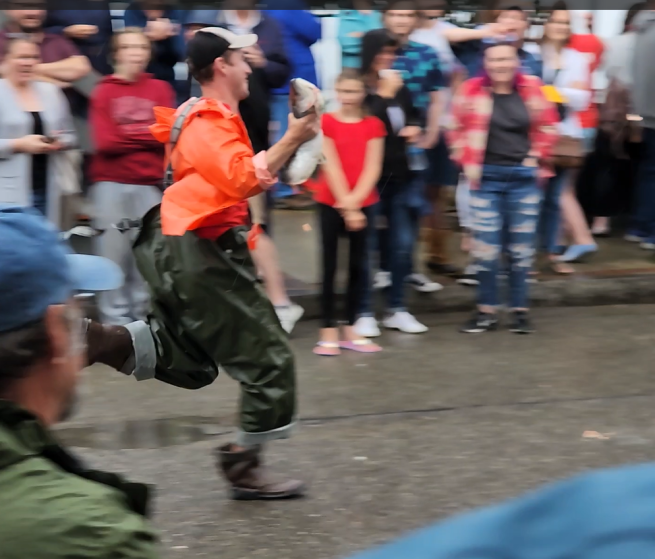
An annual cod relay race – using raw salmon instead – is one of the more hilarious traditions at Eastport’s extended Fourth of July festivities.

Running down the street with a fish is only part of the excitement.

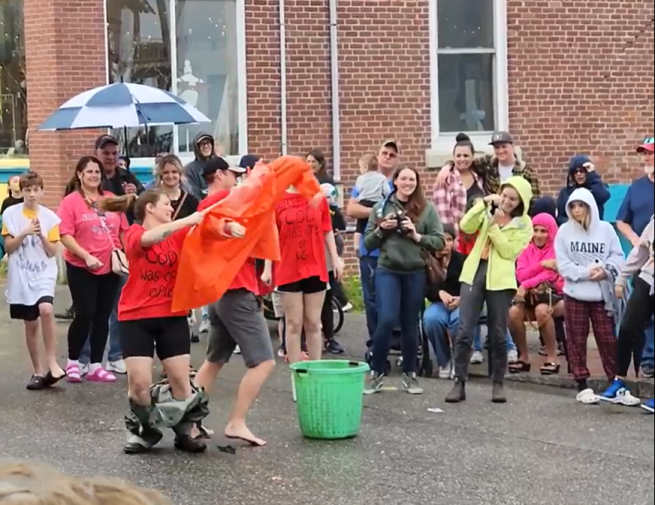
Relaying the gear – boots and the slicker, along with the fish – to the next runner is the heart of the contest. Here, two of the younger runners have it almost down to a science.

All-ages teams are paired off during the day until there’s a first-place winner.

This feels like a ‘welcome to the club’

Coming up at the Phoenix wine bar downtown on Thursday from 6-8 pm, I’ll be one of six local writers reading from our books.

It’s organized by Catherine SJ Lee, whose wonderful collection of short stories Island Secrets is well worth acquiring. One secret she doesn’t mention is how many fine writers and other artists dwell on the charming island I now call home. Honestly, I feel honored to be among those invited to read and am certainly looking forward to personally meeting others.

Each of us will present a 15-minute selection of our work and then engage in a meet-and-greet over a bookselling and signing at the end.

These days, presenting my case without including an accompanying PowerPoint does feel a bit strange. Still, as a writer, I do love having the text itself be the sole focus, as I have enjoyed in our monthly open mics at the arts center.

The wine bar event is part of the first ArtWalk weekend of the season in Eastport and Lubec. Other planned activities include gallery tours, rock painting, sidewalk chalking, games, musicians around town, an outdoor contradance, and perhaps a street dance or two.

Regarding the median age of tradesmen

As a passerby noted while observing renovation work in town, the median age of tradesmen in the U.S. is 57. It’s no doubt higher here in Maine and Sunrise County, especially.

There’s a lot of work needing to be done, too: carpentry, plumbing, roofing, masonry, insulating, windows … We have a long list ourselves and are still looking for help.

Forget the “Go west, young man,” advice of yore. Many youths would be well-advised to go into the construction trades, pronto. Financially, they’d be way ahead of those with a college degree but heavily in debt. They could even live wherever they want.

Hey, kids, if you love to hunt and fish or sail and camp, Sunrise County would fill your dreams. You’d definitely be welcome.

On a more personal note, send me your references and let’s talk.